Hospitality CRM: What It Is, and What 20 Doors Actually Need
Type hospitality CRM into a search bar and you get two very different things wearing the same label. One is a serious enterprise category built around hotel guest data: platforms that merge reservations from a property management system and a central reservation system into one guest profile, segment it, and run campaigns designed to shift bookings away from the online travel agencies and onto the hotel's own website. The other is every generic sales CRM that has noticed hospitality is a large market and added the word to its landing page.
If you run a small vacation rental or short-term rental management company, neither one is quite aimed at you, and working out why takes longer than it should. The hotel-grade platforms are genuinely excellent products, built by people who understand hotel commercial teams. They are also priced around room counts, they assume somebody whose actual job title is marketing, and they arrive as an implementation project rather than a signup. At twenty doors, most of that depth is bought and never used.
This piece does two things. First it explains what a hospitality CRM actually is and does, properly, because the category is worth understanding before you decide against it. Then it makes the honest case for what an operator with a handful of homes really needs, which turns out to be much less about guest marketing automation and much more about the homeowner relationship, the enquiry nobody answered, and the back office that currently lives in five spreadsheets. If you want the applied version of that argument, the vacation rental CRM page covers the business layer specifically.
Cost bands below are third-party estimates from software directories and independent reviewers as of August 2026, not published vendor prices. Most platforms in this category quote after a demo. Always get your own quote.
What a hospitality CRM actually is
Strip away the marketing and a hospitality CRM is a guest data platform with a messaging engine bolted to it. Its job is to answer one question that the operational systems cannot: who are our guests as people rather than as reservations, and what should we say to them next.
That breaks into a recognisable set of capabilities, and every credible platform in the category has most of them.
The unified guest profile. Reservations arrive from several places: the property management system, the booking engine on your own site, the OTAs, sometimes a call. The same human appears in all of them with a different spelling, a different email and no shared identifier. The first real job of a hospitality CRM is identity resolution: merging those records into one profile with stay history, total spend, party composition, preferences, requests and complaints attached. This is unglamorous and it is where a lot of the engineering actually goes. A guest database that has never been deduplicated cannot be segmented usefully, and everything downstream depends on it.
Segmentation. Once profiles are clean, you can cut the list by things that predict behaviour: first-time versus returning, average nightly spend, length of stay, booking channel, origin market, lead time, family versus couple versus corporate, season stayed. Segmentation is the difference between a newsletter to everyone and an offer that a specific group is plausibly interested in.
Pre-stay messaging. The confirmed booking is the highest-intent moment in the whole relationship. Hospitality CRMs run structured pre-arrival sequences: confirmation, useful arrival detail, and upsells such as early check-in, a late departure, an airport transfer, a room or unit upgrade, a bottle in the fridge. Done well this raises revenue per stay without touching the nightly rate, which is why hotels care about it so much.
In-stay and on-property messaging. Mid-stay check-ins, service recovery when something has gone wrong, and offers for whatever else the property sells. For a hotel that means the restaurant and the spa. For most rental operators it means very little, which is worth noticing early.
Post-stay and win-back. The thank you, the review request timed to arrive while the memory is warm, the survey, and then the longer game: a message next spring to the family who came last spring, a seasonal offer to everyone who stayed in shoulder season, a reactivation campaign for guests who have not returned in two years.
Campaigns and direct-booking revenue. Broadcast and triggered email, increasingly SMS and WhatsApp, sometimes ad audiences exported to Meta and Google. The commercial promise of the whole category is that a booking sourced from your own guest list costs you a campaign instead of a fifteen to twenty percent channel commission.
Loyalty and repeat business. Recognition tiers, member rates, points, or a simpler returning-guest discount. The mechanics vary, the intent does not: make the second stay more likely than the first was.
Reputation and reviews. Collecting reviews on the channels that matter, monitoring what appears, routing complaints to somebody who can fix them, and reporting sentiment over time.
Reporting and attribution. Campaign performance, revenue attributed to the CRM rather than to the OTA, guest lifetime value, segment performance, and the direct-versus-channel mix that a commercial director gets asked about every month.
Read that list as a hotel operator and it is obviously valuable. Read it as someone managing eighteen cabins and you can probably feel which four items apply to you and which five you would never open. That is the whole problem in one paragraph, and it is not a criticism of the software.
Want to see it in action?
Watch how Zoye automates your daily workflow - from lead management to team collaboration.
See How It WorksWhy the category was built for hotels
Understanding the design constraints explains the price and the fit better than any feature comparison.
A hotel has a data model these platforms can rely on. There is a property management system and often a central reservation system, both producing a steady, structured stream of reservations, folios and rate codes for the same physical inventory. Room 214 exists whoever is in it. A hospitality CRM can sit on top of that stream and do serious work.
A hotel also has repeat-guest economics that justify the spend. Business travellers return to the same city. Leisure guests return to a brand they trust. A resort has a season that comes round again with the same families in it. When a meaningful share of next year's revenue comes from people who already stayed, a platform that increases return rate by a few points pays for itself quickly.
A hotel has somebody to operate it. Revenue managers, marketing managers, a commercial director, sometimes an agency. These platforms are powerful because a trained person is going to use them daily, build segments, design campaigns and read the attribution report. That assumption is embedded in the interface.
And a hotel is used to buying software as a project. Implementation, data migration, integration with the PMS, template design, brand configuration, training, a go-live date. Weeks of work, an onboarding fee, and a procurement process that expects all of it.
Change the buyer to a management company with twenty units across four owners, and every one of those four assumptions weakens at once. The inventory is scattered and changes when an owner leaves. The repeat rate is structurally lower, because a guest books a lake or a coastline rather than your brand. There is no marketing person, there is you and possibly one coordinator. And there is no procurement process, there is a Tuesday evening when you finally have time to look at software.
The platforms, named honestly
These are real products and the people who buy them are not making a mistake. Here is the shape of each, described fairly.
Revinate is one of the best known names in hotel guest data and marketing, combining a guest data platform with campaign tooling and reservation sales. Hotels choose it for the quality of the guest database work and the depth of its email marketing. It is built for properties with a commercial team.
Cendyn is a broad hospitality commercial platform spanning CRM, guest marketing, and revenue and sales tooling, typically bought by hotel groups and larger independents that want several of those functions from one vendor. Breadth is the point, and breadth is exactly what a small operator is not shopping for.
Profitroom focuses on driving direct bookings for hotels and resorts, pairing a booking engine and website with marketing automation aimed at reducing channel dependency. Strong fit for an independent hotel that has decided direct booking is its strategy.
SendSquared sits at the more accessible end, offering guest communication and marketing for hotels and resorts, including messaging alongside email. It does not publish public pricing.
Alongside those there is a long tail of independent-hotel CRMs and guest-experience platforms sold per property, plus guest-messaging tools that overlap with the same jobs from the operations side.
On cost, the pattern is consistent and it matters more than any individual number. As of August 2026, this category is quote-based: you book a demo, the price depends on your room or unit count and the modules you take, and there is usually a one-time implementation or onboarding fee on top of the subscription. Third-party software directories and independent reviewers commonly place independent-hotel CRM platforms in the hundreds to low thousands of US dollars per month per property, with implementation extra. Those are third-party estimates, not published prices, and several vendors including SendSquared publish no pricing at all. If a blog post quotes you a precise monthly figure for one of these platforms as though it were on their website, be sceptical.
For a hotel with 120 rooms, a few hundred dollars a month against the commission saved on a handful of direct bookings is straightforward arithmetic. For a manager with twenty units, the same number is a meaningful share of the software budget for a set of capabilities that mostly assume a guest list you are not allowed to market to. Which brings us to the constraint nobody puts on a slide.
See what Zoye can do for you
From CRM and deal tracking to AI-powered task management - explore everything Zoye offers in one workspace.
Explore FeaturesThe guest data problem at small scale
Guest marketing assumes you own the guest relationship. If most of your bookings come through the major channels, you partly do not, and this is not a software limitation you can buy your way out of.
Airbnb does not hand you a guest's real email address. Contact details passed through other channels are frequently aliased, restricted by the channel's terms, or usable only for matters relating to that specific stay. Channel policies also change, so check the current rules for every channel you use before you spend anything on a platform priced by the size of your marketable list. The practical result at small scale is a guest database where a large share of records cannot legitimately receive a marketing campaign at all.
Then there is the repeat-rate reality. A city hotel can reasonably expect a share of guests back. A lakeside cabin usually gets a household once, or once every few years, because the decision is about the destination and the dates. Plenty of well-run small portfolios have single-digit repeat rates, and no CRM changes that structural fact. It can improve the margin on the guests who do come back, which is worth something, but the base you are multiplying is small.
None of this means guest relationships are worthless. It means the guest side is the wrong place for a small operator to spend first. Your PMS already sends the arrival instructions, the check-out note and the review request. Adding a second system to send similar messages to a partly unmailable list is not where the next hour of your week should go.
What a small operator actually needs
Watch where the money and the losses actually sit at 5 to 40 properties and the priority list rearranges itself.
The homeowner relationship comes first. Winning one owner adds recurring management revenue for the length of the agreement, plus every guest booking that comes with the property. This is the compounding asset in your business, and it is almost universally run on memory. The recognisable failure is meeting three homeowners at a viewing, meaning to follow up, and finding out in October that one of them signed with the manager down the road in June. An owner pipeline with real stages, a next action on every record and follow-up that actually happens is worth more than any guest campaign you could run this year.
Enquiry response. The enquiry that arrives on Instagram at 11pm and gets answered at noon is usually lost, and it was lost to response time rather than to price. Every enquiry needs to land in one place, with its source recorded, and get a fast first answer plus a chase if it goes quiet. Source attribution is what eventually tells you which of your marketing channels is worth continuing.
Documents and agreements. Management agreements, owner addenda, insurance certificates, permits, inventories, key and access records. Scattered across email, a shared drive and someone's laptop is the normal state, and it becomes an expensive state during a dispute or an audit. These belong on the owner and property record.
Staff and cleaner coordination. Not the changeover calendar, which your PMS or an operations tool already handles, but the rest: maintenance that needs quoting, a supplier chasing payment, the linen order, onboarding checklists for a new property, the fifty small tasks that only exist in your head.
Owner invoicing and reporting on time. Owners judge you on the statement arriving predictably and on being told about problems before they ask. The bookkeeping side of that sits in your PMS or accounting system. The chasing, the reminders and the promises made in a phone call sit nowhere, until they sit in a system.
Notice what that list has in common. None of it is guest marketing automation. All of it is the business around the bookings, which is precisely the half that hotel-grade CRMs were never built for and generic sales CRMs handle only if you are willing to configure them for a fortnight. The comparison with the general small-business category is instructive here; see the guide to CRM for small business for how the same argument plays out outside hospitality.
A five-minute decision framework
| Your situation | What to buy first |
|---|---|
| Hotel or resort, a commercial or marketing person on staff, meaningful repeat rate | A hotel-grade hospitality CRM. The category exists for you and it works |
| Boutique property, mostly direct bookings, an owned and mailable guest list | A lighter guest-marketing tool, or the marketing module your PMS already sells |
| 5 to 40 rentals, mostly OTA bookings, growth comes from winning owners | The business layer: owner pipeline, enquiry capture, documents, staff tasks, owner invoicing |
| Managing homes for other owners, PMS already in place | Keep the PMS. Add the owner and back-office half, not a second guest-messaging system |
| One or two units you self-manage | Your PMS plus a shared calendar. Buy nothing else yet |
Two tests save real money. Ask what a platform will do in your first ninety days that you are not already doing, and be specific about which segment receives which message on which day. And ask what share of your guest records you are actually permitted to market to. If either answer is vague, the purchase is early.
Ready to streamline your business?
Zoye brings AI-powered CRM, task management, and automation into one workspace.
Get StartedWhere Zoye fits, and where it does not
Zoye is an AI Business Operator for the business side of a small rental portfolio. Rather than another system you configure and then maintain, it captures the work, keeps the records current itself, and does the chasing.
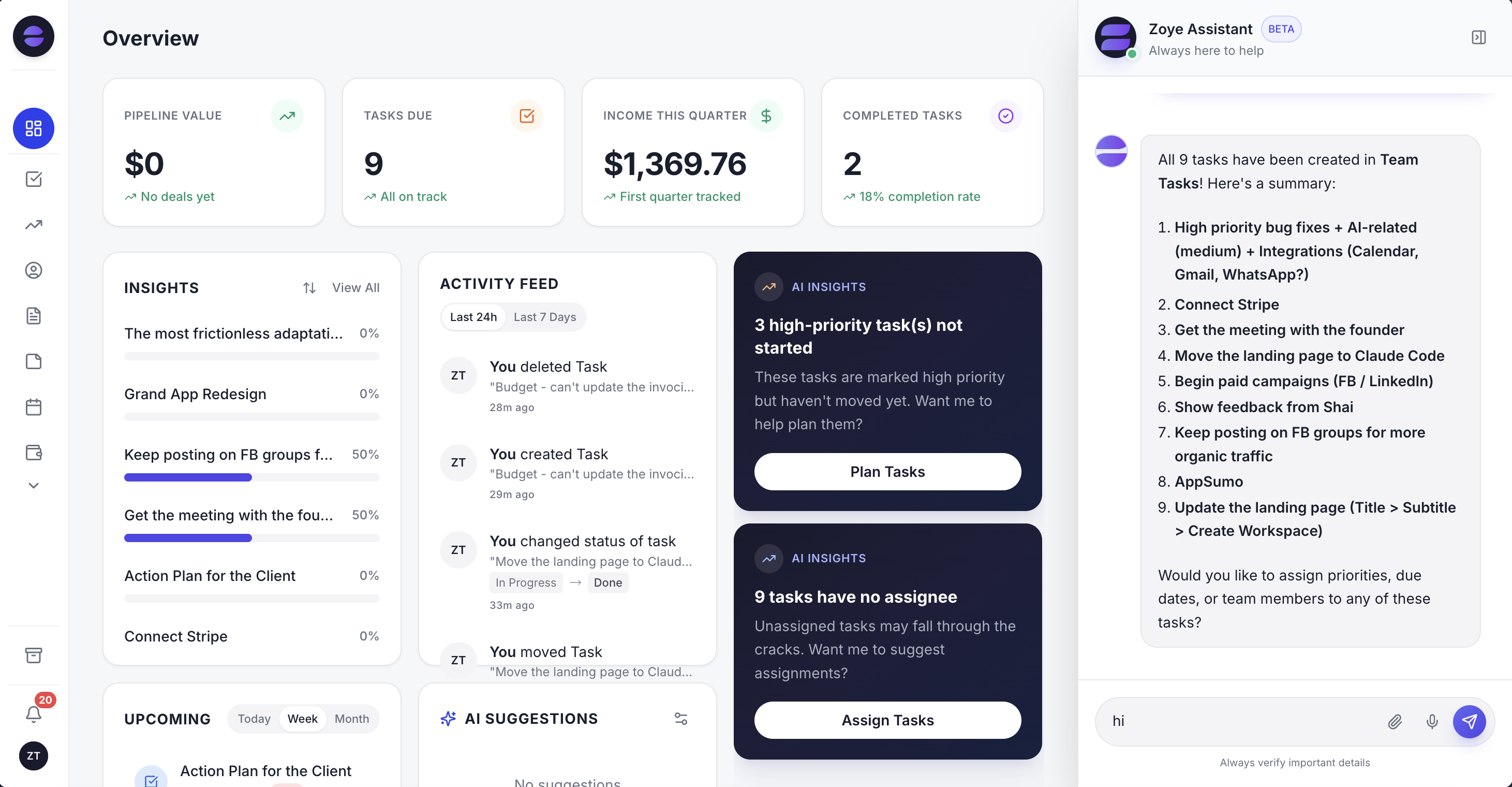 One view over the owner pipeline, the open enquiries and the tasks each property needs this week.
In practice that means owner leads and guest enquiries arrive from your site, your inbox, WhatsApp and social with their source attached, so you can see which channel produces signed agreements without anyone typing a report. Each owner moves through stages with a next step and a date, and when a thread goes quiet the operator drafts and sends the next message rather than waiting for you to remember during a changeover week. Management agreements and owner documents sit on the owner record where you can find them a year later. Cleaner, maintenance and onboarding tasks sit on one board with the people who have to do them. Owner invoicing runs to a schedule with reminders that go out on their own. You describe the routine you want in one plain sentence, including from WhatsApp or Slack, and the operator builds it and runs it.
The boundary needs saying plainly, because this article is exactly where a reader expects otherwise. Zoye is not a property management system and it is not a guest-marketing platform. There is no channel manager and no Airbnb, Booking.com or Vrbo sync. There is no availability calendar, no nightly rate engine and no booking engine. There is no OTA guest inbox, and there are no owner statements with trust accounting. It also does not run guest segmentation, loyalty tiers or hotel-style campaign attribution, which is what the platforms named above are genuinely good at. Keep Guesty, Hostaway, Lodgify, OwnerRez or Smoobu for the reservations, and keep your reputation tooling for reviews. Zoye takes the growth and administration around them.
Pricing: plans start at $5 per month for 1 member, then $59 per month for 10 members, $99 per month for 20 members, and $199 per month for 100 members, with a Customize tier for larger portfolios. Pricing is flat-rate per plan rather than per seat. Check the pricing page for current figures.
Best for: vacation rental and short-term rental management companies from roughly 5 to 40 properties, co-hosts, and villa or cabin brands that already run a PMS and need the owner-acquisition and back-office half to run itself.
Why operators pick Zoye
Three reasons come up repeatedly at this size.
It matches where the value is. The owner relationship, not the guest campaign, is what grows a management company from twelve doors to thirty, and it is the part that has usually never had a system at all.
It does not add another thing to maintain. The operator updates its own records, moves its own stages and sends its own follow-ups, which is the only version of this that survives a busy season.
It respects the stack you already bought. The PMS keeps the calendar and the channels. Nothing is migrated, nothing is duplicated, and you stop trying to make one tool do two jobs badly.
Put the half of your business that lives in your head somewhere it cannot be forgotten. Get started with Zoye and let the operator chase the owners and the enquiries while you run the properties.
A hospitality CRM is a system that holds a single record per guest and then markets to those records. It merges reservations from the property management system and the booking channels into one guest profile, cleans and deduplicates the data, segments it by things like stay history, spend, length of stay and origin market, and runs the messaging around the stay: the pre-arrival note, the in-stay offer, the post-stay thank you and review request, and the win-back campaign months later. Most platforms in the category also cover loyalty or repeat-guest programmes, reputation and review management, and reporting that attributes direct revenue back to a campaign.
The property management system owns the booking. It holds the calendar, the rates, the channel connections, the payments and the operational record of who is staying in which unit tonight. A hospitality CRM owns the relationship. It takes the data the PMS produces and turns it into a guest profile it can segment and message. In practice the CRM depends on the PMS and never replaces it, which is why every serious hospitality CRM leads with its list of PMS integrations. If a vendor claims to be both, look closely at which half is thin.
The honest answer is that most of the category does not publish a price. As of August 2026, hotel-grade platforms such as Revinate, Cendyn, Profitroom and SendSquared are quoted after a demo, priced on room or unit count and on the modules you take, and usually carry a one-time implementation or onboarding fee. Third-party software directories and independent reviewers commonly place independent-hotel CRM platforms in the hundreds to low thousands of US dollars per month per property, with implementation on top. Treat those figures as third-party estimates rather than published prices, and get your own quote.
Most small managers do not need the hotel-grade version of one. At 5 to 40 properties the guest side is largely already handled by your PMS, which sends the arrival instructions and the review request, and your repeat rate is structurally lower than a hotel's because guests book a destination rather than a brand. The relationship that actually compounds at that size is the homeowner relationship, plus the enquiry that arrives at 11pm and the back office of agreements, staff tasks and owner invoicing. That is where a small operator should spend the software budget first.
Only partially, and this is the constraint most guest-marketing pitches skip. Airbnb does not hand you a guest's real email address, and contact details passed through other channels are often aliased or restricted by the channel's terms, so a large share of your guest list is not directly marketable. Check your current channel policies before you buy anything priced on the size of your guest database. Direct bookings from your own site are a different story, which is why direct-booking effort usually pays better than guest-marketing software for a small portfolio.
Keep your PMS for bookings, rates, channels and the guest messaging it already sends. Then put the business half somewhere it cannot be forgotten: the homeowner pipeline with stages and follow-up, every enquiry captured with its source and chased until it is answered, management agreements and owner documents on the owner record, cleaner and staff tasks on one board, and owner invoicing on a schedule. Zoye runs that half as an AI Business Operator, and it is not a PMS or a guest-marketing platform.
Conclusion
A hospitality CRM is a real and well-built category: unify the guest, segment the guest, message the guest at the right moment, and win back the ones who left. If you run a hotel with somebody whose job is marketing, buy one and use it properly. If you manage twenty homes for other people, the same purchase buys depth you will not open, priced against a guest list you are not fully allowed to email, while the thing that would actually grow your company sits untouched in your head. Start with the owner pipeline, the enquiry that gets answered in minutes, and the back office that stops depending on your memory. Add guest marketing when you own a guest list worth marketing to.
For more context, see the vacation rental CRM page, the guide to CRM for small business, the explainer on what a CRM system is, and the roundup of the best vacation rental software.