Business management used to mean spreadsheets, status meetings, and a dozen disconnected tools stitched together with manual effort. The teams pulling ahead in 2026 aren't working harder. They're working with AI that handles the operational weight so they can focus on what actually moves the needle. Zoye is one example of this shift, and the wider category of AI-native business platforms is reshaping how small and mid-sized teams operate. Much of that shift starts with the basics covered in what is business process automation.
What Does the Future of Business Management Look Like?
The future of business management isn't about adding more tools to your stack. It's about consolidating everything (your CRM, tasks, deals, calendar, and documents) into a single intelligent system that understands how your business operates.
Here is what that looks like in concrete terms. AI-powered business management means:
- Your CRM updates itself after every call, email, and meeting, instead of someone setting aside time to type up notes that are already going stale.
- Tasks are prioritized automatically based on deadlines, deal value, and current team capacity, so the most important work surfaces to the top without a manual triage meeting.
- Pipeline risks (a deal with no activity in three weeks, a champion who stopped replying) are flagged before they cost you revenue.
- Reports are generated the moment you ask for one, not by spending half an hour exporting CSVs and rebuilding the same chart.
- Follow-ups happen on time because the system schedules and surfaces them, not because someone remembered to set a reminder.
These capabilities exist today. The businesses adopting them are already pulling away from competitors still running on manual processes, because the operational overhead that slows a manual team down (data entry, status chasing, report building) is exactly the work that AI removes first.
Why Traditional Business Management Is Falling Behind
The tools most teams rely on were built for a different era. They store information, but they don't think. They require input, but they don't take initiative. As businesses scale, these limitations become serious bottlenecks.
Too Many Tools, Not Enough Connection
Most small businesses run daily operations across a handful of disconnected tools: a CRM, a task manager, a calendar, a budget spreadsheet, a chat app, a notes app. Your CRM doesn't talk to your task manager. Your calendar doesn't inform your pipeline. Your documents live in a completely separate world. Every time you switch tools you lose context, and you re-enter the same information in three places. The friction is not the price of any single subscription. It is the compounding cost of stitching the tools together by hand, day after day.
Manual Processes Don't Scale
When your team is five people, you can get away with updating spreadsheets by hand and sending follow-up reminders via Slack. When you grow to fifteen or fifty, those manual processes become a full-time job for someone. Traditional business management creates a ceiling on how fast your team can grow without hiring more people just to manage the work about work.
Reactive Instead of Proactive
Most business management today is reactive. A deal goes cold, and you notice two weeks later. A task slips through the cracks, and you find out at the next standup. A key client hasn't been contacted in a month, and nobody flagged it. Traditional tools show you what happened. AI-powered management tells you what's about to happen - and often handles it before you need to intervene.
A Day in an AI-Powered Team Versus a Manual One
The gap is easiest to see by following the same workflow through both worlds. Consider a five-person consulting firm closing a new client.
| Workflow step | Manual team in 2024 | AI-powered team in 2026 |
|---|---|---|
| After a sales call | Salesperson types notes into the CRM later, if they remember | Assistant captures the call summary and updates the deal record automatically |
| Next steps | Someone manually creates a follow-up task and sets a reminder | A follow-up task is created, assigned, and dated the moment the deal advances |
| Stalled deal | Noticed two weeks later, at the next pipeline review | Flagged the day activity stops, with a suggested next action |
| Weekly report | Operations lead spends an hour exporting and formatting | Generated in seconds by asking "How did the pipeline perform this week?" |
| Onboarding the client | Account manager improvises the welcome sequence | A consistent onboarding sequence runs from a template, reviewed not rebuilt |
The manual column is not incompetent. It is the normal state of a busy team. The difference is that every step in the right column removes a point where work used to fall through the cracks, and it does so without anyone having to remember.
How Zoye Is Built for the Future of Business Management
Zoye is an AI-native workspace designed from the ground up for the way modern teams actually work. It brings your CRM, tasks, deals, calendar, and documents into one place, all managed by an AI assistant that learns your business and gets more useful over time.
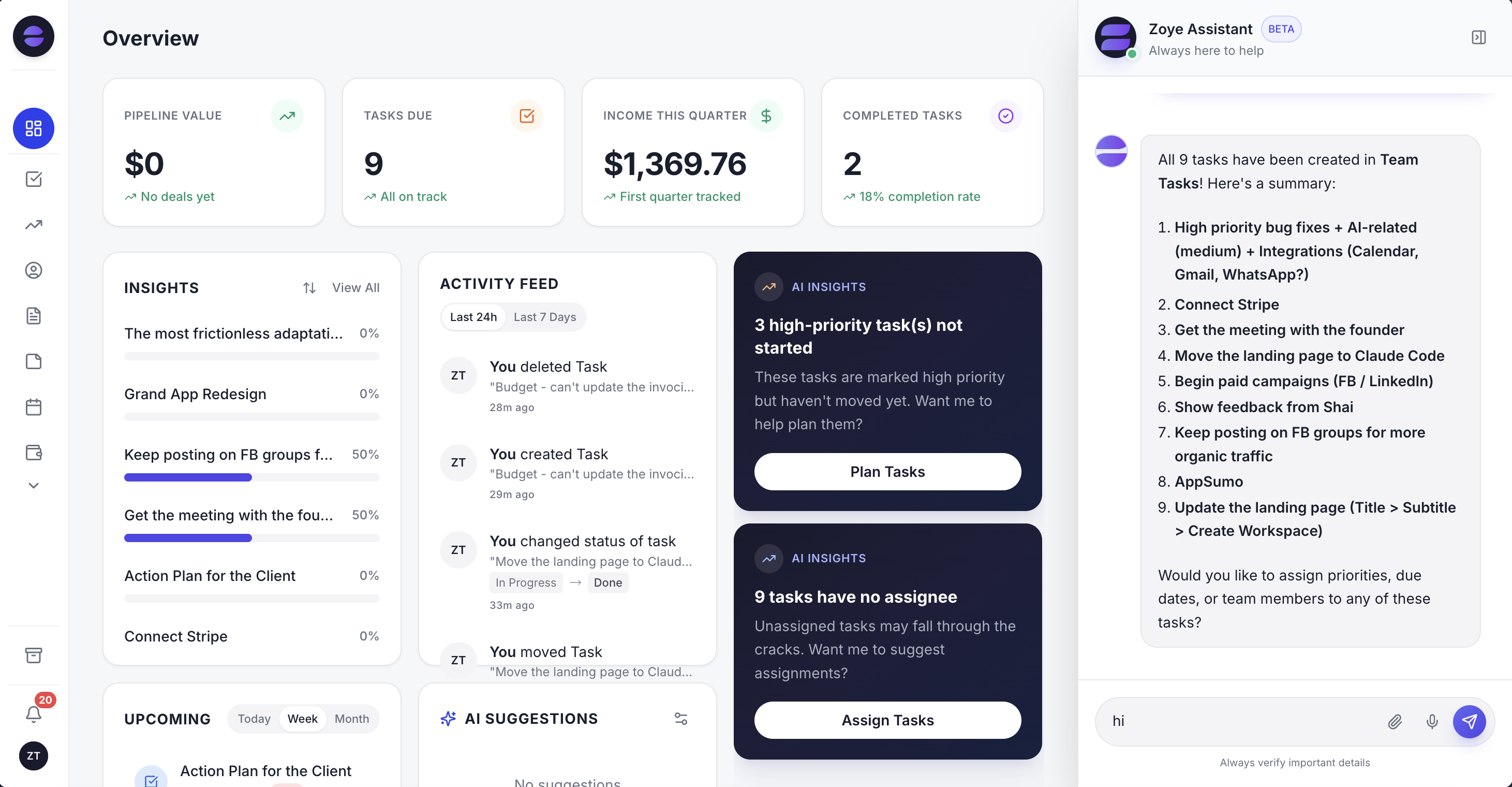
What sets Zoye apart is that the AI isn't bolted on as an afterthought. It's the foundation. When you add a deal to your pipeline, Zoye automatically creates follow-up tasks, schedules reminders, and monitors engagement. When a prospect goes quiet, Zoye flags it and suggests next steps. When you need a report, you just ask: "How did our pipeline perform this month?" and get an instant, accurate answer.
Tasks the AI can act on
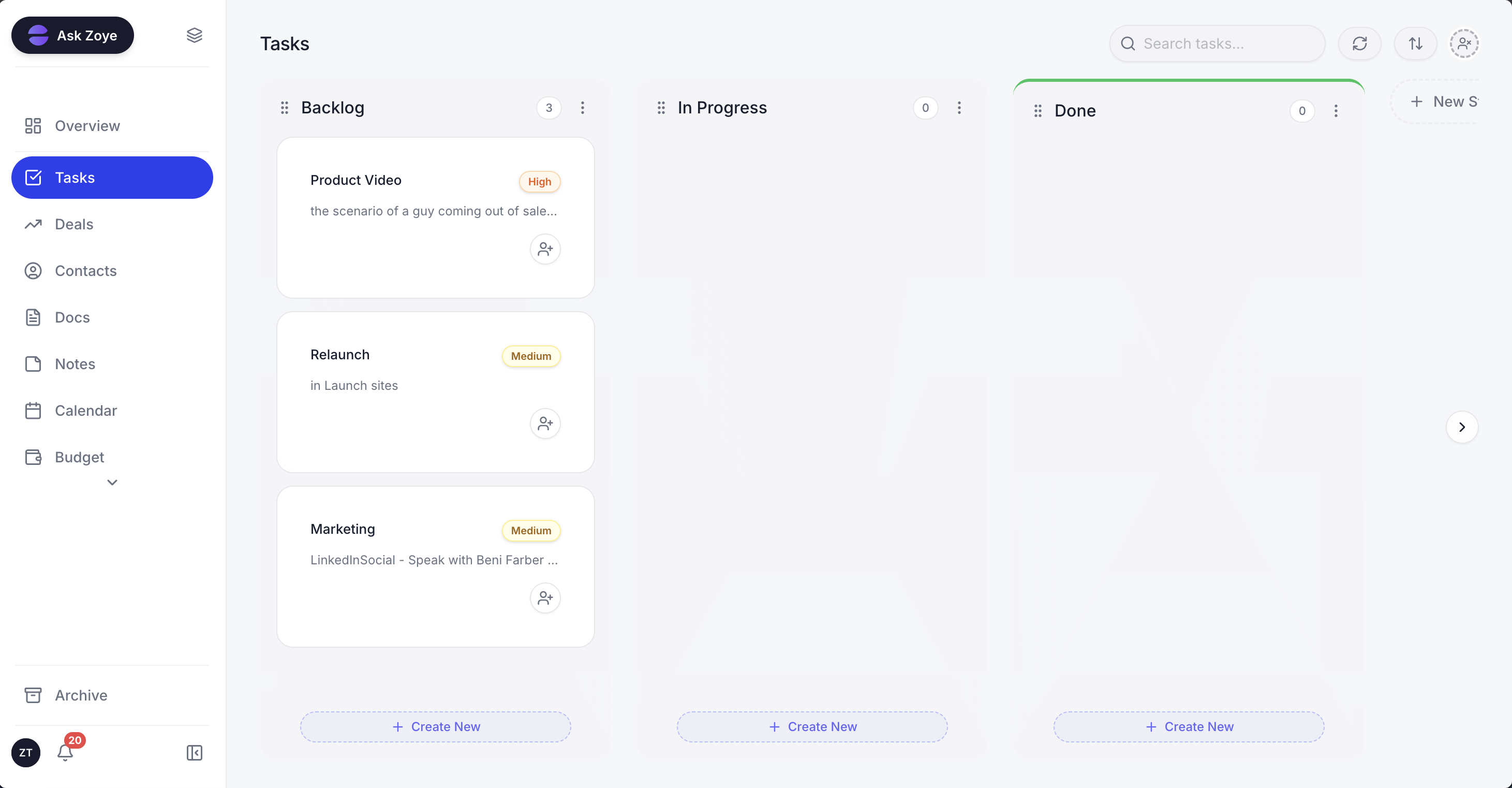
The future-state team does not write tasks in a notebook and hope the AI sees them. Zoye keeps work in a Kanban board with priority labels, dependencies, and owners as first-class fields. The assistant reads and updates the board directly, so an AI-flagged follow-up appears as a real task on the right person's column.
Calendar that reflects what matters
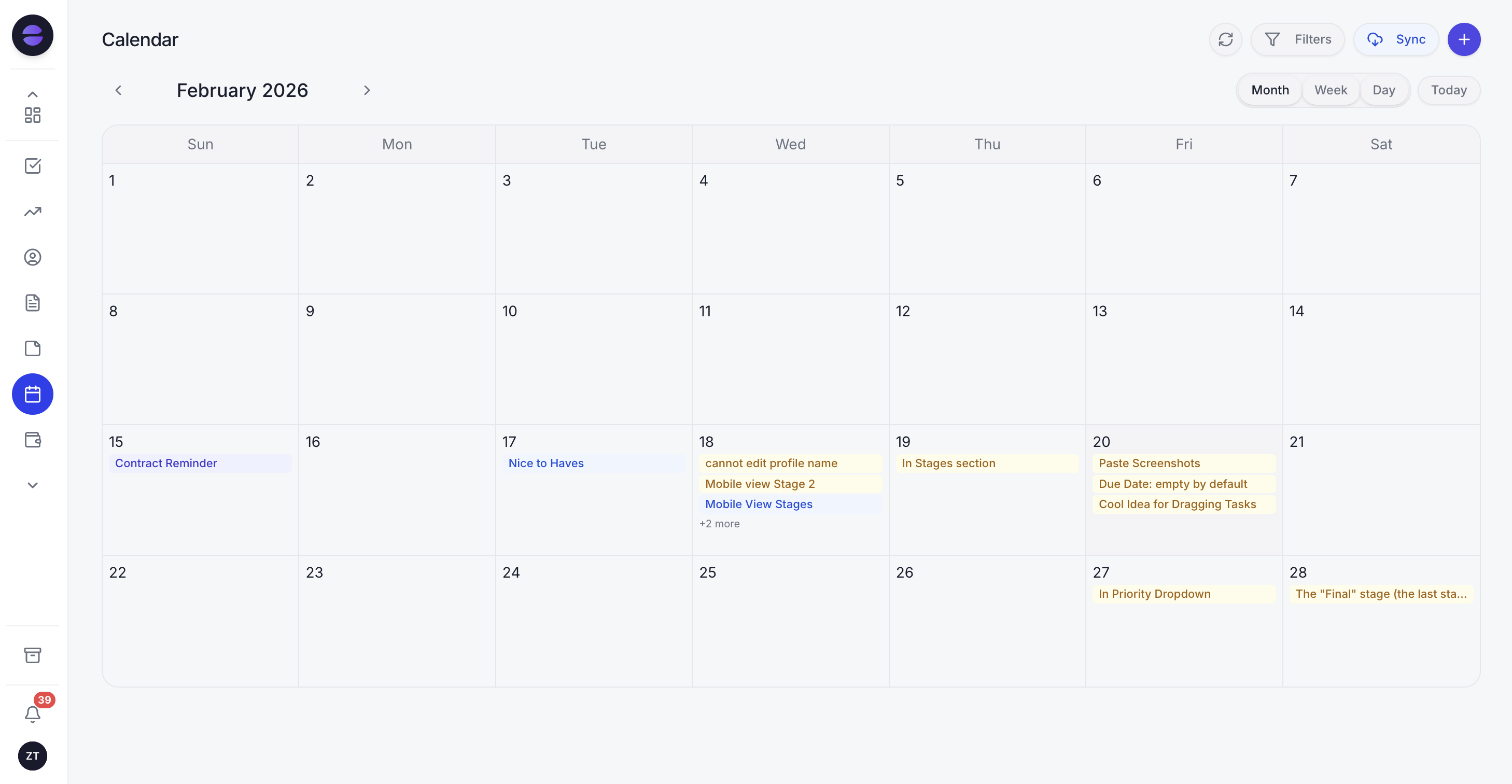
A future-state calendar reflects deal urgency, not whoever was loudest in the meeting. Tasks land on Zoye's calendar automatically. The AI proposes deep-work blocks for the work the data says actually matters. There is no separate scheduling tool to sync.
Reports that surface signal early
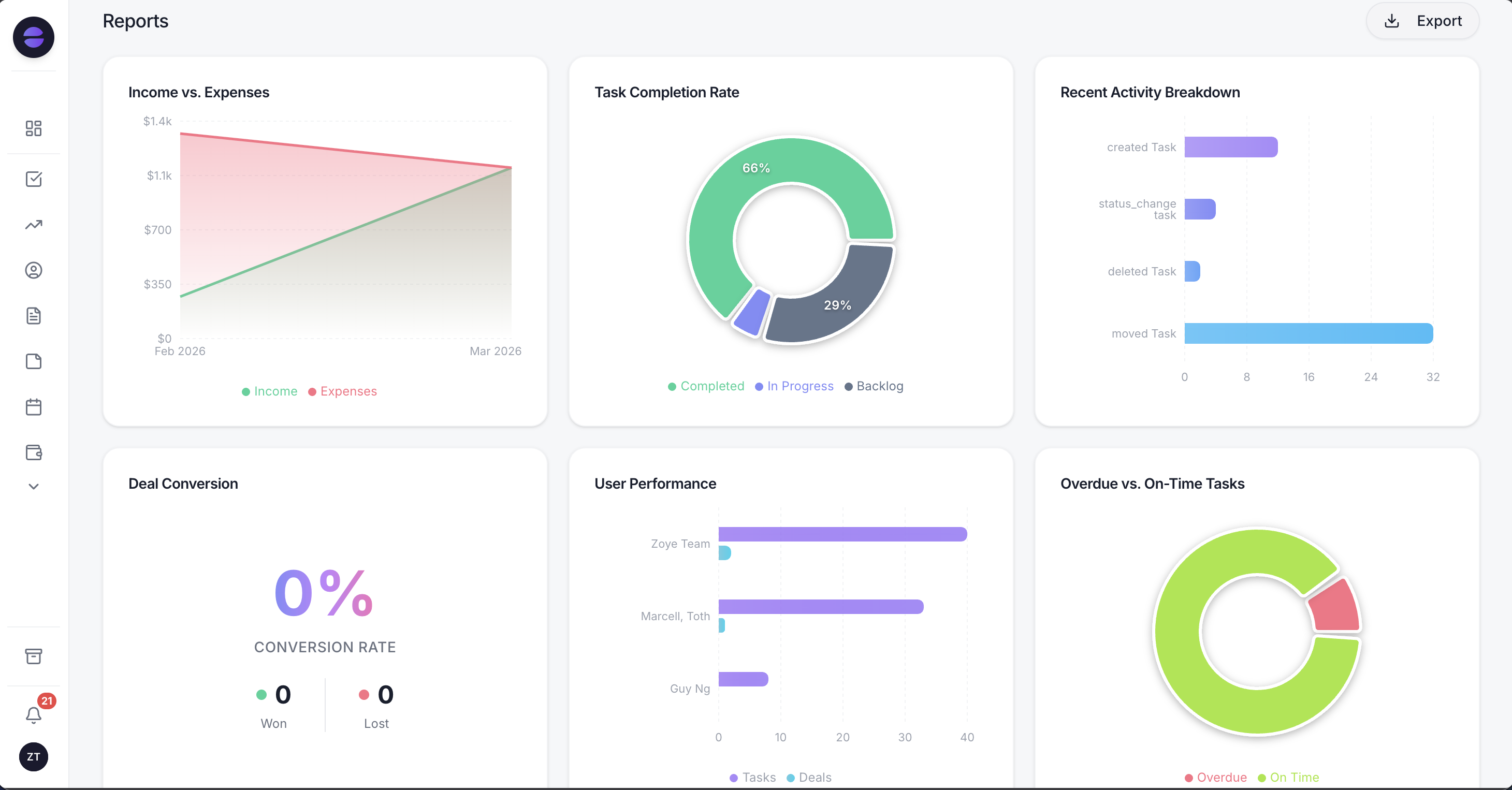
The shift from reactive to proactive management hinges on reports that arrive before the problem. Zoye Reports brings tasks, deals, contacts, budget, and team activity into one exportable dashboard - the foundation the assistant uses to flag stalled deals, overloaded reps, and at-risk projects in the morning summary.
Knowledge alongside the work
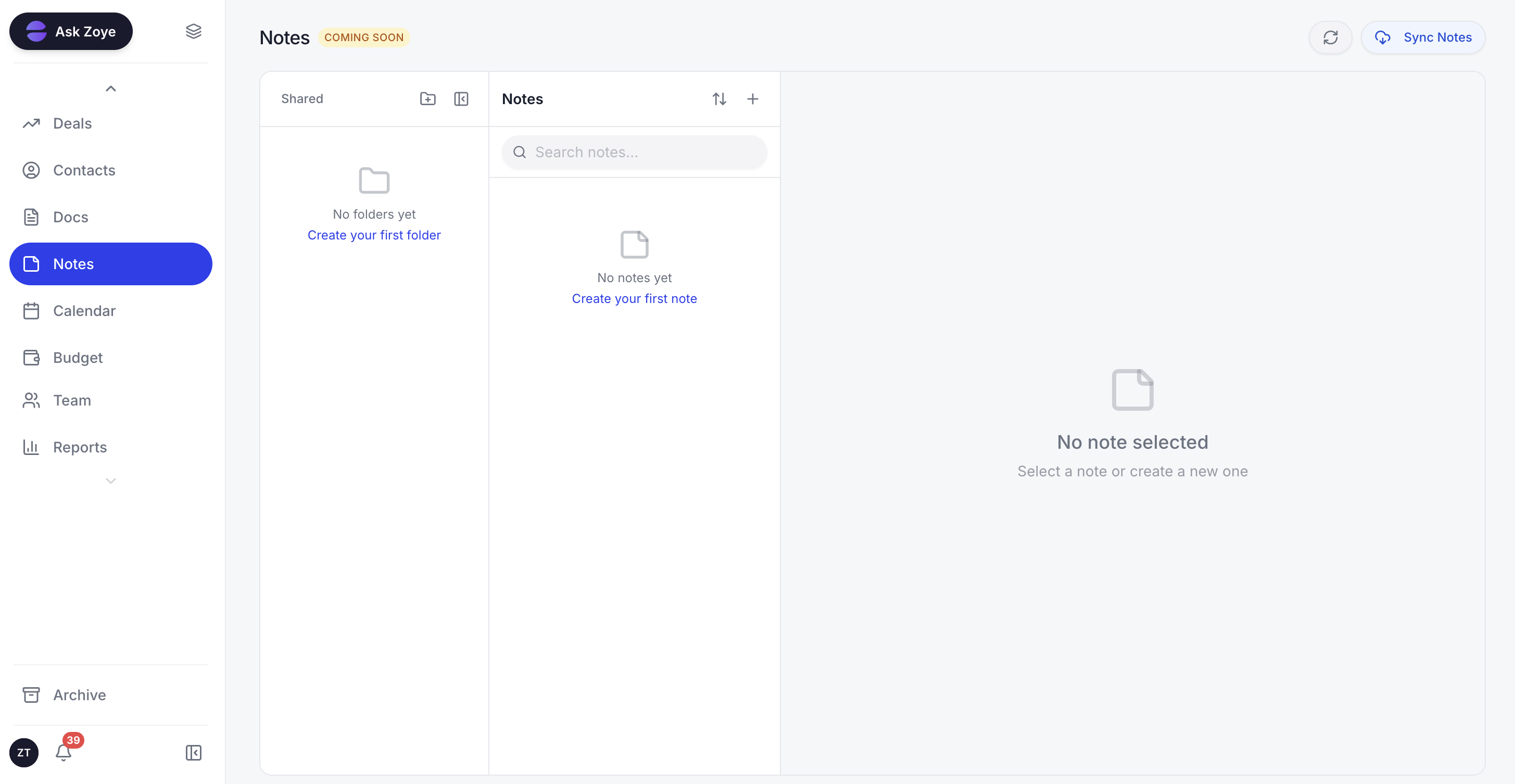
A future-state team treats documentation as live alongside the work, not as a graveyard wiki nobody updates. Zoye Notes brings docs into the same workspace as the tasks and deals they describe, so the playbook for "deal at risk" is one click from the deal itself. Available on every plan.
This is what AI-powered business management actually looks like in practice - not a chatbot sitting in the corner, but an intelligent layer woven through every part of your workflow. Your CRM data informs your task priorities. Your task completion feeds into your reports. Your calendar reflects what actually matters based on deal stage and urgency. Everything is connected because everything lives in one system.
For teams focused on productivity, Zoye eliminates the invisible overhead that slows everyone down: the minutes spent updating a deal record after every call, the time lost rebuilding the same weekly summary, the constant tab-switching between tools that fragments your focus. None of that work creates value. All of it used to be unavoidable. The shift to AI-powered management is, at its core, the decision to stop paying that tax.
A concrete example of proactive management
Picture a sales lead who closed twelve deals last quarter. In a manual setup, two of those deals would probably have slipped if a colleague had not happened to notice they had gone quiet. In an AI-powered setup, the assistant flags a deal the day activity stops, names the contact who went dark, and proposes a re-engagement message based on the last conversation. The lead still decides whether to send it. The difference is that the decision now happens while the deal is still warm, not three weeks later when it has already cooled.
What an AI-Powered Team Actually Looks Like
The phrase "AI-powered team" gets used loosely. In practice it does not mean a team that has bought an AI subscription. It means a team where four specific things are true:
- There is one source of truth. Customer data, deals, tasks, calendar, and budget live in one connected system rather than five apps that each hold a fragment. The AI can only reason about your business if it can see all of it at once.
- Routine work is delegated to AI by default, not by exception. The default for note-taking, follow-up scheduling, report building, and contact enrichment is "the assistant does it," and a human steps in only for judgment.
- Information flows toward people, not away from them. Instead of a manager pulling a report to find out a deal stalled, the system pushes the alert the day it happens. The team reacts to early signals rather than post-mortems.
- People spend their hours on judgment. Relationship-building, creative work, negotiation, and strategy are what humans do. Everything that is repetitive and rule-shaped moves to the AI layer.
A team can adopt every AI tool on the market and still fail all four tests if the data stays fragmented. The tooling matters less than the structure.
How to Prepare Your Business for the Shift
You don't need to overhaul everything overnight. The smartest teams are making the transition gradually, starting with the areas that deliver the most immediate impact. Here is a concrete four-week sequence that works for most small teams.
Week 1: Audit where your team spends its time
Before changing any tools, find out where the hours actually go. Have each person log their work in 30-minute blocks for five days and tag each block: customer-facing, data entry, status updates, searching for information, report building, or deep work. Almost every team is surprised by how much falls into the middle four categories. Those four are exactly what AI-powered management removes, so the audit tells you precisely where the payoff is largest.
Week 2: Consolidate before you automate
Automation built on top of fragmented tools just creates faster chaos. Before layering in AI, bring your core workflows (CRM, tasks, and communication) into fewer systems. Pick the one tool that already holds the most of your operating data and migrate the adjacent workflows toward it. The closer you get to a single source of truth, the more powerful AI becomes, because it has full context to work with. A practical test: if your AI assistant cannot answer "which deals are at risk this week?" it is because the data it needs lives somewhere it cannot see.
Week 3: Automate your single biggest time sink
Do not try to automate everything. Take the largest category from your Week 1 audit (for most teams it is follow-ups or report building) and move just that one to AI. Run it for the week and measure the time recovered. A narrow first win builds the team's trust far faster than a sweeping rollout that nobody finishes.
Week 4: Choose tools that learn, and review the results
Not all AI features are created equal. Some tools offer basic if-this-then-that rules dressed up as intelligence. Look for platforms that genuinely improve from your data: your deal patterns, your team's work habits, your customer interactions. At the end of the month, compare a fresh time audit against Week 1. The hours you recovered are the real measure of the shift, not the number of features you switched on.
Frequently Asked Questions
AI is shifting business management from reactive to proactive. Instead of manually tracking tasks, deals, and deadlines, AI-powered tools analyze patterns, predict outcomes, and automate routine decisions - letting managers focus on strategy and people.
An AI-powered team uses intelligent tools that handle CRM updates, task prioritization, scheduling, and reporting automatically. Team members spend their time on creative problem-solving and relationship-building rather than administrative busywork.
No. Modern AI business management platforms like Zoye are designed for non-technical users. Just tell Zoye what you need, the way you would brief a colleague, and it handles the complexity behind the scenes.
No. AI replaces the coordination overhead that consumes a manager's day - status chasing, report building, scheduling, routine task assignment. It does not replace the judgment work that defines management: developing people, making calls in ambiguous situations, and setting direction. The role shifts toward more judgment and less administration, not toward redundancy.
Start with a one-week time audit to find your biggest operational time sink, consolidate your core data into as few tools as possible so the AI has full context, then automate that single time sink first and measure the hours recovered before expanding. A narrow first win builds trust faster than a sweeping rollout.
Conclusion
The future of business management isn't about working harder or hiring more people to manage the chaos. It's about working with intelligent systems that understand your business, anticipate what needs to happen, and handle the operational work that used to eat up your best hours. The teams that embrace AI-powered management now won't just keep up - they'll set the pace for everyone else.