Most advice about Instagram leads stops at attention. Post more Reels, use the right hooks, grow the following, and leads will arrive. Then a small business does all of that, the comments and DMs start coming in, and a month later nobody can say how many of those people became customers, who replied to them, or where half of them went. The followers grew. The pipeline did not.
The gap is rarely the content. It is what happens after someone raises their hand. A comment that never gets a reply, a story reply buried under forty others, a DM answered two days late, an Instant Form submission sitting in a download nobody opened: each of those was a lead, and none of them counted. Instagram is very good at starting conversations and not designed to remember them for you.
This guide covers both halves. First, the routes that actually produce leads on Instagram in 2026, organic and paid, with what Meta's messaging rules allow on each. Then the capture layer, the part that decides whether any of it shows up in revenue. It sits under our Facebook and Instagram automations page. Meta's messaging policy details below were checked against Meta's own developer documentation in October 2026, and Meta revises them regularly, so check the current pages before you build on any single rule.
What actually counts as an Instagram lead
Before choosing tactics, agree on a definition, because the word lead gets stretched until it means nothing.
A follower is not a lead. A like is not a lead. Even a comment that says "love this" is not a lead. A lead is a specific person who has shown interest in something you sell, whom you can reach again, and whose interest is written down somewhere your business will see it tomorrow. That last clause is the one most Instagram strategies skip.
On Instagram, people show interest in five ways: they comment on a post or Reel, they reply to a story, they send a DM, they tap a profile button or bio link, or they submit a form from an ad. Every route in this guide produces one of those five signals. The job is to make each signal easy to send and impossible to lose.
A useful test for any Instagram activity is to ask what the next step is for the person who liked it. If the honest answer is "follow us and hope", the content is building awareness, which is fine, but it is not lead generation and should not be judged as such.
Build the profile as a funnel, not a portfolio
The profile is where interested people land after any post, Reel or ad, and most small business profiles treat it as a gallery. Treat it as a short sales page instead.
Switch to a professional account. A Business or Creator account gives you insights, contact options on the profile and the ability to run ads. It is also a hard requirement for any automated messaging: Meta only allows automation on an Instagram Business or Creator account connected to a Facebook Page, through an approved Meta app.
Write the bio for the person, not for you. One line on who you help and with what, one line on the outcome, one line telling them what to do next. "DM the word QUOTE for a price in 24 hours" is a better bio line than a slogan, because it gives a lead a way to identify themselves.
Give the link one job. A link-in-bio page with eleven buttons hands the decision back to a visitor who arrived with about four seconds of patience. Put the action that matters at the top: book a call, get a quote, join the waitlist. Everything else can live lower down or nowhere.
Use the contact options and story highlights. Contact buttons let people reach you without typing a message from scratch. Highlights work as a permanent menu: one for prices or packages, one for results, one for how working with you works, one for frequently asked questions. Each should end with the same instruction as the bio.
Organic route one: keyword comments on posts and Reels
The keyword comment is the most reliable organic lead mechanic on Instagram right now, because it turns a passive viewer into a named person with one word. A post or Reel ends with "comment GUIDE and I will send it to you", and every person who comments gets a private message.
The rule that makes this work is Meta's private reply: a business can send one private message in response to a comment, within 7 days of that comment, and the person sees that the message refers to what they wrote. If they reply to that message, the normal 24-hour messaging window opens and the conversation can continue. One comment, one private reply; a second automated message only follows if they answer.
That shapes how you write the first DM. It has to deliver what the post promised and ask one question that invites a reply, because the reply is what opens the conversation. "Here is the price list. Is this for a home or a business?" works. A wall of text with three links and no question usually ends the thread.
A public reply under the comment helps too: it tells everyone else reading that the mechanic is real and that you answer. Our full walkthrough of the pattern, including trigger words and the first message, is in Instagram comment to DM automation.
Organic route two: stories, stickers and replies
Stories are where your warmest audience is, because people only see them if the algorithm thinks they care about you. A story reply goes straight into the DM inbox and opens a messaging window, which makes stories the cheapest conversation starter on the platform.
The trick is to make replying effortless. A question sticker ("What is the one thing slowing your bookings down?") gets answers from people who would never write a DM cold. A poll followed by a story that says "reply YES and I will send the checklist" converts the tap into a message. A link sticker sends people to the single destination from your bio. And a plain "reply with the word PRICE" works better than most people expect, because a story reply feels private and low-stakes.
Answer story replies fast. The person replied while they were thinking about you; an hour later they are thinking about something else.
Organic route three: the DM inbox itself
Every route above ends in the DM inbox, so the inbox is where leads are actually won. Three Meta rules govern it.
First, the 24-hour window. After a person messages you, you have 24 hours to reply with anything relevant, promotional content included. After that, you wait for them to write again. Meta's Human Agent tag lets a human, not a bot, reply within a separate 7-day period, but it needs App Review permission and it is meant for genuine human support, not for re-engaging people automatically.
Second, no cold outreach. You can message people who messaged you, commented, replied to a story or clicked an ad. You cannot message a list of accounts that never engaged. Most legacy message tags that used to stretch the window have been retired, so there is no clever exception to plan around.
Third, automated replies have obligations. Meta asks bots to respond within 30 seconds and to disclose that they are automated where the law requires it, which Meta recommends doing always: at the start of a conversation, after a long gap, and when switching from a human back to automation.
Want to see it in action?
See Zoye catch a new lead, answer on WhatsApp and set up the follow-up, all from one message.
See How It WorksPaid route one: Click-to-Instagram-Direct ads
A Click-to-Instagram-Direct ad has a "Send message" button instead of a link, so a tap opens a DM with your business. The ad buys a conversation, not a visit.
Two things make this format worth testing. The person starts the conversation, which means it is warm and the messaging rules are on your side. And after the person's first message following a Click-to-Instagram-Direct ad, the messaging window can last up to 7 days instead of 24 hours, which gives a small team room to have a proper exchange.
The failure mode is equally clear. A tap on the ad produces nothing but an opened chat. If nobody replies for three hours, you paid for a conversation and let it walk away. The first reply should arrive within seconds, greet the person, confirm what the ad offered and ask one qualifying question. Prefilled conversation starters on the ad, such as "What does it cost?" or "Do you have availability this month?", help people send that first message without thinking.
Paid route two: Instant Form lead ads
Lead ads on Instagram run on Meta's Instant Forms: a tap opens a short form with the name and email already filled from the person's profile, and they submit without leaving the app. It is the fastest way to collect contact details at volume.
The trade-off is that the effort removed from the form has to be absorbed by your follow-up. People who submitted in two taps decided less than people who typed their details on a website, so more of them are early and lukewarm. Three habits make the format work: keep the form short and ask only questions that change who follows up or what they say, make sure the campaign and ad name travel with the contact so you can see which ad produced sales rather than submissions, and reply in minutes. The full mechanics are in Facebook lead ads to CRM, and they apply to Instagram placements in exactly the same way.
Which route fits which offer
There is no single best route. There is a best route for what you sell and how much conversation it needs before someone buys.
| Route | Best for | What it needs from you |
|---|---|---|
| Keyword comments | Lead magnets, price lists, quick offers | A first DM that delivers and asks one question |
| Story replies | Warm followers, repeat buyers, launches | Fast human or automated replies |
| Profile and bio link | Anyone who checks you out after a post | One clear action and a working link |
| Click-to-Instagram-Direct ads | Offers that need a question answered first | A reply within seconds, every time |
| Instant Form lead ads | Volume, callbacks, quotes, waitlists | Instant follow-up and campaign attribution |
A service business with a considered purchase (a clinic, a renovation firm, a coach) usually does best with DM ads and keyword comments, because the sale starts with a conversation. A business with a simple, repeatable offer (a class, a product drop, a free consultation slot) often gets more from lead forms. Judge every route on the same number, booked calls or paid customers, not cost per lead.
See what Zoye can do for you
CRM, deals, tasks and your Instagram, Facebook and WhatsApp automations in one workspace. Just ask Zoye and it sets any of it up for you.
Explore FeaturesThe capture layer: where Instagram leads are won or lost
Everything above produces signals. The capture layer turns signals into leads you can count. It has five parts, and each one fails in a recognisable way when it is missing.
A contact with a source. Every commenter, story replier, DM sender and form submitter becomes a contact the moment they engage, with the route recorded: which post, which story, which ad, which form. Without this, Instagram is a black box and your best post looks the same as your worst.
An instant first reply. The first message goes out in seconds, whether a person or an automation sends it. It confirms what they asked for and asks one useful question. Speed matters most here because the person is still in the app and still thinking about you.
Qualification that lands on fields. The two or three answers that decide what happens next (what they need, when, roughly what budget) should be saved on the contact, not left inside a chat thread that nobody will scroll back through.
An owner. Someone specific is responsible for the lead, with a fallback when that person is away. An unowned lead is a lead nobody follows up.
A follow-up that is scheduled, not remembered. If the person goes quiet, a task or a sequence brings the conversation back while there is still a window to do it in, or moves it to a channel they agreed to, such as WhatsApp.
One more detail that saves real embarrassment: recognise repeat people. The person who commented on a Reel in March and replied to a story in June is one lead with two touches, not two strangers. Matching them to the existing contact is what lets you say "good to hear from you again" instead of starting from zero.
A weekly Instagram lead routine for a small business
Here is an illustrative routine for a five-person service business with one person spending a few hours a week on Instagram. Adjust it to your offer; the shape matters more than the days.
Monday: publish one keyword-comment Reel tied to a single offer, with the trigger word in the caption and on screen. Check that the auto-DM fires by commenting from a test account.
Tuesday: run a story sequence with a question sticker on the problem your offer solves, then a story that invites a one-word reply for the resource.
Wednesday: review last week's leads by source. Which post, story or ad produced conversations, and which produced booked calls? Move budget or effort toward the second number.
Thursday: publish a proof post (a result, a before and after, a short client story kept anonymous) ending with the same call to action as the bio.
Friday: clear the follow-ups. Every lead from the week either has a next step on the calendar, a scheduled follow-up, or a clear reason it was closed.
Ongoing: Click-to-Instagram-Direct or lead form ads run against the offer that converted best organically, so paid traffic lands on something already proven.
What gets Instagram accounts limited
Part of getting leads from Instagram is not losing the account that produces them. Meta is clear about what crosses the line.
Unofficial bots and browser automation tools that like, follow, comment or DM on your behalf risk action blocks and account restrictions, because they operate outside the approved API. Mass cold DMs to people who never engaged break the messaging policy no matter how they are sent. Scraping follower lists of other accounts to message them falls in the same bucket. Follow and unfollow loops still circulate as growth advice and still get accounts limited.
The safe line is simple. Automate replies to people who engaged with you, through an official Meta integration, inside the messaging windows. Everything else is either manual and human, or a risk to the account.
Ready to hand off the busywork?
Zoye brings AI-powered CRM, task management, and automation into one workspace.
Get StartedHow Zoye turns Instagram activity into leads
Zoye is an AI Business Operator: one workspace with tools that already link to each other, plus an assistant that operates them for you. Facebook and Instagram is one of those tools, and its job is the capture layer described above.
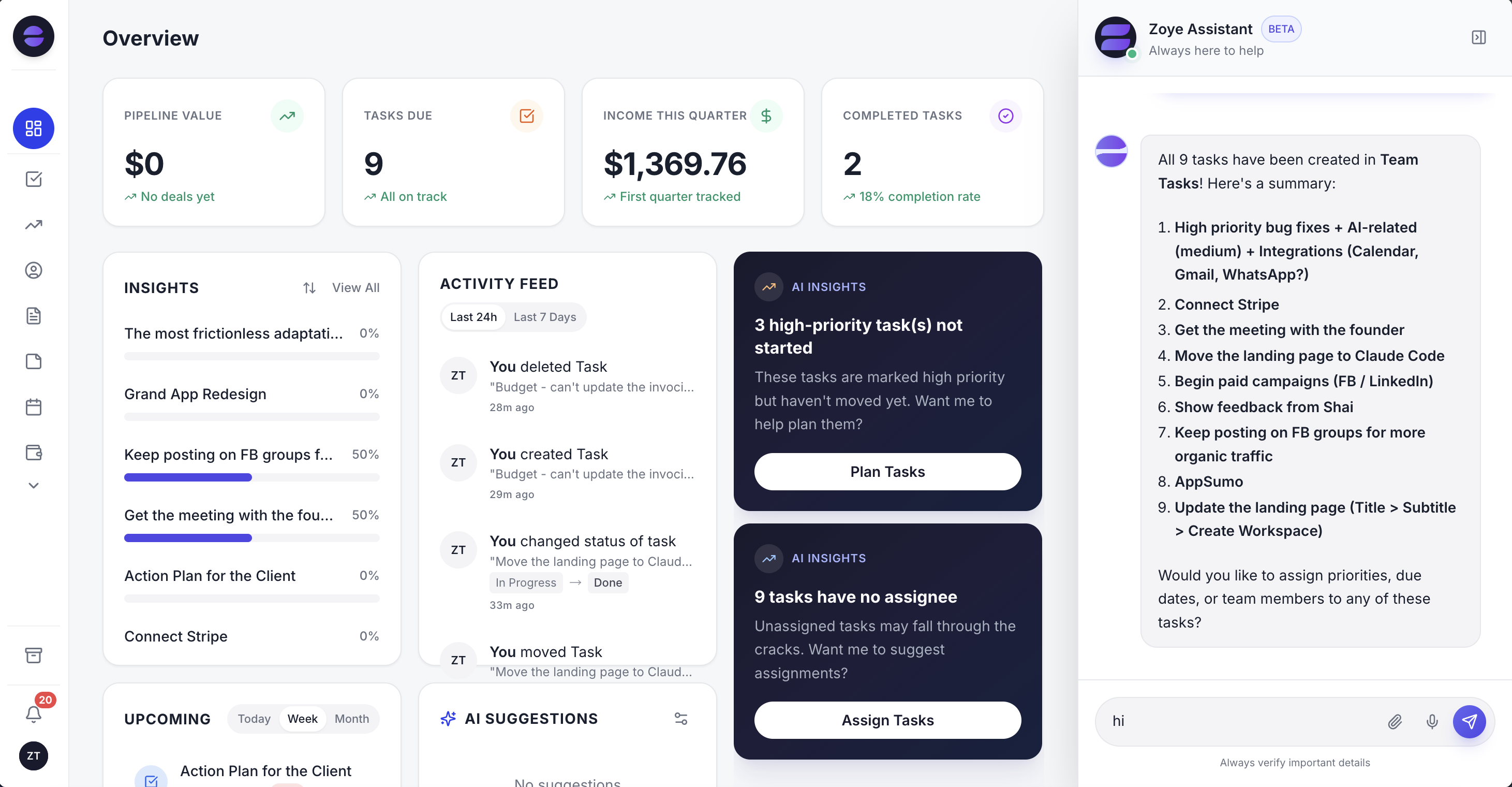
Every comment, story reply, DM and form submission lands as a contact with its source, so the dashboard shows which Instagram routes are producing real leads.
One connection covers a Facebook Page and its linked Instagram Business or Creator account. When someone comments with your keyword, Zoye can post a public reply and send the private DM within seconds, on one post or on every post. When someone DMs the account or replies to a story, Zoye answers right away with buttons to tap, a file, or a reply in your brand's voice, and anything it should not answer is handed to a person on your team with the whole chat on the lead's card. Instant Form submissions from lead ads become contacts with their fields mapped and the campaign and ad name saved. Repeat people are matched to the contact they already have, with each comment and its permalink kept on the record.
From there, an Instagram lead is an ordinary Zoye lead. The WhatsApp welcome can go out with consent, a qualifying conversation can write answers onto fields, an owner can be assigned, follow-up tasks can be created, and the lead shows up in your pipeline and reports next to every other source. If Meta rejects a send or a Page loses a permission, you hear the reason instead of a false confirmation.
Setup is guided in four steps: connect the Page, choose which workspace its leads go to, build the auto-DM, then test it live by commenting on your own post. You can also describe what should happen to the assistant in the app, on WhatsApp or in Slack, and Zoye builds the rule, shows it to you, and waits for your approval before anything runs.
To be clear about the limits: Zoye does not run your ads or schedule your posts, and it will not make weak content convert. It makes sure that every person Instagram sends you is answered, recorded and followed up.
If your Instagram already starts conversations and you want every one of them to become a lead you can see, explore Zoye's Facebook and Instagram automations and check the plans on the pricing page.
For more context, see our guides to Instagram comment to DM automation, Facebook lead ads to CRM, and how to stop losing leads.