
Jira has been the default project tracker for software teams since 2002. It is comprehensive, customisable, and battle-tested. It is also dense, expensive at scale, and increasingly out of step with how modern cross-functional teams actually want to work. In 2026, the gap between Jira and the new generation of project tools has widened to the point where switching is no longer just about preference. For many teams, it is about productivity.
This guide compares the seven best Jira alternatives in 2026, ranked for small to mid-size teams that want better UX, lower cost, and native AI without giving up the operational depth that made Jira the standard in the first place. The picks span pure engineering tools, cross-functional platforms, and lightweight boards, so the right fit depends mainly on how much of your team works outside of code. Teams migrating from traditional waterfall tooling should also see the best Microsoft Project alternatives.
Why teams are looking beyond Jira in 2026
The pressure to leave Jira comes from four directions that have intensified over the past two years.
Per-user pricing scales painfully. Jira Premium runs around $17 per user per month, and Enterprise tiers go higher. A 20-person team on Premium pays roughly $340 per month, or about $4,080 per year, for what is essentially a ticketing system. Adding Confluence for docs and Atlassian Intelligence for AI features pushes the bill substantially higher for the same team. That is a meaningful chunk of payroll for a tool that does not generate revenue.
Pricing reflects published rates as of June 2026; check each vendor's pricing page for current figures.
The interface is hostile to non-developers. Jira was designed by engineers for engineers, and it shows. Marketing, design, customer success, and operations team members who try to use Jira typically need a week of onboarding just to understand the basic flows. Many give up and ask engineering to file tickets on their behalf, which creates the exact friction that cross-functional collaboration is supposed to eliminate.
No native CRM, budget, or modern AI. Jira is a project tracker, period. To run a complete business operation on Jira, you stack Confluence (docs), Atlassian Intelligence (AI), a separate CRM (Salesforce or HubSpot), a separate calendar tool, and usually a separate budget tracker. Each subscription is its own login, its own data silo, and its own monthly bill. Teams under 50 people increasingly want one workspace that handles everything.
Slow performance and a heavy learning curve. Jira loads slowly at scale, especially on large boards with many tickets and custom fields. Modern alternatives are noticeably faster and lighter, with cleaner workflows out of the box.
The 7 best Jira alternatives in 2026
1. Zoye - the AI-native all-in-one alternative
Zoye is the strongest Jira alternative for teams that want PM plus CRM plus calendar plus budget plus AI in a single workspace. It is purpose-built for the modern small business and growing startup, where the same team handles product development, customer relationships, scheduling, and financial tracking, often with the founder still wearing multiple hats.
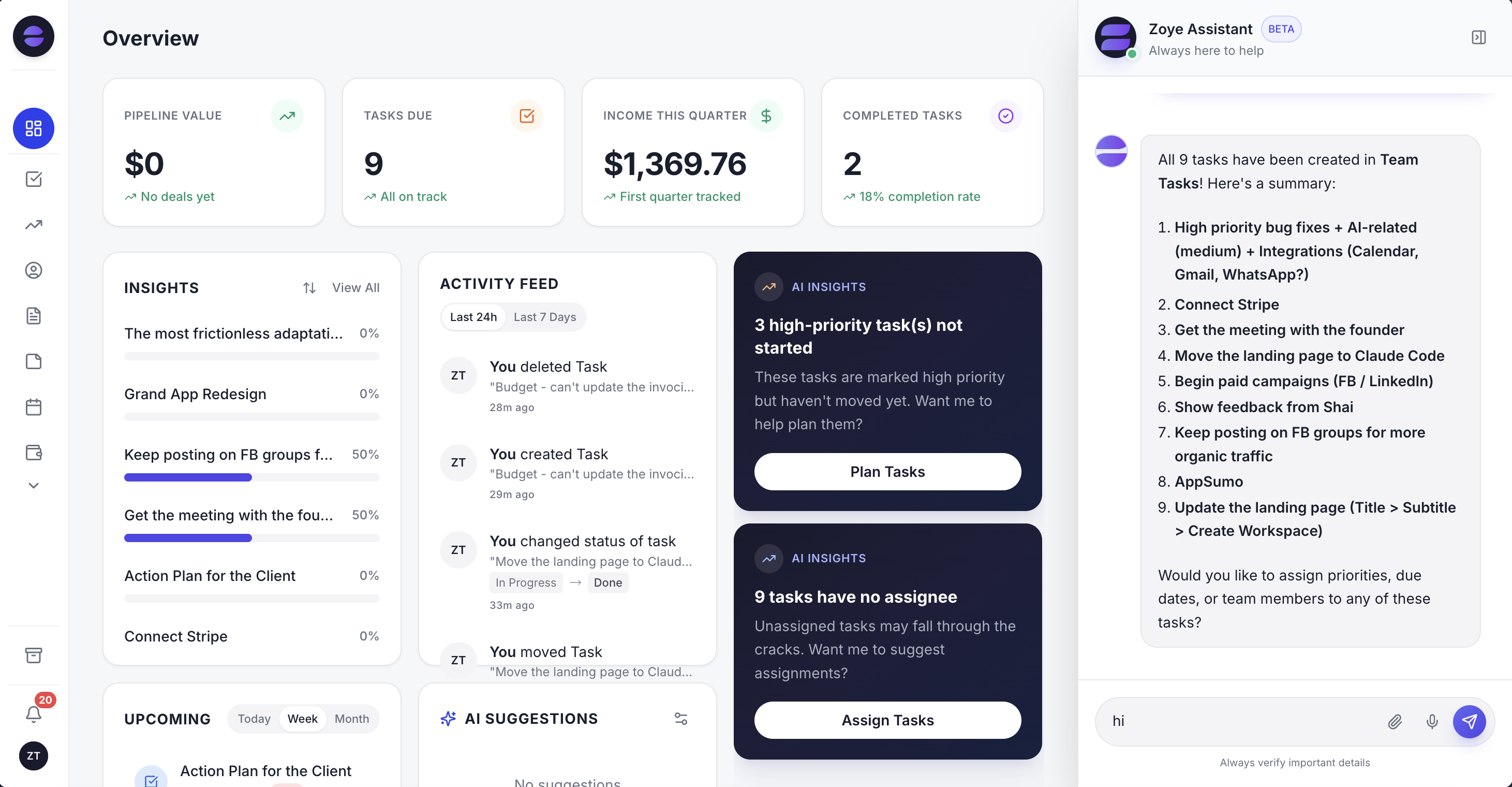
Compared to Jira, the workflow is faster on every dimension. New team members onboard in hours, not weeks. The interface is friendly to non-developers, so marketing and customer success can actually use it. CRM is built in, so sales pipeline and customer history live alongside the engineering work. Budget tracking is built in, so the founder can see runway without leaving the app.
Zoye Assistant - AI that works, not just talks
The AI assistant is the differentiator. Where Jira's Atlassian Intelligence is a chat sidebar that answers questions about tickets, Zoye lives inside the workspace and takes real action. You can ask Zoye to triage incoming bug reports, assign them to the right engineer based on current workload, summarise yesterday's progress for the standup, schedule the sprint retro, and draft a customer status update on a delayed feature. All by text or voice, through the app, WhatsApp, or Slack.
Tasks - tickets without the Jira ceremony
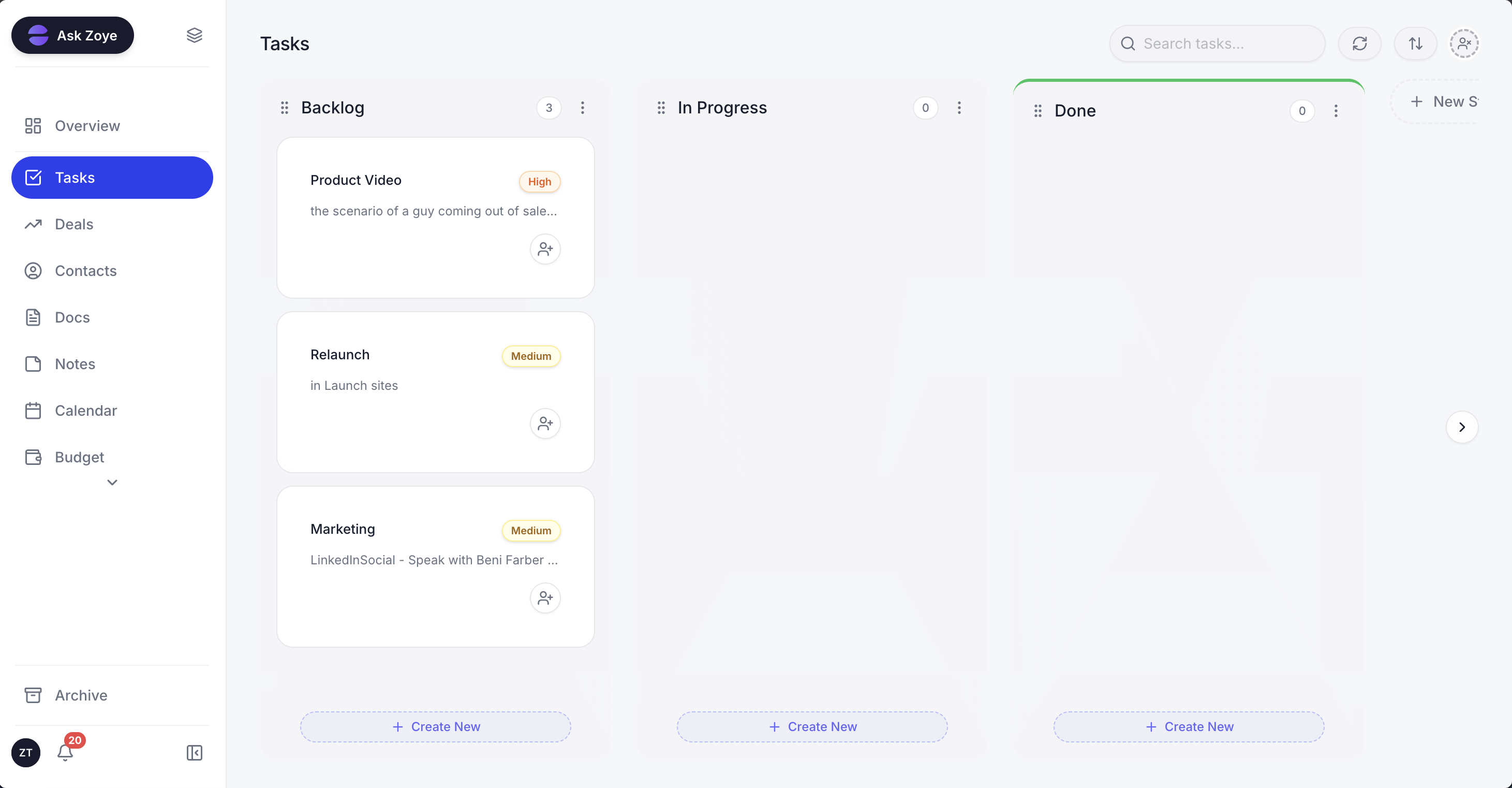
Jira asks for custom schemes, workflow configuration, and project type selection before a team can move. Zoye ships with sensible defaults. List, board, calendar, and timeline views work on every project. Engineers and non-engineers share the same workspace without translation.
Calendar - tasks where they belong
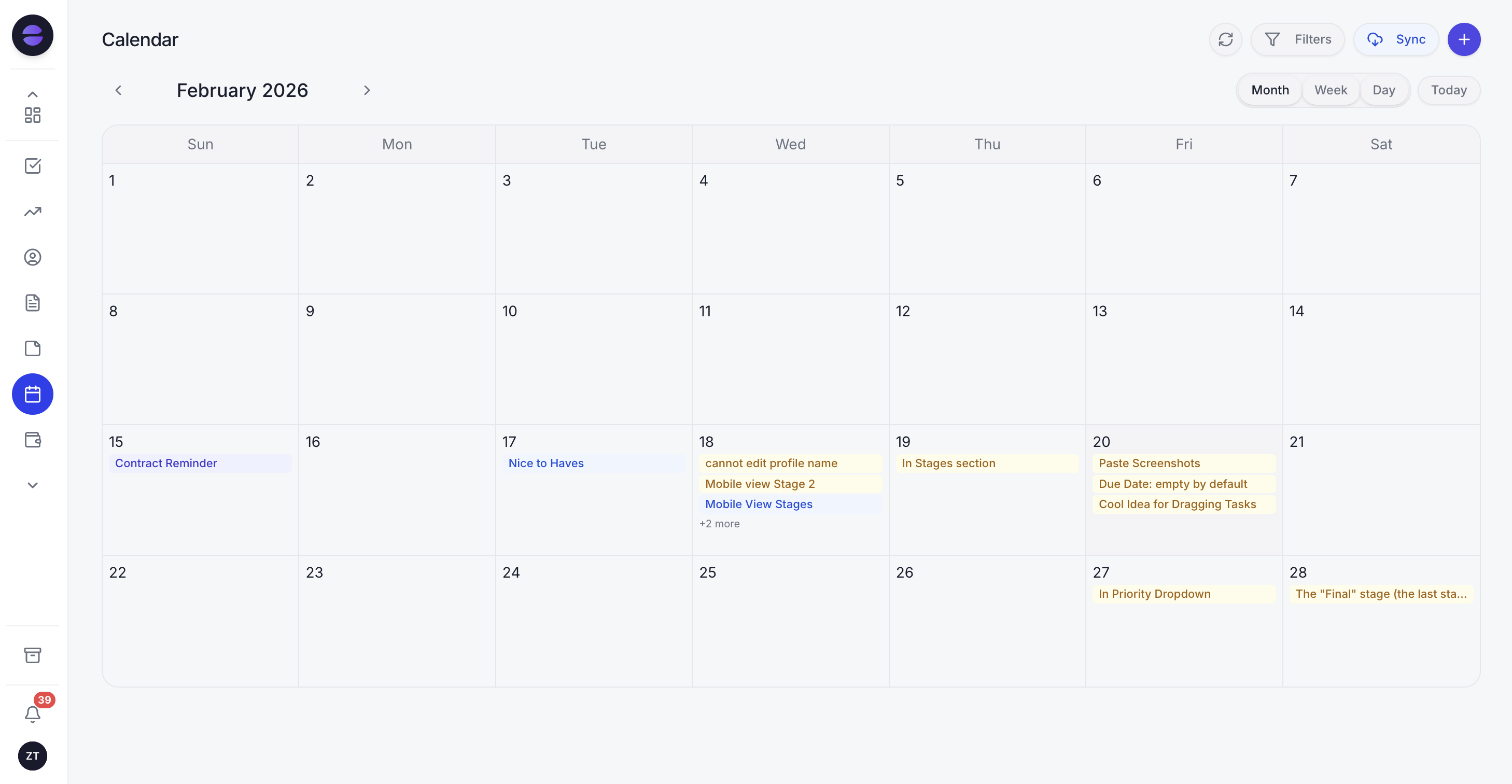
Jira does not include a native team calendar. Zoye's calendar IS the workspace calendar. Tasks appear automatically. Sprints, deadlines, and meetings all live in one view. No Outlook plugin or Google sync to maintain.
Reports that pull from the whole workspace
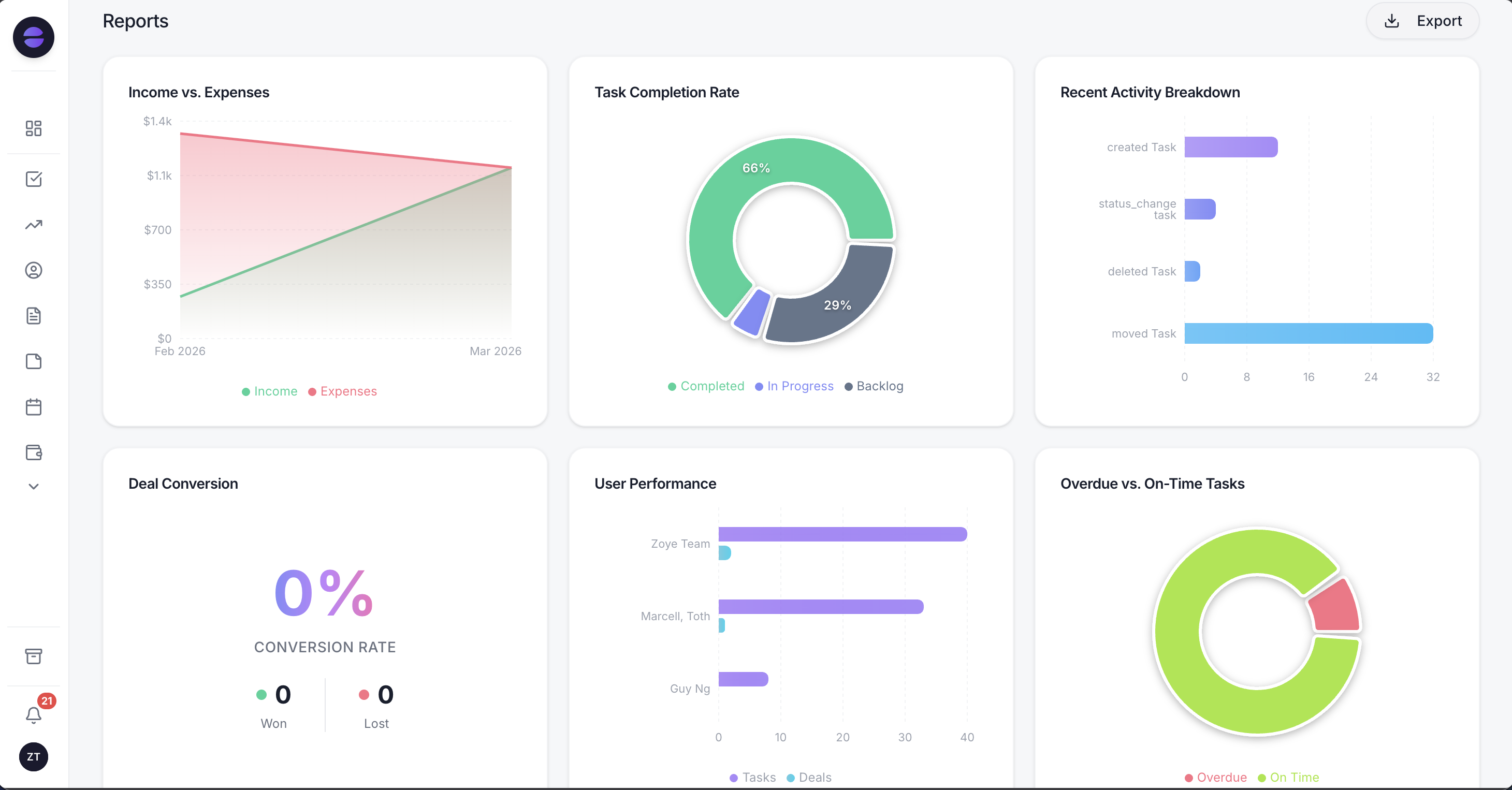
Jira reporting is engineering-first. Zoye Reports brings tasks, deals, contacts, budget, and team activity into one exportable dashboard. The weekly status report writes itself from real workspace activity - usable by engineering, sales, and the founder.
Notes - collaborative docs, built in
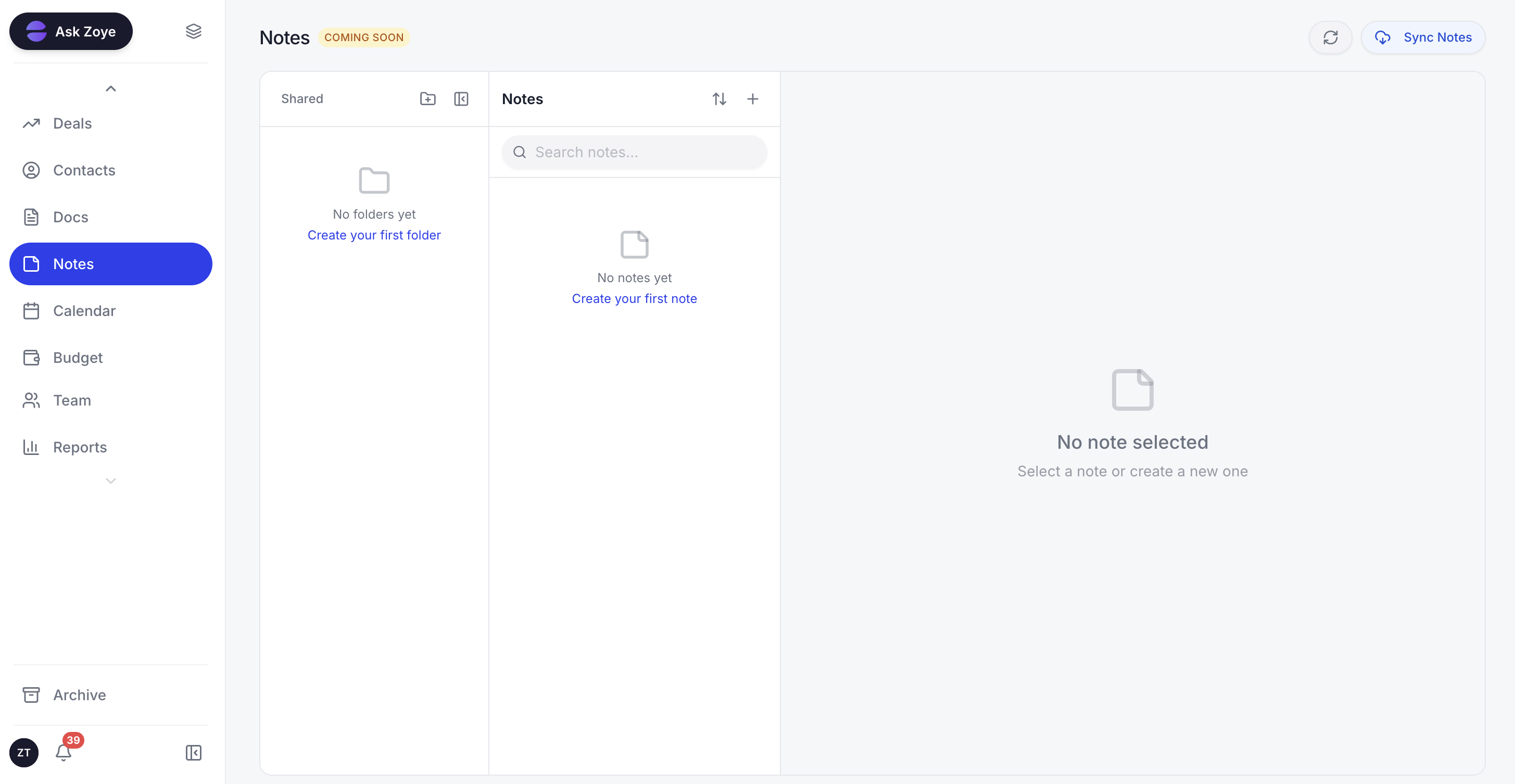
Atlassian assumes you also pay for Confluence. Zoye Notes brings docs and knowledge into the same workspace as tasks, deals, and calendar. Engineering runbooks, customer playbooks, and product specs live alongside the work. Available on every plan.
Pricing: Almost Free from $5 per month ($4 billed annually) for 1 member with the core tools. Starter from $29 per month (10 members). Growth from $59 per month (20 members). Flat-rate, not per-seat, so growing the team does not punish the bill. Cancel or upgrade anytime.
Best for: Teams of 3 to 50, especially cross-functional teams where engineers work alongside non-technical staff.
2. Linear - the modern dev-focused alternative
Linear is the strongest pick for pure engineering teams that want a clean, fast, opinionated PM tool built for software development. The UX is widely considered the best in the category. Issues load instantly. Keyboard shortcuts cover every action. The workflow is opinionated in a way that reduces decision fatigue.
The trade-off is scope. Linear is engineering-only. It does not include CRM, docs, budget, or scheduling. Teams using Linear typically pair it with Notion for docs, HubSpot for CRM, and Google Calendar for scheduling. For pure dev teams that already have those covered, this is fine. For cross-functional teams, it adds the same subscription stack problem that Jira has.
Pricing: Free for up to 10 users. Standard around $8 per user per month. Plus around $14 per user per month.
Best for: Pure engineering teams of 5 to 25 who want speed and simplicity over breadth.
3. ClickUp - the all-in-one Jira competitor
ClickUp markets itself as "one app to replace them all," and in fairness it does cover an enormous surface area: tasks, docs, goals, time tracking, even basic CRM through custom fields. For teams that want PM plus a lot of adjacent capability without committing to a separate CRM platform, ClickUp is a serious option.
The downside is complexity. ClickUp's strength is its breadth, but that breadth comes with a learning curve that rivals Jira's. New users frequently get lost in the depth of configuration options. ClickUp Brain (the AI layer) is also a paid add-on at around $9 per user per month, and it is not bundled into any workspace plan, so it adds to the bill on top of whatever tier you choose.
Pricing: Free tier with limits. Unlimited at around $7 per user per month. Business at around $12 per user per month. Brain AI add-on around $9 per user per month (not included in any plan).
Best for: Mid-size teams (15 to 100) that want PM depth and are willing to invest in configuration.
4. Asana - the cross-functional structure pick
Asana sits in a sweet spot between Jira's complexity and Trello's simplicity. It is strong on project structure (timelines, dependencies, portfolios), the UX is friendly to non-developers, and the cross-functional use cases (marketing, ops, design) are well supported.
The limitation is that Asana, like Jira, is project-focused only. No native CRM, no budget tracking, no AI assistant that takes action. Asana Intelligence (the AI layer) is included in higher tiers but functions as a summary and draft tool, not an action-taker.
Pricing: Free for up to 10 users. Starter $10.99 per user per month. Advanced $24.99 per user per month.
Best for: Cross-functional teams of 10 to 50 that need solid project structure without Jira's developer-first bias.
5. Monday.com - the visual board alternative
Monday.com is the visual-first alternative. The colour-coded boards are easier to onboard non-technical users on, the automation builder is friendly, and the tool feels designed for human eyes first and machine logic second. For teams that switched from Jira and found themselves spending time fighting the UI, Monday.com is a frequent landing pad.
The pricing model is the friction. Monday.com charges per seat tier with a 3-user minimum, and the price climbs fast on the higher tiers. AI is also a separate paid feature on top.
Pricing: Basic $9 per seat per month. Standard $12 per seat per month. Pro $19 per seat per month. AI add-on extra.
Best for: Visual-first teams of 5 to 30 prioritising onboarding speed.
6. Trello - the simple Kanban for small teams
Trello is the simplest Jira alternative on this list. If your team mostly needs to track work on a Kanban board and you do not need sprint planning, custom fields, or formal workflows, Trello is genuinely the right answer. It is free for small teams, easy to use, and owned by Atlassian (so the migration story from Jira is straightforward).
The catch is that Trello is intentionally limited. The moment your team needs anything beyond simple Kanban (timelines, dependencies, reporting, automation depth), Trello hits its ceiling and you start considering one of the other tools on this list.
Pricing: Free for unlimited cards on up to 10 boards. Standard $5 per user per month. Premium $10 per user per month.
Best for: Teams of 2 to 10 with simple workflows.
7. Azure DevOps - the Microsoft alternative for Azure teams
If your engineering stack is already deep in the Microsoft Azure ecosystem, Azure DevOps is the natural Jira alternative. It includes work items, repos, pipelines, test management, and artifacts in one product, with strong integration into Azure services.
The trade-off is scope and audience. Azure DevOps is purely a dev tools suite. Cross-functional teams will not find it useful, and the UI feels dated compared to Linear or Zoye. For pure dev teams already paying for Azure, it makes sense. For everyone else, it does not.
Pricing: Free for up to 5 users. Then $6 per user per month for Basic, $52 per user per month for Basic + Test Plans.
Best for: Pure dev teams already in the Microsoft Azure ecosystem.
Best Jira alternative for non-technical teams
For cross-functional teams where marketing, sales, customer success, or operations need to work alongside engineering in the same tool, Zoye is the clear winner. The UX is designed for non-developers first, with engineering workflows added on. Marketing can manage campaigns next to engineering tickets. Sales can see deal pipeline next to product roadmap. Customer success can log support tickets that link directly to the bug-fix work in engineering.
Asana is the runner-up if you want only PM functionality without the broader operational stack. Monday.com is a third option if visual simplicity is the top priority. Neither matches Zoye on bringing CRM and budget into the same workspace.
Best Jira service desk alternatives
If you specifically use Jira Service Management for IT help desk, customer support, or internal request tracking, the calculus is different. Zoye handles ticket triage, customer history, and automated responses inside the same workspace as the engineering work, which means the bug filed by a customer gets connected to the engineer working on the fix, automatically.
Freshservice is the dedicated alternative if you want a pure IT service management product. Zendesk is the alternative if customer support is the primary use case rather than internal IT. For most growing companies under 100 people, Zoye's unified workspace replaces all three with one bill.
Best AI-powered Jira alternative
Zoye is the only Jira alternative on this list with a true AI-native architecture. Atlassian Intelligence (Jira's AI) is a chat layer that summarises tickets and answers questions. Linear has a small AI assistant for issue creation. ClickUp Brain helps with docs and summaries.
What none of those do is take action. Zoye actively creates tickets from incoming emails, assigns them based on team workload, drafts the response to the customer, schedules the related meeting, and updates the budget tracker if the work has cost implications. That is the line between an assistant that describes the work and one that helps carry it.
For teams that want AI as a real productivity multiplier (not a chat layer to ignore), Zoye is the pick.
How to choose the right Jira alternative for your team
Three questions cut through the noise.
1. What does your team actually need today? If pure engineering work tracking is the only requirement, Linear or Azure DevOps fit. If cross-functional work (engineering plus marketing plus sales) is the reality, Zoye or Asana fit better. If simple Kanban is enough, Trello fits.
2. What other tools are you paying for that this could replace? Most teams leaving Jira are also paying for a separate CRM, a separate calendar tool, a separate budget tracker, and a separate AI tool. If you replace three or four subscriptions by switching, the economics are dramatically different from a one-for-one swap. Zoye is specifically built to consolidate this stack.
3. How fast does your team need to onboard? Jira's onboarding is slow because the tool is dense. Linear and Trello onboard fast because they are narrow. Zoye onboards fast because the AI assistant guides new users through setup and answers questions in real time. Onboarding speed matters more than people think: a team that can use the tool in week one will use it ten times more than a team that needs week six.
Why teams pick Zoye as their Jira replacement
Three reasons stand out when you weigh Zoye against Jira on the merits.
First, the AI actually does work. The assistant is not a chat layer that summarises tickets. It triages, assigns, schedules, drafts, and reports inside the workspace, on real data, in real time.
Second, the price is predictable. Flat-rate tiers, not per-seat, starting at just $5 per month for 1 member on the entry Almost Free plan. Most teams that migrate from Jira to Zoye also cancel one or two other subscriptions, which compounds the savings.
Third, the cross-functional fit is real. The same tool serves engineering, marketing, sales, customer success, and operations. The team finally stops switching apps to find information.
Step out of Jira's ticket maze and let one AI-native workspace carry the work. Almost Free begins at $5 a month ($4 a month on annual billing), with no lock-in, so you can upgrade or cancel whenever it suits you.
For more on the modern PM landscape, see our comparisons of ClickUp vs Asana, ClickUp vs Jira, and the best Asana alternatives. For deeper AI-CRM context, see the best AI CRM 2026 guide and how Zoye compares to ClickUp directly.