
Most businesses that bought a chatbot discovered the same thing within a month. The bot answered the question, the customer said thanks, and then someone on the team still had to open the CRM, type the lead in, check the calendar, book the slot and remember to follow up on Thursday. The conversation was automated. The work was not.
That gap is the whole story of the AI agent vs chatbot question. Vendors now label almost everything an "agent", which makes the word nearly useless as a buying signal. A clearer line exists, though, and it has nothing to do with how fluent the replies sound. A chatbot produces an answer. An agent produces a change in your systems: a new lead, a booked meeting, an updated deal, a follow-up that will actually happen. Everything else in this comparison follows from that one difference.
This guide sets out the distinction plainly, puts the two side by side, explains where a plain chatbot is genuinely the right call, walks through how each one fails, and covers the governance an agent needs before you let it near customers. It ends with the WhatsApp rules that changed in 2026, because that is where many small businesses meet both technologies first.
The one-line distinction
A chatbot is a conversation interface. A message comes in, a reply goes out. Older chatbots pick that reply from a decision tree: press 1 for opening hours, press 2 to talk to someone. Newer ones generate it with a large language model trained on your FAQ or help pages. Either way, the job ends at the reply.
An AI agent is a system that pursues a goal by taking actions. It has access to tools, meaning the records and functions a business runs on, and it decides which of them to use, in what order, to get something done. "A new enquiry came in from the website, qualify it, put it in the pipeline, offer two meeting times and remind the owner if nobody replies by tomorrow" is an agent's job. No chatbot, however good its language, can do that, because it has nothing to act on.
A useful way to test any product: ask what is different in your business after the conversation ends. If the only thing that changed is that someone received an answer, you are looking at a chatbot. If a record exists that did not exist before, a slot is gone from the calendar, or a task is waiting with a due date, you are looking at an agent.
There is a middle category worth naming. An AI assistant drafts, summarises and suggests, but a human carries out every step. It sits between the two, and plenty of products sold as agents are really this. Our pillar guide to AI agents explores that ladder in more depth; here the focus is the head-to-head decision.
AI agent vs chatbot at a glance
| Dimension | Scripted chatbot | AI chatbot (answer only) | AI agent |
|---|---|---|---|
| Core job | Route and answer from a fixed tree | Answer in natural language from a knowledge base | Reach a goal by acting on business systems |
| Where answers come from | Pre-written replies | A language model plus your documents | Live records, tools and the model |
| Changes your data | No | No, or only a form at the end | Yes: creates, updates, books, schedules |
| Handles unexpected questions | Poorly, falls back to a menu | Well, sometimes too confidently | Well, and can look up the real answer |
| Main failure mode | Dead ends and loops | Plausible but wrong answers | Wrong action taken on real data |
| Setup effort | Low, grows with every branch | Low to medium | Medium: permissions, rules, approvals |
| Governance needed | Minimal | Content review | Approvals, logs, reversibility, scopes |
| Best fit | Predictable FAQs and routing | High-volume questions with written answers | Lead handling, booking, follow-up, record upkeep |
The table hides one important nuance: the right-hand column is not automatically better. It is more capable and it carries more responsibility. The next sections explain when that trade is worth making.
How each one handles the same enquiry
Take one ordinary message, sent on a Tuesday evening to a small physiotherapy clinic: "Hi, do you have anything this week for a knee problem? I can only do mornings."
The scripted chatbot recognises nothing in that sentence that matches its tree. It replies with a menu: "Please choose: 1. Opening hours 2. Prices 3. Book an appointment 4. Speak to us". The person picks 3 and gets a link to an online booking page, or a message saying a team member will reply in working hours. Some will click. Many will message the next clinic on their list.
The AI chatbot understands the message perfectly. It replies warmly that the clinic treats knee injuries, lists the morning opening hours and invites the person to book through the link. The reply is better written. The outcome is identical: no record exists, no slot is held, and the clinic only learns about this person if they finish the booking themselves.
The AI agent reads the same message and checks the calendar for morning availability this week. It offers two real times, writes a new lead with the source and the stated problem onto the record, and once the person picks Thursday at 9, books the slot and sends a confirmation. If the person goes quiet, a reminder lands on the owner's task list for the next morning. The clinic's front desk arrives on Wednesday to a booked appointment and a complete record, not an unanswered chat.
This is typical rather than exceptional, and it shows why speed to answer was never the real bottleneck. The bottleneck was everything that has to happen after the answer.
Want to see it in action?
See Zoye catch a new lead, answer on WhatsApp and set up the follow-up, all from one message.
See How It WorksWhen a plain chatbot is the right answer
It would be convenient for anyone selling agents to claim chatbots are obsolete. They are not, and in several situations a simple bot is the better decision.
The questions are predictable and the answers are stable. A gym fielding the same twelve questions about opening hours, parking, class schedules and membership freezes does not need a system that can write to its CRM. A scripted bot answers those with zero risk of making something up, because every answer was written by a person.
Nothing needs to be recorded. If the conversation genuinely ends at the answer, such as a directions request or a store locator, an agent's ability to act is unused capacity you are paying for.
You need certainty more than flexibility. In regulated contexts, some businesses prefer replies that a compliance person approved word for word. A fixed tree gives you exactly that.
Routing is the whole job. "Sales, support or billing?" followed by a handover to the right human is a solved problem. A menu does it well.
Your systems are not ready. An agent is only as good as the records it can reach. If your customer data lives in four spreadsheets and nobody trusts the calendar, connecting an agent will automate the mess. Fix the record first.
If your situation fits several of these, a chatbot plus a reliable handover to a person may be all you need, and you can revisit the question when volume grows. Our guide to the free WhatsApp chatbot options covers where those tools stop being enough.
When you need an agent
The signs point the other way when the conversation is only the first step of work your team then repeats by hand.
Every conversation ends with someone retyping it. If staff copy names, numbers and requirements from chats into a CRM, the chatbot moved the typing from the customer to your team. An agent writes the record as the conversation happens.
Leads go cold between the reply and the follow-up. The most expensive gap in most small businesses is not the first reply, it is the second touch that never comes. An agent schedules it and checks whether it happened.
Answers depend on live data. "Is my order shipped?", "Do you have Saturday availability?", "What do I still owe?" A chatbot answering these from documents will either deflect or guess. An agent looks them up in the record.
One request spans several tools. Booking a consultation might touch the calendar, the contact, a deal stage, a reminder task and a confirmation message. Agents exist precisely for multi-step work across connected tools.
The owner is the integration layer. If the business only works because one person remembers to move every piece by hand, that person is doing an agent's job at owner rates. The case for a business operator rather than a bot starts here.
How each one fails
Every technology fails. What matters is how, and how expensive the failure is when it happens.
Scripted chatbots fail visibly. The customer hits a dead end, gets the same menu three times or types "human" into the void. The damage is frustration and abandonment. It is easy to spot in transcripts and easy to fix by adding branches, although every branch adds maintenance, and large trees become brittle in ways nobody fully understands a year later.
AI chatbots fail persuasively. A language model answering from documents can produce a reply that sounds authoritative and is wrong: a price that changed last quarter, a policy that applies only to another branch, an availability promise nobody can honour. Because the reply is fluent, the customer believes it. The cost is a broken promise you did not know you made. The usual fixes are tighter source documents, instructions to say "I don't know", and regular review of transcripts.
AI agents fail by acting. An agent that misreads intent can create a duplicate contact, book the wrong slot, move a deal to the wrong stage or send a message that should not have gone. The failure is a change to real data, which is more serious than a wrong sentence. It is also the most controllable failure of the three, because actions can be gated, logged and undone in ways that a sentence already read by a customer cannot.
One failure mode is shared by the last two and deserves its own line: answering from the model's memory instead of from your data. A model has no idea what your pipeline looks like today. Any system that reports figures, availability or balances must read them from the live record at the moment of asking, or it is guessing in a confident voice.
See what Zoye can do for you
CRM, deals, tasks and your Instagram, Facebook and WhatsApp automations in one workspace. Just ask Zoye and it sets any of it up for you.
Explore FeaturesGovernance: what an agent needs before it touches customers
The extra power of an agent is only safe with controls designed in from the start. These are the ones that matter, roughly in order of importance.
Approval before anything is sent. Customer-facing messages, bulk changes and anything destructive should wait for a person to confirm, at least until the agent has a track record. The approval step costs seconds and prevents the one failure that cannot be taken back: a message the customer has already read.
A log of every run. For each action you should be able to see what triggered it, what the agent decided, which records changed and what was sent. If you cannot answer "why did this happen?" from the log, you do not have governance, you have hope.
Reversibility. A mistaken stage change, an unwanted task or a wrong field value should be undoable from the log, not repaired by hand from memory.
Scoped permissions. The agent should act with the same permissions as the person it works for, and no more. A salesperson's agent has no business inside payroll.
Honest failure reporting. When a send is rejected or a connection loses access, the agent must say so and give the reason. A system that reports success when the message never left is worse than no automation.
Narrow start, deliberate widening. Begin with one or two jobs where mistakes are cheap and value is obvious, such as answering new leads and scheduling follow-ups. Review the log weekly for the first month. Add scope when the record justifies it.
None of these are features you bolt on later. If a product you are evaluating cannot show you an approval step, a run log and a way to undo an action, treat its "agent" label with suspicion.
The WhatsApp angle: what Meta's 2026 rules mean
For many small businesses the AI agent vs chatbot decision arrives through WhatsApp, because that is where customers already write. Two policy facts shape it.
General-purpose AI chatbots are barred from the Business Platform. Since 15 January 2026, Meta's WhatsApp Business Solution Terms do not allow general-purpose AI chatbots on the WhatsApp Business Platform, meaning services where the AI assistant itself is the product being offered, in the style of a consumer chat assistant. Business-specific AI remains allowed. An AI that serves a business's own customers for support, bookings, sales or qualification is exactly what the platform is for. It is worth reading this precisely: the rule does not ban AI on WhatsApp, and it does not mean any bot you build is automatically compliant either.
The platform's normal rules still govern every message. The customer service window is 24 hours from the customer's last message. Inside it you can reply freely; outside it, only an approved template can be sent. Messages are billed per delivered message by category and recipient country, and since 1 October 2026 each business number gets 1,000 free service messages per month before service messages are charged. Conversations that start from a click-to-WhatsApp ad or a Page call-to-action button and are answered in time open a free entry window of up to 7 days. Rates vary by country, so check Meta's own rate card rather than relying on any figure quoted secondhand. Our guide to WhatsApp Business API pricing covers the details.
Here the difference between the two technologies becomes concrete. A WhatsApp chatbot answers inside the window and the conversation ends there. A WhatsApp agent answers inside the window, writes the lead to the CRM while the window is open, and knows that a follow-up on day three needs an approved template rather than a free-form message, because it can see when the customer last replied. Consent and opt-out also have to live somewhere: a STOP should be honoured across every automation, not only the bot that received it.
Ready to hand off the busywork?
Zoye brings AI-powered CRM, task management, and automation into one workspace.
Get StartedWhere Zoye fits
Zoye is an AI Business Operator: one workspace with thirteen tools that already link to each other, from CRM and contacts to tasks, deals, calendar, documents, budget and invoices, reports and automations, plus an assistant that operates them for you. In the terms of this article, it sits firmly in the agent column, with the governance built in.
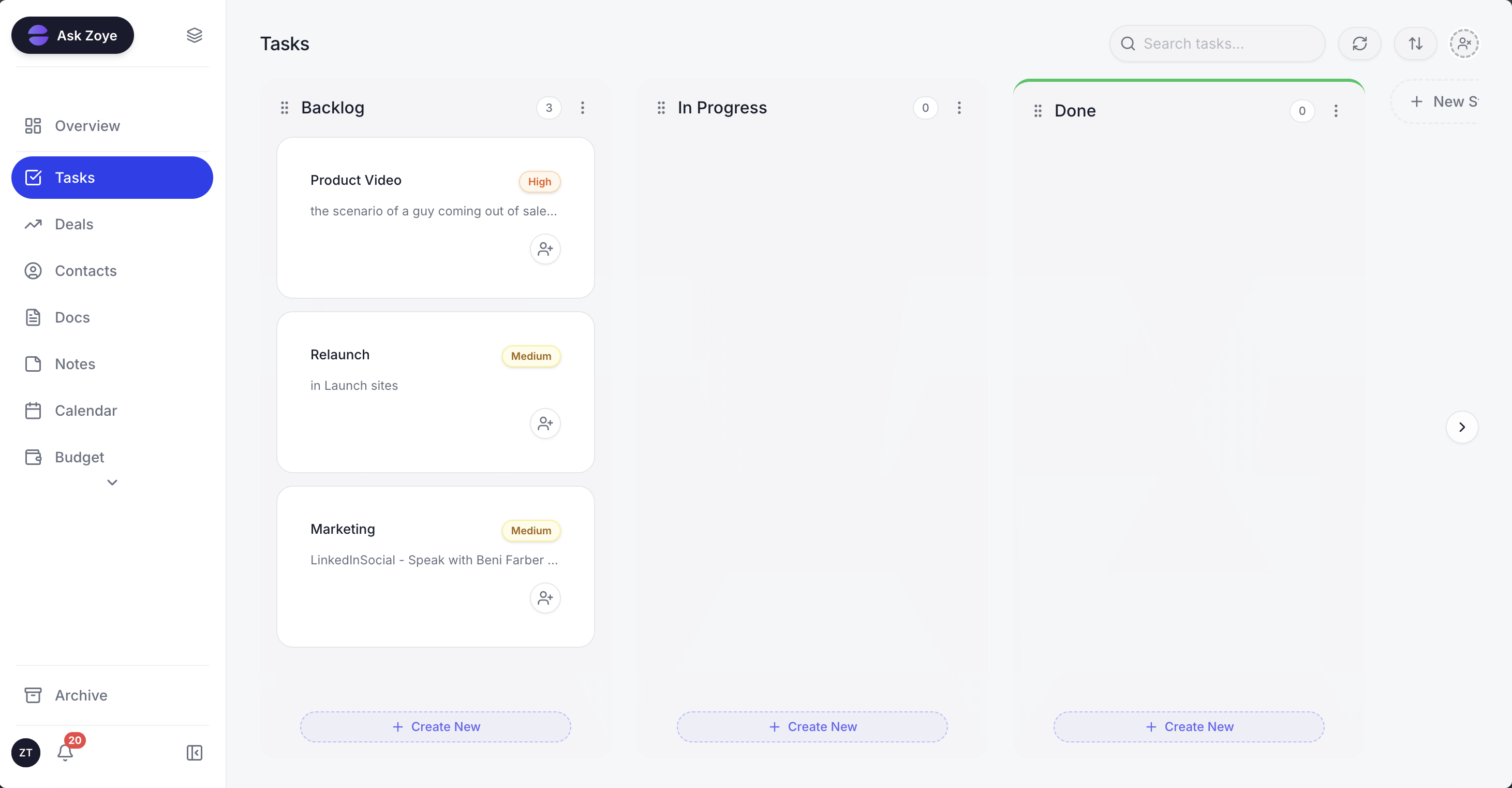
Tasks the agent created from conversations land on the same board as everything else, each linked to the contact and the deal it came from.
On WhatsApp, the Zoye agent creates and updates contacts, companies, leads, deals, tasks, meetings, notes, documents and invoices. It answers questions from live data, such as this week's meetings, overdue invoices or the state of the pipeline, rather than from a model's memory. Voice notes are transcribed and acted on, including several requests in one note, and a photo of a business card becomes a contact. Destructive or bulk actions ask for confirmation first. The same assistant, with the same tools and permissions, works in the web app, in Slack and in Claude through the connector.
On the customer side, Zoye's WhatsApp automations answer new leads, run a qualifying conversation that writes answers straight into CRM fields, and keep follow-ups on the lead record so they stop automatically when the person replies, books or pays. Every automation is off until you switch it on and confirms before sending. It runs on the official WhatsApp Business Platform, uses approved templates automatically when the 24-hour window has closed, and honours STOP across the workspace.
Automations follow the governance pattern above. Describe what should happen, and Zoye builds the rule, shows it to you in plain English and waits for your approval before anything runs. Every run is logged with what fired, what changed and what it sent, and it can be reversed. If Meta rejects a message or a connection loses permission, you are told why instead of receiving a false confirmation.
Plainly stated: Zoye is not a helpdesk ticketing suite and not a flow canvas for building decision trees. If a scripted FAQ bot is all you need, a simple chatbot tool will do that job.
Pricing (monthly / annual-equivalent): Almost Free $5 / $4 (1 team member, 1GB), Starter $29 / $23 (10 members, 5GB), Growth $59 / $47 (20 members, 10GB), Scale $119 / $95 (100 members, 25GB), and Customize on quote. See pricing for the full detail.
How to choose: four questions
Run through these before you buy anything labelled bot, assistant or agent.
- What should be different after the conversation? If the answer is "the customer knows something", start with a chatbot. If the answer is "a record, booking or follow-up exists", you need an agent.
- Where does the truth live? If the right answer depends on today's calendar, pipeline or balance, the system must read it live. Documents alone will not do.
- What would a mistake cost? Map the worst plausible error. A wrong answer about parking is cheap. A wrong message to a client is not. Expensive mistakes demand approvals and logs.
- Who maintains it? A scripted tree needs someone to keep adding branches. An agent needs someone to review its log and approve its rules. Pick the maintenance you can actually staff.
Many businesses end up with both: a few fixed answers for the truly predictable questions, and an agent for everything that turns into work.
The bottom line
The AI agent vs chatbot choice is not about which one sounds more human. It is about where the work ends. A chatbot finishes when the reply is sent, and that is exactly right for predictable, stable questions. An agent finishes when the business has changed: the lead is recorded, the slot is booked, the follow-up is scheduled and the log says who approved what. If your team spends its evenings turning chats into records, the second one is what you were actually trying to buy.
Check pricing for the plan that fits, and see what an agent does with your next enquiry. Explore the Zoye agent on WhatsApp to see it working where your customers already are.
For more context, see our guides to AI agents, what an AI Business Operator is, and free WhatsApp chatbots and their limits.