The Best CRM for Tour Operators in 2026: What Actually Fits a Small Operator
A family emails on a Sunday about the six-day trek in October, four adults and a teenager. You reply on Monday with a route, a price and two hotel options. They ask about the altitude on day three. You answer that evening. Then nothing. Four weeks later you notice the dates you were holding are gone, and you never find out whether they booked elsewhere or gave up. The trek was never the problem. The three weeks of silence were.
Tour and activity operators occupy an awkward corner of the software market. The products that dominate the search results are reservation and ticketing engines, and they are genuinely good at what they do: availability, capacity per departure, an online checkout, a widget on your site, distribution to marketplaces. They are also built to start working at the moment somebody pays. The weeks before that payment, when a stranger is comparing you against two other operators and waiting on an answer, sit outside them. So does most of the operational week around a departure: the guide who has not confirmed, the minibus supplier who wants numbers by Thursday, the two guests who still owe a balance.
This guide covers the honest options for a small tour or activity operator: a solo guide, a team of five running several products, or a company selling fixed departures. It ranks Zoye first for the enquiry and follow-up half of the job and then states plainly what Zoye does not do, because a buyer guide that pretends one tool covers everything is how operators end up paying for three systems and still running the important part from a spreadsheet.
Vendor pricing here is described by model rather than by figure, because most platforms in this category price on booking volume or quote after a demo. Models reflect what vendors publish or what independent reviewers commonly report as of August 2026. Confirm current figures on each vendor's own pricing page before you buy.
The six jobs a tour operator needs covered
Before comparing tools, it helps to separate the work into jobs, because no single product on this page does all six well and the marketing implies otherwise.
Catching the enquiry, wherever it lands. For a small operator, demand arrives from the website form, Instagram DMs, WhatsApp, email, a phone call from a hotel concierge, and a marketplace message from a traveller who found you on a listing site. Each of those is a different inbox with a different owner, and the ones that arrive at 11pm are the ones most likely to be answered at noon the next day.
Following up on the quote and the itinerary. Multi-day and tailor-made trips involve several rounds: a draft itinerary, a revision, a question about single supplements, a decision that waits on somebody's annual leave being approved. Most lost revenue in this business is not a lost argument about price. It is a thread that stopped.
Managing groups and departures. A departure has a date, a capacity, a guide, a minimum viable number, and a list of people at different stages of committing. Someone has to know when a departure is at risk of not running and when to stop selling it.
Coordinating suppliers and guides. Local guides, drivers, accommodation, permits, equipment hire, restaurants. Each needs numbers by a deadline and a confirmation you can find later when there is a dispute.
Chasing deposits and balances. The deposit secures the departure and the balance arrives before it. Both need chasing, politely and more than once, across every trip at the same time. This is the task that gets dropped in high season, which is exactly when the money matters.
Earning the repeat and the referral. A traveller who had a good week is the cheapest booking you will ever get, and also the one you are least likely to contact next season. The same goes for the hotel, the agency and the guide who send you people.
Jobs one, two, five and six are CRM work. Job three is reservation work. Job four sits in between and usually falls into a spreadsheet. If part of your business is renting out lodges, cabins or apartments alongside the tours, the accommodation side of that has its own pattern, covered in our guide to a vacation rental CRM.
The best CRM options for tour operators in 2026
1. Zoye, the operator that runs the enquiry and follow-up half
Zoye is the strongest pick for the CRM half of a tour operator's stack, because it does the chasing rather than displaying a list of things you should have chased. You instruct it in plain language and it acts: it captures enquiries as leads with the channel attached, replies fast, follows up on quotes that went quiet, reminds guests about deposits and balances, and keeps the guide and supplier tasks around each departure moving.
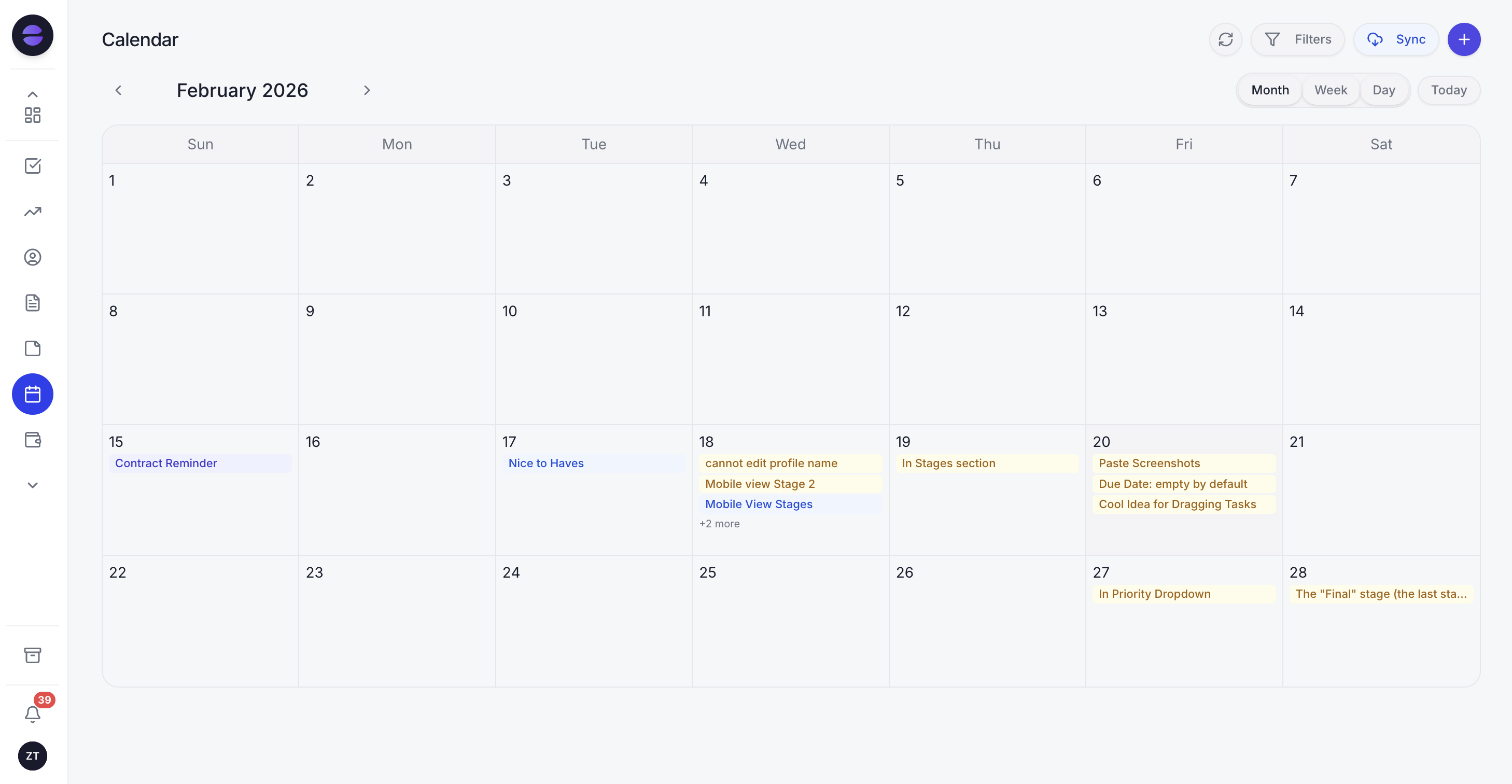 Departures, supplier cut-off dates and balance deadlines on one calendar, with the assistant handling the follow-up around each one
Start with the part that decides bookings. Zoye brings WhatsApp, Instagram, your website enquiry form and email into one place and turns each new conversation into a lead automatically, with its source recorded so you eventually learn which channel is worth your time. The assistant can draft or send the first reply the moment a message arrives, which is the difference between a warm answer within minutes and a polite reply the following afternoon to someone who has already booked a competitor.
Then the follow-up. Ask it which quotes have had no reply for more than five days and you get the list. Tell it to message them and it does, over email or WhatsApp, in your tone. Say "chase every guest on the October trek who has not paid the balance, then remind me on Friday" and that runs without you building a workflow diagram. You can describe a recurring routine once, for example a check-in a week before each departure and a review request three days after, and it keeps running.
Around that sits the rest of the back office a small operator improvises. Contacts hold guests, guides, drivers, hotels and agencies with full history, so the person who covers for you can see the whole thread. Itineraries, permits, insurance certificates and supplier confirmations attach to the record they belong to instead of living in an email search. Task boards track each departure from enquiry to wrap-up. The calendar carries departure dates, supplier deadlines and payment dates together. Expenses per trip and guest invoicing keep the margin visible, and you can ask for a report in a sentence rather than rebuilding a sheet each month. Most of it can be run over WhatsApp, which matters when your office is a trailhead.
Be clear about the boundary, because it is the reason this works alongside your existing tools rather than against them. Zoye has no seat-inventory or departure-capacity engine, no online booking or ticketing checkout, no channel connections to travel marketplaces, and no payment gateway of its own beyond invoicing. It will not sell the last two seats on Saturday's kayak trip or stop an overbooking. Keep your reservation platform for availability, checkout and distribution. Zoye holds the enquiry pipeline, the contacts, the itineraries as documents, the tasks and the follow-up, next to whatever booking tool you already run.
Pricing: flat monthly plans covering the whole workspace rather than a charge per seat, so adding a seasonal guide or an office assistant does not change the bill. Current plans are on the pricing page.
Best for: solo guides and small operators, roughly one to twenty staff, whose enquiries arrive as messages and whose real bottleneck is follow-up rather than checkout.
2. Dedicated tour-operator platforms
This is a real category and worth understanding before you shop anywhere else. Platforms such as Tourwriter, TourCMS, Lemax and Tourplan are built for operators selling multi-day, tailor-made or group itineraries, and they combine itinerary building, costing, supplier management, reservations and back-office functions in one system. If you assemble complex trips from many components and need the costing and the supplier confirmations to be part of the same document as the itinerary, this is the shape that fits.
The honest trade-offs are cost and weight. Pricing in this category is typically quoted after a demo rather than published, often scaling with users or booking volume, and implementation is a project rather than an afternoon. The depth that makes them powerful for a company with an operations department is overhead for a two-person outfit running weekend hikes. Sales and marketing follow-up is also usually the thinner part of these systems: they are strongest once a trip exists and lighter on the messy stage before it does, and few of them treat an Instagram DM as a first-class entry point.
Pricing model: predominantly quote on request, scaling with users or volume; implementation and training are usually separate.
Best for: operators building complex multi-day or tailor-made itineraries with real supplier costing, typically with staff dedicated to operations.
3. Booking and ticketing platforms
Rezdy, Checkfront, FareHarbor, Bokun, Peek Pro, Xola and Regiondo belong to this category, and for day tours and activities one of them is close to mandatory. They own live availability and capacity per time slot, an online checkout that works on a phone, a booking widget for your site, resource management for boats, bikes and guides, waivers, and distribution to marketplaces and resellers. If your business is high-volume and short-duration, this is where your operational truth lives and it should be the tool you choose most carefully.
Two things to understand. The pricing models genuinely differ: some vendors publish monthly plans, some charge a percentage of bookings, and some are commonly reported as having no monthly fee while taking a per-booking fee that is often passed to the traveller. Model your own volume against each rather than comparing headline prices, because the cheapest option at fifty bookings a month is rarely the cheapest at five hundred. The other limitation is the one this article exists for. These platforms are excellent from the checkout onward and thin before it. An enquiry that never becomes a booking mostly does not exist in them, and neither does the hotel partner you have been meaning to call back, which is why so many operators run one of these plus a spreadsheet.
Pricing model: published monthly plans, a percentage of bookings, or a per-booking fee with no monthly charge, depending on the vendor.
Best for: day tours, activities and anything sold by the time slot, where availability and checkout are the core of the business.
Want to see it in action?
Watch how Zoye automates your daily workflow - from lead management to team collaboration.
See How It Works4. General CRMs: HubSpot, Pipedrive and Zoho
A general sales CRM can be bent into shape for a tour operator, and plenty of operators do exactly that. HubSpot has a well-known free tier, a large ecosystem and marketing tools that go far beyond anything travel-specific. Pipedrive is clean, cheap to start and its pipeline view maps neatly onto enquiry, quote, deposit and paid. Zoho is unusually broad for the money, with invoicing, forms and support tools you can wire together across the suite.
The cost is that none of them knows anything about your business, so you build it. You define the stages, the custom fields for departure date and party size, the reminder sequences, and then you keep the whole thing fed by hand. Messaging channels are typically an add-on or an integration rather than a native surface, which is a problem when most of your enquiries are DMs. Useful automation tends to sit in higher tiers, and because these tools charge per seat, adding seasonal staff during the months you actually need them raises the bill at the worst time. Most importantly, all three show you what needs chasing and none of them chase it, which is the same gap you had with a spreadsheet, only with better charts.
Pricing model: published per-seat tiers, with a free entry tier at HubSpot and Zoho; costs rise with seats and with the automation tiers.
Best for: operators with a genuine sales team, appetite for configuration, and someone whose job includes maintaining the system.
5. Spreadsheets and a shared inbox
This is what most small operators actually use, and it deserves respect rather than a sneer. A well-built sheet is free, flexible, understood by everyone, and for your first two seasons it is genuinely the right answer. Departures across, names down, a column for deposit paid, a tab for guides.
The failure mode is predictable and always the same. A spreadsheet cannot answer an enquiry, cannot tell you that a quote has been silent for nine days, cannot remind a guest that a balance is due next week, and cannot be safely opened by two people at once during the week when three departures overlap. The information is all there and none of it acts. Worse, the operational knowledge is in the head of whoever built it, so the first illness or holiday in peak season becomes a business risk. The moment your enquiry volume exceeds what you can hold in your memory, the sheet stops being a system and becomes a record of what you forgot.
Pricing model: free, plus the hours and the missed bookings, which are the expensive part.
Best for: brand-new operators in their first season or two, before enquiry volume outgrows memory.
Tour operator CRM comparison
| Option | What it is really for | Pricing model | Strongest at | What it leaves you to do |
|---|---|---|---|---|
| Zoye | The business around the bookings | Flat monthly plans for the whole workspace | Enquiry capture from messaging channels, quote and balance chasing done for you, supplier and guide tasks, contacts and documents | No capacity engine, no checkout, no marketplace channels, no payment gateway beyond invoicing |
| Dedicated tour-operator platforms (Tourwriter, TourCMS, Lemax, Tourplan) | Complex multi-day and tailor-made itineraries end to end | Mostly quote on request, scaling with users or volume | Itinerary building with real supplier costing, reservations and back office in one system | Implementation is a project; sales-stage follow-up and messaging channels are usually thin |
| Booking and ticketing platforms (Rezdy, Checkfront, FareHarbor, Bokun, Peek Pro, Xola, Regiondo) | Selling availability online | Published plans, a percentage of bookings, or a per-booking fee | Live capacity, mobile checkout, resources, waivers, marketplace distribution | Almost everything before the payment, plus partner and repeat-guest follow-up |
| General CRMs (HubSpot, Pipedrive, Zoho) | Generic sales pipelines | Published per-seat tiers, free entry tiers at two of them | Configurability, reporting, large integration ecosystems | You build the travel logic and keep it fed; the chasing is still manual; seat pricing punishes seasonal staff |
| Spreadsheets and a shared inbox | Recording what you already know | Free | Zero cost, total flexibility, no learning curve | Every reply, every reminder and every chase, and it breaks when two people need it at once |
Which option fits which operator
The solo guide or owner-operator. You are the sales team, the operations team and the guide, and your bottleneck is that you are on a mountain when the enquiries arrive. Skip anything with an implementation project. If you sell scheduled day activities, take a booking platform with a per-booking or low monthly model, and put a CRM layer next to it that answers and chases for you from your phone. If you sell a handful of multi-day trips a year, you may not need a booking engine at all yet: an enquiry pipeline plus invoicing covers you further than people expect.
The small team, roughly three to fifteen staff, with several products. This is where the spreadsheet breaks and where most operators buy in the wrong order. The instinct is to upgrade the booking system. The better move is usually to fix capture and follow-up first, because you already have more demand than you convert, and enquiry leakage is invisible in every report you currently look at. Keep your reservation platform, add a business layer that holds the pipeline, the documents, the guide tasks and the payment chasing, and only then reconsider the booking engine.
The multi-departure operator selling fixed group departures. Your central question is which departures will run, and that needs both halves. The reservation system owns capacity, cut-offs and overbooking protection. The CRM owns the pipeline of people leaning towards each date, the deposit chasing that turns leaning into committed, and the supplier deadlines that hang off a confirmed head count. Operators who run this well can answer, on any Tuesday, which departure is three bookings short and who the three most likely bookings are. That answer is a pipeline question, not an inventory question.
The tailor-made or luxury operator. Long sales cycles, high value per booking, many revisions. A dedicated tour-operator platform earns its cost here if the itinerary and the costing must be the same object. Even then, keep an honest look at the follow-up: the six-figure enquiry that goes quiet after revision three is worth more attention than any costing feature.
The operator selling mostly through marketplaces and resellers. Distribution is your priority, so choose the booking platform with the strongest channel connections in your market and accept its pricing model. Your CRM job is then narrower but still real: turning marketplace guests into direct repeat guests, and keeping the agencies and hotels that send you business on a contact list that gets called rather than a note in a phone.
Where quote and itinerary follow-up actually breaks
It is worth being precise about the failure, because the fix is small once you can see it.
A quote is not a document, it is a conversation with a next step and a date. When the next step lives only in the head of whoever sent it, the failure is not laziness, it is load. In high season a small operator is holding twenty of these at once while also driving, guiding and answering the phone. The thread that stops is usually the one where the guest went quiet rather than said no, which feels like a rejection and is almost never one. Two follow-ups sent a week and a month apart recover a meaningful share of them.
So the practical requirements are unglamorous. Every quote needs a stage and a date for the next contact. Somebody or something needs to notice when that date passes. The follow-up needs to be short, specific and easy to reply to, referencing the actual trip rather than "just checking in". And it needs to happen whether or not the person who sent the quote is available, which is the part a spreadsheet can never provide. This is the whole argument for a CRM layer at this size, and it is why an assistant that sends the message beats a dashboard that highlights it in red.
See what Zoye can do for you
From CRM and deal tracking to AI-powered task management - explore everything Zoye offers in one workspace.
Explore FeaturesSupplier, guide and departure coordination
The week around a departure has a shape that repeats: confirm the guide, give the accommodation final numbers by their cut-off, book transport, check permits and equipment, send joining instructions to guests, then reconcile costs afterwards. Every operator has this routine and most run it from memory plus a checklist in a notes app.
Two things make the difference. The first is that the routine exists as tasks with owners and dates attached to the departure, so it is visible to more than one person and nothing depends on remembering that the boat operator needs numbers seventy-two hours out. The second is that supplier confirmations are attached to the departure or the supplier contact rather than sitting in an email thread, because the day you need one is the day there is a dispute about what was agreed.
None of this needs a specialist product. It needs a task board, a calendar, contacts with document storage, and something that nudges when a deadline is close. What it must not be is a second copy of information that also lives in your booking system, which is why the useful split is clean: the reservation platform holds who is booked and what capacity remains, and the business layer holds the work around delivering it.
Deposits, balances and money you have already sold
Cash flow in this business is a sequence of small chases. A deposit converts an intention into a departure that will run, and a balance arrives before travel or it does not arrive at all. In practice the problem is not that guests refuse to pay. It is that nobody asks twice.
A reasonable cadence is a deposit request with a clear expiry, a reminder before that expiry, a balance notice a set number of weeks out, one reminder, then a personal message. Written down it is obvious. Executed by hand across every live trip in July, it is the first thing to slip. Automating it is the highest-return administrative change most small operators can make, and it does not require a payment platform, only a reliable reminder and an invoice the guest can act on.
Be careful about what any CRM claims here. Holding the invoice, the amount, the due date and the reminder is CRM work. Taking the card payment is a payment processor or your booking platform's checkout. Zoye handles the invoicing and the chasing and has no payment gateway of its own, so the money still lands wherever it lands today.
Ready to streamline your business?
Zoye brings AI-powered CRM, task management, and automation into one workspace.
Get StartedPutting it together without a project
You can have this working in about a week, and the sequence matters more than the tools.
Day one, funnel the channels. Get website enquiries, WhatsApp, Instagram and email arriving in one place, and make each new conversation a record with its source. Do nothing clever yet. Just stop losing things.
Day two, define five stages. New enquiry, quote sent, awaiting decision, deposit paid, travelled. Five is enough. Every enquiry gets a stage and a next-contact date.
Day three, write three messages. A first reply, a five-day follow-up and a one-month revival. Specific to the trip, short, ending in an easy question. These three messages will earn more than any feature you buy this year.
Day four, automate the money reminders. Deposit expiry, balance due, balance overdue. Set them once against the departure date.
Day five, move the departure routine out of your head. List the tasks for the week before a departure, with the deadlines relative to the date, and let it repeat.
Then leave the booking system alone. If your availability and checkout work, changing them mid-season buys risk and no revenue. Revisit that decision in the off season.
One habit worth keeping: for a month, write down every enquiry that never received a second contact. That number is your real growth budget, and it usually shocks people more than any pricing page.
Frequently asked questions
It depends on which half of the job you need solved. If you need availability, capacity per departure and an online checkout, that is a reservation or ticketing platform, and Rezdy, Checkfront, FareHarbor, Bokun, Peek Pro and Regiondo all compete there. If your problem is that enquiries arrive from six places and quotes go unanswered, you need a CRM layer, and Zoye is the strongest pick at small-operator size because it captures each enquiry with its source and runs the follow-up itself. Dedicated tour-operator platforms such as Tourwriter, TourCMS, Lemax and Tourplan combine both for multi-day and tailor-made itineraries, usually at a quoted price.
Usually yes, because a booking system starts working at the moment somebody pays. Everything before that is invisible to it: the Instagram question at 11pm, the family comparing three operators, the quote sent on Tuesday that nobody chased on Friday, the school group asking about next spring. Those are the highest-value conversations you have, and in most small operations they live in a shared inbox and two phones. A CRM holds them as records with stages and follow-up dates, so a maybe becomes a booking instead of silently going elsewhere.
A CRM can hold the departure as a record, show who has enquired, who has paid a deposit and who still owes a balance, and chase the gaps. It cannot sell the last two seats safely, because that needs live inventory shared with every sales channel. Capacity, cut-off dates and overbooking protection belong in your reservation system. Zoye specifically has no seat-inventory or departure-capacity engine, so keep your booking platform for that and use the CRM for the pipeline and the follow-up around it.
The reliable pattern is to stop treating each channel as a separate inbox. Route messages into one place, turn every new conversation into a lead with its source attached, and give it a first reply fast, because response speed decides more bookings than price does at the enquiry stage. Zoye centralises those conversations, creates the lead automatically, and the assistant can draft or send the first reply and then chase on a schedule, which matters when the person who answers is also the person guiding.
A travel agent sells someone else's product, so their CRM revolves around supplier quotes, commissions and the client's booking file. A tour operator sells its own product, so the CRM has to hold departures, capacity questions, guides, local suppliers, group paperwork and the deposit-to-balance cycle on trips the operator is responsible for delivering. The pipelines look similar and the operational load is not the same. If you resell rather than operate, our guide to a CRM for travel agents is the better fit.
No, and it is not meant to. Zoye has no seat-inventory or departure-capacity engine, no online booking or ticketing checkout, no channel connections to travel marketplaces, and no payment gateway of its own beyond invoicing. Keep your reservation platform for availability, checkout and channel distribution. Zoye holds the enquiry pipeline, the contacts, the itineraries as documents, the tasks and the follow-up, and it sits alongside whatever booking tool you already use.
The bottom line
There is no single best CRM for tour operators, because the category is two jobs wearing one name. Availability, capacity and checkout belong to a reservation platform, and for day tours and activities you should choose that carefully and model its pricing against your real volume. Everything else, the enquiry that arrived at midnight, the quote that went quiet, the guide who has not confirmed, the balance due in three weeks, the guest who loved last year's trip and has not heard from you since, is CRM work, and it is the half that most operators run from a spreadsheet and their own memory.
Zoye is built for that half and honest about the boundary. No capacity engine, no checkout, no marketplace channels, no payment gateway of its own beyond invoicing. What it does is hold the pipeline, the contacts, the itineraries as documents, the tasks and the deadlines, and then actually do the chasing, in plain language, from your phone, alongside whatever booking tool runs your departures.
For more context, see our guide to a CRM for travel agents if you resell rather than operate, the vacation rental CRM page if you also let out property, the best WhatsApp CRMs if most of your enquiries are messages, the guide to a CRM for small business, and the rest of the Zoye blog.