The Best CRM for Real Estate Investors in 2026: 7 Honest Options
Almost every CRM marketed under the words "real estate" was built for somebody who is not you. It assumes a client, a listing, a commission and a transaction that resolves inside ninety days. Buying and holding rental property looks nothing like that. You are not moving somebody else's house; you are hunting for an asset worth owning, and the person who eventually hands you that asset is a broker you have been in touch with for eleven months, a wholesaler whose list lands at six in the morning, or an owner who told you last spring to check back once the estate was settled.
That means the record you need is not a buyer with a budget and a mortgage pre-approval. It is a deal that has to move through stages, a rolodex of people who bring you deals, a lender and a contractor for each of them, a folder of documents per property, and above all a follow-up rhythm that keeps you present in twenty conversations at once. Investors rarely lose money because they underwrote badly. They lose the deal because nobody replied for three weeks and the seller signed with the buyer who did.
This guide covers seven honest options for that job in 2026: the general CRMs, the investor-specific category, the spreadsheet you are probably still using, the landlord platforms people confuse with a CRM, and Zoye. It is written for an investor with a handful to a few dozen doors, buying a few properties a year, without an acquisitions team.
Vendor pricing is described by model rather than by figure, because per seat software prices change often. Where a specific number matters, check the vendor's own pricing page. Descriptions here reflect what vendors published as of August 2026.
What investing actually asks of a CRM
Strip out the sales-team features and the job comes down to five things.
A deal pipeline with real stages. Sourcing, analysis, offer, under contract, closed or operating. The value is not the pretty board, it is knowing at a glance that four deals are sitting in analysis with nobody underwriting them and two offers have been out for eleven days without a chase.
A relationship rolodex that survives your memory. Brokers, wholesalers, agents who work your submarket, off market owners, property managers, and the people who quietly matter most: your lenders and your contractors. Each one needs a note on what they do, what they charge, when you last spoke and what you promised. A phone with three hundred contacts and no context is not a rolodex.
Documents attached to the property, not to an inbox. The purchase agreement, inspection report, appraisal, insurance binder, closing statement, scope of work, contractor quotes. Every investor has lost twenty minutes hunting for the version of a document that email eventually surfaced. Multiply that by the number of doors you own.
Tasks that belong to a deal or a property. Order the inspection, chase the appraisal, confirm the wire, get the utilities switched, follow up on the roof quote. These are dated obligations with consequences, not a mental list.
Follow-up that happens without you. This is the whole ballgame. The third contact is where relationships with brokers and sellers turn into deals, and the third contact is the first thing to disappear the week a boiler fails at one of your units. If your system only records that a follow-up is due, you have bought a nicer version of the problem.
Note what is missing from that list: rent collection, tenant screening, lease ledgers and underwriting maths. Those belong in a landlord platform, a bookkeeper's software and your own model. Confusing the two categories is the single most common mistake investors make when shopping, which is why two of the entries below exist mainly to tell you what they are not.
Why an agent CRM is the wrong shape
If you have already trialled a real estate CRM and it felt subtly wrong, this is why. Agent tools are built around a listing and a client, with lead sources like portals and open houses, drip campaigns aimed at buyers, and reporting measured in commission. Our guide to the best CRM for real estate agents is genuinely useful if that is your business, and it is a completely different job from yours.
An investor inverts almost every assumption in that software. You are the buyer, not the seller's representative. Your "leads" are people who might sell to you, or introduce you to somebody who will. Your sales cycle is measured in seasons, not weeks. And your relationship with a property starts rather than ends at closing, which is where an agent CRM simply stops having anything to say. If part of your portfolio is short term rentals, the operating side has its own tooling gap, which is what a vacation rental CRM addresses.
The 7 best CRMs for real estate investors in 2026
1. Zoye, the operator that works the pipeline instead of storing it
Zoye is the strongest option here for one specific reason: it acts. Where every other tool on this list gives you a place to record that a broker has gone quiet, Zoye is an AI Business Operator you instruct in plain language, and it carries out the follow-up itself.
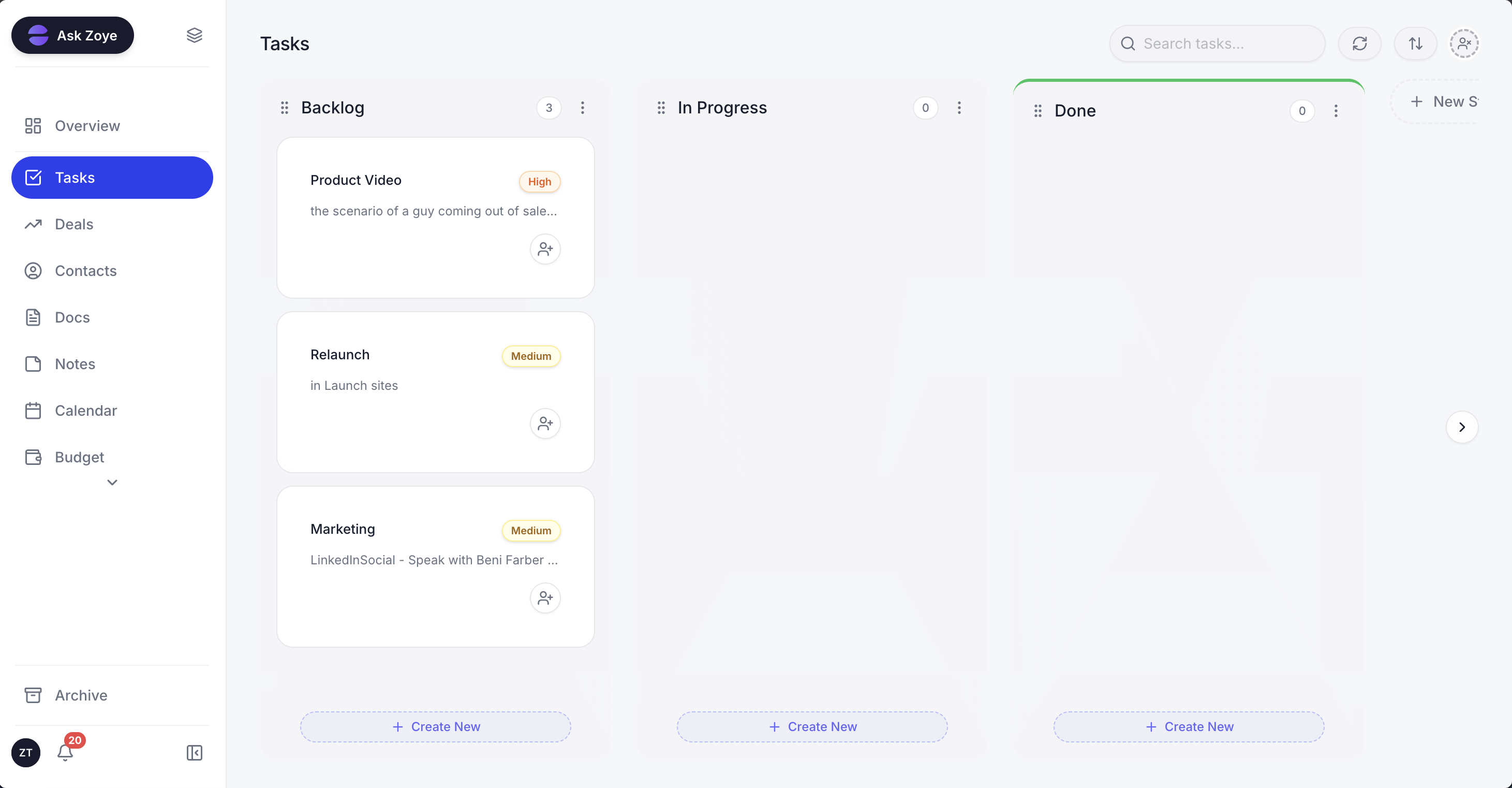 Deals, broker follow-ups and per-property work on one board, with the assistant chasing what has gone quiet
In practice that looks like this. You come back from a viewing and say "log the owner of the two duplexes on the north side, asking too much, remind me in six weeks", and both the record and the reminder exist without you opening a form. You ask which broker conversations have had no contact in three weeks, get the list, tell it to message them, and the messages go out. A wholesaler's email arrives and lands as a deal in sourcing with the source attached. An offer sits unanswered for ten days and the chase happens on schedule rather than when you happen to think of it. You can drive all of it from WhatsApp, which matters when your day is spent inside properties and in cars rather than at a desk.
Underneath the assistant sits the boring infrastructure the spreadsheets were holding together. A pipeline you can view as a board, a list or a calendar. Contacts for brokers, wholesalers, lenders, contractors and owners, each with history and notes. Documents attached to the property they belong to, so the appraisal and the signed contract stop living in email threads. Tasks with owners and dates for inspection, financing and title work. Expenses and reports you request in a sentence instead of rebuilding by hand each quarter. Because the assistant maintains the records itself, the system stays current without becoming another thing you have to feed, which is the reason most investors abandoned their last CRM.
Be clear about the boundary, because it matters. Zoye does not collect rent, does not screen tenants, keeps no lease ledger, does not do trust accounting or owner statements, holds no availability calendar or booking engine for short term units, and will not underwrite a deal for you. Keep your landlord platform, your accountant's software and your own model for those. Zoye runs the acquisition and relationship half of the business, which is precisely the half no other tool in your stack covers.
Pricing: flat monthly plans for the whole workspace rather than a charge per seat, so adding a partner, a bookkeeper or a virtual assistant does not change what you pay. Current plans are on the pricing page.
Best for: investors from about four doors upward whose real constraint is follow-up and relationships rather than analysis.
Want to see it in action?
Watch how Zoye automates your daily workflow - from lead management to team collaboration.
See How It Works2. HubSpot, the general CRM with the most generous starting point
HubSpot's free tier is the reason it appears on almost every list like this, and the reason is legitimate. You get contacts, companies, deals with custom stages, email tracking and a decent mobile app at no cost, which is more than enough to model a five stage acquisition pipeline properly. For an investor moving off a spreadsheet for the first time, it is a low risk place to learn what you actually need.
The trade-offs are structural. HubSpot is a sales and marketing platform, so its vocabulary fights you constantly: deals want a monetary value and a close date, contacts want lifecycle stages, and none of it understands a property as an object that persists after the deal closes. The features that would do your chasing sit in the paid Sales and Marketing tiers, and the cost curve above the free tier is steep. Its AI drafts and suggests rather than executing a follow-up sequence on your behalf.
Pricing: free CRM tier, then per seat paid tiers that scale quickly. Check HubSpot's pricing page for current figures.
Best for: investors who want a real pipeline at no cost and are comfortable bending sales terminology to fit acquisitions.
3. Pipedrive, the cleanest pipeline in the category
If your problem is genuinely just the pipeline, Pipedrive is the least annoying way to solve it. It is built around a visual deal board, it is quick to learn, custom fields and stages are trivial to set up, and the mobile experience is good enough to update a deal from a parking space outside a property. Investors who track a dozen live opportunities and want nothing else tend to be happy with it for years.
The limit is scope. Pipedrive is a pipeline and little more: document handling is thin, there is no natural home for the property once it becomes an asset, and the automation is rule based, so it runs the sequences you built rather than reacting to a plain instruction. It also charges per seat, which is mildly irritating when the extra seat is a part time bookkeeper who logs in twice a month.
Pricing: per seat monthly tiers with no free plan beyond a trial. Check Pipedrive's pricing page for current figures.
Best for: investors who want a fast, clean deal board and already have documents and property records handled elsewhere.
4. Zoho CRM, the configurable budget option
Zoho is the answer for investors who enjoy building. It is inexpensive relative to the category, deeply customisable, and if you are willing to put the work in you can model properties as their own module, link them to deals, brokers and lenders, and end up with something genuinely close to a purpose built investor system. The wider Zoho suite covers documents, signatures and books, which appeals if you want one vendor.
The cost is time, and then more time. Every hour of configuration is an hour you are not underwriting, and a customised Zoho instance is something you have to maintain as your strategy changes. The interface shows its breadth, onboarding is a project rather than an afternoon, and the automation, while capable, is rule based and needs designing before it does anything for you.
Pricing: a limited free tier for very small teams, then low cost per seat editions. Check Zoho's pricing page for current figures.
Best for: technically confident investors who want maximum flexibility for a small budget and will invest the setup weeks.
See what Zoye can do for you
From CRM and deal tracking to AI-powered task management - explore everything Zoye offers in one workspace.
Explore Features5. Investor-specific tools, as a category
There is a real category of software built for people who buy property, and it deserves an honest treatment rather than a single logo. Broadly it splits three ways.
Sourcing and outbound tools are built around finding and contacting owners: driving for dollars apps that let you mark properties from the car, list building with owner data, then skip tracing, direct mail and call or text campaigns. DealMachine is the best known shape here. These are genuinely useful if your acquisition strategy is outbound volume, and they are not really CRMs, although most now bolt a pipeline onto the side.
All in one investor platforms such as REsimpli aim to hold lead sources, the pipeline, marketing spend, KPIs and some accounting in one product, priced by tier and usually with call tracking and dialler features aimed at high volume operators.
Configured generic platforms are the traditional route: a Podio base with an investor workflow layer such as InvestorFuse on top, or an agency build on someone else's framework. Extremely flexible, and you inherit somebody else's structure plus an ongoing dependency on whoever maintains it.
The honest read on the whole category: it is optimised for wholesalers and high volume acquisition machines, where the constraint is lead throughput and cost per contract. If you buy three or four rentals a year and hold them, you will pay for dialler and campaign machinery you never switch on, and you will still find the operating side of your portfolio thinly served. Several of these vendors also price on request or by tier with add ons, so get the total in writing before comparing.
Pricing: varies widely by tier and add on; several are quote based. Confirm directly with the vendor.
Best for: outbound-heavy wholesalers and flippers doing volume, rather than steady buy and hold investors.
6. Spreadsheets, Airtable and Notion, the incumbent you are trying to leave
The most common CRM for real estate investors is still a spreadsheet, and it earned that position. Your underwriting model is probably better than anything a vendor would sell you, it costs nothing, and it does exactly what you told it to. Airtable and Notion are the sophisticated versions: linked tables for properties, deals and contacts, views by stage, and a decent mobile app.
The failure is always the same, and it is not the numbers. A spreadsheet cannot notice. It will not tell you that a wholesaler has gone quiet for two weeks, will not send the message, and holds no documents, so the appraisal and the contract still live in email. Airtable and Notion improve the structure but leave you as the engine: you built the base, you maintain the base, and you still do all the chasing. Most investors who leave keep their model for underwriting and move relationships, documents and follow-up somewhere that acts.
Pricing: free to low cost. Airtable and Notion have free tiers and per seat paid plans.
Best for: investors with one to three doors, and as a permanent home for your underwriting maths whatever else you adopt.
7. Landlord and property management platforms, which are not CRMs
Buildium, AppFolio, RentRedi, DoorLoop and Stessa come up constantly in investor discussions, so it is worth being precise about what they do. They run the property after you own it: leases, rent collection, tenant screening, maintenance requests, accounting and owner reporting. If you have tenants, you need something in this category and these are good products.
What none of them holds is a deal that has not happened yet. There is no place for the broker you are cultivating, the seller who said call back in autumn, or the offer waiting on a response, because those are not tenancies. This is why so many investors end up with a landlord platform for the doors and a spreadsheet for everything upstream of them, and then wonder why acquisitions feel disorganised. The two categories are complements, not alternatives.
Pricing: typically per unit per month with minimums, or a flat landlord plan for small portfolios. Check each vendor's pricing page.
Best for: every investor with tenants, alongside whatever you use for deal flow.
The options at a glance
| Option | What it is really for | Pricing model | Holds the deal pipeline | Does the chasing |
|---|---|---|---|---|
| Zoye | Acquisitions, relationships, documents and follow-up | Flat monthly per workspace | Yes, with property records and documents | Yes, the assistant acts on plain instructions |
| HubSpot | Sales pipeline with a free entry point | Free tier, then per seat | Yes, in sales vocabulary | Only on paid tiers, and it suggests |
| Pipedrive | A clean visual deal board | Per seat monthly | Yes, deals only | Rule based automations you build |
| Zoho CRM | Configurable low cost platform | Low per seat, small free tier | Yes, once you build it | Rule based, needs designing |
| Investor tools | Outbound sourcing at volume | Tiered or quoted, add ons | Usually, aimed at wholesaling | Diallers and campaigns you run |
| Spreadsheets | Underwriting and numbers | Free to low cost | Only as a static list | No |
| Landlord platforms | Rent, leases, maintenance, accounting | Per unit or flat landlord plan | No, post-closing only | Tenant side only |
Which fits which investor
One to three doors. Stay on the spreadsheet, and stop feeling guilty about it. Your entire deal flow fits in your head and your phone, and the honest return on adopting software right now is close to zero. Do two things instead: keep one shared document listing every broker, wholesaler and owner you have spoken to with a next-contact date, and put those dates in your calendar. That is a CRM in the only sense that matters at this size.
Four to fifteen doors. This is where the switch pays. You are talking to enough people that some of them are being forgotten, you have documents for several properties, and contractor and lender relationships now carry real value. If your bottleneck is follow-up and staying present in twenty conversations, Zoye fits, because the chasing happens whether or not your week went sideways. If you would rather do the chasing yourself and only want structure, HubSpot's free tier or Pipedrive will serve you well. Either way, keep a landlord platform for the tenants and your model for the numbers.
Fifteen doors and up. You now have two distinct operations: an acquisition pipeline and a property business, often with a partner, a bookkeeper, a property manager and several contractors touching them. Per seat pricing starts to bite here, and so does the cost of context living in one person's head. Look for flat pricing, per-property document handling, delegated tasks and follow-up that runs without a person driving it. If you are also buying at volume through outbound campaigns, an investor-specific platform alongside is defensible. If a slice of your portfolio is short term rentals, the operating tooling for that is separate again, and there is a fuller treatment in our piece on where property management leads come from.
The five stages worth building, and what to chase in each
Whatever you adopt, the stages carry most of the value. Five are enough.
Sourcing. Anything you have heard about but not underwritten: a wholesaler's blast, a broker's off market mention, a driving-for-dollars address, a referral. The only discipline that matters here is that every item has a source, because in twelve months the source data tells you which relationships actually produce and which just produce email.
Analysis. Your shortlist, being underwritten. Chase yourself here: a deal sitting in analysis for two weeks is a decision you have not made, and undecided deals silently consume attention.
Offer. Submitted and waiting. This stage exists so nothing sits unanswered. An offer with no response after a week needs a chase, and a polite chase converts more often than most investors expect.
Under contract. The most expensive stage to run badly, because everything is date-bound: inspection windows, financing deadlines, title work, insurance, the wire. This is where tasks with real dates earn their keep.
Closed or operating. The property leaves the pipeline and becomes an asset with its own documents, contacts, expenses and tasks. If you flip or refinance, add a rehab stage between under contract and operating rather than building a second pipeline that nobody maintains.
Ready to streamline your business?
Zoye brings AI-powered CRM, task management, and automation into one workspace.
Get StartedThe rolodex that actually produces deals
Every experienced investor says the same thing: after the first few properties, deal flow comes from people rather than portals. That makes the contact side of your system more valuable than the pipeline, and it is the part almost everybody neglects.
Brokers and agents in your submarket. They send the good one to whoever they thought of first, and they think of whoever stays in touch. A note on their focus area, the last conversation and a quarterly reminder is worth more than any list you could buy.
Wholesalers. Volume, mixed quality, occasional gold. Track which ones have sent you deals that actually penciled out, and be honest with yourself about the ones who have never produced anything.
Off market owners. The highest value and slowest category. Someone who says "not right now" is not a dead lead, they are a lead with a date on it. Record the date and the reason, then be the person who checks back politely twice a year.
Lenders. Not a sales relationship, an operational one. Terms, appetite, speed to close, who to call when a deal needs to move in nine days. Keep the last conversation and the current appetite noted, because it changes with rates.
Contractors and trades. Arguably the most valuable contacts you own, and the ones most often kept in a phone with no notes. Scope, rate, reliability, which property they last worked on, whether they turn up. Attach their quotes to the property.
The reason to hold these in a system rather than a phone is not tidiness, it is the reminder. A rolodex nobody is prompted to work is an address book. That distinction is worth more than any feature comparison in this article, and it is the same argument we make for smaller service businesses in our guide to the best CRM for small business.
How to choose, in four questions
1. After setup, who does the following up? If the answer is you, and your weeks are already broken up by tenants and contractors, you have chosen a filing system. Be honest about the hours you really have.
2. Does it hold the property after closing? Half of the value is documents and tasks attached to an asset you will own for a decade. A tool that forgets the property the moment the deal closes solves half a problem.
3. Who else needs access, and what does that cost? A partner, a bookkeeper, a property manager, a virtual assistant. Per seat pricing punishes exactly the behaviour that makes a portfolio scale.
4. Will you still be using it in six months? The graveyard is full of investor CRMs abandoned in week three because keeping them current became a second job. The test is simple: does the system maintain itself, or do you maintain it?
Frequently asked questions
It depends on how many doors you own and where your deals come from. Zoye is the strongest pick for investors whose bottleneck is follow-up, because it works the pipeline and chases the broker, wholesaler and seller conversations itself rather than waiting for you to remember. HubSpot, Pipedrive and Zoho are solid, cheap-to-start general CRMs if you are happy configuring stages and doing the chasing yourself. Investor-specific tools are worth a look if you run outbound campaigns at volume. Landlord platforms like Buildium, AppFolio or RentRedi are excellent at rent, leases and maintenance, but they were never built to hold a deal that has not closed yet.
If you own one or two properties and buy something every few years, a well kept spreadsheet is genuinely enough. The switch usually pays for itself somewhere around the fourth or fifth door, or the moment you are talking to more than about fifteen brokers, wholesalers and owners at once. That is the point where deals stop being lost to bad analysis and start being lost to silence: the seller you meant to call back in March, the broker who sent you an off market pocket listing and never got a reply, the lender you forgot to re-engage before rates moved.
You can, and plenty of good investors do. A spreadsheet is unbeatable for the numbers: rent, expenses, cap rate, cash on cash, the model you have tuned over years. What it cannot do is remind you. It has no idea that the wholesaler you replied to has gone quiet for two weeks, it will not send the follow up message, and it holds no documents, so the appraisal and the signed contract still live in email. Most investors end their spreadsheet phase by keeping the underwriting model and moving the relationships and the follow-up somewhere that acts on them.
Five stages cover almost every buy and hold strategy: sourcing, analysis, offer, under contract, and closed or operating. Sourcing holds anything you have heard about but not yet run numbers on. Analysis is the shortlist you are underwriting. Offer is submitted and waiting. Under contract is where inspection, financing and title all need chasing on dates. Closed or operating is where the property leaves the deal pipeline and becomes an asset with its own documents, tasks and contacts. If you also flip or refinance, add a rehab stage between under contract and operating rather than inventing a second pipeline.
No. Zoye does not collect rent, does not screen tenants, holds no lease ledger, does not produce trust accounting or owner statements, has no availability calendar or booking engine for short term rentals, and does not underwrite a deal for you. Keep your landlord platform, your bookkeeping software and your own underwriting model for all of that. Zoye runs the part around it: the deal pipeline, the broker and lender and contractor relationships, the documents attached to each property, the tasks, and the follow-up that produces the next acquisition.
Not directly, and any tool that claims otherwise is selling you a list. What a CRM changes is your conversion rate on the relationships that produce off market deals. Off market flow comes from brokers who think of you first, wholesalers who send you the good ones before the blast, and owners who remember the person who checked in politely twice a year. All three of those are follow-up problems, not sourcing problems, and follow-up is exactly what falls over when you are managing tenants and contractors at the same time.
The bottom line
There is no single best CRM for real estate investors, because the category is really three jobs pretending to be one. Underwriting belongs in your model. Tenants, rent and leases belong in a landlord platform. What is left over, the deal pipeline, the people who bring you deals, the documents per property and the follow-up that keeps you in twenty conversations, is the job an investor CRM is actually for, and it is the job most tools on the market were not designed to do.
Pick by your real bottleneck. If it is structure, the free and cheap general CRMs will give you stages and a board today. If it is lead volume, look at the investor-specific platforms. If it is what happens to a relationship the week your attention goes elsewhere, you need something that follows up on its own rather than reminding you to. Zoye is built for that last case, running the acquisition and relationship half of a portfolio next to whatever you use for rent and for numbers.
For more, see the CRM for real estate agents if you also sell, the vacation rental CRM for managed portfolios, the guide to where property management leads come from, the best CRM for small business, and the rest of the Zoye blog.