
Search for a WhatsApp CRM in 2026 and you will find dozens of tools that all promise the same thing: your team answers customers faster. Shared inboxes, chatbots, broadcast campaigns, quick replies. Useful, but notice what is missing: every one of them assumes a human is still doing the actual work of running the business. Someone still has to log the lead, update the deal, remember the follow-up, and book the appointment. The inbox got smarter; the workload did not shrink.
That is why so many owners have a graveyard of tools they signed up for and quietly stopped using. The software organized the chaos, but it never took any of the chaos off their plate. In this guide we rank the nine best WhatsApp CRMs by a different metric: how much of the work the tool actually does for you. At one end sit pure inbox tools that help you answer. At the other end sits a new category: an AI operator you can message on WhatsApp that captures leads, chases follow-ups, books clients, and updates the CRM by itself.
We cover both ends honestly, because they solve different problems. If you need a support team inbox, some of the tools below are excellent at exactly that. If you are an owner who wants the admin work to disappear, the ranking order will make sense quickly.
Pricing reflects published rates as of July 2026; check each vendor's pricing page for current figures.
Best WhatsApp CRM software: quick comparison
| WhatsApp CRM | Category | Does the work for you? | Best for | Pricing from |
|---|---|---|---|---|
| Zoye | AI operator | Yes - captures leads, chases follow-ups, books clients, updates the CRM itself | Owners who want to run the business from WhatsApp | $5/mo (1 member), then $29/mo (10 members) |
| WATI | Inbox + broadcast | No - you plan and build every campaign | High-volume broadcast and chatbot campaigns | ~$39/mo + Meta fees |
| Kommo | Pipeline CRM | No - AI assists replies only | Sales teams that live in deals and stages | $15/user/mo |
| respond.io | Omnichannel inbox | No - you build the workflows | Mid-size teams, high message volume | ~$79/mo |
| Clientify | Marketing suite | No - inbox, not operator | SMBs in Spain and Latin America | ~$39/mo |
| Leadsales | Simple pipeline | No - follow-ups are manual | Small LATAM teams wanting simplicity | ~$84/mo (3 users) |
| AiSensy | Marketing engine | No - chatbot flows you configure | Indian D2C running broadcast/ad funnels | ~$12/mo + Meta fees |
| Interakt | Commerce messaging | No - thin CRM layer | Indian merchants selling via WhatsApp | ~$12/mo + Meta fees |
| TimelinesAI | CRM bridge | No - syncs chats, does not act | Teams keeping their existing CRM | ~$25/seat/mo |
The rest of this guide explains each pick and, more importantly, the one distinction that decides which is right for you: whether the tool answers your messages or actually runs your business.
Why the WhatsApp CRM category is being rethought in 2026
Four shifts are changing what buyers expect from this category.
WhatsApp became the front door of the business, not a side channel. In most of Latin America, India, Southern Europe, and the Middle East, customers do not fill in forms or send emails; they send a WhatsApp message. When the primary sales channel lives on a phone, a CRM that treats WhatsApp as an afterthought integration loses deals in the gaps between apps.
Shared inboxes solved answering, not operating. The first generation of WhatsApp CRMs put team inboxes, labels, and chatbots on top of the WhatsApp Business API. That fixed the "five salespeople, one number" problem. It did nothing about the follow-up that never got sent, the lead that never got logged, or the quote nobody chased. Owners are realising the bottleneck was never the inbox.
AI moved from suggesting to executing. Chatbots that deflect customer questions are old news. The meaningful change in 2026 is AI that takes action on the owner's side: reading a conversation, creating the lead, scheduling the follow-up, updating the deal stage, and building the automation that keeps doing it. Tools whose AI only drafts replies now look like half a product.
Per-user and per-conversation pricing punishes growth. Most inbox tools charge per seat, and the official WhatsApp Business API adds Meta conversation fees on top. A growing team can watch a $40 tool become a $400 line item. Flat-rate platforms that include AI and every feature on every plan are winning the value comparison.
The 9 best WhatsApp CRMs in 2026
1. Zoye - the AI operator you run over WhatsApp
Zoye sits in this list because owners search for a WhatsApp CRM, and it covers the customer side of that job: an instant first message, a Lead Bot that answers and qualifies, and broadcasts. But it is built as an AI Business Operator, the AI that runs your business rather than another tool you operate. Every other product here helps your team answer customers inside WhatsApp. Zoye answers them and then keeps working for you: you message it on WhatsApp the way you would message a great operations manager, and it executes.
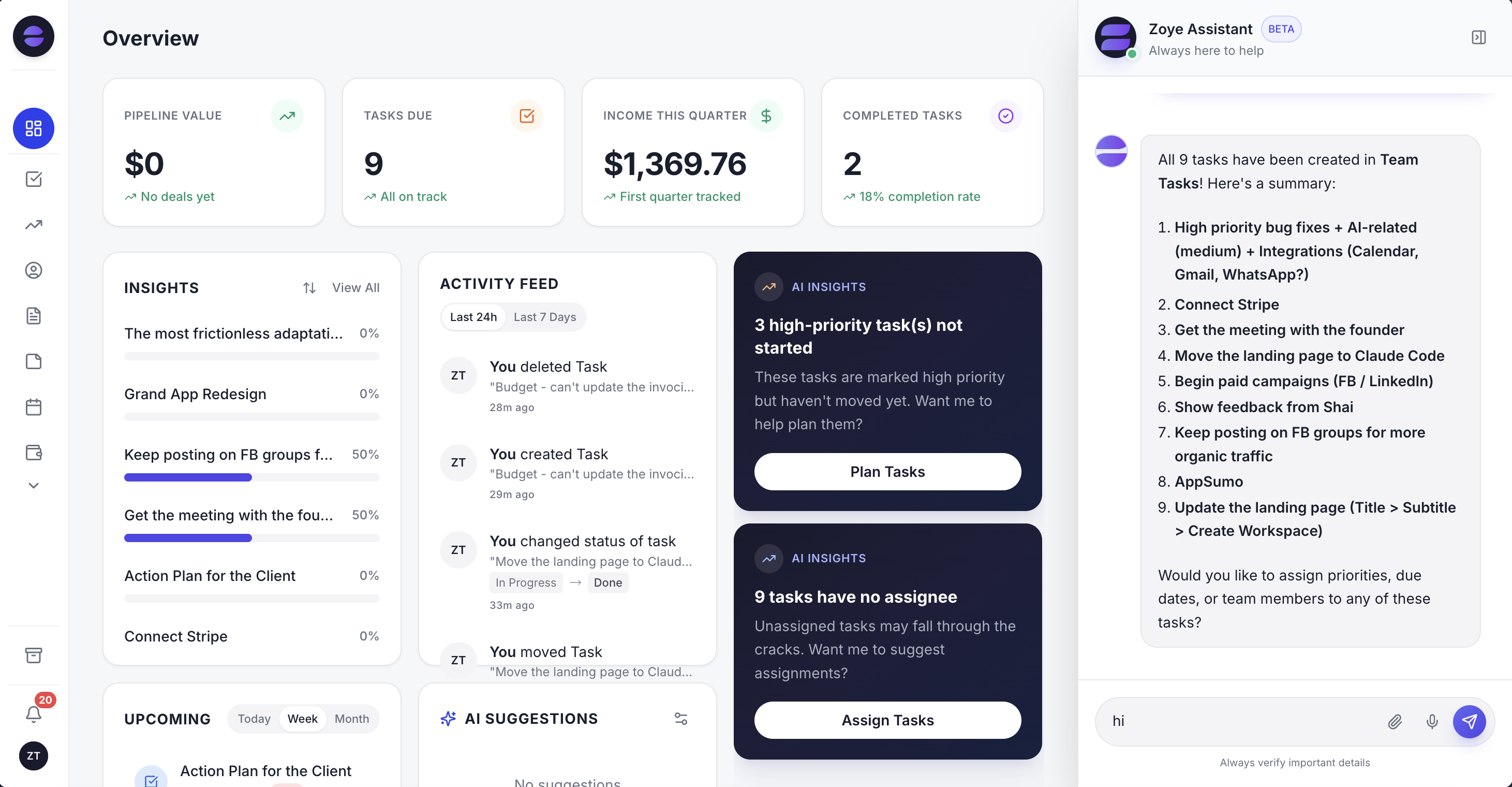 The Zoye dashboard: your whole business at a glance, with proactive AI Insights and Zoye Assistant always available on the right
In practice that looks like this. A new enquiry comes in and the Zoye Assistant captures it as a lead in the CRM with the context filled in. A quote goes unanswered for three days and the assistant chases it without being asked. A client wants Thursday afternoon and the assistant books them against your real calendar. You type "when a new lead comes from WhatsApp, send our intro message and create a follow-up task for two days later" and Zoye builds that automation: no workflow canvas, no Zapier-style wiring, nothing to maintain. Non-technical owners never have to "administer" Zoye, which is exactly why it does not end up in the abandoned-software graveyard.
On the customer side, all of this runs on the official WhatsApp Business Platform:
- Instant first message to every new lead, from any source.
- Lead Bot that answers, qualifies, books a slot, and follows up when the chat goes quiet; in free-text mode Zoye, as an AI agent, holds the conversation.
- Broadcasts to an audience you pick by stage, source, or tag, sent now or scheduled.
- Payments in the chat into your own account (Stripe, or Grow in Israel), with payers moved to the next stage automatically.
- Click-to-chat link and QR code, plus click-to-WhatsApp ad results followed all the way to deals won and revenue.
The same kind of automatic replies runs on Instagram and Facebook comments and DMs, and each conversation lands on the contact's card. You switch any of it on by asking: "send every new WhatsApp lead our welcome message and book the ready ones for a call" is enough for Zoye to set it up.
Behind the assistant sits a complete workspace: CRM with deals and pipelines, tasks with list, board, calendar, and timeline views, a shared calendar, budget tracking, and reports that pull from all of it. Customer conversations are centralised, and the assistant drafts replies when you want it to. Notes, the collaborative docs module, is included as well. Everything the inbox tools bolt together is native here, and the AI is the one keeping it up to date.
Pricing: Almost Free from $5 per month (or $4 per month billed annually) for 1 member with the full platform including AI, cancel or upgrade anytime. Starter from $29 per month (10 members). Growth from $59 per month (20 members).
Best for: Owners and small teams who want WhatsApp to be where they run the business, not just where they answer it.
2. WATI - the WhatsApp broadcast and inbox workhorse
WATI is one of the best-known platforms on the official WhatsApp Business API: shared team inbox, no-code chatbots, and broadcast campaigns to thousands of contacts. For businesses whose growth engine is WhatsApp marketing at volume, it is a proven choice with a large ecosystem.
The limitation is that WATI is a messaging platform with contact attributes, not a real CRM: there is no serious deal pipeline, and everything it sends still has to be planned, built, and monitored by you. Costs also stack: platform fees plus Meta conversation fees plus extra charges for additional users.
Pricing: Growth plan from around $39 per month billed annually, plus WhatsApp conversation fees. Higher tiers for more users and API access.
Best for: Businesses running high-volume WhatsApp broadcast and chatbot campaigns.
3. Kommo - the pipeline-first messenger CRM
Kommo (formerly amoCRM) attacks the category from the CRM side: a proper sales pipeline where every card carries its WhatsApp conversation, plus a salesbot builder and multichannel inboxes. For a structured sales team that lives in deals and stages, it is one of the most complete options here.
The limitation is that Kommo is a system you must set up and operate: pipelines, bots, templates, and integrations all need configuring, and per-user pricing means the cost scales with every seat. The AI features assist with replies and summaries; they do not run the pipeline for you.
Pricing: From $15 per user per month (Base) billed annually; Advanced $25, Enterprise $45.
Best for: Sales teams that want a classic pipeline CRM with WhatsApp built into every deal.
4. respond.io - the omnichannel inbox for scale
respond.io is the enterprise-leaning option: one inbox for WhatsApp, Instagram, Messenger, Telegram, and more, with a powerful workflow builder and solid reporting. Mid-size teams handling thousands of conversations across channels choose it for reliability and depth.
The limitation is that this power is aimed at conversation management, and it is priced and designed for teams rather than owners. Workflows are capable but you build and maintain them, and the platform can feel heavy for a five-person business that just wants leads followed up.
Pricing: Starter from around $99 per month; Growth from around $159 per month, scaling with seats and contacts.
Best for: Mid-size support and sales teams managing high message volume across multiple channels.
5. Clientify - the Spanish-speaking market's marketing suite
Clientify bundles CRM, marketing automation, funnels, and a WhatsApp inbox into one suite, and it has become a favourite across Spain and Latin America, with local onboarding and a strong partner network in Spanish.
The limitation is breadth over depth: each module is lighter than a dedicated tool, the WhatsApp side is an inbox rather than an operator, and teams outside the Spanish-speaking ecosystem will find community, templates, and support thinner.
Pricing: Solo plans from around $39 per month; Flow plans with inbox and automation from around $59 per month billed annually.
Best for: SMBs in Spain and Latin America that want CRM plus marketing in one Spanish-first suite.
6. Leadsales - the simple WhatsApp pipeline for LATAM
Leadsales built a deliberately simple product: connect WhatsApp, Instagram, and Facebook, and drag conversations through a visual pipeline. For small LATAM businesses graduating from "everything lives in the owner's phone," that simplicity is the selling point.
The limitation is that simple cuts both ways: automation is thin, reporting is basic, there is no meaningful AI, and every follow-up still depends on a human remembering to send it. It organises the chaos without reducing the workload.
Pricing: From around $84 per month for 3 users, with additional users paid per seat.
Best for: Small Latin American teams that want a no-training-needed WhatsApp pipeline.
7. AiSensy - the WhatsApp marketing engine from India
AiSensy focuses on WhatsApp marketing at Indian-market pricing: broadcasts, click-to-WhatsApp ads, chatbots, and catalog messages on the official API, with pricing that undercuts most global rivals. For D2C brands running campaign-driven growth, it delivers a lot per rupee.
The limitation is that it is a campaign tool wearing a CRM badge: contact management is basic, there is no deals pipeline to speak of, and the "AI" is mostly chatbot flows you configure. Owner-side operations (follow-ups, bookings, deal tracking) stay manual.
Pricing: Basic from around ₹999 (about $12) per month plus WhatsApp conversation fees.
Best for: Indian D2C and SMB brands running WhatsApp broadcast and ad-funnel campaigns.
8. Interakt - the commerce-friendly Indian contender
Interakt, part of the Jio ecosystem, targets small Indian merchants with official-API messaging, catalog and payment integrations, and Shopify connectivity. For a shop selling through WhatsApp conversations, the commerce plumbing is genuinely convenient.
The limitation mirrors AiSensy: the CRM layer is thin, workflows are geared to storefront messaging rather than sales operations, and businesses outside India will find the feature set and integrations less relevant.
Pricing: Starter from around ₹999 (about $12) per month billed annually, plus conversation fees.
Best for: Indian merchants selling through WhatsApp with catalog and payments.
9. TimelinesAI - the bridge between WhatsApp and your existing CRM
TimelinesAI takes a pragmatic angle: it connects regular WhatsApp numbers (no Business API approval needed) to the CRM you already use: HubSpot, Pipedrive, Zoho, or monday. Chats sync into the CRM timeline, and multiple numbers can be managed from one place.
The limitation is that a bridge is only as good as what it connects: TimelinesAI does not manage deals or follow-ups itself, so you still pay for and operate a separate CRM, and the non-API approach trades compliance guarantees for convenience.
Pricing: From around $25 per seat per month, billed annually.
Best for: Teams happy with their existing CRM who just need WhatsApp conversations synced into it.
Want to see it in action?
See Zoye catch a new lead, answer on WhatsApp and set up the follow-up, all from one message.
See How It WorksInbox vs operator: the distinction that actually matters
Strip away the feature lists and every tool above answers one of two questions.
The first question is "how does my team answer WhatsApp messages faster?" That is the inbox category: WATI, respond.io, AiSensy, and Interakt at the campaign end, Kommo, Clientify, Leadsales, and TimelinesAI at the pipeline end. They are customer-facing. Their AI, where it exists, drafts replies and routes chats. The work of running the business - logging, chasing, booking, updating - remains yours, just better organised.
The second question is "how does the work get done without me doing it?" That is the operator category, and in 2026 Zoye is effectively its definition. Zoye does talk to your customers, through the instant first message and the Lead Bot, but the bigger difference is what happens after the chat. It has write access to your CRM, calendar, and tasks, it acts on its own (chasing the quote, booking the client, updating the stage), and it builds automations when you describe what you want. You can manage all of it from the same WhatsApp app your customers already pulled you into.
A useful test: imagine going quiet for a week. With an inbox tool, messages get answered but nothing else moves. With an operator, follow-ups still go out, leads still get captured, and your pipeline is current when you return. That is the ranking logic of this article in one paragraph.
What a WhatsApp CRM actually costs in 2026
The sticker price on a WhatsApp CRM pricing page is rarely the price you pay. Most tools in this category sit on the official WhatsApp Business API, which means Meta bills you separately for conversations on top of whatever the vendor charges. Add per-seat pricing and the gap between the advertised number and the invoice gets wide.
There are three cost layers to check before you buy.
The platform fee. What the vendor charges per month, and whether that is flat or per user. A $15 per user tool is $150 a month at ten people.
Meta message fees. The WhatsApp Business API charges for each template message Meta delivers, priced by category (marketing, utility, authentication) and by the customer's country. Replies you send inside the 24-hour customer service window are free. Marketing conversations to India cost a fraction of marketing conversations to the UK or Germany. A business sending a few thousand marketing messages a month can easily add $100 to $500 to its bill, and no vendor pricing page includes this.
The operating cost nobody prices. Someone has to build the chatbot flows, write the templates, submit them to Meta for approval, monitor the campaigns, and answer the replies. That is hours per week. It is the largest cost in the category and it never appears in a comparison table.
Here is what a realistic monthly total looks like for a five-person business sending moderate volume:
| Tool | Platform fee (5 users) | Meta conversation fees | Realistic monthly total |
|---|---|---|---|
| Zoye | $29 flat (10 members included) | Yes, billed by Meta for template messages you send | $29 plus Meta's message charges |
| WATI | ~$39 and up, extra users charged | Yes, billed by Meta | ~$80 to $250 |
| Kommo | $15/user = $75 | Yes, via your API provider | ~$120 to $300 |
| respond.io | ~$99 and up | Yes, billed by Meta | ~$150 to $400 |
| Clientify | ~$39 to $59 | Yes, via connected provider | ~$90 to $250 |
| Leadsales | ~$84 for 3 users, more per seat | Varies by setup | ~$110 to $200 |
| AiSensy | ~$12 and up | Yes, billed by Meta | ~$60 to $300 |
| Interakt | ~$12 and up | Yes, billed by Meta | ~$60 to $300 |
| TimelinesAI | ~$25/seat = $125 | Not applicable (no API) | ~$125 plus your separate CRM |
Conversation-fee ranges are illustrative and depend heavily on volume, message category, and customer country. Check Meta's current rate card for your markets.
The structural point: Meta's charges follow the template messages you send, whichever tool sends them, so a broadcast-heavy month costs more on every platform, Zoye included. What really separates the tools is the platform fee and the hours. Per-seat pricing grows with every teammate, while a flat price with the AI doing the follow-up keeps both the bill and the workload steady as you grow.
Free WhatsApp CRM: what you actually get
"Free WhatsApp CRM" is one of the most searched phrases in this category, and it is worth being straight about what free means here, because the answer is usually disappointing.
The WhatsApp Business app is free, and it is not a CRM. Meta's free Business app gives you labels, quick replies, a catalog, and away messages on a single phone. That is genuinely useful for a solo operator, and for many businesses it is the right starting point. But it has no deal pipeline, no follow-up automation, no reporting, and critically no multi-device team access beyond a handful of linked devices. When two people need to work the same number properly, you have outgrown it.
Most "free" CRM plans are time-limited trials. In this category, WATI, AiSensy, Interakt, and respond.io offer trials rather than free tiers. After the trial you are on a paid plan, and the Meta conversation fees start regardless.
Free tiers that do exist are heavily capped. Where a genuine free plan exists, it typically limits you to a few hundred contacts, one user, and no automation, which means it solves the demo problem rather than the business problem.
Free also has a hidden cost. A tool with no automation means every follow-up depends on a human remembering. The lead that goes cold because nobody chased the quote costs more than any subscription in this list.
The honest recommendation: if you are testing whether WhatsApp works as a sales channel at all, start with Meta's free Business app and lose nothing. When you need the conversation to become a tracked lead with a follow-up that fires without you, the cheapest real answer is Zoye's Almost Free plan at $5 per month, or $4 per month billed annually, which includes the full platform and the AI assistant rather than a stripped-down teaser. That is less than most tools charge for a single extra seat.
Do you need the WhatsApp Business API?
This is the fork that decides half your shortlist, and a lot of buyers get pushed toward the expensive answer by default.
You need the official API if you send outbound marketing at volume (broadcasts to opt-in lists, promotional campaigns, click-to-WhatsApp ad funnels), you need several agents working one number with proper routing and SLAs, or you need message delivery guarantees and compliance documentation for a regulated industry.
You probably do not need it if your WhatsApp use is conversational rather than campaign-driven: customers message you, you reply, and the real problem is that the resulting work (logging the lead, chasing the quote, booking the slot, updating the deal) falls through the cracks.
That second case describes most small businesses, and it matters because the API route carries real friction: business verification with Meta, a display-name review, message templates submitted for approval before you can send them, a 24-hour customer service window that governs when you can message freely, and per-conversation billing forever after.
Tools like TimelinesAI bridge a regular number into a CRM without the API, trading compliance guarantees for convenience. Zoye covers both cases on the official WhatsApp Business Platform. You connect your number once, and the rest is set up for you: the instant first message, the Lead Bot, and broadcasts to an audience picked by stage, source, or tag. Meta's approval rules and per-message charges still apply to broadcasts, as they do everywhere, but you are not the one building and running the API operation.
Best WhatsApp CRM for small business
Small businesses have three realistic paths in 2026.
If your growth is campaign-driven (broadcasts, click-to-WhatsApp ads, promotions to an opt-in list) pick a campaign engine: WATI globally, AiSensy or Interakt if you are in India. Budget for conversation fees and for the time someone spends building and monitoring campaigns.
If you have a small sales team that thinks in pipelines and stages, pick Kommo or Clientify, and accept the per-seat pricing and the setup weeks as the cost of structure. TimelinesAI is the shortcut if you already run HubSpot or Pipedrive and only need the WhatsApp thread inside it.
If you are an owner whose real problem is that everything depends on you, pick the operator. Zoye's entry Almost Free plan starts at just $5 per month (or $4 per month billed annually) and covers 1 member with the full platform including AI, which means a solo founder can run leads, follow-ups, bookings, tasks, and budget on it for about the price of a cup of coffee, and without becoming the administrator of yet another system. That last part matters more than any feature: the most common fate of small-business software is abandonment, and the tool you just talk to is the one you keep using.
See what Zoye can do for you
CRM, deals, tasks and your Instagram, Facebook and WhatsApp automations in one workspace. Just ask Zoye and it sets any of it up for you.
Explore FeaturesBest WhatsApp CRM by industry
The right pick shifts with how your business actually sells.
Real estate. Enquiries arrive at all hours, viewings need booking against a real calendar, and the follow-up cadence over weeks is what closes the deal. An operator that books and chases without you beats an inbox. See our guide to a CRM for real estate agents.
Clinics, salons, and med spas. The workload is appointments, reminders, and no-show recovery. Look for real calendar integration and automated reminders rather than broadcast power. See WhatsApp CRM for clinics and CRM for salons.
Travel agents and tour operators. Long quote cycles, lots of back-and-forth, and enquiries that die from silence rather than rejection. Automated follow-up on unanswered quotes is the single highest-value feature. See CRM for travel agents.
Ecommerce and D2C. If you run catalog messages, abandoned-cart nudges, and promotional broadcasts, this is the one case where a campaign engine genuinely wins. AiSensy and Interakt are strong in India, WATI globally.
Professional services. Lawyers, accountants, consultants, and agencies sell through conversation and lose money to admin. The operator model fits best. See CRM for lawyers, CRM for accountants, and CRM for consultants.
Field service and trades. Jobs, quotes, scheduling, and invoicing dominate, with WhatsApp as the customer channel. See field service management software for small business.
How to set up a WhatsApp CRM without losing a week
Most WhatsApp CRM rollouts stall in the same four places. Here is the order that avoids them.
1. Decide the number strategy first. Moving a number that already has your customer history onto the Business API is a one-way door: once migrated, the WhatsApp Business app no longer works on that number. Decide whether you are migrating your existing number or starting a new one before you sign anything, and export your chat history first if it matters to you.
2. Get contacts in before conversations. Import your customer list into the CRM side first, so incoming chats match to existing records instead of creating duplicates. A messy first week of duplicate contacts is the single most common reason a rollout gets abandoned.
3. Set up the follow-up rules before the templates. Teams instinctively start by writing broadcast templates, because that is the visible part. The revenue is in the invisible part: what happens when a quote goes unanswered for three days, or when a new enquiry arrives at 11pm. Define those rules first. In Zoye you do this by telling it the outcome you want, for example "when a quote goes unanswered for three days, send a friendly WhatsApp follow-up and give me a call task", and it builds the automation, so this step takes minutes rather than a workshop.
4. Run one week in parallel before you switch fully. Keep the old process alive for one week and compare. You are looking for leads that appeared in one system and not the other. Fix the gap before you turn the old process off.
5. Only then optimise. Templates, broadcast segmentation, and chatbot branches are refinements. They are worth doing after the core loop works, not before.
Staying inside WhatsApp's rules
This part gets skipped in most comparison articles and then costs businesses their number. WhatsApp is not email, and the rules are enforced.
The 24-hour window. Once a customer messages you, you can reply freely for 24 hours. After that window closes you can only send a pre-approved template message, and it is billed as a new conversation. Any tool promising unlimited free outbound messaging is either using the free Business app (which does not scale) or describing something that will get restricted.
Templates need approval. Marketing and utility templates are submitted to Meta and reviewed. Rejections are common for vague, promotional, or badly formatted content, and approval takes time. Build this into your timeline.
Opt-in is mandatory. You need documented consent before sending marketing messages. Buying a contact list and broadcasting to it is the fastest route to a blocked number, and the block can extend to your business account rather than just the campaign.
Quality ratings are real. Meta tracks how often recipients block or report you and throttles your messaging limits accordingly. A single aggressive campaign can cut your daily send limit for weeks.
The practical implication for your shortlist: if you pick a campaign-heavy tool, budget for someone to own compliance. If your WhatsApp use is mostly conversational, most of this weighs much less on you. When you do broadcast, keep the audience tight: in Zoye you pick it by stage, source, or tag, which makes it easy to send only to the contacts who asked to hear from you.
Migrating to a WhatsApp CRM without losing conversations
Three things protect you during a switch.
Export before you migrate. WhatsApp chat exports are per-conversation and manual, which is painful but recoverable. Once a number moves to the Business API, the old app history is gone from that device. Do the export first.
Keep the contact record, not just the chat. What matters long-term is the customer record with its history, deal stage, and next action, not the raw message thread. Prioritise getting clean contacts into the new system over preserving every message.
Expect a two-week overlap. Anyone promising a same-day cutover has not done one. Plan for both systems running briefly, and assign one person to reconcile them daily.
How to choose: four questions to ask before you buy
1. Who does the work after setup: the tool or you? Chatbots and broadcasts still need someone planning, building, and monitoring them. An operator does the follow-ups, capture, and updates itself. Be honest about how much operating time you actually have.
2. Do you need the official WhatsApp Business API? Bots, broadcasts, and high-volume outbound campaigns require it (and Meta's per-message fees). Either way, pick a tool that connects the official API for you so you are not building that operation yourself; Zoye does, and you connect your number once.
3. What happens to the total price at 5, 10, 20 people? Per-seat pricing plus conversation fees compounds. Flat-rate pricing, like Zoye's $29 for 10 members, keeps the math predictable as you grow.
4. Where do the rest of your operations live? If deals, tasks, calendar, and budget sit in three other tools, a WhatsApp inbox adds a fourth silo. A workspace that already contains all of them - with the AI keeping them updated - subtracts silos instead.
Why owners pick Zoye
A few themes come up consistently among owners who chose Zoye after trying inbox tools.
The work actually leaves their plate. Lead capture, follow-up chasing, bookings, and CRM updates happen without a human remembering them, because the assistant executes rather than suggests.
There is nothing to maintain. You tell Zoye the outcome you want, and it wires and runs the automations. No flow canvas, no broken zaps, no "automation admin" role.
It meets them where they already are. Owners in WhatsApp-first markets live in the app all day; being able to run the whole business from that same app removes the biggest reason software goes unused.
One workspace replaces the stack. CRM, tasks, calendar, budget, and reports live together, so the WhatsApp channel feeds a complete operational picture instead of another disconnected inbox.
The customer side is covered too. New leads get an instant reply, the Lead Bot qualifies and books them, and broadcasts go out to the audience you choose, all from the same place.
On Trustpilot, where Zoye holds a 4.4 TrustScore, Liana N summed it up: "Amazing one stop shop to manage all my clients, leads, opportunities, sales, etc. The WhatsApp agent is great and very useful and helpful! I recommend it for any type of business." More reviews on Trustpilot.
Try Zoye for your business. The entry Almost Free plan starts at just $5 per month, or $4 per month billed annually, with the full platform including AI - the price of a cup of coffee, and you can cancel or upgrade anytime.
For more context, see the CRM for real estate agents, the CRM for personal trainers and fitness studios, the CRM for course creators, workshops and events, the CRM for coaches, the CRM for small business, the best CRM software in 2026, our WhatsApp automation guide, the best GoHighLevel alternatives, and the rest of the Zoye blog.
See the six automations Zoye ships for this, and how each one stays inside WhatsApp's rules, on the WhatsApp Automations page.