
Nobody searches for Microsoft Dynamics alternatives because the software is bad. Dynamics 365 is a serious platform with a serious customer base, and in the right company it does things a lighter CRM cannot approach. People search for alternatives because of what surrounds it: a modular licence that turns one purchase into three, a configuration project measured in months rather than afternoons, and the quiet ongoing requirement of a person whose job includes keeping the thing alive.
That last cost is the one that surprises buyers. The licence appears on the pricing page and can be budgeted. The partner statement of work, the data migration, the Power Automate flows that encode your actual process, and the admin who maintains all of it do not appear anywhere until you are already committed. A team of twenty that wanted a pipeline and a follow-up reminder can find itself six months into a programme it did not intend to start.
This guide compares the seven strongest Microsoft Dynamics alternatives in 2026, with real published prices, and it is honest about the cases where staying on Dynamics is the correct decision. If you are earlier in the process and still working out what the category even covers, our explainer on what a CRM is is a better starting point than this page.
Pricing reflects published rates as of September 2026; check each vendor's pricing page for current figures.
Why teams are looking beyond Dynamics 365 in 2026
Four pressures show up repeatedly, and only one of them is about features.
The licensing is modular, and buyers rarely realise how modular. Dynamics 365 is not one product. Sales, Customer Service, Field Service and Business Central are distinct applications with distinct prices. As of September 2026, Microsoft's own pricing pages list Sales Professional at $65 per user per month paid yearly, Sales Enterprise at $105, and Sales Premium at $150. Customer Service Professional is $50 and Customer Service Enterprise is $105. Business Central Essentials is $80 per user per month, Premium is $110, with a $8 Team Members licence for read-mostly staff. A company that wanted "Microsoft's CRM and finance system" is looking at two licence lines before anything is configured, and the person who needs light access to both still needs to be licensed for both.
The implementation is the real invoice. Dynamics deployments typically run through an implementation partner because the platform assumes one. Entities get modelled, security roles get designed, business process flows get built, integrations get wired. That work is genuinely valuable when your process is complex enough to deserve it. It is dead weight when your process is "capture the lead, chase it, close it, invoice it". The licence is the part you can compare on a spreadsheet; the project is the part that decides whether the year goes well.
Customisation flows through Power Platform. Much of what a growing team would consider ordinary configuration lands in Power Apps, Power Automate or Dataverse. This is architecturally elegant and it is why Dynamics scales so far. It also means that changing how a form behaves or how a notification fires is a development task with its own licensing and its own skill requirement. Without someone in-house who knows that surface, small changes queue behind a consultant's availability, and teams stop asking for them. A CRM nobody can adjust is a CRM people quietly work around, which is one of the classic reasons CRM implementations fail.
The ecosystem lock-in is real, and for some readers it is a feature. This deserves saying plainly rather than being framed as a drawback. If your organisation is already Microsoft end to end, Dynamics inherits your identity model, your compliance posture, your Power BI reporting and your Teams surface for free. Leaving means giving that up and rebuilding some of it. For a company with an IT function, that integration is worth paying for. For a twenty-person company where "IT" is the operations manager and a laptop, it is a promise that never gets collected.
Want to see it in action?
See Zoye catch a new lead, answer on WhatsApp and set up the follow-up, all from one message.
See How It WorksThe 7 best Microsoft Dynamics alternatives in 2026
1. Zoye - the AI-native workspace that skips the implementation
Zoye is the strongest pick for teams who wanted what Dynamics promised, a single system where the customer, the work and the money all live together, but who cannot justify a deployment project to get there.
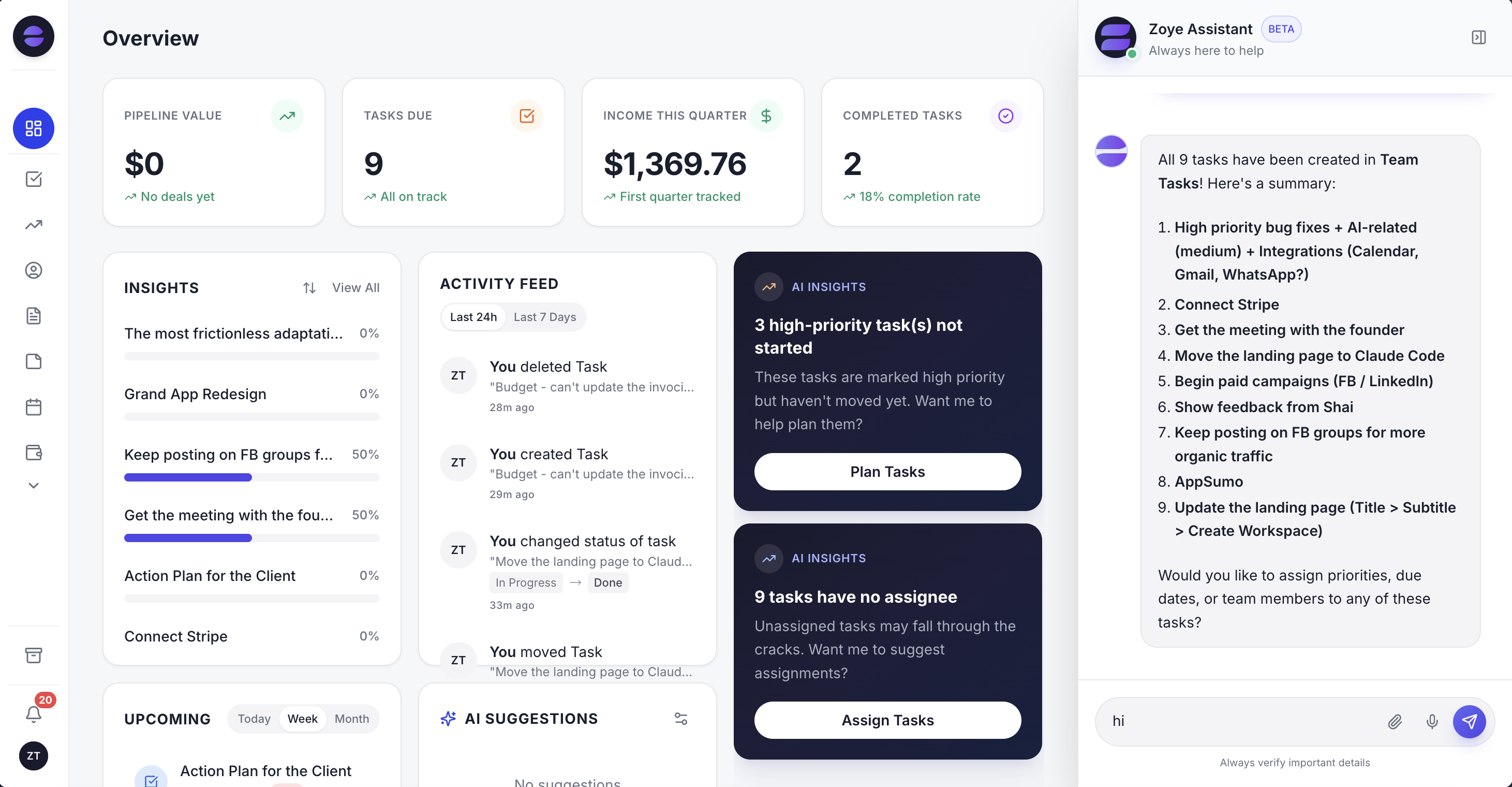
One workspace where contacts, deals, tasks and invoices already know about each other, with no modelling step before you start.
The CRM side covers what a Dynamics Sales deployment is usually configured to do for a mid-size team: contacts and companies, deals on a visual pipeline with stages you define, custom fields, documents attached to the record they belong to, quotes and invoices, follow-up automation and exportable reports. The structural difference is that none of it needs building. There is no entity modelling step, no security role design phase and no Dataverse layer underneath. A record type exists, it already links to the others, and you start using it the same afternoon.
The scope is also wider than a CRM. Tasks with list, board, calendar and timeline views sit in the same workspace as the pipeline, so delivery and sales are not two systems with an integration between them. The calendar is the workspace calendar rather than a sync. Budget and invoicing live next to the deals that generated them. Reports pull across all of it at once, which is the job people usually buy a separate BI licence and a data warehouse to do.
The Zoye Assistant acts, it does not suggest
The assistant is the part that separates this from a cheaper Dynamics. It works on your live records rather than describing them: creating contacts and deals from an email, a PDF or a photographed business card, drafting the follow-up, surfacing what has gone quiet, chasing an overdue invoice, turning a meeting into action items with owners and dates, and answering "what is in the pipeline for this quarter" with real figures rather than a chart you have to interpret. It runs in the web app, on WhatsApp, by voice note, and in Slack, with the same tools and the same permissions in each. Anything destructive or bulk asks for confirmation first, and runs are logged and reversible.
You can also set up an automation by telling Zoye what should happen, in whichever of those places you happen to be. Zoye turns it into a real trigger, conditions and actions, shows you the finished rule in plain English, and nothing runs until you approve it. That is the same job Power Automate does, without the second product.
Honest scope. Zoye is not an ERP. It does not do manufacturing, warehouse management, field service dispatch or double-entry financial accounting, so it is not a Business Central replacement. It is a replacement for the customer, pipeline, work and billing layer, which is what most teams evaluating Dynamics 365 Sales actually need.
Pricing: flat-rate, not per seat. Almost Free is $5 per month ($4 per month billed annually) and covers 1 team member with 1GB storage. Starter is $29 per month ($23 annually) for up to 10 members and 5GB. Growth is $59 per month ($47 annually) for up to 20 members and 10GB. Scale is $119 per month ($95 annually) for up to 100 members and 25GB. Larger or white-label requirements are quoted through the Customize plan. See pricing for the current detail.
Best for: teams from one person to a hundred who want the Dynamics outcome without the Dynamics project, and who want the AI to do the work rather than summarise it.
2. Salesforce - the like-for-like enterprise platform
If you are leaving Dynamics because of the software rather than the weight of it, Salesforce is the honest comparison. The depth is comparable, the ecosystem of apps and implementation partners is larger, and the reporting and automation model is more mature in places.
What it does not solve is the reason most people are here. Salesforce is also a platform that expects configuration, also usually involves a partner, and also grows an admin role around itself. Swapping one for the other is a vendor decision, not a simplification.
Pricing: as of September 2026, Salesforce publishes Starter Suite at $25 per user per month, Pro Suite at $100, and its higher Sales Cloud editions at $195, $395 and $550 per user per month billed annually.
Best for: organisations that need enterprise CRM depth and have the admin capacity to run it.
3. HubSpot - the one your team will actually adopt
HubSpot is the usual landing spot for companies that found Dynamics technically fine and organisationally unusable. Adoption is its genuine strength: the interface explains itself, reps update records without being chased, and the free CRM tier means you can prove the process works before anyone signs anything.
The trade-offs arrive later. Pricing is per seat and climbs steeply across tiers, the Professional and Enterprise plans carry mandatory one-time onboarding fees, and the marketing side is priced against contact volume, so growth is billed twice.
Pricing: as of September 2026, HubSpot publishes Sales Hub Free at $0, Starter at $20 per seat per month at list, Professional at $100 per seat with a required $1,500 onboarding fee, and Enterprise at $150 per seat with a $3,500 onboarding fee. Promotional rates below list appear periodically.
Best for: sales teams where adoption is the binding constraint and budget is not.
4. Zoho CRM - the modular suite at a fraction of the licence cost
Zoho is the closest thing to Dynamics' breadth at small-business prices. There is a CRM, a finance product, a projects product, a desk product, and a suite bundle that ties them together, so the "one vendor for the whole business" logic survives the move.
The cost of that breadth is the same one Dynamics buyers know: administering many apps with separate interfaces and permission models, and finding that the AI and automation features you wanted sit on the upper editions. It is cheaper sprawl, but it is still sprawl.
Pricing: a free edition for up to 3 users, then paid editions at a low per-user monthly rate rising through Professional, Enterprise and Ultimate. Zoho prices regionally, so check Zoho's pricing page for the figures in your currency. Our Zoho CRM alternatives guide covers the trade-offs in more depth.
Best for: cost-sensitive teams that want suite breadth and accept the administration that comes with it.
5. Pipedrive - the opposite of an implementation
Pipedrive is a deliberate reaction to platforms like Dynamics. It does one thing, a visual sales pipeline, and it does it with almost no setup. A team can be live the day they sign up, and reps who resisted every previous CRM tend to use it, because there is very little to resist.
The limit is the same as the strength. Pipedrive is sales only. Delivery, finance, support and reporting across the business all live somewhere else, which recreates the integration problem you may have been trying to escape.
Pricing: per-seat monthly tiers with no free plan beyond a trial, starting from a low entry rate and rising through several editions. Check Pipedrive's pricing page for current figures.
Best for: sales-led teams that want pipeline clarity and have the rest of the stack covered.
See what Zoye can do for you
CRM, deals, tasks and your Instagram, Facebook and WhatsApp automations in one workspace. Just ask Zoye and it sets any of it up for you.
Explore Features6. Freshsales - the mid-market CRM with AI included at the entry tier
Freshsales, from Freshworks, is a credible like-for-like for Dynamics 365 Sales at a fraction of the price. It carries contact and deal management, sequences, a built-in phone and email layer, and Freddy AI for scoring and drafting, and the interface is far lighter than a Dynamics form.
It is narrower than Dynamics by design: no finance module, no field service, no manufacturing. And, like Pipedrive, it assumes the rest of your operations live in other products.
Pricing: as of September 2026, Freshworks publishes Growth at $9 per user per month billed annually, Pro at $39, and Enterprise at $59, with a 21-day trial rather than a permanent free plan.
Best for: sales teams that want Dynamics-style capability with a fraction of the setup and cost.
7. Bitrix24 - the flat-priced all-in-one for larger headcounts
Bitrix24 is worth a look for the specific case where per-user licensing is the problem. It bundles CRM, tasks, telephony, documents, a website builder and internal collaboration, and it prices per plan rather than per seat, so a large team costs the same as a small one on the same tier.
The honest warning is density. Bitrix24 fits an enormous amount into one interface, and the learning curve is steep enough that some teams never get past the parts they configured on day one.
Pricing: as of September 2026, Bitrix24 publishes a free plan for 1 to 2 users, Basic at $49 per month billed annually for 5 users, Standard at $99 for 50 users, Professional at $199 for 100 users, and Enterprise from $399 for 250 users. Monthly billing is higher. See our Bitrix24 alternatives guide for the fuller picture.
Best for: large teams where per-seat pricing is the main cost driver and interface density is tolerable.
When Dynamics 365 is still the right answer
A comparison that only argues one way is not useful, so here is the other side.
Stay on Dynamics if the Microsoft estate is your architecture rather than your email provider. If identity and access already run through Entra ID with conditional access policies you care about, if Power BI sits on a warehouse your finance team trusts, if Teams is where work actually happens, and if Business Central is the ledger, then Dynamics 365 is not one more application. It is the customer layer of a system you already operate, and no independent CRM will reproduce that coherence.
Stay if your process is genuinely complex. Multi-entity finance, manufacturing routing, field service scheduling with parts and warranties, regulated audit trails: this is what the platform was built for, and lighter tools do not fail at it gracefully, they fail at it completely.
Stay if you already have the admin. The maintenance cost that makes Dynamics painful for a small company is already sunk in a company with an internal platform team, and the flexibility becomes an asset instead of a bottleneck.
Leave if none of that describes you. If Dynamics is doing the job of a pipeline and a task list, you are paying for a factory to make one product.
Ready to hand off the busywork?
Zoye brings AI-powered CRM, task management, and automation into one workspace.
Get StartedHow to choose a Microsoft Dynamics alternative
Four questions settle it faster than a feature matrix.
1. Who will own the system in six months? This is the question that predicts success. If the answer is a named person with time in their week, a configurable platform is fine. If the answer is "whoever has a minute", buy something that works well with no owner at all. Most failed CRM projects are ownership failures, not software failures.
2. What is the total cost, not the licence cost? Add the seats, the modules, the connectors, the onboarding fee, the partner days and the reporting tool. Compare that number, over three years, against the alternative. A $59 per month flat plan and a $105 per user per month licence for twenty people are not in the same conversation once the project is included.
3. Does the record need to travel? If a contact becomes a deal that becomes a project that becomes an invoice, count how many systems it crosses today. Every hop is a place where a number is retyped and a follow-up is dropped. Consolidation pays exactly where records travel, and nowhere else.
4. What do you want the AI to do? Most CRM AI in 2026 summarises, scores and drafts inside a sidebar. That is useful and it is not the same as an assistant that creates the record, sends the follow-up after you approve it and tells you which deals went quiet. Decide which one you are buying before the demo, because both are called AI.
What migrating off Dynamics 365 actually involves
The data is the easy part. Dynamics exports contacts, accounts, opportunities, activities and notes cleanly, and the schema maps onto every tool on this list without much argument.
Three things are harder, and planning for them is the whole job.
The customisations do not come with you. Business process flows, custom entities, plugins and Power Automate flows encode years of decisions about how your company works. They cannot be exported, and this is the moment to ask which of them still reflect reality. In most estates, a meaningful share exist because someone requested them in 2022 and nobody switched them off.
Reporting has to be rebuilt, and usually shrinks. If Power BI dashboards sit on top of Dataverse, that layer ends at the migration. The compensation is that a workspace with built-in cross-tool reporting removes the need for most of them. Write down the reports someone actually opens weekly, which is a shorter list than the one that exists.
Someone has to decide what to leave behind. Years of Dynamics data include dead opportunities, duplicated accounts and custom fields nobody has filled since the original consultant left. Migration is the one chance to arrive clean. Filter to active records, archive the rest for reference, and carry across only the fields in current use.
For teams moving to Zoye specifically, the assistant handles deduplication, tagging and enrichment as the import runs, so the cleanup that usually consumes the first fortnight happens while the data lands. A typical mid-size move is measured in days rather than quarters, because there is no configuration phase waiting on the other side.
Why teams pick Zoye instead of Dynamics 365
The reasons cluster tightly.
There is no project between signing up and using it. The records exist, they are already linked, and the work starts the same day rather than after a discovery workshop.
The bill is one line and it does not scale with headcount. Twenty people on Growth is $59 per month, which changes what a CRM decision even feels like when the alternative is per-user licensing across two or three Dynamics modules.
The scope covers the whole customer, not just the sale. Contacts, deals, tasks, calendar, documents, invoicing and reports live in one workspace, so the record does not have to travel between systems to complete its life.
The AI does the work. It creates the record, writes the follow-up, chases the invoice, turns the meeting into tasks and answers questions from live data, on WhatsApp and Slack as readily as in the browser, and it asks before it does anything it cannot undo.
If Dynamics 365 has become a system you maintain rather than a system that helps, try the version with no implementation in front of it. Zoye starts at $5 per month, flat-rate pricing means no per-seat arithmetic as you grow, and you can change plans whenever the team does.
For more context, see the best Zoho CRM alternatives, the best Bitrix24 alternatives, our explainer on what a CRM is, and the reasons CRM implementations fail.