
Search for a free WhatsApp chatbot in 2026 and you will find dozens of tools promising the same thing: build a bot in minutes, answer your customers automatically, and pay nothing. It is a tempting pitch, and for many businesses the free plan genuinely delivers value at the start. The problem is what the word "free" hides and what "chatbot" never does.
First, "free" almost always means "free up to a point": a small number of contacts, a few conversations per month, one flow, no real AI, no broadcast sending, and none of the integrations that matter. The moment your volume grows, you hit the ceiling and the free plan becomes a paid one. Second, and more important: a chatbot answers questions, but it does not run your business. It does not log the lead into a CRM by itself, chase the quote that sat unanswered for three days, book the client against your real calendar, or build the next automation. Answering gets faster; your work of operating stays exactly the same.
In this guide we cover the best free WhatsApp chatbot options honestly, explaining where each free plan runs out, and we introduce the category that solves the gap no chatbot solves: an AI operator you run from WhatsApp itself that does the work in your place.
Pricing reflects published rates as of July 2026; check each vendor's pricing page for current figures.
Why "free" is almost never truly free
Four catches show up in nearly every free plan in the category.
The volume cap arrives fast. Free plans typically unlock a few hundred contacts or a few dozen conversations per month. For a bot that answers the occasional question, that is fine. For a business that sells on WhatsApp every day, the cap becomes a wall within weeks, and the only way through is the paid plan.
Real AI sits behind the paywall. Many "free chatbots" are, in practice, decision trees of "if the customer taps here, reply with that." The layer of genuine AI that understands natural language, summarises conversations, and decides the next step is nearly always reserved for paid tiers. The free version is a menu of buttons, not an assistant that reasons.
The official API charges per message. Broadcasts, campaigns, and high volume require the official WhatsApp Business API, and Meta charges for each template message it delivers (marketing, utility, authentication), priced by type and by the customer's country, regardless of whether the tool is free. Replies inside the 24-hour window after a customer writes to you are free. The software can be free; the conversation is not. That cost is easy to forget in a budget and hard to ignore on a bill.
The scope is answering, not operating. This is the catch no price reveals. Even the best free chatbot stops working the moment the customer leaves the conversation. Who logs the lead, who remembers the follow-up, who books the appointment, and who updates the deal is still you. The bottleneck was never the speed of the reply; it was all the work that happens after it.
The best free WhatsApp chatbot options in 2026
1. Zoye - the AI operator you run over WhatsApp
Zoye appears in this list because owners search for a free WhatsApp chatbot, and it does that job: its WhatsApp Lead Bot answers new customers, qualifies them, and books them in. But it is built as an AI Business Operator, the AI that runs your business rather than another tool you operate, so it works on both sides of the conversation. Every other chatbot in this list stops at answering your customer. Zoye also works for you: you message it on WhatsApp the way you would message a great operations manager, and it executes.
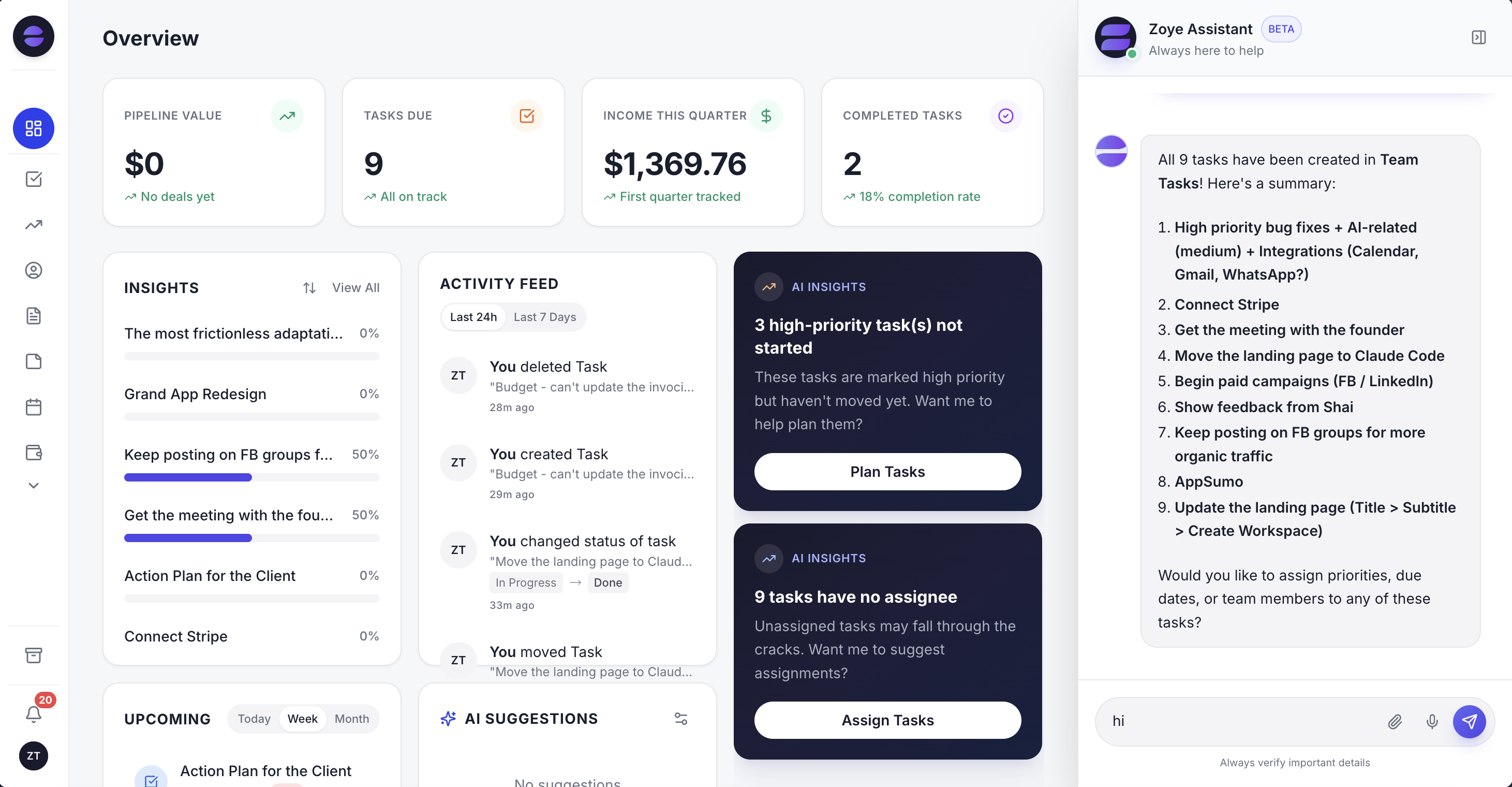 The Zoye dashboard: your whole business at a glance, with proactive AI Insights and Zoye Assistant always available on the right
In practice, it looks like this. A new enquiry arrives and the Zoye Assistant captures it as a lead in the CRM with the context filled in. A quote goes unanswered for three days and the assistant chases it without being asked. A client wants Thursday afternoon and the assistant books them against your real calendar. You type "when a new lead comes from WhatsApp, send our intro message and create a follow-up task for two days later" and Zoye sets that automation up: no flow canvas, no Zapier-style wiring, nothing to maintain. Non-technical owners never have to "administer" Zoye, which is exactly why it does not end up in the abandoned-software graveyard.
Facing your customers, this is what runs on the official WhatsApp Business Platform:
- An instant first message to every new lead, wherever they came from.
- The Lead Bot answers, asks your qualifying questions, books a slot, and follows up when the chat goes quiet. In free-text mode, Zoye, as an AI agent, holds the conversation in your business's voice.
- Payments in the chat go straight to your own account (Stripe, or Grow in Israel), and whoever pays moves to the next stage automatically.
- A click-to-chat link and QR code for your website, shop window, or flyers.
Every one of those conversations lands on the contact's card in the CRM, so the bot and your pipeline never tell different stories. Setting it up is just as easy: ask Zoye "greet every new WhatsApp lead, ask what they need, and offer a slot this week", and it sets that up for you. The ready-made flows are on the WhatsApp Automations page.
Behind the assistant sits a complete workspace: CRM with deals and pipelines, tasks in list, board (Kanban), calendar, and timeline views, a shared calendar, budget tracking, and reports that pull from all of it. Customer conversations are centralised, and the assistant drafts replies when you want it to. Notes, the collaborative docs module, is part of it too. Everything the free chatbots leave out is native here, and the AI is the one keeping it up to date.
And most relevant for anyone who arrived searching for "free": Zoye is the lowest-cost operator in this list. Its entry plan, Almost Free, is just $5/month ($4/month billed annually - the price of a cup of coffee), covers 1 member with the full platform and AI included, and you can cancel or upgrade anytime. A solo founder runs leads, follow-ups, bookings, tasks, and budget for the price of a coffee, and without becoming the administrator of yet another system.
Pricing: Almost Free from $5/month ($4/month billed annually) for 1 member with the full platform including AI. Starter from $29 per month (10 members). Growth from $59 per month (20 members).
Best for: Owners and small teams who want the work to leave their plate, not just their replies to get faster.
2. BotPenguin - the bot builder with a generous free plan
BotPenguin is one of the best-known chatbot builders with a genuine free plan: no-code flows, auto-replies, and integration with WhatsApp, websites, and other channels. For anyone who wants to build a question-and-answer bot quickly at no cost, it is a friendly starting point.
The limitation is the usual one on this list: the free plan restricts conversations and features, the more advanced AI sits in paid tiers, and the bot solves answering, not operating. Once the conversation ends, logging the lead, chasing the follow-up, and booking remains your manual work.
Pricing: Free plan with message and feature limits. Paid plans from accessible monthly rates as volume grows, plus official WhatsApp API fees.
Best for: Small businesses that want a simple question-and-answer bot with no upfront cost.
3. Kommo (free trial) - the messenger CRM with a pipeline
Kommo (formerly amoCRM) attacks the category from the CRM side: a real sales pipeline where every card carries its WhatsApp conversation, plus a salesbot builder. The free period lets you learn the pipeline structure before subscribing.
The limitation is that Kommo's free access is essentially a trial, not a permanent plan, and the platform is a system you must configure and operate: pipelines, bots, templates, and integrations all need setup, and pricing scales per user. The AI assists with replies and summaries; it does not run the pipeline for you.
Pricing: Free trial period; paid plans from around $15 per user per month billed annually.
Best for: Sales teams that want a classic pipeline CRM with WhatsApp built into every deal.
4. WATI (free trial) - the broadcast and inbox workhorse
WATI is one of the best-known platforms on the official WhatsApp Business API: shared team inbox, no-code chatbots, and broadcast campaigns to thousands of contacts. The free trial lets you test before taking on the monthly cost.
The limitation is that WATI is a messaging platform with contact attributes, not a full CRM: there is no serious deal pipeline, and everything it sends still has to be planned, built, and monitored by you. Costs stack: platform fees plus Meta conversation fees.
Pricing: Free trial; paid plans from around $39 per month billed annually, plus WhatsApp conversation fees.
Best for: Businesses running high-volume WhatsApp broadcast and campaign sends.
5. Landbot (free plan) - the visual conversation builder
Landbot is known for its visual flow builder, with a free plan to start. For anyone who values a drag-and-drop editor and wants to design the conversation journey carefully, it is one of the most pleasant options to use.
The limitation is the same pattern: the free tier restricts volume and features, official WhatsApp integration usually requires a paid plan, and the product is a conversation builder. It does not manage deals or chase follow-ups; operating stays in your hands.
Pricing: Free plan with limits; paid plans by volume and channel, plus official API fees where applicable.
Best for: Teams that want to design conversation flows visually and test at no upfront cost.
6. ManyChat - the message-automation veteran
ManyChat made its name in Instagram and Messenger automation and offers WhatsApp automation with a free plan. For small businesses already living in social channels who want everything in one place, the familiarity helps.
The limitation is that the historical focus is message marketing, not customer management: WhatsApp usually needs a paid plan, the CRM is thin, and the automation is flow-based, not operational. Once the flow ends, no one logs the lead or books the client for you.
Pricing: Free plan for selected channels; paid plans from monthly rates that scale with contacts, plus WhatsApp fees.
Best for: Small businesses focused on message marketing across several channels.
Chatbot vs operator: the distinction that actually matters
Strip away the feature lists and every chatbot above answers a single question: "how does my team answer WhatsApp messages faster?" That is the answering category. The tools are customer-facing. Their AI, where it exists, drafts replies and routes chats. The work of running the business (logging, chasing, booking, updating) stays yours, just better organised.
There is a second question that no free chatbot answers: "how does the work get done without me doing it?" That is the operator category, and in 2026 Zoye is effectively its definition. Zoye does answer your customers, through the Lead Bot and its AI agent, but answering is where its work starts, not where it ends. It has write access to your CRM, calendar, and tasks, it acts without waiting to be asked (chasing the quote, booking the client, updating the stage), and it builds automations when you tell it what should happen. And you run all of it from the same WhatsApp app your customers already use.
A useful test: imagine going quiet for a week. With a chatbot, messages get answered but nothing else moves. With an operator, follow-ups still go out, leads still get captured, and your pipeline is current when you return. That is the ranking logic of this article in one paragraph.
Want to see it in action?
See Zoye catch a new lead, answer on WhatsApp and set up the follow-up, all from one message.
See How It WorksThe best free WhatsApp chatbot for small business
Small businesses have three realistic paths in 2026.
If you only need a no-cost question-and-answer bot for simple queries, BotPenguin or the free plans of Landbot and ManyChat work, as long as you accept the volume caps and know operating stays manual.
If you want to evaluate a pipeline CRM with WhatsApp before subscribing, use the free periods of Kommo or WATI, remembering they are trials, not permanent plans, and that pricing scales per user and per conversation.
If your real problem is that everything depends on you, pick the operator. Zoye's entry plan, Almost Free, is just $5/month ($4/month billed annually) and covers 1 member with the full platform and AI included, which means a solo founder runs leads, follow-ups, bookings, tasks, and budget for the price of a coffee, and without becoming the administrator of yet another system. That last part matters more than any feature: the most common fate of small-business software is abandonment, and the tool you just talk to is the one you keep using.
See what Zoye can do for you
CRM, deals, tasks and your Instagram, Facebook and WhatsApp automations in one workspace. Just ask Zoye and it sets any of it up for you.
Explore FeaturesHow to choose: four questions before you build a bot
1. Who does the work after the conversation ends: the tool or you? A chatbot answers and stops. An operator logs the lead, chases the follow-up, and books. Be honest about how much operating time you actually have each day.
2. Where does the free plan run out? Check the caps on contacts, monthly conversations, active flows, and team members, and where real AI starts to cost money. Free is great for testing; plan for the real cost before you depend on it.
3. Will you need the official WhatsApp Business API? Bots, broadcasts, and high-volume outbound run on the official API, and Meta bills each template message it delivers on top of the tool's price. Pick a tool that connects the official platform for you, so you are not running an API project on the side. Zoye connects through the official WhatsApp Business Platform, and you connect your account once.
4. Where do the rest of your operations live? If deals, tasks, calendar, and budget sit in three other tools, a WhatsApp chatbot adds a fourth silo. A workspace that already contains all of them, with the AI keeping them updated, subtracts silos instead of adding them.
Why owners pick Zoye
A few themes come up consistently among owners who chose Zoye after trying free chatbots.
The busywork genuinely disappears. New enquiries get captured, cold threads get chased, appointments get booked, and the customer record keeps itself current, because Zoye carries each task out rather than just recommending it.
There is nothing to maintain. You describe the outcome you want, and Zoye wires and runs the automation. No flow canvas, no broken integration, no "automation admin" role.
It lives inside the app owners already open all day. In WhatsApp-first markets nobody wants to sign into a separate dashboard, so being able to run the business straight from the chat is what finally makes the tool stick instead of gathering dust.
Everything sits in one place instead of five. Contacts, tasks, calendar, invoicing, and reports share a single workspace, so each WhatsApp conversation feeds a full operational view rather than becoming one more siloed inbox.
It answers customers too. The Lead Bot greets, qualifies, and books new leads on WhatsApp, and the conversation is already on the contact's card when you open it.
Zoye holds a 4.4 TrustScore on Trustpilot, and one reviewer, Liana N, wrote: "Amazing one stop shop to manage all my clients, leads, opportunities, sales, etc. The WhatsApp agent is great and very useful and helpful! I recommend it for any type of business." Read the rest of the reviews on Trustpilot.
Try Zoye for your business. The entry plan, Almost Free, is just $5/month, with the full platform including AI.
For more context, see the best WhatsApp CRMs in 2026, our guide to automated WhatsApp customer service, and our overview of AI agents.
See the six automations Zoye ships for this, and how each one stays inside WhatsApp's rules, on the WhatsApp Automations page.