
Best Google Workspace Alternatives 2026: 7 Platforms That Do More
Google Workspace earned its place by making team communication and collaboration almost effortless. Gmail, Docs, Sheets, Drive, and Meet are mature, fast, and familiar to nearly everyone you hire. For email and documents, it remains one of the best products in its category, and this guide does not pretend otherwise.
The reason teams start shopping for alternatives in 2026 usually has nothing to do with email quality. It comes down to two very different motivations. One group wants a privacy-first suite that keeps data out of Google's ecosystem, whether for compliance, principle, or control. The other group has realised that Google Workspace is only ever half of their toolset: it handles email, docs, and storage, but the real work of running a business (managing customers, tracking projects, watching the budget, automating the busywork) happens in a separate stack of subscriptions bolted on top. This guide covers the seven best Google Workspace alternatives in 2026 for both groups, starting with the platform that replaces the operational layer rather than the inbox.
Pricing reflects published rates as of June 2026; check each vendor's pricing page for current figures.
Why teams are looking beyond Google Workspace in 2026
The pressure to move comes from four directions that have grown more pronounced this year.
Google Workspace is communication, not operations. Email, docs, drive, and meet are excellent, but they are the surface of how a business runs, not the core. There is no CRM to track customers and deals, no project management to run delivery, and no budget tracking to watch the money. Teams end up paying Google for collaboration and then paying a separate stack (a CRM, a project tool, a finance tracker, an AI assistant) on top. The combined bill and the constant context switching between logins is the real cost.
Privacy and data control. Google's business model and its position in the ad ecosystem make some teams uncomfortable storing customer data, contracts, and internal documents inside that ecosystem. Industries with compliance requirements, agencies handling client data, and privacy-conscious founders increasingly want either end-to-end encryption or full self-hosting, neither of which Google Workspace offers.
AI is a paid add-on, not a built-in operator. Gemini is capable, but the meaningful business features sit behind additional cost, and even then the AI mostly drafts and summarises inside individual documents. It does not run across your customers, projects, calendar, and budget as a single assistant that takes action. Teams that want AI woven into operations, not bolted onto a document editor, look elsewhere.
Per-seat pricing scales with headcount. Google Workspace is billed per user per month, so every hire raises the bill, and that is before you add the per-seat cost of the CRM, project tool, and AI subscriptions stacked on top. For a growing 10-to-30 person team, the total cost of the Google-plus-stack approach climbs quickly and unpredictably.
The 7 best Google Workspace alternatives in 2026
1. Zoye - the business-operations alternative
Zoye is the strongest Google Workspace alternative for teams whose real problem is not email, but everything they bolt onto email to actually run the business. Zoye does not try to replace Gmail. It replaces the stack you pile on top of Google: the CRM, the project tool, the budget tracker, and the AI assistant, unified into one workspace.
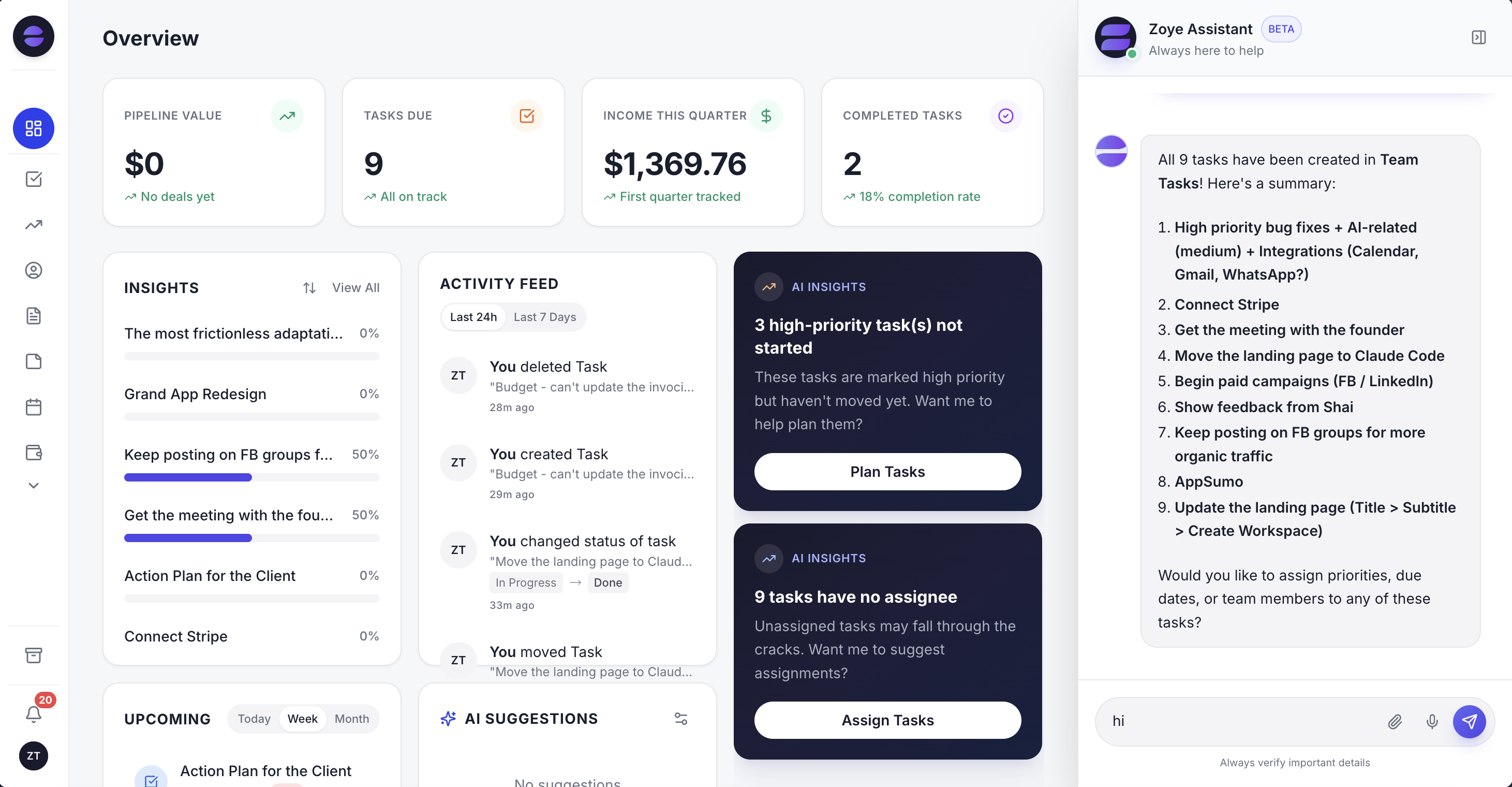
That framing matters, because most "Google Workspace alternatives" lists compare inbox to inbox. The more useful question for a lot of teams is: what are you actually paying Google plus three other vendors to accomplish? If the answer involves tracking customers, running projects, watching a budget, and getting AI help across all of it, Zoye consolidates that into a single platform with one bill.
A real CRM, not a spreadsheet in Drive
Google Workspace has no CRM, so teams track customers in Sheets until that breaks, then buy a separate CRM. Zoye includes a native CRM out of the box: contacts, companies, deals, and a pipeline with custom stages. Customer history, deals, and the tasks attached to them live in the same workspace as everything else, instead of in a spreadsheet that nobody updates.
Projects and tasks where the work actually happens
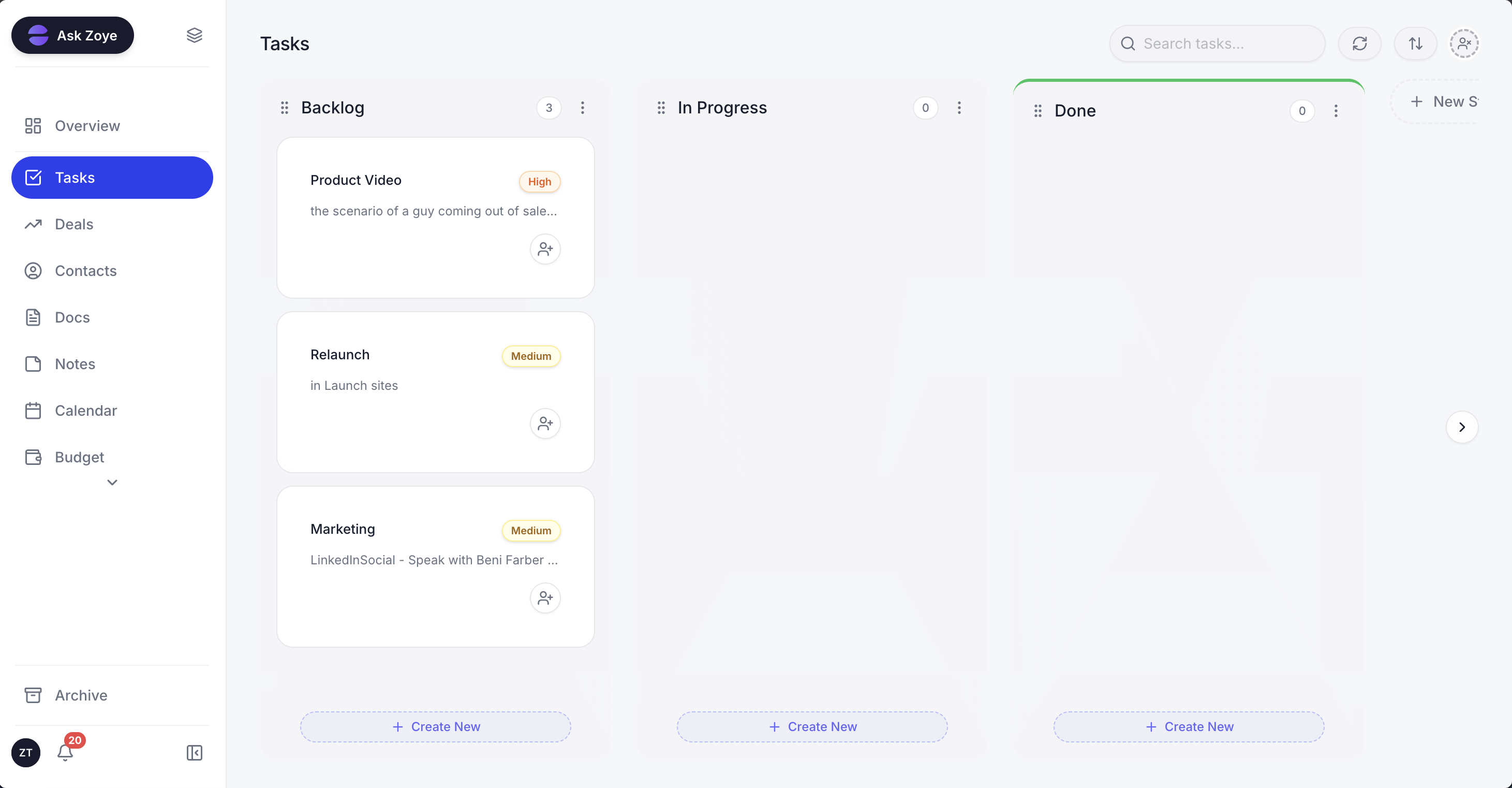
Google Workspace has no project management, so teams add one more subscription. Zoye ships list, board (Kanban), calendar, and timeline views, with custom fields, dependencies, workload management, time tracking, and project templates. New projects run on sensible defaults with no configuration marathon, and the whole team works in one place rather than copying status between Docs, a chat app, and a separate PM tool.
A calendar that fills itself
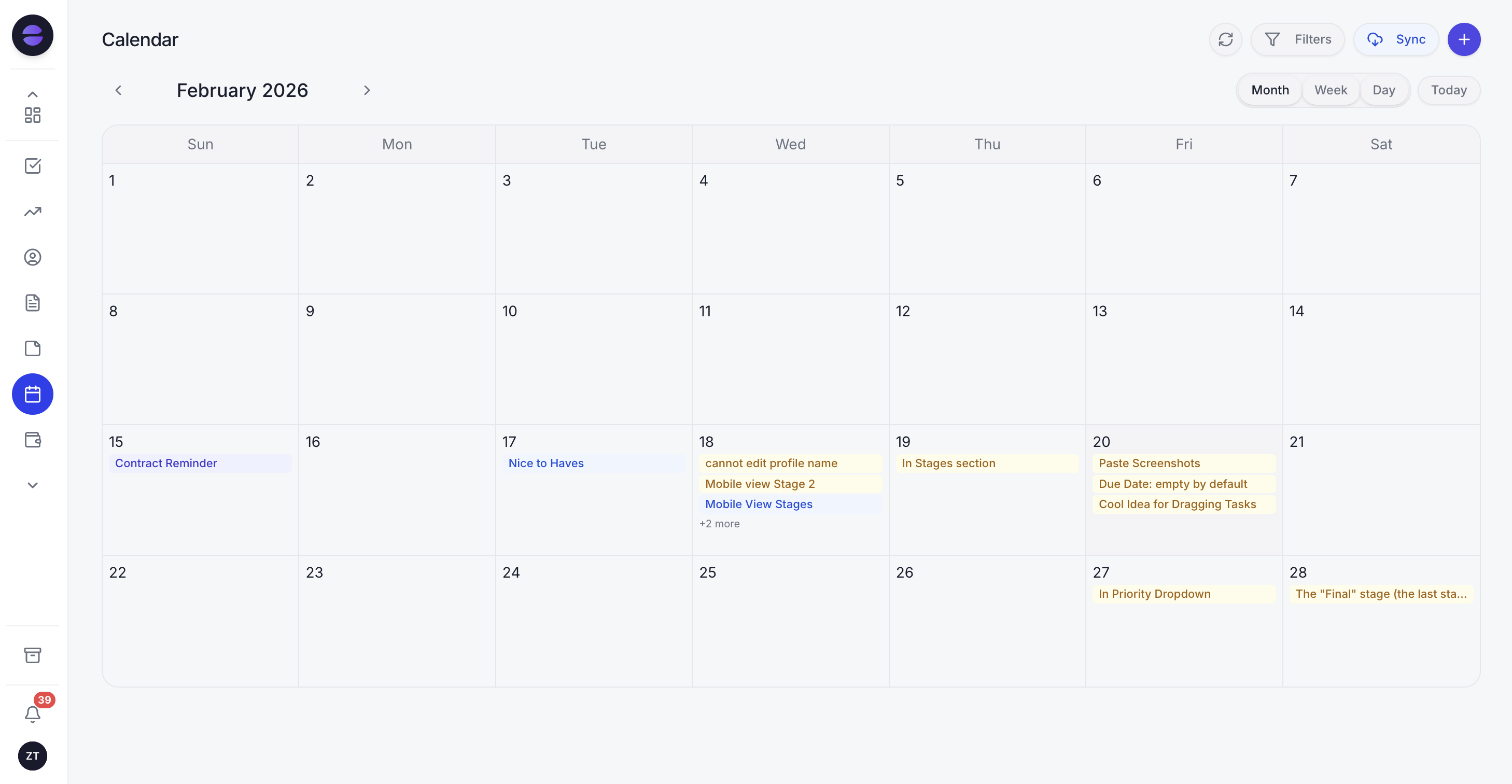
In a Google-plus-stack setup, your deadlines live in the project tool and your meetings live in Google Calendar, and the two never quite agree. Zoye's calendar IS the workspace calendar. Tasks appear on it automatically as their due dates arrive, meetings layer over deadlines, and there is no sync to configure between separate systems.
Reports across the whole business
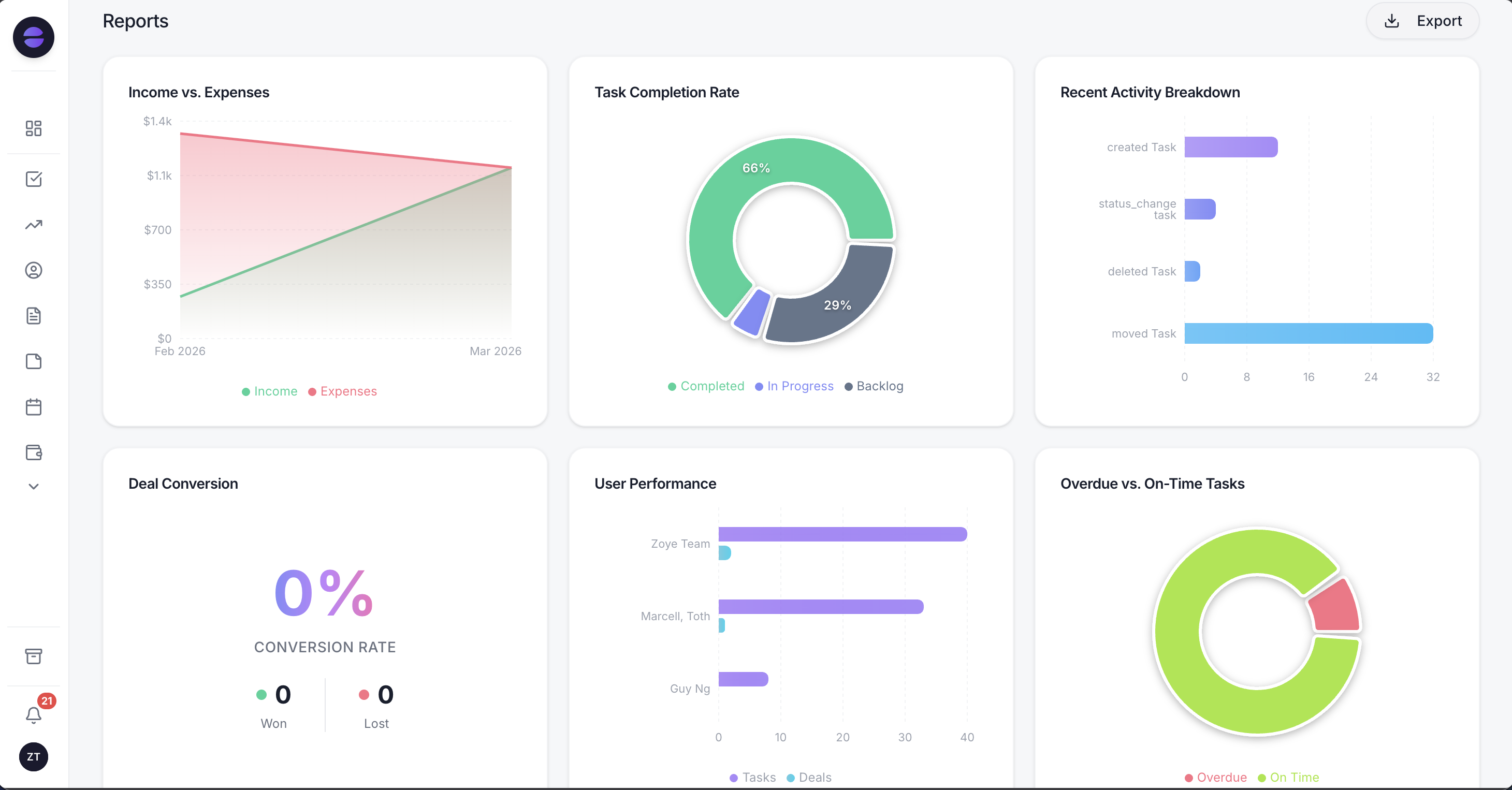
Pulling a status update out of Google Workspace means stitching together a doc, a sheet, and whatever the separate CRM and PM tools export. Zoye Reports brings financial, task, deal, and team data into one exportable dashboard. The weekly status report is a click, not an afternoon of copy and paste.
Zoye Assistant - AI that acts across the workspace
This is the difference that matters most against the Google-plus-Gemini approach. Gemini drafts and summarises inside a document. Zoye's assistant, named Zoye, runs across the entire workspace and takes action. It drafts task descriptions from a short brief, surfaces overdue and blocked work before deadlines slip, reassigns workload by team capacity, generates a weekly status report on demand, schedules meetings around deadlines, and creates tasks straight from incoming emails. It also handles deduplication and tagging when you migrate data in. It acts; it does not just suggest.
Zoye also has a live WhatsApp integration and import connectors for Trello, Jira, Notion, ClickUp, and Monday.com, so the operational data you already keep elsewhere comes across cleanly.
The pricing model is the other half of the value. Where Google Workspace and the stack on top of it all bill per seat, Zoye is flat-rate. A 15-person team pays one fixed monthly fee on Growth instead of multiplying four subscriptions by fifteen people.
Pricing: Almost Free from $5 per month ($4 billed annually) for 1 member with the full platform including AI, cancel or upgrade anytime. Starter from $29 per month (up to 10 members). Growth from $59 per month (up to 20 members). Flat-rate, not per seat. AI included at every tier.
Best for: Teams that keep Gmail but want to replace the CRM, project, budget, and AI stack they bolt onto Google with one workspace.
2. Microsoft 365 - the closest like-for-like swap
Microsoft 365 is the most direct Google Workspace replacement when you want a full office suite. Outlook, Word, Excel, PowerPoint, Teams, OneDrive, and SharePoint cover the same ground as Gmail, Docs, Sheets, Slides, Meet, and Drive, often with more depth in the desktop apps. Copilot adds AI across the suite for teams already paying for it.
The trade-offs are familiar: it is still per-seat pricing, the AI features sit behind additional cost, and like Google it is an office suite rather than an operations platform, so CRM, project management, and budget tracking remain separate purchases. For a deeper comparison, see the best Microsoft 365 alternatives.
Pricing: Business Basic from around $6 per user per month, Business Standard around $12.50 per user per month, Business Premium around $22 per user per month.
Best for: Teams that want the most complete like-for-like office suite, especially Windows-centric organisations.
3. Zoho Workplace - the affordable full suite
Zoho Workplace is the strongest pick when you want a full office suite at a lower price than Google or Microsoft. It bundles mail, a docs and spreadsheet editor, presentations, cloud storage, chat, and video meetings, and it plugs into the broader Zoho ecosystem (including Zoho CRM) if you want to extend beyond the basics.
The trade-off is that the polish and ecosystem maturity sit a step behind Google and Microsoft, and stitching the wider Zoho suite together to cover CRM and projects can become its own integration project. For a closer look, see the best Zoho alternatives.
Pricing: Free plan for small teams, Standard around $3 per user per month, Professional around $6 per user per month.
Best for: Cost-conscious small businesses that want a complete office suite cheaper than Google Workspace.
4. Notion - the docs-first collaboration alternative
Notion is the strongest pick for teams whose Google Workspace usage is mostly documents, wikis, and shared knowledge. Its docs and databases are best in class, and it doubles as a lightweight project tracker, so it can replace a chunk of Docs and Drive while adding structure Google never had.
The trade-off is that Notion is not an email client and not a true office suite, so it complements rather than fully replaces Google Workspace. Its AI is a separate paid feature. For a wider comparison, see the best Notion alternatives.
Pricing: Free for personal use, Plus around $10 per user per month, Business around $15 per user per month.
Best for: Content-heavy teams that want docs, wikis, and knowledge management beyond what Google Docs offers.
5. ClickUp - the work-management alternative
ClickUp is the alternative for teams whose pain is less about email and more about the project and task chaos that Google Workspace cannot organise. It covers tasks, docs, goals, time tracking, and dashboards in one tool, so it can absorb the operational work that would otherwise spread across Sheets and Docs.
The trade-offs are a steep learning curve, an AI feature (ClickUp Brain) that is a paid add-on rather than native, and the fact that it is a work-management platform, not an email or full office suite. For more, see the best ClickUp alternatives.
Pricing: Free plan, Unlimited around $7 per user per month, Business around $12 per user per month, plus the Brain AI add-on.
Best for: Teams that want to replace the project and task layer Google Workspace lacks.
6. Nextcloud - the privacy-first, self-hosted suite
Nextcloud is the leading choice for teams that want full data control. It is open source and self-hostable, giving you file sync and share, calendars, contacts, a collaborative office editor, video calls, and more, all running on infrastructure you own. For privacy, compliance, and data sovereignty, nothing on this list goes further.
The trade-off is operational: self-hosting means you (or a managed provider) run the server, handle updates, and own the uptime. The experience is excellent once configured, but it asks more of you than a hosted product.
Pricing: Free to self-host (you provide the server). Paid enterprise support and managed hosting are available from various providers.
Best for: Privacy-conscious and compliance-driven teams that want to own their data and can run their own infrastructure.
7. Proton - the encrypted, privacy-first suite
Proton is the privacy-first alternative for teams that want encryption without running their own server. Proton Mail, Calendar, Drive, Docs, and Pass deliver end-to-end encrypted email and storage from Switzerland, under strong privacy law. It is the closest thing to a privacy-by-default Google Workspace.
The trade-off is scope: Proton focuses on secure communication and storage, so it does not aim to provide CRM, project management, or an acting AI assistant. It replaces the inbox and drive with an encrypted equivalent, not the operational stack.
Pricing: Free tier available, Proton Business plans from around $7 per user per month depending on storage and features.
Best for: Privacy-first teams that want encrypted mail, calendar, and storage without self-hosting.
Best Google Workspace alternative for small business
For a small business, the right pick depends on which gap hurts most. If you simply want a cheaper full office suite, Zoho Workplace is the value leader and Microsoft 365 is the most complete swap. If your real problem is that Google Workspace leaves you tracking customers in a spreadsheet and projects in your head, Zoye is the clearest answer, because it adds the CRM, project management, budget, and AI a small business actually needs to operate, at flat-rate pricing that does not punish you for hiring.
Many small teams land on a practical combination: keep Gmail for email, and run Zoye for the operations. That keeps the familiar inbox while finally giving the business a real system for customers, projects, and money.
Best AI-powered Google Workspace alternative
Zoye is the strongest AI-native alternative here. Google's Gemini and Microsoft's Copilot are both capable, but they live inside the document and the inbox, drafting and summarising when asked. They are assistants for writing, not operators for the business.
Zoye's assistant is wired into the same data as the CRM, projects, calendar, and budget, so it does the operational work: it creates tasks from incoming emails, assigns them by current workload, drafts customer follow-ups, schedules meetings around deadlines, and generates a weekly status report on demand. The AI is the way you run the workspace, not a sidebar that comments on a single file.
Best privacy-first Google Workspace alternative
For privacy, the choice comes down to how much control you want. Proton is the easiest privacy-first path: hosted, end-to-end encrypted mail, calendar, drive, and docs with nothing to maintain. Nextcloud goes further by being open source and self-hostable, so your data never leaves infrastructure you own, at the cost of running that infrastructure yourself.
Either one keeps your communication and files out of the Google ecosystem. Neither, by design, provides the CRM and operations layer, so privacy-focused teams often pair one of them with a dedicated operations platform.
How to choose the right Google Workspace alternative for your team
Three questions narrow the field quickly.
1. Are you replacing email, or the stack on top of email? If you want a like-for-like office suite, look at Microsoft 365, Zoho Workplace, or a privacy-first suite. If your real problem is the CRM, project tool, budget tracker, and AI you bolt onto Google, Zoye replaces that operational layer in one workspace.
2. How much do you care about privacy and data control? If end-to-end encryption or self-hosting is non-negotiable, Proton (hosted, encrypted) and Nextcloud (open source, self-hosted) are the two to evaluate first.
3. How do you want to pay? Per-seat pricing means every hire raises the bill across every tool you stack. Zoye's flat-rate model fixes the operations cost regardless of headcount, which is why growing teams often consolidate there.
Migrating away from Google Workspace
The migration people dread is the email migration, and it is genuinely the most involved part of any move, which is one reason many teams keep Gmail and change only the layer above it. If you are switching email suites, the mature options (Microsoft 365, Zoho, Proton) all provide guided import tools for mail, contacts, and calendars, and the process is well-trodden.
Replacing the operational stack is usually the easier and higher-value move. Most teams have customer data scattered across Sheets, project notes in Docs, and budget numbers in another spreadsheet. Consolidating that into one workspace is an opportunity to leave the stale copies behind and bring across only what is live.
For teams moving the operations layer to Zoye specifically, the assistant handles the import interactively. You describe what you have today (customers in a spreadsheet, projects in another tool, the live deals that matter) and Zoye proposes the equivalent structure, deduplicates the records, and tags them as it brings them in, asking only about the choices that genuinely matter.
Why teams pick Zoye to replace the Google stack
Three points come up most often when teams explain the switch.
First, the operations finally live in one place. CRM, projects, calendar, budget, and reports stop being four subscriptions and become one workspace, so the team stops switching logins to do its job.
Second, the pricing makes sense. Flat-rate billing replaces a pile of per-seat subscriptions, so the cost of running operations stops climbing with every new hire.
Third, the AI does work. Instead of an assistant that drafts inside a single document, Zoye's assistant takes action across the whole business, from creating tasks out of emails to writing the weekly report.
Keep the docs and email you rely on, and let Zoye take over the customers, projects, and numbers Google Workspace was never built to manage. Almost Free starts you off at $5 per month (or $4 per month billed annually), yours to cancel or upgrade at any point.
For more context, see the best Microsoft 365 alternatives, the best Notion alternatives, the best ClickUp alternatives, and the best Zoho alternatives.