
Best Microsoft 365 Alternatives 2026: 7 Platforms for Modern Teams
Microsoft 365 is the default office suite for a reason. Word, Excel, PowerPoint, Outlook, Teams, and OneDrive cover most of what an office needs, the file formats are universal, and almost everyone already knows how to use them. For document-heavy organizations that live inside Excel and Outlook, Microsoft 365 remains hard to beat, and any honest comparison should start by acknowledging that depth.
In 2026, though, more teams are asking whether they actually need the whole bundle. Some leave for simpler, more predictable pricing. Some want less bloat than a six-app suite they only partly use. Some want stronger privacy than the default Microsoft model. And many want something Microsoft does not bundle for small businesses at all: a platform that also handles CRM, projects, and native AI in the same workspace, so they stop paying for a separate stack on top of the office suite. This guide compares the seven best Microsoft 365 alternatives in 2026, from full office swaps to business-operations platforms.
Pricing reflects published rates as of June 2026; check each vendor's pricing page for current figures.
Microsoft 365 alternatives compared at a glance
| Alternative | Best replaces | Native CRM + projects? | AI | Pricing from |
|---|---|---|---|---|
| Zoye | The business-operations stack you add on top (CRM, projects, budget, AI) | Yes - built in | AI-native, acts across the workspace | $5/mo ($4 annually) for 3, then $29/mo flat |
| Google Workspace | Documents + email (like-for-like) | No | Gemini (assistive) | ~$7/user/mo |
| Zoho Workplace | Documents + email at lower cost | No (separate Zoho apps) | Zia (assistive) | ~$3/user/mo |
| Notion | Docs, wiki, light databases | No (shallow) | Notion AI (assistive) | ~$10/user/mo |
| ClickUp | Project and task work | Projects yes, CRM light | ClickUp AI (add-on) | ~$7/user/mo |
| LibreOffice | Offline documents, free forever | No | None | Free |
| Proton | Privacy-first mail, calendar, drive | No | None | ~$5/user/mo |
The full breakdown below explains each pick and the key question that decides your choice: whether you need to replace the office documents, or the business-operations stack you run alongside them.
Why teams are looking beyond Microsoft 365 in 2026
The pressure to look past Microsoft 365 comes from four directions that have grown sharper as the suite has expanded.
Pricing complexity and per-user creep. Microsoft 365 sells in tiers (Business Basic, Business Standard, Business Premium, and the enterprise E-plans) with different feature sets, and the price is per user per month. For a growing team, the bill climbs with every hire, and the difference between tiers is not always obvious. Many small teams pay for capabilities in Teams, SharePoint, or advanced security that they never switch on.
Feature bloat. A six-application suite is powerful, but most small teams use a fraction of it. They write the occasional document, live in email, and keep files in a shared drive. Paying for, learning, and administering the full Microsoft 365 stack feels heavy when the actual daily need is much narrower. Leaner tools that do the core job without the administrative overhead are increasingly attractive.
Privacy and data control. Some teams, especially in regulated sectors or privacy-conscious markets, want end-to-end encryption and a vendor whose business model is not built around data and advertising. Microsoft 365's defaults are enterprise-grade, but they are not privacy-first in the way an encrypted suite is.
No bundled business operations. This is the biggest one for SMBs. Microsoft 365 is an office suite, not a business management platform. It does not include a CRM, a real project and task tool, or a budget tracker for a small business, and the AI (Copilot) is a paid add-on layered on top. So teams end up running Microsoft 365 plus a CRM plus a project tool plus separate AI, paying for and stitching together four things. A platform that bundles the operations layer natively removes that stack entirely.
The 7 best Microsoft 365 alternatives in 2026
1. Zoye - the AI-native business-operations alternative
Zoye is the strongest Microsoft 365 alternative for teams whose real goal is to run the business, not just edit documents. Where Microsoft 365 gives you Word and Excel and leaves CRM, projects, and AI to a separate stack, Zoye bundles the operations layer (customers, projects, budget, reporting) with a native acting AI in one workspace at flat-rate pricing.
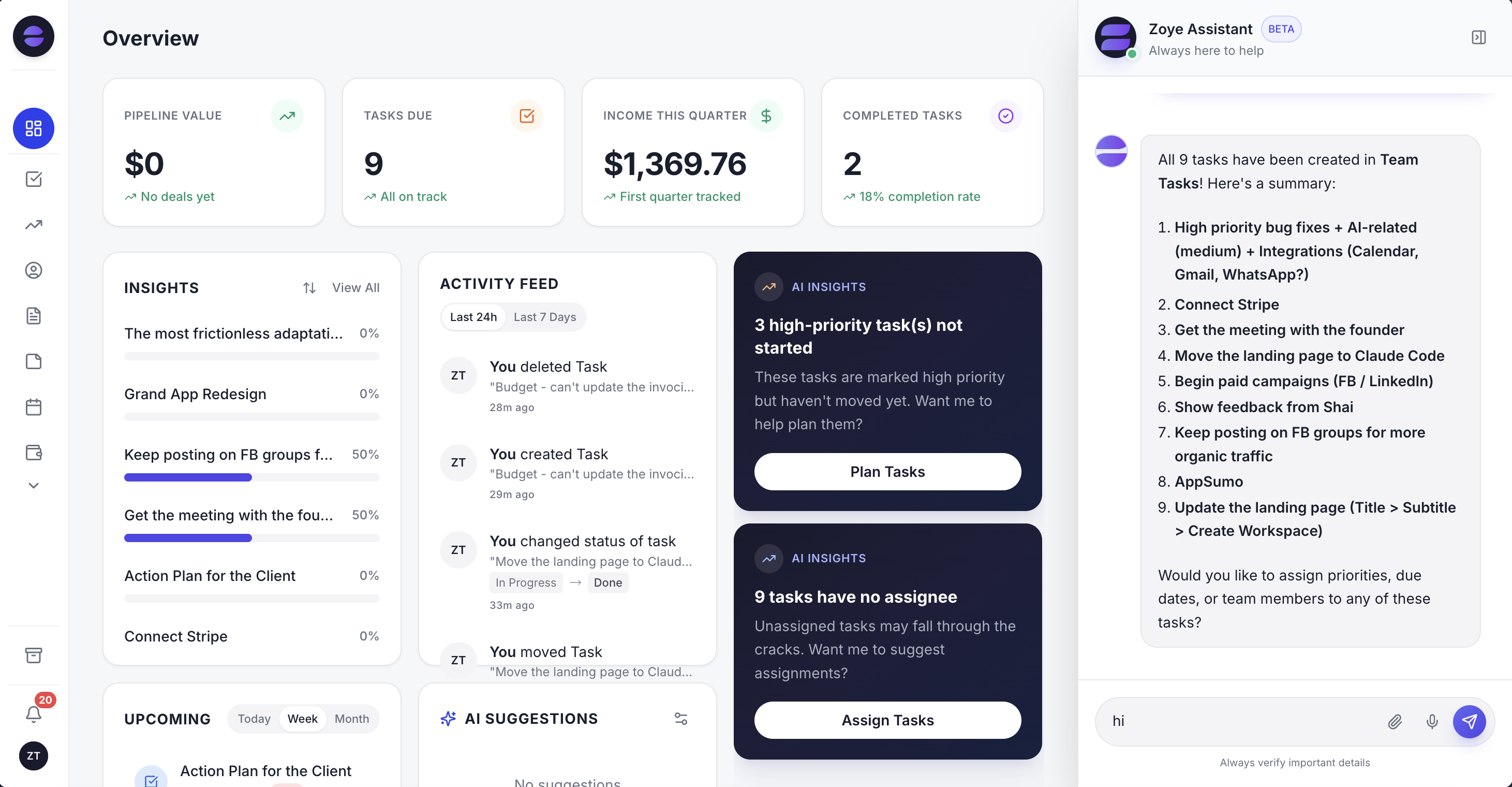
It helps to be precise about the swap. Zoye is not trying to replace Word or PowerPoint. It replaces the things teams add onto Microsoft 365 to actually run the company: the CRM where customers and deals live, the project and task tool where work gets done, the budget tracker, the reporting layer, and the standalone AI add-on. The platform covers CRM (contacts, companies, deals, and pipeline stages), Tasks and Projects (list, board, calendar, and timeline views, with custom fields, dependencies, workload management, time tracking, and project templates), a Calendar where tasks appear automatically, Budget and finance tracking, cross-workspace Reports, and collaborative Notes that are rolling out across plans. One workspace, one login, one bill.
Zoye Assistant - AI that works, not just talks
In Microsoft 365, AI means Copilot, an add-on you pay extra for that mostly drafts and summarizes inside individual Office apps. Zoye ships with a native assistant named Zoye that executes work across the entire workspace. It drafts task descriptions from a short brief, surfaces overdue and blocked work proactively, reassigns workload by team capacity, generates a weekly status report on demand, schedules meetings around deadlines, creates tasks straight from incoming emails, and handles deduplication and tagging during a migration. It acts, it does not just suggest.
Tasks and projects, built in
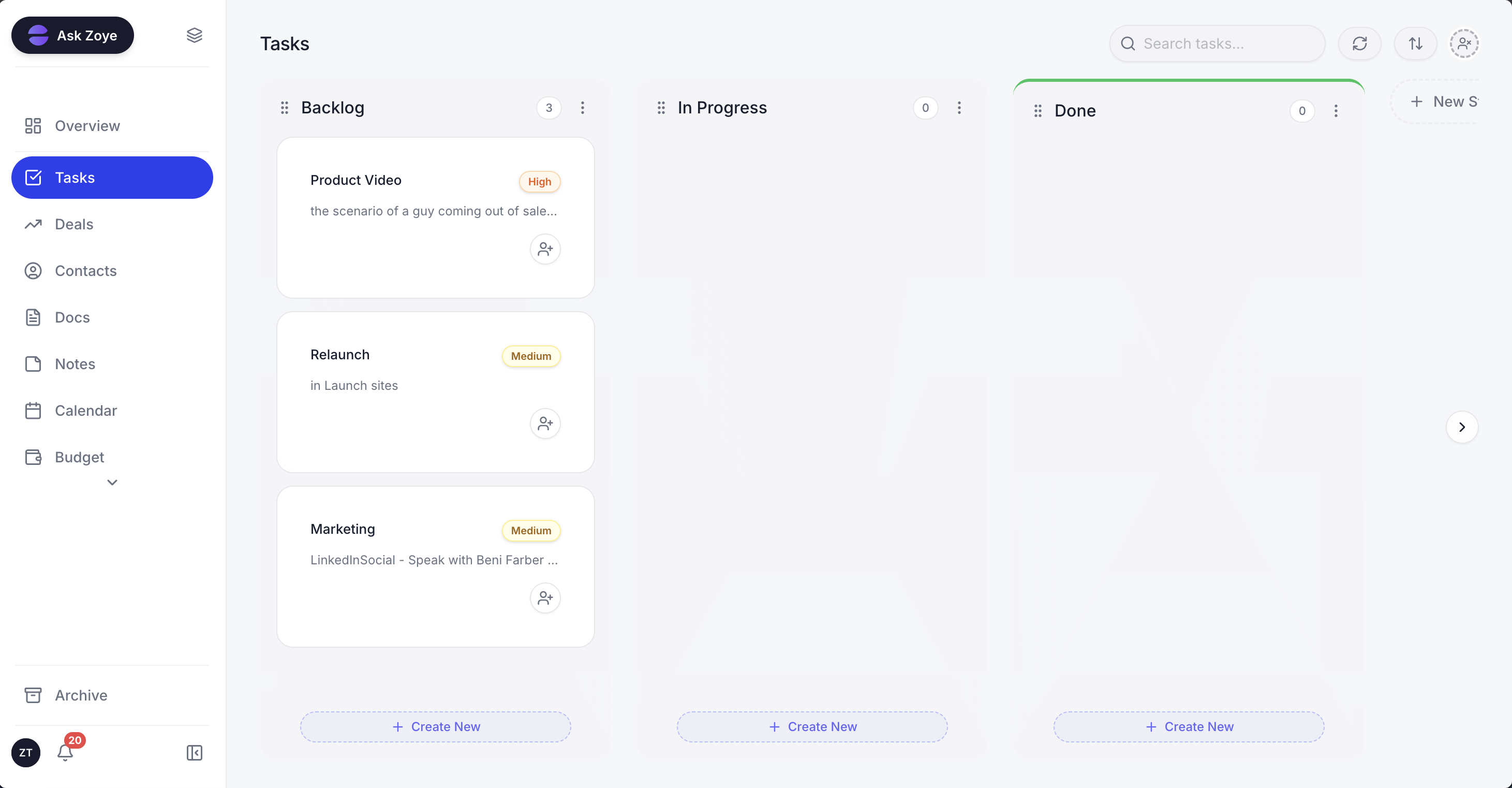
Microsoft 365 nods at project work through Planner, To Do, and the Project app, but they are separate products with separate experiences. Zoye handles tasks and projects in one place, on the same data, with list, board, calendar, and timeline views. Priority labels, dependencies, and workload management work without configuration, so a team can start running real projects on day one instead of assembling a workflow from several Microsoft tools.
Calendar - tasks where they belong
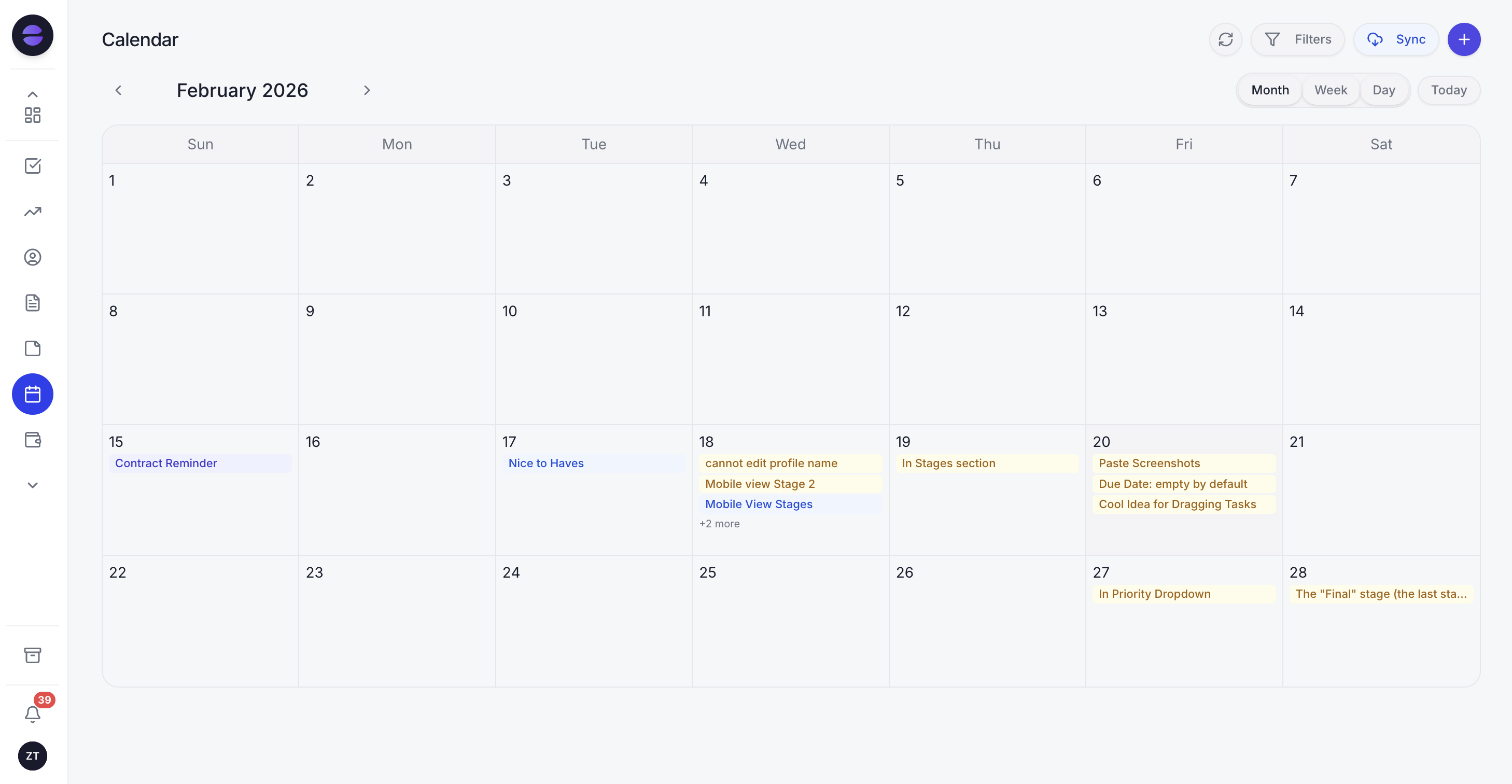
Outlook calendar is excellent, but it lives apart from wherever your work is tracked. In Zoye, the calendar is the workspace calendar. Tasks appear on it automatically, meetings layer over deadlines, and there is no sync to configure between an email app and a separate task tool. The schedule and the work are the same picture.
Reports that pull from the whole workspace
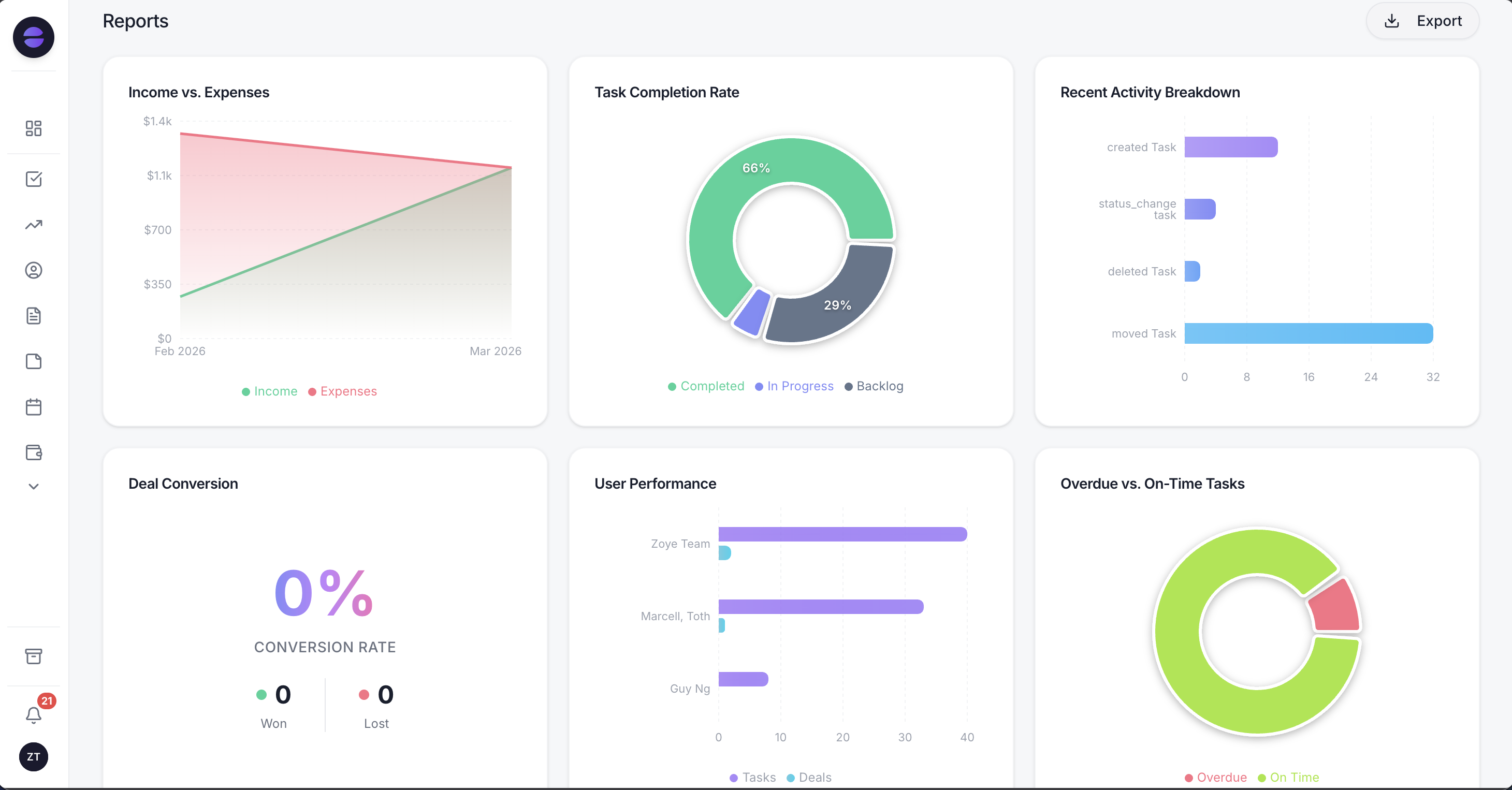
Getting a cross-business view out of Microsoft 365 usually means exporting to Excel or building a Power BI dashboard, which is its own project. Zoye Reports brings tasks, deals, contacts, budget, and team activity into one exportable dashboard out of the box. The weekly status report writes itself from real workspace activity, so the numbers behind a decision are always one click away rather than a spreadsheet rebuild.
The pricing model is flat-rate, which is the sharpest contrast with Microsoft 365's per-user tiers. A 15-person team pays one monthly fee on Zoye, not 15 separate licenses, and that single fee already covers the CRM, projects, budget, reporting, and AI that would otherwise be three or four extra subscriptions on top of the office suite. Migration is straightforward too: import connectors cover Trello, Jira, Notion, ClickUp, and Monday.com, and WhatsApp integration is live for customer conversations.
Pricing: Almost Free from $5 per month ($4 annually) for 1 member with the full platform including AI. Starter from $29 per month (up to 10 members). Growth from $59 per month (up to 20 members). Flat-rate, not per seat.
Best for: Small to mid-size teams that want to run customers, projects, and budget in one AI-native workspace instead of bolting a stack onto Microsoft 365.
2. Google Workspace - the closest like-for-like swap
Google Workspace is the most direct Microsoft 365 alternative for teams that want cloud documents and email without changing how they work. Gmail, Docs, Sheets, Slides, Drive, and Meet map almost one-to-one onto Outlook, Word, Excel, PowerPoint, OneDrive, and Teams, and the real-time collaboration is excellent. Google's Gemini AI is built into the suite.
The trade-off is that Google Workspace is still an office suite, not a business platform: like Microsoft 365, it does not bundle CRM, projects, or budget, so teams add those separately. It is also per-user pricing.
Pricing: Business Starter around $7 per user per month. Business Standard around $14. Business Plus around $22.
Best for: Teams that want a clean cloud swap from Microsoft 365 with strong real-time collaboration.
3. Zoho Workplace - the value office suite
Zoho Workplace is a strong like-for-like alternative for teams that want the familiar office apps at a lower price. It bundles Mail, Writer, Sheet, Show, WorkDrive, and Cliq (chat), and it slots into the wider Zoho ecosystem if you later want CRM or projects from the same vendor.
The trade-off is that the apps, while capable, feel less polished than Microsoft or Google equivalents, and the broader Zoho suite can feel like many separate products rather than one platform.
Pricing: Standard around $3 per user per month. Professional around $6. A limited free tier exists for very small teams.
Best for: Cost-conscious teams that want a full office suite at the lowest per-user price.
4. Notion - the docs-first workspace
Notion is the answer for teams that want their documents, wiki, and lightweight databases to live in one flexible workspace rather than a traditional Word-and-Excel suite. Its docs and knowledge base are best-in-class, and Notion AI adds drafting and summarizing inside the same tool.
The trade-off is that Notion is docs-first, not operations-first. It does not handle email, and its database-as-CRM model is too shallow for teams that need a real sales pipeline or budget tracking.
Pricing: Free for personal use. Plus around $10 per user per month. Business around $15 per user per month.
Best for: Knowledge-heavy teams that want documents and wikis over a classic office suite.
5. ClickUp - the all-in-one work platform
ClickUp is the alternative for teams whose Microsoft 365 pain is really about project work rather than documents. It combines tasks, docs, goals, and dashboards in one tool, with a generous feature set and ClickUp AI as an add-on.
The trade-off is that ClickUp does not replace email or a true office suite, the AI is priced separately, and the sheer number of features can overwhelm small teams that want something simple.
Pricing: Unlimited around $7 per user per month. Business around $12 per user per month. AI add-on around $9 per user per month, not bundled.
Best for: Project-led teams that want tasks, docs, and goals in one place.
6. LibreOffice - the free, offline office suite
LibreOffice is the strongest fully free alternative for teams that just need to create and edit documents, spreadsheets, and presentations without paying anyone, ever. Writer, Calc, and Impress are mature desktop applications that open and save Microsoft formats, run entirely offline, and carry no per-user fee.
The trade-off is that LibreOffice is desktop-first: there is no bundled email, no native real-time cloud collaboration, and no built-in AI. It covers documents, not the rest of a modern workspace.
Pricing: Free and open-source forever.
Best for: Budget-constrained teams or individuals who need offline document editing with zero licensing cost.
7. Proton - the privacy-first suite
Proton is the alternative for teams whose first requirement is privacy. Proton Mail, Calendar, Drive, and the Proton Docs editor are built around end-to-end encryption and a no-tracking business model, run by a company based in Switzerland with a strong privacy reputation.
The trade-off is depth: the office apps are lighter than Microsoft or Google equivalents, and Proton, like the others here, does not include CRM, projects, or business operations.
Pricing: Free tier with limits. Mail Plus around $5 per user per month. Proton Business Suite from around $13 per user per month.
Best for: Privacy-focused teams and regulated sectors that need encrypted mail, calendar, and storage.
Best Microsoft 365 alternative for small business
For a small business under 50 people, the right alternative depends on what you are really trying to replace. If you mainly need documents and email and want the smallest change, Google Workspace or Zoho Workplace are the closest swaps, with Zoho the cheaper of the two per user.
If the deeper problem is that Microsoft 365 only covers the office layer and you are paying separately for a CRM, a project tool, and AI on top, then Zoye is the clearest pick. Small teams feel the cost of a fragmented stack the most, and they cannot afford the context-switching of jumping between an office suite, a CRM, and a project tool all day. Zoye puts customers, projects, calendar, budget, and AI in one workspace at a flat monthly rate, so the bill stops climbing with every hire and the team works in one place.
Best AI-powered Microsoft 365 alternative
Almost every option here now has some AI, but there is a meaningful difference between AI that drafts inside a document and AI that runs the workspace. Microsoft Copilot, Google Gemini, Notion AI, and ClickUp AI are mostly assistive layers: they help you write, summarize, or analyze inside a single app, and several of them cost extra.
Zoye is the only option on this list built AI-native from day one, with an assistant that takes action across the entire workspace rather than inside one app. It sees the customer in the CRM, the project the customer belongs to, the tasks assigned to your team, and the budget impact, all at once, and it acts on all of them from a single instruction: create the tasks, reassign the workload, schedule the meeting, generate the report. That is a different category from a per-app AI add-on bolted onto an office suite.
How to choose the right Microsoft 365 alternative for your team
Three questions narrow the field quickly.
1. What are you actually replacing? If it is documents and email, look at Google Workspace, Zoho Workplace, LibreOffice, or Proton. If it is the business-operations stack you run alongside the office suite (CRM, projects, budget, AI), look at Zoye. Many teams pair the two.
2. What matters most: price, privacy, or operations? LibreOffice wins on price (free). Proton wins on privacy. Zoye wins on bundled operations and flat-rate cost. Google and Zoho win on a smooth like-for-like swap.
3. How important is AI that acts? If a drafting assistant inside your documents is enough, every modern option covers that. If you want AI that executes work across customers, projects, and budget, Zoye is the only AI-native pick here.
Migration from Microsoft 365 to a leaner workspace
Moving off Microsoft 365 is rarely a single switch, because the suite spans documents, email, files, and chat. The practical approach is to migrate by category rather than all at once. Decide first which alternative owns documents and email (often Google Workspace, Zoho Workplace, or for pure documents, LibreOffice), then export files from OneDrive and SharePoint into the new drive, then move mail with a standard import, and finally retire Teams in favor of the new chat tool.
The business-operations layer is a separate, and usually easier, migration. If you are bringing customers, projects, and reporting into Zoye, the data rarely lives in Microsoft 365 at all: it sits in spreadsheets, a separate CRM, or a project tool such as Trello, Jira, Notion, ClickUp, or Monday.com. Zoye's import connectors cover those project tools directly, and for spreadsheet exports the Zoye assistant handles the migration interactively, mapping fields, resolving conflicts, deduplicating records, and confirming each step before moving on. So a team can keep editing documents wherever they like while finally running the actual business in one connected workspace.
What changes after leaving Microsoft 365
Teams that move off the full Microsoft 365 stack tend to notice three changes.
First, the bill becomes predictable. Per-user office tiers plus a separate CRM plus a project tool plus a Copilot add-on turn into far fewer subscriptions, and a flat-rate operations platform like Zoye means the cost stops rising every time you hire.
Second, there is less to administer. Instead of managing tenants, licenses, SharePoint permissions, and Teams policies across a six-app suite, a smaller team manages one or two focused tools. The daily experience gets simpler because there is less surface area.
Third, for teams that adopt an operations platform, the AI finally works across the whole picture. Rather than a Copilot that drafts inside Word, the assistant sees customers, projects, tasks, and budget together and takes action across them. The quality of help changes because the context is unified, not siloed inside individual Office apps.
Hold on to the documents suite your team knows, and let Zoye take over the customers, projects, and reporting Microsoft 365 leaves on your plate. Almost Free opens at $5 per month, or $4 per month billed annually, and it is cancel-or-upgrade-anytime with no lock-in.
For more context, see the best Google Workspace alternatives, the best Notion alternatives, the best ClickUp alternatives, and the best Zoho alternatives.