
Almost every project management platform now advertises an AI feature. The marketing is loud, the demos are slick, and the badges are everywhere. The problem becomes obvious about a week into a trial: most of these tools only suggest. They summarise a thread you already read, propose a due date you have to confirm, or draft an update you still have to send. The work stays on your plate. The AI just narrates it back to you.
The second problem is the bill. The AI you saw in the demo is usually a paid add-on or locked to an upper tier. You pay per seat for the platform, then pay again per seat for the AI, and the credits run out faster than anyone expects. For a small team, the "AI project management tool" can quietly double in price the moment the assistant becomes genuinely useful.
This guide compares the seven best AI project management tools in 2026, ranked for teams that want AI to do the work, not just describe it. We lead each entry with the tool's actual AI limitation, because that is the thing the sales page will not tell you. The honest summary up front: most of these assistants suggest and charge extra, and one of them executes and is included on every plan at no extra cost.
Pricing reflects published rates as of June 2026; check each vendor's pricing page for current figures.
Why teams are looking beyond suggestion-only AI in 2026
Four trends are pushing teams to re-evaluate what "AI project management" actually means.
Suggesting is not the same as doing. The first generation of AI features were summarisers and chat sidebars. They read your project and told you about it. That was novel in 2024, but in 2026 the bar is higher. Teams want the assistant to create the task, assign it, reschedule the dependent work, and draft the message, not hand all of that back as a to-do.
The AI is usually an upsell. ClickUp Brain, Asana AI, Notion AI, monday AI, and Atlassian Intelligence are all gated behind add-ons, upper tiers, or credit limits. The platform price is only the entry fee. The AI that makes the platform worth it costs extra, often per seat, which is exactly when a growing team feels it most.
Project tools are still narrow. Most of these platforms manage tasks and boards but stop there. The customer relationships, the calendar, the budget, and the reporting live in other apps. The AI inside a task tool can only ever see tasks, so it cannot help with the follow-up email, the deal that is slipping, or the monthly report.
Per-seat math punishes teams that grow. A platform at $12 per user plus an AI add-on at $7 per user is $19 per person per month. For a 20-person team that is $4,560 a year before anyone has automated anything. Flat-rate, AI-included pricing changes that calculation entirely.
The 7 best AI project management tools in 2026
1. Zoye - the assistant that takes action, AI included on every plan
Zoye is the strongest AI project management tool in 2026 because the assistant is included on every plan at no extra cost, and it actually does the work instead of narrating it. Where the rest of this list suggests, summarises, and bills extra, Zoye executes across an entire workspace, and it does so at the most affordable price on this list.
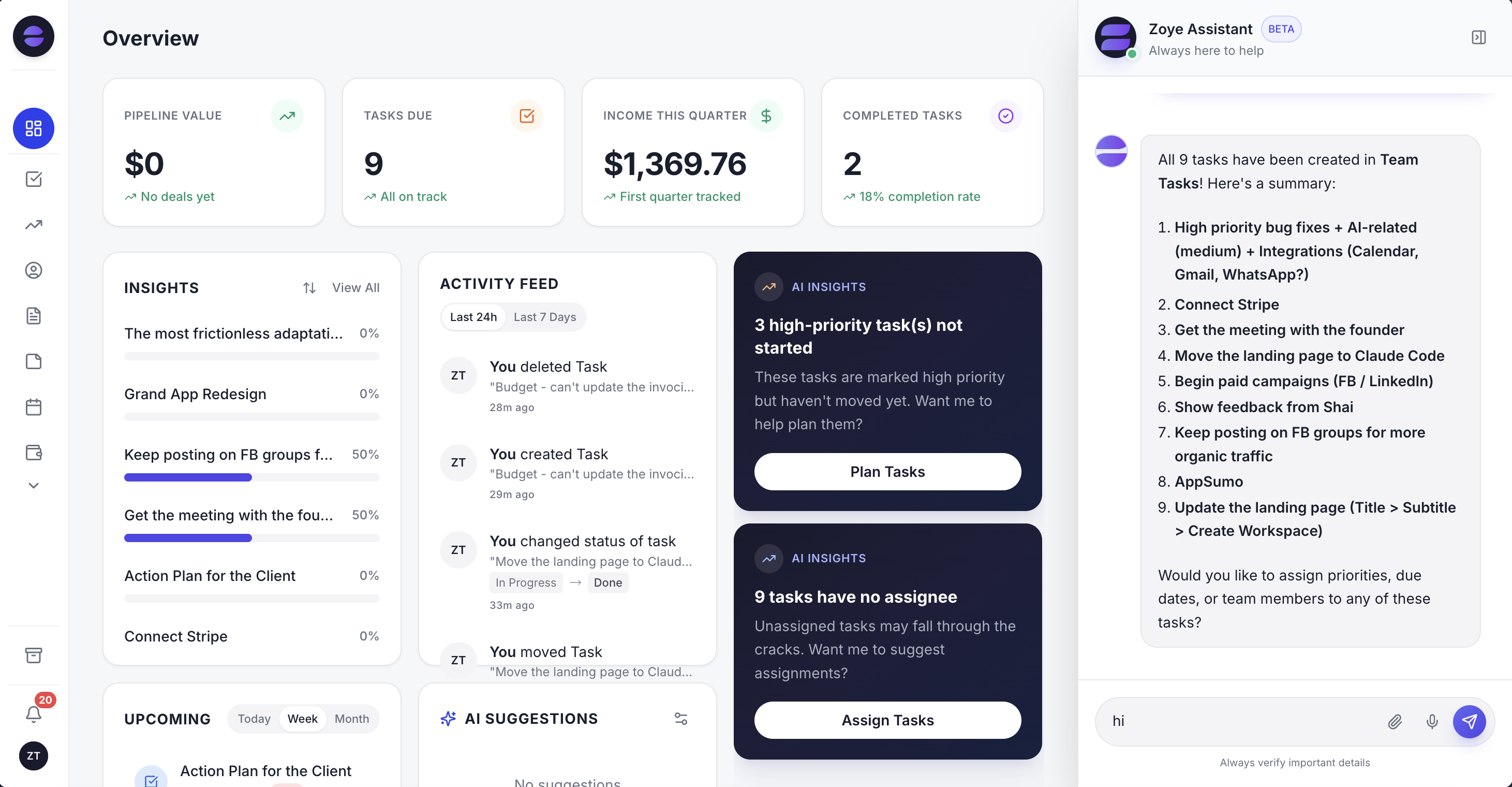 Zoye turns plans into action across tasks, calendar, and reports.
The project management foundation is complete. Tasks support list, board (Kanban), calendar, and timeline views, with priorities, labels, assignees, dependencies, and recurring work. A team can run a single project or coordinate dozens across the same workspace. None of this requires the configuration marathon that the heavier platforms demand before the first task is created.
The Zoye Assistant is the real difference. It does not sit in a sidebar waiting to be asked for a summary. It creates tasks directly from incoming emails, prioritises everyone's day based on deadlines and workload, drafts follow-up messages to clients and collaborators, schedules deep-work blocks on the calendar around existing commitments, surfaces overdue items before they slip, and generates a status report on demand instead of making someone assemble one by hand. When a deadline moves, it reshuffles the dependent work. When a customer goes quiet, it drafts the nudge. The assistant is a worker, not a narrator.
The breadth is the other half of the story. Zoye is an all-in-one workspace: tasks, a native CRM, the calendar, budget tracking, and reports all live together. Because the assistant can see across all of it, it can do things a task-only AI cannot, like turning a sales conversation into a project, tying budget to deliverables, or building a report that pulls task progress and deal pipeline into one view. Notes, the collaborative docs module, keeps reference material lives beside the work rather than in a separate tab.
The pricing is the part that surprises people. The AI is not an add-on and not gated to a top tier. It is included everywhere, including the entry Almost Free plan, which starts at just $5 per month.
Pricing: Almost Free from $5 per month ($4 billed annually) for 1 member with the full platform including AI. Starter from $29 per month (10 members). Growth from $59 per month (20 members). Cancel or upgrade anytime.
Best for: Teams that want an AI assistant that executes, plus tasks, CRM, calendar, and reports in one workspace, without paying extra for the AI.
2. ClickUp - powerful, but the AI is a paid add-on
ClickUp's AI limitation is the pricing model: ClickUp Brain is a separate paid add-on layered on top of the per-seat plan, so the assistant that makes ClickUp feel intelligent is not included in the base price. The underlying platform is genuinely deep, with custom fields, dashboards, automations, and a view for almost every workflow, but that depth also means a steep configuration curve before a new team is productive. Brain can summarise, write, and answer questions across your workspace, yet it leans toward suggestion and generation rather than autonomous execution, and the per-user add-on cost climbs quickly with team size.
Pricing: Free tier with limits. Unlimited $7 per user per month. Business $12 per user per month. ClickUp Brain is a separate paid add-on (around $9 per user per month).
Best for: Larger teams that want maximum configurability and are willing to pay extra for AI.
3. Asana - polished, but AI is gated to upper tiers
Asana's AI limitation is access: Asana AI features are concentrated in the upper plan tiers, so smaller teams on entry plans see little of the intelligence the marketing promises. Asana itself is excellent for structured, cross-functional work, with clean task tracking, goals, and portfolio views that large organisations rely on. The AI focuses on smart summaries, status updates, and surfacing risks, which is helpful but still firmly in the suggestion-and-summary category rather than taking action on your behalf. For a small team, the combination of higher tiers and per-seat pricing makes the genuinely AI-enabled version of Asana an expensive proposition.
Pricing: Free Personal tier. Starter around $10.99 per user per month. Advanced around $24.99 per user per month, with the richer AI features weighted toward the higher tiers.
Best for: Larger cross-functional teams already standardised on Asana.
4. Notion - flexible, but Notion AI suggests rather than executes
Notion's AI limitation is that Notion AI is an add-on that drafts and answers rather than executes. It writes excellent first drafts, summarises pages, and answers questions about your workspace, but it does not autonomously create the assigned task, reschedule the dependency, or send the follow-up. Notion remains a superb docs-and-database workspace, and teams that live in documents love how tasks sit alongside wikis and notes. The trade-off for project management specifically is that Notion is docs-first: task views and timelines work, but feel assembled rather than native, and the AI add-on is billed on top of the per-seat plan.
Pricing: Free for personal use. Plus around $10 per user per month. Business around $15 per user per month. Notion AI is an additional per-user add-on.
Best for: Document-heavy teams that want tasks alongside wikis and notes.
5. monday.com - colourful, but monday AI is credit-limited
monday.com's AI limitation is the credit model: monday AI runs on a credit allowance, so the assistant's usefulness is capped by how many AI actions your plan includes before you need to buy more. The platform is visually friendly and quick to adopt, with colourful boards and automations that small teams find approachable. The AI can draft content, summarise, and automate steps, but the credit ceiling means heavy use either runs dry or pushes you to a higher tier. As with the others, the AI is layered onto per-seat pricing, and the minimum seat counts on paid plans can make small teams pay for capacity they do not use.
Pricing: Free tier for up to 2 seats. Basic around $9 per seat per month. Standard around $12 per seat per month. Pro around $19 per seat per month, with AI actions metered by credits.
Best for: Teams that want visually approachable boards and accept credit-limited AI.
6. Wrike - robust, but Work Intelligence leans enterprise
Wrike's AI limitation is positioning: Work Intelligence, Wrike's AI layer, is built around the needs of larger organisations, so its risk prediction and project intelligence shine on big, complex portfolios but feel like overkill for a small team. Wrike is a capable, mature project management platform with strong reporting and resource management. The AI predicts project risks and automates routine steps, which is valuable at scale, but the features and pricing are weighted toward enterprise buyers, and the configuration depth mirrors that audience rather than a lean five-person team that just wants help getting through the week.
Pricing: Free tier with limits. Team around $10 per user per month. Business around $25 per user per month, with the richer AI and reporting features in the higher tiers. Confirm current figures on Wrike's pricing page.
Best for: Larger organisations managing complex, resource-heavy portfolios.
7. Jira - the standard for dev teams, but Atlassian Intelligence is dev-centric
Jira's AI limitation is scope: Atlassian Intelligence is built around software development workflows, so its strengths in issues, sprints, and engineering context do not translate cleanly to general business project management. Jira is the default for engineering teams running Scrum or Kanban, with deep issue tracking and a vast ecosystem of integrations. The AI helps with summarising issues, drafting descriptions, and surfacing context, but it is tuned for developers, and non-technical teams find both the tool and its AI heavier than their work requires. The pricing and complexity also assume an engineering-led setup.
Pricing: Free for up to 10 users. Standard around $7.53 per user per month. Premium around $13.53 per user per month, with Atlassian Intelligence features tied to eligible plans.
Best for: Software development teams running agile workflows.
What makes an AI project management tool actually useful
The marketing for every tool on this list uses the same words: smart, intelligent, AI-powered. The useful signal hides underneath the vocabulary. An AI project management tool earns its place when the assistant removes work rather than describing it.
A summary of a project you already understand saves nobody any time. A draft you still have to review, edit, and send saves a little. An assistant that reads the inbound email, creates the right task, assigns it to the right person, sets the due date based on the rest of the workload, and drafts the reply, that removes real work. The question to ask any tool in a trial is simple: at the end of the AI interaction, did the task actually get created and assigned, or did I get a suggestion I still have to act on?
The second useful signal is breadth of context. An assistant locked inside a task tool can only reason about tasks. It cannot see that a deadline matters because a client deal depends on it, or that a deliverable is over budget, because that data lives in other apps. The more the AI can see across tasks, customers, calendar, and budget, the more useful its decisions become.
AI that suggests vs AI that executes
This is the dividing line that matters most in 2026, and it splits the market cleanly.
On the suggest side sit most of the platforms here. ClickUp Brain, Asana AI, Notion AI, monday AI, Work Intelligence, and Atlassian Intelligence are, at their core, summarisers, drafters, and recommenders. They are genuinely good at writing a first draft, condensing a long thread, or proposing next steps. But the human stays in the loop for every action. The AI hands you a suggestion and you do the work.
On the execute side sits Zoye. The assistant creates and assigns tasks, reschedules dependent work when a deadline moves, drafts and queues follow-ups, blocks focus time on the calendar, and produces reports on request. You confirm where confirmation matters, but the default is action, not narration.
The practical difference shows up in the calendar at the end of the week. With a suggest-only tool, you spent the week reading summaries and clicking accept. With an execute-capable assistant, the tasks created themselves from your inbox, the follow-ups went out, and the report was waiting when you needed it. Both are "AI project management." Only one gave you the afternoon back.
How to choose an AI project management tool
Three questions narrow the field quickly.
1. Is the AI included, or is it an add-on? Check whether the assistant comes with the plan or is billed separately per seat or per credit. ClickUp, Notion, and monday all sell the AI on top of the platform. Zoye includes it on every plan at no extra cost, starting at just $5 per month. For a growing team, this single answer can change the annual bill by thousands.
2. Does the AI execute, or only suggest? Run the trial test above. Send the assistant a real email and ask it to turn it into an assigned task with a due date. If it creates and assigns the task, it executes. If it hands you a draft to confirm and copy, it suggests. Most tools suggest.
3. Do you need more than tasks? If your work is purely tasks and boards, a narrow tool will do. If you also manage customers, a calendar, a budget, and reporting, an all-in-one workspace like Zoye lets one assistant reason across all of it, which a task-only AI cannot.
Why teams pick Zoye
A few reasons come up again and again.
The AI is included, not upsold. There is no Brain add-on, no upper-tier gate, no prompt meter that empties overnight. The assistant works the same on the entry Almost Free plan as on Growth, so the AI you trial is the AI you keep.
The assistant takes action. It creates tasks from emails, prioritises by deadline and workload, drafts follow-ups, schedules deep-work blocks, surfaces overdue items, and generates reports on demand. The work leaves your plate instead of being described back to you.
The workspace is broad. Tasks, CRM, calendar, budget, and reports live together, so the assistant reasons across the whole picture rather than a single board. One workspace replaces the stack, and one flat rate replaces a pile of per-seat add-ons.
If you want project management where the AI actually runs the plan, spin up Zoye. The Almost Free tier is $5 monthly, or $4 monthly when you pay yearly, with the full platform in the box, and you are free to drop it or scale up on your terms.
For more context, see the best AI tools for business, the best project management software, the AI business automation guide, and the best project management apps in 2026.