
Asana vs Trello 2026: Which Wins, and a Better Third Option
Asana and Trello are the two tools most teams compare when they move off spreadsheets and email threads. They share a parent company, Atlassian, but they are built for different stages of a team's life. Trello is the simplest way to get a Kanban board running: cards, lists, and a few clicks, and you are organised. Asana is a structured work-management platform that ties daily tasks to timelines, goals, and company objectives, built to hold up as a team and its workload grow.
The honest problem with the Asana-versus-Trello debate is that they often are not really competing for the same job. Trello is the easy on-ramp; Asana is the engine room. And both leave the same gaps: neither includes a real AI assistant in its everyday plan, neither covers CRM or budget in the same place as your tasks, and both bill per seat, so the price climbs with every hire. If you are weighing the two, the right answer might be a different kind of tool entirely.
This comparison walks through the dimensions that actually decide the choice - ease of use, views, scale, AI, and pricing - and is fair about where Trello and Asana each genuinely win. Then it covers the third option both miss.
Pricing reflects published rates as of June 2026; check each vendor's pricing page for current figures.
Asana vs Trello at a glance
| Dimension | Zoye | Asana | Trello |
|---|---|---|---|
| AI assistant | Included on every plan, takes action | Asana AI - Advanced (~$24.99/user/mo)+ | Lightweight AI, no full assistant |
| Views | List, Board, Calendar, Timeline | List, Board, Timeline, Calendar, Gantt | Board (Kanban); others via Power-Ups |
| CRM / Deals | Built in, all plans | Not included | Not included |
| Budget / finance | Built in | Not included | Not included |
| Ease of use | Same-day, AI does the setup | Structured, moderate learning curve | Easiest, board-simple start |
| Scale | Grows without re-platforming | Built for scale + goals | Strains past simple boards |
| Pricing model | Tier-based, not per seat | Per seat | Per seat + paid Power-Ups |
| Entry plan | Almost Free, $5/mo, 1 member, full platform incl AI | Personal, up to 10 users | Generous free Kanban |
| Team plan price | $29/mo (whole team, up to 10) | ~$10.99/user/mo annual | ~$5/user/mo annual |
| Best for | Teams wanting tasks + CRM + budget + AI in one | Growing teams needing structure at scale | Small teams wanting a simple board |
Ease of use and getting started
This is the dimension where Trello and Asana diverge most sharply, and it is usually the first thing a team feels.
Trello is about as simple as project software gets. The entire product is built around one idea: a board with lists and cards you drag from one column to the next. A new user can build a working board in a few minutes with no training, no onboarding project, and no decisions about hierarchy. For a small team, a side project, or a personal workflow, that low friction is genuinely hard to beat. You open Trello and you are productive immediately.
Asana is more structured and therefore takes longer to learn. Tasks live inside projects, projects roll up into portfolios, and everything can tie to goals. There are lists, boards, timelines, and a calendar, plus rules, custom fields, and dependencies. That depth is the point - it is what lets Asana hold a complex, multi-team operation together - but a new user has more to absorb in the first week. You adapt to Asana's model rather than inventing your own.
Verdict: Trello for the fastest, simplest start with almost no learning curve. Asana when you are willing to invest a little setup time to get real structure.
Views: boards, lists, and timelines
How you can look at your work is where the two tools show their different ambitions.
Trello is, at heart, a single-view tool. The Kanban board is the product, and it is an excellent one: clean, visual, and satisfying to drag cards across. Other views - calendar, timeline, table, dashboard - exist, but most arrive through Power-Ups, the add-ons that extend Trello's capability. Layer enough of them on and Trello can do more, but each Power-Up is one more thing to configure, and some of the most useful ones sit behind paid plans.
Asana ships multiple views as standard. List view is dense and fast for teams that live in task lists. Board view covers Kanban. Timeline gives you a clean Gantt-style picture of dependencies and milestones, and Calendar shows deadlines at a glance. Switching views is instant, and the same task data renders every way without add-ons. For a team that needs to see work as both a list and a timeline, Asana is built for that out of the box.
The honest gap for both: a view is still just a view of your tasks. Neither pulls your customer pipeline, your budget, or your calendar into the same picture, because those live in other tools.
Verdict: Trello if a single great Kanban board is most of what you need. Asana if you need lists, timelines, and calendars working together without stacking add-ons.
Scale: where each tool tops out
This is where the comparison stops being a coin toss.
Trello is brilliant up to a point and then starts to strain. As soon as a team needs cross-project reporting, dependencies between tasks, workload balancing, or a portfolio view across many boards, the pure-Kanban model runs out of room. You can bolt on Power-Ups to fill some gaps, but stacking add-ons turns a famously simple tool into a patchwork that is harder to maintain and, with paid Power-Ups, no longer cheap. Trello is the right tool for simple, board-shaped work, not for a sprawling operation.
Asana is built for exactly the scale Trello struggles with. Timeline, Workload, Goals, and the Work Graph that connects tasks to objectives are designed to keep a large, multi-team operation coherent. Reporting, portfolios, and dependencies are first-class, not add-ons. This is the core reason a growing company often graduates from Trello to Asana: the work outgrew the board.
Verdict: Trello for small, simple, board-shaped work. Asana when the team and the workload grow past what a single board can hold.
AI capabilities
Both tools have added AI, and both keep it modest.
Asana AI (Asana Intelligence) includes smart summaries, AI Studio for no-code workflows on higher tiers, and assignable AI features. It is a reasonable, well-integrated set, available from the Advanced tier (around $24.99/user/month) upward. It mostly summarises, drafts, and suggests inside projects.
Trello has added lightweight AI features for things like drafting card content, but there is no full assistant that runs your workflow. AI is a helper at the edges, not a core part of the product.
The shared limit is the same one every project tool hits: the AI lives inside the project tool. It can summarise a project or draft a description, but it cannot take a single instruction and execute across your tasks, a CRM, a calendar, and a budget, because those modules are not all in one system to begin with.
Verdict: Asana AI is the more capable of the two but sits behind a pricey tier. Trello's AI is a light helper. For an AI that takes action across your whole business, see the third option below.
The third option both miss: Zoye
Asana and Trello leave the same three holes: AI is limited and gated, the price scales per seat (plus Power-Ups on Trello), and you still need separate tools for CRM and budget. Zoye is an AI-native workspace that closes all three. Tasks, deals, contacts, calendar, budget, and reports live in one place, with a personal AI assistant included on every plan that takes real action across all of them from a single text or voice instruction.
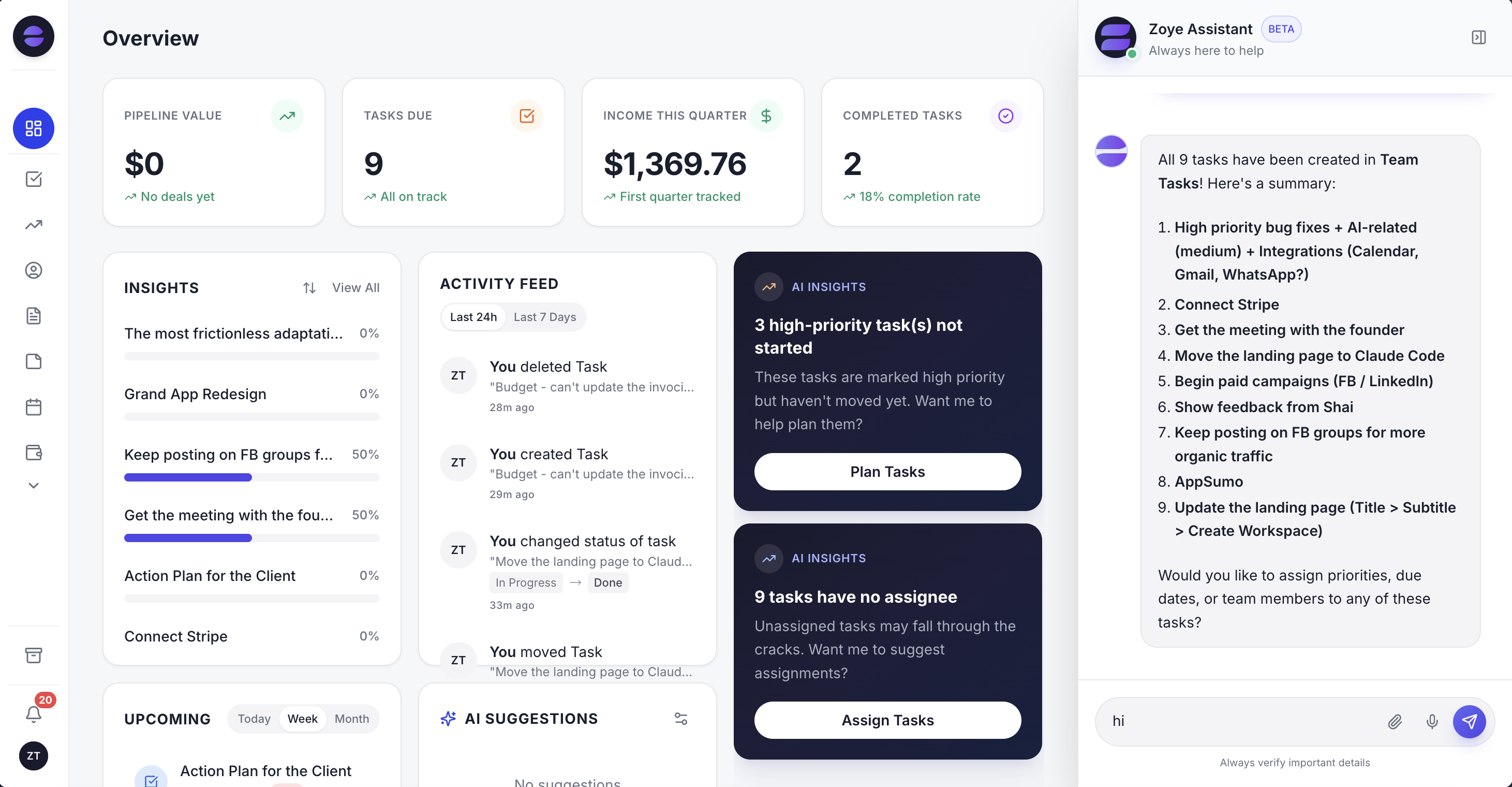 Zoye combines the board simplicity Trello is loved for with the structure Asana scales to, plus native CRM, budget, and an action-taking AI
Where Trello gives you a simple board and Asana gives you structured projects, Zoye gives you both. You get list, board, calendar, and timeline views, with custom fields, dependencies, workload management, and time tracking, so it stays simple to start but scales without re-platforming. The board below is ready to use the moment you open it, no Power-Ups to install.
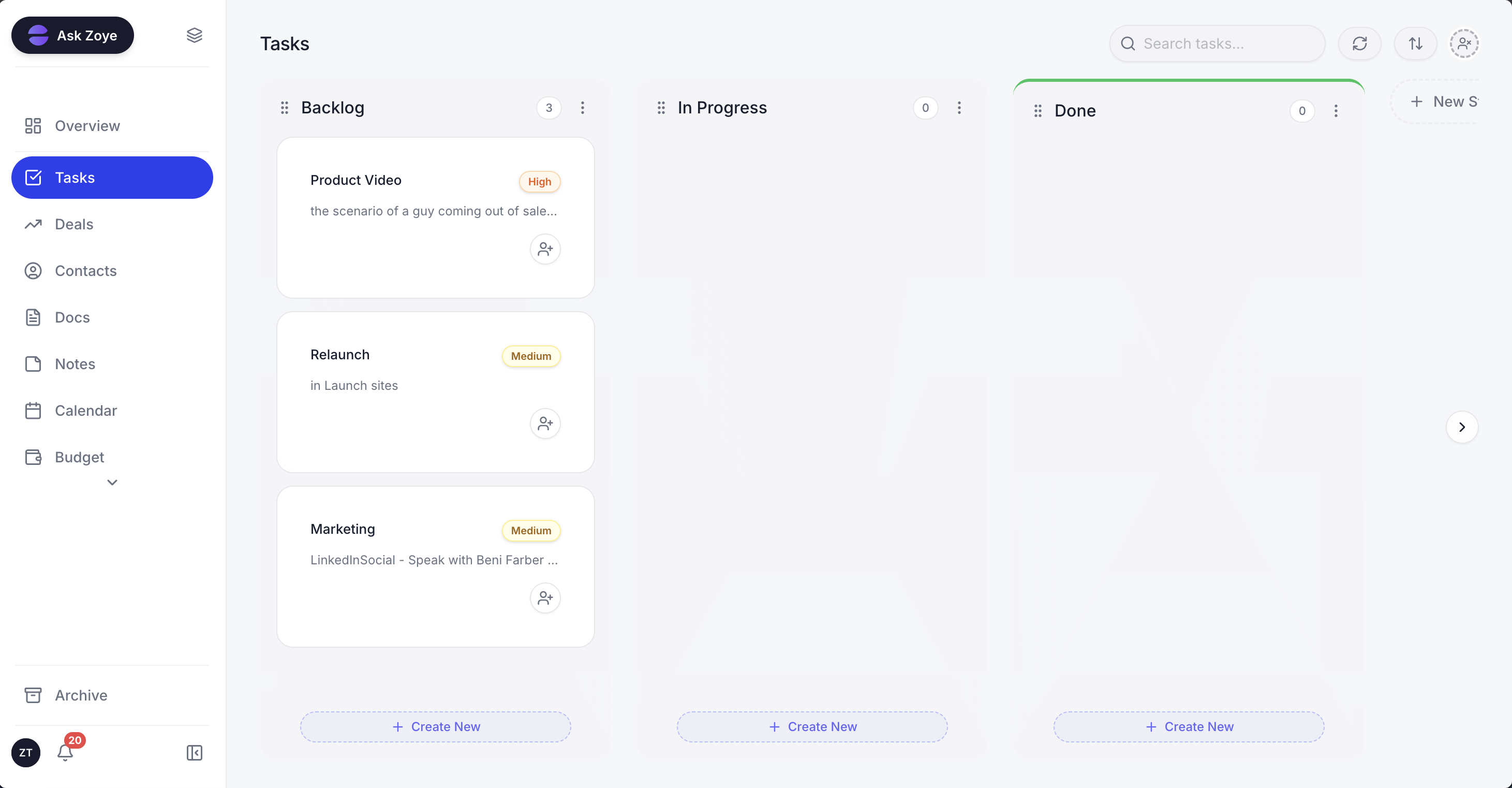 A clean Kanban board with priority labels, the Trello experience without the add-on hunt
What neither competitor touches is everything around the tasks. Zoye connects your project work to a real Deals-and-Contacts CRM, native budget tracking, and live cross-workspace reports, and your tasks land on the calendar automatically with no sync setup or integration to configure.
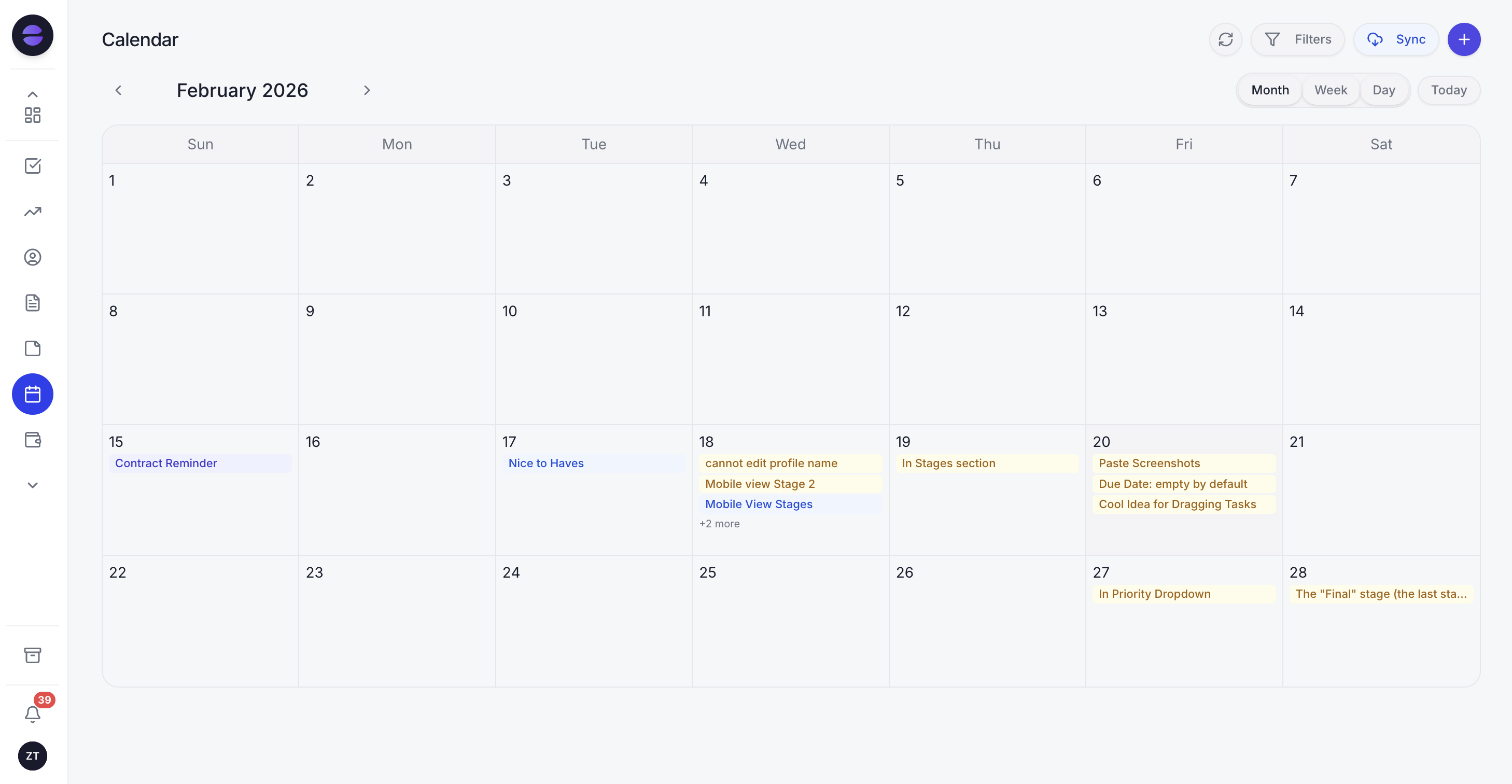 Deadlines flow onto the calendar on their own, so your schedule and your tasks are never out of step
The Zoye Assistant does not just suggest. It creates tasks from an incoming email, prioritises your day by deadline and workload, drafts follow-ups, schedules meetings around deadlines, surfaces overdue and blocked work proactively, reassigns workload by capacity, and generates a weekly status report on demand. During a migration from Trello or Asana, it also handles dedup and tagging so your data arrives clean. It acts, it does not just advise.
The pricing is flat, not per seat. The entry plan is Almost Free and covers 1 member with the full platform including AI at $5/month. Starter is $29/month for up to 10 members, and Growth is $59/month for up to 20. There are no paid Power-Ups to add and no AI tier to upgrade into. A 20-person team gets tasks, CRM, calendar, budget, reports, and an action-taking AI assistant for less than two Asana Advanced seats.
Real example: A 12-person marketing agency owner finishes a client call and dictates one line on her phone: "Brightwave wants a Q3 campaign, budget about $18K, kickoff in two weeks." Zoye opens the client deal, files the contact, books a kickoff event on the calendar, and drafts the campaign tasks against the budget. In Trello that is a board with no record of the client or the money; in Asana it is a tidy project but still no CRM and no budget.
Asana vs Trello on pricing
Per seat, Trello is the cheaper starting point, but the comparison is not as simple as the sticker price.
Trello pricing:
- Free: $0 (generous, unlimited cards, up to 10 boards per Workspace)
- Standard: around $5/user/month annual
- Premium: around $10/user/month annual
- Enterprise: custom
- (Many extra views and integrations arrive via Power-Ups, some paid)
Asana pricing:
- Personal: Free (up to 10 users, basic features)
- Starter: around $10.99/user/month annual
- Advanced: around $24.99/user/month annual (includes Asana AI)
- Enterprise / Enterprise+: Custom
The 20-person team math:
- Trello Premium: 20 x ~$10 = about $200/month (plus any paid Power-Ups, and still no CRM or budget)
- Asana Advanced (AI included): 20 x ~$24.99 = about $500/month
- Zoye Growth (20 members, AI + CRM + budget included): $59/month
For the same headcount, Zoye costs a fraction of either, and it also covers the CRM and budget that both Trello and Asana leave out entirely.
Verdict: Trello is the cheapest to start, especially on its free plan, but Power-Ups erode that advantage and it caps out on capability. Asana costs more per seat and bundles AI only at its top tier. Both are per-seat models that grow with headcount, and neither includes everything a running business needs.
Which should you choose?
Choose Trello if:
- You want the simplest possible board with almost no learning curve
- Your work is genuinely board-shaped and not very complex
- You are a small team, freelancer, or running a personal workflow
- A generous free plan matters more than depth
Choose Asana if:
- You expect to grow and want real structure from day one
- You need timelines, dependencies, workload, and goals at scale
- You can absorb the Advanced tier (around $24.99/user/month) for AI
- You do not need CRM or budget tracking in the same tool
Choose Zoye if:
- You want an AI assistant that takes action included on every plan
- You need tasks, CRM, calendar, and budget in one connected workspace
- You want board simplicity that still scales, without paid Power-Ups
- You prefer flat tier-based pricing over per-seat charges that grow with hiring
- You want to be operational the same day with no configuration project
The bottom line
Asana and Trello are both strong tools that often serve different moments in a team's life. Trello is the simplest, fastest way to get a Kanban board running, ideal for small teams and simple work that fit on a board. Asana is the structured, scalable choice, ideal for growing teams that need timelines, goals, and workload management to keep complex work coherent, and that can pay for the Advanced tier to unlock AI.
The real question for 2026 is not just which of the two wins, but whether either is built for how your business actually runs. Trello caps out as the work grows and leans on paid Power-Ups; Asana scales but gates AI and bills per seat. And neither gives you a customer pipeline, a budget, and your tasks in one connected place with an assistant that acts across all of them.
If you need that - one AI-native workspace with tasks, CRM, calendar, and budget, an assistant that takes real action, and flat pricing that does not punish growth - the honest answer is neither Asana nor Trello. Zoye is built for that team, with everything included on every tier and operational the same day you sign up.
For more context, see our guides to the best Asana alternatives, the best Trello alternatives, the best ClickUp alternatives, and the best project management apps in 2026.