Agile Project Management in 2026: A Complete Guide
Most projects do not fail because the team lacked talent. They fail because a long, rigid plan was written before anyone understood what the work would actually require, and then reality refused to match the plan. Requirements change, priorities shift, a customer asks for something nobody anticipated, and a six-month roadmap that looked airtight in a planning meeting starts to crack within weeks. The traditional response was to write the plan more carefully. The agile response is to stop pretending the future is knowable and to build a way of working that expects change.
Agile project management is that way of working. Instead of one big plan delivered at the end, the team delivers in short cycles, reviews progress constantly, and adjusts course as it learns. It started in software but now runs marketing campaigns, product launches, agency client work, and operations of every kind. In 2026, with teams smaller, faster, and more cross-functional than ever, agile is less a methodology you adopt and more the default expectation of how modern work gets done.
This guide explains what agile actually is, how it differs from waterfall and from Scrum, the core frameworks teams use, and the agile process step by step. It closes with what an agile team genuinely needs from its software and how to run agile in practice without drowning in tools. It is written for founders, team leads, and operators who want a clear, accurate picture rather than buzzwords.
What is agile project management?
Agile project management is an iterative approach to delivering work. Rather than committing to a fixed scope and a fixed timeline up front, the team breaks the work into small pieces, delivers them in short cycles, gathers feedback, and uses what it learns to shape what comes next. Each cycle produces something usable, so value arrives early and continuously instead of all at once at the end.
The foundation is the Agile Manifesto, written in 2001 by a group of software practitioners frustrated with heavy, document-driven processes. Its four values, in plain language, are:
- People and conversations over processes and tools. A team that talks to each other will outperform one that hides behind handoff documents, no matter how good the tooling.
- Working output over exhaustive documentation. A feature a customer can actually use is worth more than a perfect specification of a feature that does not exist yet.
- Customer collaboration over contract negotiation. Stay close to the people you are building for instead of treating the original brief as a contract to defend.
- Responding to change over following a plan. A plan is useful, but when the world changes, adapting beats marching forward off a cliff.
A common misreading is that the right-hand items do not matter. They do. The manifesto says the left-hand items matter more. Processes, documentation, and plans still exist in agile teams; they are just servants of the work, not the point of it.
Agile vs waterfall
Waterfall is the traditional, sequential model: gather all requirements, design everything, build everything, test everything, then release. Each phase finishes before the next begins, like water flowing down a series of steps. It works well when requirements are genuinely fixed and well understood, which is rarer than most plans assume.
Agile replaces the single long sequence with many short ones. The difference is easiest to see side by side.
| Dimension | Waterfall | Agile |
|---|---|---|
| Planning | Detailed plan up front | Continuous, rolling planning |
| Delivery | One release at the end | Frequent small releases |
| Change | Costly, resisted | Expected, welcomed |
| Feedback | After launch | Every cycle |
| Risk | Surfaces late | Surfaces early |
| Best fit | Fixed, well-known scope | Evolving or uncertain scope |
The practical upshot is that waterfall front-loads certainty and back-loads risk: you do not learn whether the plan was right until the end, when changing course is most expensive. Agile spreads the risk out, surfacing problems while they are still cheap to fix. For most modern work, where requirements evolve as you build, that trade is worth making.
Agile vs Scrum (and where Kanban fits)
This is the single most common point of confusion, so it is worth being precise. Agile is a mindset, a set of values and principles. It does not tell you exactly what meetings to hold or how long your cycles should be. Scrum and Kanban are frameworks: concrete ways to put the agile mindset into practice.
Scrum organises work into fixed-length cycles called sprints, with defined roles and a regular rhythm of meetings. Kanban organises work as a continuous flow on a board, limiting how much is in progress at once. Both are agile. Neither is more agile than the other; they simply suit different kinds of work.
So when someone asks "should we use agile or Scrum," the question itself is slightly off. Scrum is one way of being agile. You can be agile with Kanban, with Scrum, with a hybrid of both, or with your own tailored approach, as long as you hold to the underlying values: iterate, inspect, adapt.
The core agile frameworks
Three frameworks cover the overwhelming majority of agile teams.
Scrum
Scrum is the most widely adopted agile framework. Work is delivered in sprints, fixed cycles usually lasting one to four weeks, each producing a potentially shippable increment. Scrum defines three roles: the product owner, who owns the backlog and decides what gets built; the scrum master, who removes obstacles and protects the process; and the development team, who do the work. It also defines a set of ceremonies: sprint planning, the daily stand-up, the sprint review, and the retrospective. The strength of Scrum is its predictable rhythm; the cost is that it carries more structure than some teams need.
Kanban
Kanban is lighter. Instead of fixed sprints, work flows continuously across a board with columns like To Do, In Progress, and Done. Its defining discipline is the work-in-progress limit: a cap on how many items can sit in any column at once, which forces the team to finish work before starting more and exposes bottlenecks immediately. Kanban suits teams with a steady stream of incoming work and changing priorities, such as support, operations, or content teams, where committing to a fixed sprint scope is awkward.
Hybrid and Scrumban
Many real teams blend the two. Scrumban keeps Scrum's planning cadence and roles but manages day-to-day work with a Kanban board and WIP limits, giving a team the rhythm of sprints without rigid sprint commitments. The lesson is that frameworks are starting points, not rulebooks. The best agile teams adopt the practices that help and quietly drop the ones that do not.
The agile project management process step by step
Whatever the framework, the agile loop follows a recognisable shape. Here it is using Scrum's vocabulary, since it names every step clearly.
1. Build the backlog. Everything the team might do lives in a single prioritised list called the product backlog: features, fixes, research, ideas. The product owner keeps it ordered so the most valuable work sits at the top. The backlog is never finished; it evolves as the team learns.
2. Plan the sprint. At the start of each cycle the team holds sprint planning. It pulls the top backlog items it believes it can complete, clarifies what "done" means for each, and commits to a realistic amount of work. The selected items become the sprint backlog.
3. Run the daily stand-up. Each day the team meets briefly, often fifteen minutes, for the daily stand-up. The point is not status reporting to a manager; it is the team synchronising with itself, surfacing blockers, and adjusting for the day ahead.
4. Do the work. The team works the sprint backlog on a board, moving items from To Do to In Progress to Done. Progress stays visible to everyone, which is half the value of agile: no one has to ask where things stand.
5. Review the increment. At the end of the sprint the team holds a sprint review, demonstrating what it built to stakeholders and gathering feedback. This is where agile earns its keep, because the feedback flows straight back into the backlog and shapes the next sprint.
6. Reflect in the retrospective. Finally the team runs a retrospective, looking inward rather than at the product: what went well, what did not, and what one thing to change next time. Then the loop begins again. The continuous improvement this builds, sprint after sprint, is what makes mature agile teams steadily faster over time.
Benefits and challenges of agile
Agile is popular for good reasons, and honest about its costs.
The benefits are real. Value ships early and often rather than at the end, so a project starts paying off before it is finished. Risk surfaces early, when it is cheap to address, instead of ambushing the team at launch. The team adapts to change as a normal event, not a crisis. And visibility is constant: a shared board means everyone, including stakeholders, can see progress without a meeting.
The challenges are equally real. Agile demands discipline; without genuine commitment to the ceremonies and the backlog, "agile" quietly degrades into chaos with no plan at all. It needs engaged stakeholders who show up to reviews and give feedback, which not every organisation provides. Long-term predictability is softer than waterfall's fixed timeline, which can unsettle teams or clients who want a single delivery date. And it can be misapplied: cargo-culting the meetings without the mindset produces all the overhead and none of the benefit. Agile works when a team embraces the underlying values, not just the rituals.
How to run agile project management with the right tool
Frameworks and ceremonies only come alive when the team can see and move the work. In practice, an agile team needs a small set of things from its software: a board to visualise flow (ideally with multiple views, since the same work reads differently as a Kanban board, a list, a calendar, or a timeline), a backlog to prioritise, a way to run sprints and track progress, reporting such as a burndown to see whether a sprint is on pace, and ideally automation so the routine parts of agile (reminders, status updates, reprioritisation) do not eat the team's time. The mistake many teams make is stitching this together from four or five disconnected apps, then spending more energy maintaining the tooling than running the work.
Zoye brings all of it into one workspace. The same tasks can be viewed as a Kanban board for flow, a list for backlog grooming, a calendar for deadlines, and a timeline for the wider plan, so the team never exports data between tools to get a different angle on the same sprint.
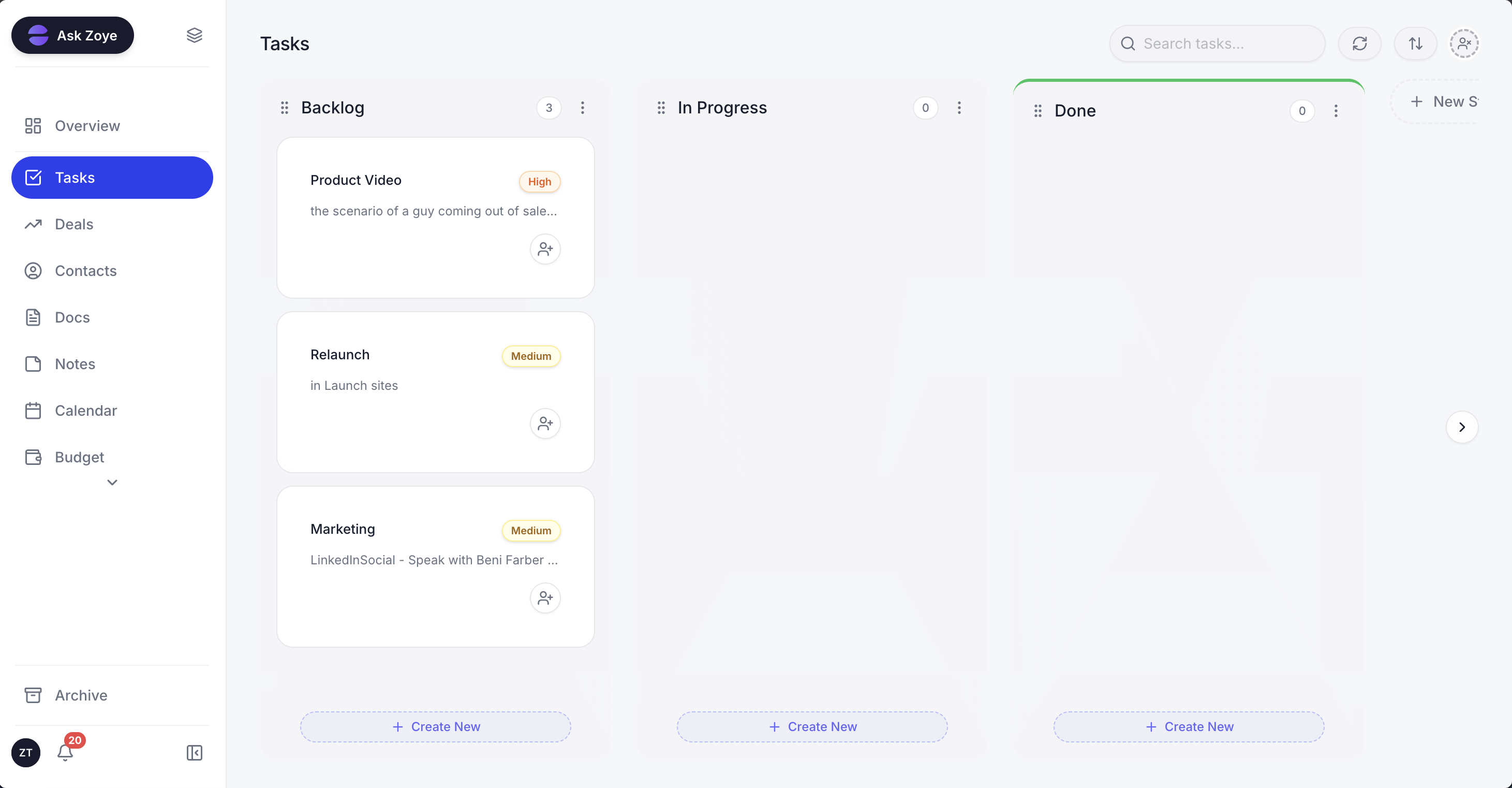 Zoye runs sprints on Kanban boards with list, calendar, and timeline views in one workspace.
What sets Zoye apart is that its AI assistant takes action rather than just suggesting. It prioritises the backlog by deadline and workload, so the top of the list reflects what genuinely matters next. It drafts updates for stand-ups and stakeholder reviews. It surfaces blockers and overdue items before they derail a sprint, rather than waiting for someone to notice. And it generates sprint reports on demand, turning a board full of tasks into a clear summary of what shipped, what slipped, and where the team stands. The assistant does the administrative work of agile so the team can focus on the actual work.
The other advantage is breadth. Because Zoye also includes a CRM, a calendar, and budget tracking in the same workspace, an agile team can connect the work on the board to the customers it serves and the money it costs, without bolting on separate systems. A product launch sprint, the customer conversations it depends on, and the budget it draws from all live together.
Pricing: Almost Free at $5 per month for 1 member with the full platform including AI. Starter from $29 per month (10 members). Growth from $59 per month (20 members). Scale from $119 per month (100 members).
Best for: Solo founders and small to mid-sized teams that want to run real agile, sprints, backlogs, boards, and reporting, in one AI-native workspace rather than a stack of disconnected apps.
A short conclusion
Agile is not a set of meetings to perform or a certificate to earn. It is a simple, durable bet: that delivering work in small increments, reviewing it honestly, and adapting as you learn beats committing to a long plan in a world that refuses to hold still. Whether you run Scrum, Kanban, or your own blend, the underlying loop, plan a little, build a little, review, reflect, repeat, is what matters. The frameworks are scaffolding around that loop, and the right tool is what keeps the loop turning without the overhead swallowing the work.
Try Zoye with your team. The entry plan is Almost Free at $5 per month for 1 member, with the full platform including AI.
For more context, see the best project management software in 2026, the best Kanban software, the best Gantt chart software, and ClickUp vs Asana.