
HubSpot vs Pipedrive 2026: Which CRM Wins for Sales Teams
HubSpot and Pipedrive show up on almost every sales-CRM shortlist in 2026, and they answer the same question from opposite ends. Pipedrive is the lean, sales-pipeline-first CRM built to do one job extremely well: move deals through stages with as little friction as possible. HubSpot is the broad platform that started in marketing and grew into a full CRM with marketing, service, and automation tools layered around it. One is focused and affordable, the other is powerful and sprawling.
The honest problem with the HubSpot-vs-Pipedrive debate is that each answer leaves a different hole. Pipedrive is narrow: it is excellent at pipeline, but light on marketing, support, and the broader operations a growing business actually runs on, so teams stack three to five other tools around it. HubSpot is the opposite: it can do a lot, but the useful pieces sit behind upper tiers and paid hubs, so the price and complexity climb fast as you grow. And both bill per seat, so either way the bill rises every time you hire.
This comparison walks through the dimensions that actually decide the choice for a sales team: ease of use, pipeline and views, automation, breadth, AI, and pricing. It is fair about where Pipedrive and HubSpot each win. Then it covers the third option both miss, for the buyer who needs more than a pipeline but does not want HubSpot's price tag.
Pricing reflects published rates as of June 2026; check each vendor's pricing page for current figures.
HubSpot vs Pipedrive at a glance
| Dimension | Zoye | HubSpot | Pipedrive |
|---|---|---|---|
| Core philosophy | AI-native all-in-one workspace | Broad CRM + marketing platform | Lean, sales-pipeline-first CRM |
| AI assistant | Included on every plan, takes action | Breeze AI - stronger on higher tiers | AI Sales Assistant - suggests, mostly paid plans |
| CRM depth | Solid contacts, companies, deals, stages | Strong, broad across hubs | Sharp pipeline, sales-focused |
| Marketing tools | Lightweight, in-workspace | Best-in-class Marketing Hub | Minimal, add-on Campaigns only |
| Ease of use | Same-day, AI does the setup | Easy for its size, more surface area | Very easy for pure pipeline |
| Automation | AI assistant executes across modules | Deep workflows on Pro+ | Workflow automation, sales-scoped |
| Projects / tasks | Built in (board, calendar, timeline) | Light tasks only | Activities and tasks, sales-scoped |
| Budget / finance | Built in | Not included | Not included |
| Pricing model | Flat tier-based, not per seat | Per seat, rises steeply at Pro+ | Per seat, climbs with team size |
| Entry plan | Almost Free, $5/mo, 1 member, full platform | Generous-ish free CRM | No free plan, trial only |
| Best for | Teams that want one workspace + AI that acts | Marketing-led teams wanting one platform | Focused sales teams on a budget |
Ease of use: focused versus broad
Both platforms are far easier than legacy enterprise CRMs, but they are easy in different ways.
Pipedrive is easier for pure pipeline work. It was built around one idea, a visual deal board where you drag a deal from stage to stage, and the whole product stays close to that idea. A sales rep can open Pipedrive, see the pipeline, and start working deals almost immediately. There is very little to configure before it is useful, and very little to get lost in. For a team whose only job is to move opportunities forward, that focus is the feature.
HubSpot is easy for its size. The interface is clean and consistent, onboarding is guided, and a small team can run a real pipeline within days. But HubSpot is a bigger surface: alongside the CRM you are navigating marketing tools, service tools, automation, and reporting. That breadth is the point if you want everything in one app, but it is more to learn than Pipedrive's single-minded board.
Verdict: Pipedrive for a sales team that wants to start moving deals today with nothing to set up. HubSpot for a team that wants one platform for sales and marketing and accepts a little more surface area.
Pipeline and views: sales clarity versus platform breadth
Pipedrive's pipeline is the cleanest in the category. The deal board is the heart of the product, and it shows. You can see exactly where every deal sits, what is rotting, and what needs a nudge today. Pipedrive layers activity reminders, deal-rotting alerts, and a clear next-action prompt on top, so reps always know what to do next. For visualising and working a sales pipeline, few tools match it.
HubSpot's views are broader but less sales-pure. HubSpot gives you deal pipelines too, plus contact and company records, marketing dashboards, service tickets, and reporting that spans the whole platform. The pipeline is good; it is just one view among many rather than the entire reason the product exists. If your team needs to see marketing performance, support load, and sales in the same tool, HubSpot's breadth pays off. If you only care about the pipeline, it is more than you need.
Verdict: Pipedrive wins on a focused, friction-free sales pipeline. HubSpot wins when you need pipeline plus marketing and service in one connected view.
Automation: sales-scoped versus platform-wide
Pipedrive's automation is sales-scoped and approachable. You can automate the repetitive parts of a sales motion: create a follow-up activity when a deal moves stage, send a templated email, update fields, and trigger reminders. It is genuinely useful and easy to set up, but it lives inside the sales process. It will not run a marketing nurture sequence or a support workflow, because those are not really what Pipedrive does.
HubSpot's automation is deeper and broader, but gated. HubSpot workflows can orchestrate marketing nurtures, lead scoring, internal notifications, and complex branching logic across the whole platform. That power is a real advantage for teams running inbound at scale. The catch is that the strongest workflow automation lives on Professional and above, which is where HubSpot's price climbs sharply.
Verdict: Pipedrive for simple, sales-focused automation that any rep can build. HubSpot for deep cross-platform automation, if you can fund the Professional tier where it lives.
Breadth and CRM: narrow specialist versus broad suite
This is the dimension where the two diverge most, and where the real trade-off lives.
Pipedrive is a specialist. It is a sales-pipeline CRM and it does not pretend to be more. There is light email, basic reporting, and add-on Campaigns, but no real marketing suite, no service desk, and nothing for projects, budget, or broader operations. That focus keeps it lean and cheap. The cost is that a growing business ends up stacking Pipedrive with a separate marketing tool, a project tool, a calendar, and an AI subscription, and stitching them together.
HubSpot is a broad suite. Its strength is that the CRM, Marketing Hub, Service Hub, and automation share one contact database, so a lead captured on a landing page flows straight into a contact record and a nurture sequence. For inbound-led teams that want marketing and sales telling one story, that integration is HubSpot's best argument. The cost is price and complexity: each hub adds money, and the useful features tend to sit on the higher tiers.
Verdict: Pipedrive if you want a sharp, narrow sales tool and will run your other functions elsewhere. HubSpot if you want sales and marketing in one suite and can absorb the hub-by-hub cost.
AI: who actually has it, and what it does
Pipedrive's AI Sales Assistant surfaces deal insights, recommends next actions, and flags which deals deserve attention, mostly on its paid plans. It is a helpful layer on top of the pipeline, but it stays inside the pipeline.
HubSpot's Breeze AI spans the platform, with content assistance, summaries, and chat-style help, and the strongest capabilities concentrated on higher tiers. It is broader than Pipedrive's assistant because HubSpot is broader.
The pattern on both is the same: the AI assists and suggests inside the CRM. It writes a draft, summarises a record, or recommends a next step, and then you do the work across your other tools. Neither takes an instruction and executes across tasks, calendar, and budget, because neither owns those things.
Verdict: HubSpot's AI is broader, Pipedrive's is more sales-focused, and both mostly suggest. For an AI that takes real action across a whole workspace, see the third option below.
The third option both miss: Zoye
Here is the gap the HubSpot-vs-Pipedrive debate never closes. Pipedrive is a sales pipeline, so your projects, calendar, budget, and broader operations live in other tools. HubSpot is a broad suite, but the price and complexity climb fast and the best parts sit behind upper tiers. Both gate their strongest features and both bill per seat, so the cost grows with every hire. And on both, the AI mostly suggests rather than acts.
Zoye is an AI-native workspace built for exactly the buyer caught between those two: someone who needs more than Pipedrive's pipeline but does not want HubSpot's price and complexity. It puts contacts, companies, deals, and stages alongside tasks, calendar, budget, and reports in one place, with a personal AI assistant included at every tier that takes real action across all of them from a single text or voice instruction.
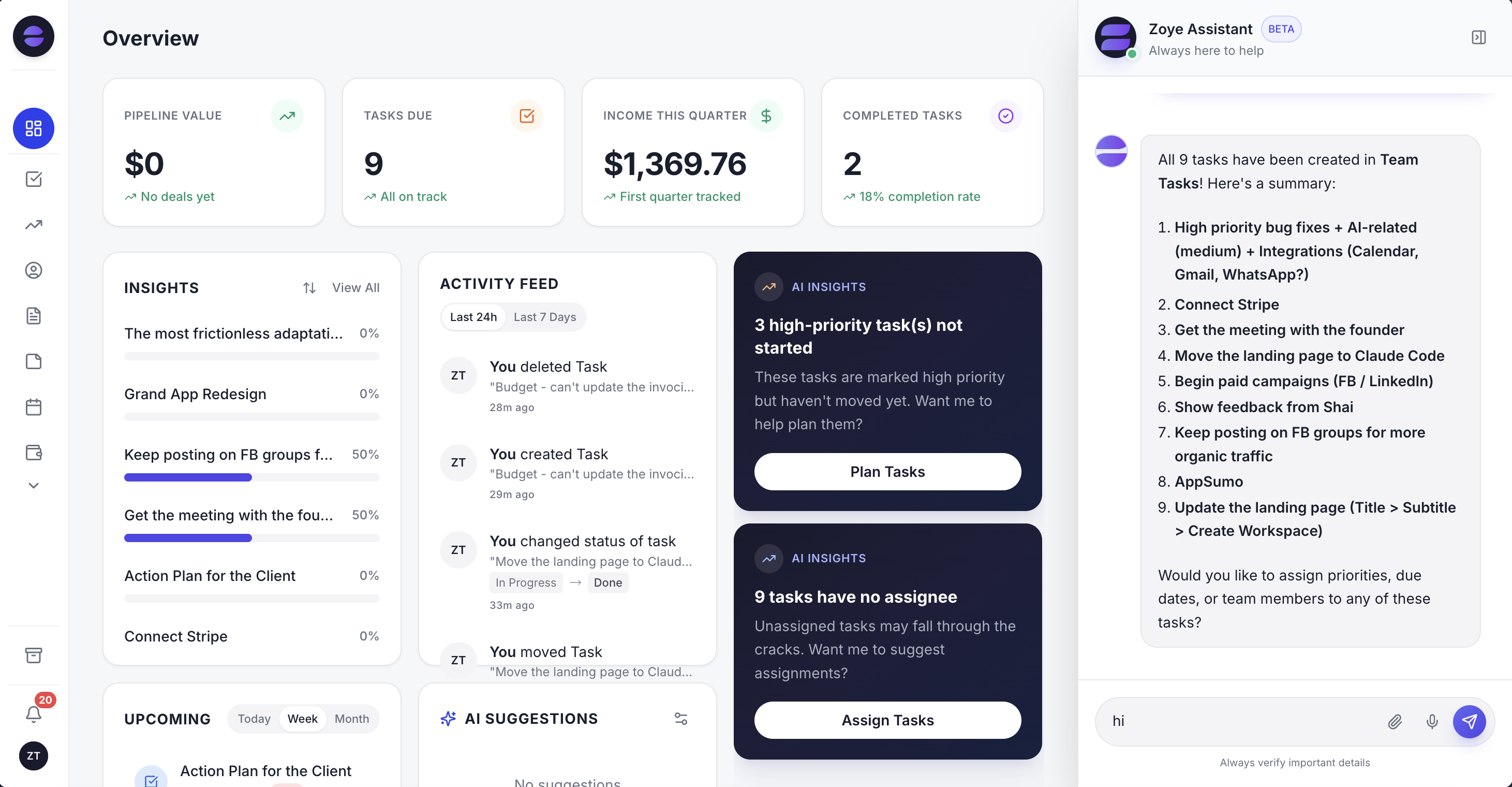 Zoye combines CRM, tasks, calendar, and reports in one AI-native workspace.
Where Pipedrive gives you a clean pipeline and HubSpot gives you a broad suite, Zoye gives you a solid CRM connected to the rest of how a sales team actually operates. The Zoye Assistant does not just summarise a deal or recommend a next step. It creates tasks from an incoming email, opens a deal and files the contact from one instruction, schedules a follow-up around your deadlines, reassigns work by team capacity, surfaces overdue and stalled deals proactively, and generates a weekly pipeline report on demand. It acts, it does not just suggest.
On views, tasks live in the same workspace as the CRM, with board, list, calendar, and timeline layouts, so the work that follows a closed deal is not stranded in a separate app. On budget, deal values and spending sit in the same place as the pipeline, which neither Pipedrive nor HubSpot includes natively. On reporting, Zoye pulls deals, tasks, finances, and team data into one exportable view across the workspace.
Pricing is flat, not per seat. The entry plan is Almost Free and covers 1 member with the full platform including AI. Starter is $29/month for up to 10 members, and Growth is $59/month for up to 20. A 20-person sales team gets a CRM, tasks, calendar, budget, reports, and an action-taking AI assistant for a flat $59/month.
Real example: A 12-person agency owner finishes a client call and dictates one line on her phone: "Brightwave signed the retainer, about $24K, kickoff next Tuesday." Zoye opens the deal, files the contact, books the kickoff on the calendar, drafts the delivery tasks, and logs the budget. In Pipedrive that is the pipeline plus a separate project tool plus a spreadsheet; in HubSpot it is the CRM plus the hubs you have paid to unlock, and still a separate place for the project work and the budget.
Want to see it in action?
Watch how Zoye automates your daily workflow - from lead management to team collaboration.
See How It WorksHubSpot vs Pipedrive on pricing
Pricing is where the two platforms surprise teams, in opposite directions.
Pipedrive pricing:
- No free plan (trial only)
- Essential: around $14 per user per month
- Advanced: around $29 per user per month
- Professional: around $49 per user per month
- Power / Enterprise: higher per-seat tiers
HubSpot pricing:
- Free CRM: $0 (limited tools, contacts and deals)
- Sales Hub Starter: from around $20 per seat per month
- Sales Hub Professional: from around $100 per seat per month
- Enterprise: custom, significantly higher
- Marketing Hub is priced separately and rises with contacts
The 20-person sales team math:
- Pipedrive Professional: 20 x around $49 = about $980/month for the CRM alone, before AI add-ons or the rest of the stack
- HubSpot Sales Hub Professional: 20 x around $100 = about $2,000/month (Marketing Hub is separate and contact-based)
- Zoye Growth (20 members, AI + CRM + tasks + calendar + budget included): $59/month
The pattern is clear. Pipedrive is the cheaper of the two for a focused sales team, but it covers only the pipeline, so the true cost includes the separate marketing, project, calendar, and AI tools you bolt on around it. HubSpot can start free, but the features sales teams actually need push it into Sales Hub Professional, which is far pricier per seat. Both are per-seat, so both grow with headcount. Zoye is a flat fraction of either, and it also covers the tasks, calendar, and budget that neither CRM includes.
Verdict: Pipedrive is the cheaper, narrower choice; HubSpot starts free but gets expensive fast as you climb the hubs and tiers. Both punish growth through per-seat pricing, and neither bundles everything a running sales team needs.
See what Zoye can do for you
From CRM and deal tracking to AI-powered task management - explore everything Zoye offers in one workspace.
Explore FeaturesWhen to choose each
Choose Pipedrive if:
- Your team's job is sales, and a clean, friction-free pipeline is the priority
- You want a CRM a rep can use productively on day one with almost no setup
- Budget matters and you do not need marketing, service, or broader operations in the tool
- You are comfortable running your other functions in separate apps
Choose HubSpot if:
- You want sales and marketing in one connected platform sharing one contact database
- Best-in-class marketing tools matter as much as the CRM to you
- You want a free CRM tier to start and can fund Professional as you grow
- Your team is marketing-led and values breadth over a single sharp pipeline
Choose Zoye if:
- You need more than Pipedrive's pipeline but do not want HubSpot's price and complexity
- You want a CRM plus tasks, calendar, budget, and reports in one connected workspace
- You want an AI assistant that takes action included at every tier, not a paid add-on
- You prefer flat tier-based pricing over per-seat charges that grow with hiring
- You want to be operational the same day with no configuration project, and manage customer conversations, including WhatsApp, from one place
Ready to streamline your business?
Zoye brings AI-powered CRM, task management, and automation into one workspace.
Get StartedFrequently asked questions
It depends on what you need. Pipedrive is the leaner, sales-pipeline-first CRM: easy to learn, affordable, and laser-focused on moving deals through stages. HubSpot is the broader platform, with a real CRM plus marketing, service, and automation tools, but it gets expensive and complex as you add hubs and seats. Pipedrive wins for a focused sales team on a budget; HubSpot wins for teams that need marketing and sales in one place and can fund the higher tiers.
For a small sales team that just needs a clean pipeline, Pipedrive is usually the simpler and cheaper starting point. For a small business that also wants marketing, forms, and email in the same tool, HubSpot's free CRM is a friendlier on-ramp, though the useful features sit behind paid hubs. Both bill per seat, so the cost climbs as you hire, which is why it is worth weighing an all-in-one option before committing.
At the very entry level HubSpot can look cheaper because its CRM has a free tier, while Pipedrive has no free plan. But the features most sales teams actually need push HubSpot into Sales Hub Professional, which is far pricier per seat than Pipedrive's plans. Pipedrive is generally the cheaper choice for a focused sales team, while HubSpot's free tier is the cheaper way to simply start. Both are per-seat models, so total cost climbs with every hire. (Pricing as of June 2026 - check each vendor's pricing page.)
Both are far easier than enterprise CRMs, but they are easy in different ways. Pipedrive is easier to set up for pure pipeline management because it does one thing and does it cleanly, so a sales rep is productive almost immediately. HubSpot is easy for its size but has more surface area, since you are also navigating marketing, service, and automation. For a sales-only team, Pipedrive feels lighter; for a team that wants everything in one app, HubSpot's consistency helps.
Both have AI, and both gate the strongest features. HubSpot's Breeze AI features sit across plans with the most capability on higher tiers. Pipedrive's AI Sales Assistant suggests next actions and surfaces deal insights, mostly on its paid plans. On both, the AI primarily assists and suggests inside the CRM rather than taking action across your tasks, calendar, and budget.
The bottom line
Pipedrive and HubSpot are both strong CRMs pulling in different directions. Pipedrive is the lean, sales-pipeline-first tool that a focused sales team can adopt in a day and afford easily, as long as it is happy to run marketing, projects, calendar, and AI elsewhere. HubSpot is the broad platform that puts sales and marketing in one suite with best-in-class marketing tools, ideal for teams that want everything in one app and can fund the hubs and the Professional tier where the power lives.
The real question for 2026 is not just which of the two wins, but whether either is built for how your whole sales operation runs. Pipedrive is narrow, so the rest of your stack lives in other tools. HubSpot is broad, but the price and complexity climb fast and the best parts sit behind upper tiers. Both gate their strongest features, both bill per seat, and on both the AI mostly suggests rather than acts.
If you need more than a pipeline but not the price and complexity of a full suite, the honest answer is a different kind of tool: one AI-native workspace with a CRM, tasks, calendar, budget, and reports, an assistant that takes real action across all of them, and flat pricing that does not punish growth. Zoye is built for that team, with everything included at every tier and operational the same day you sign up.
For more context, see our guides to the best Pipedrive alternatives, our HubSpot vs Salesforce comparison, the best CRM software in 2026, and how to choose a CRM.