
Best Teamwork Alternatives 2026: 7 Tools for Client-Facing Project Teams
Teamwork.com earned its place as one of the better project management tools built specifically for client work. Where most PM tools treat external clients as an afterthought, Teamwork.com put billing, time tracking, client users, and agency workflows at the center. For a digital agency juggling a dozen retainers, that focus on billable work and client visibility has always been the draw.
The challenge in 2026 is that the client-work category has moved on around it. Per-user pricing climbs fast as an agency hires. The interface, while functional, feels heavier than newer tools. The AI features summarise and suggest rather than do the work. And many agencies have realised they are still paying for a separate CRM, a separate calendar, and a separate budget tracker on top of their PM tool, when one connected workspace could cover all of it.
This guide compares the seven best Teamwork alternatives in 2026, ranked for agencies, consultancies, and client-facing project teams who want client-work depth without the per-seat tax or the disconnected stack. To be clear, this is about Teamwork.com, the client project management and agency software known for billing, time tracking, and client collaboration, not the generic idea of teamwork.
Pricing reflects published rates as of June 2026; check each vendor's pricing page for current figures.
Why teams are looking beyond Teamwork.com in 2026
Four trends drive the migration.
Per-user pricing punishes growth. Teamwork.com charges per user per month, which is fine for a five-person studio but adds up quickly. A 20-person agency that adds freelancers and client guests watches the monthly bill climb with every seat. Flat-rate alternatives that include unlimited collaborators on a tier deliver more predictable economics as the agency scales.
The stack is still fragmented. Teamwork.com is project-and-client focused, but most agencies still run a separate CRM for the sales pipeline, a separate calendar, and a separate budget or finance tool. That is three or four subscriptions and three or four logins for what could be one workspace. Consolidated platforms close that gap.
AI is a suggestion box, not a worker. Teamwork.com has added AI features, but like most incumbents they live in a side panel that summarises and recommends. The newer generation of AI-native tools treats the assistant as a team member that creates tasks, drafts client updates, and reprioritises the workload automatically.
Client work needs speed, not setup. Agencies live or die on turnaround. Tools that demand heavy configuration before they deliver value cost billable hours up front. The strongest alternatives get a client project moving in minutes, not days.
The 7 best Teamwork alternatives in 2026
1. Zoye - the AI-native all-in-one alternative
Zoye is the strongest Teamwork.com alternative for client-facing teams that want project and task management plus the full operational workspace, with native AI that actually does the work.
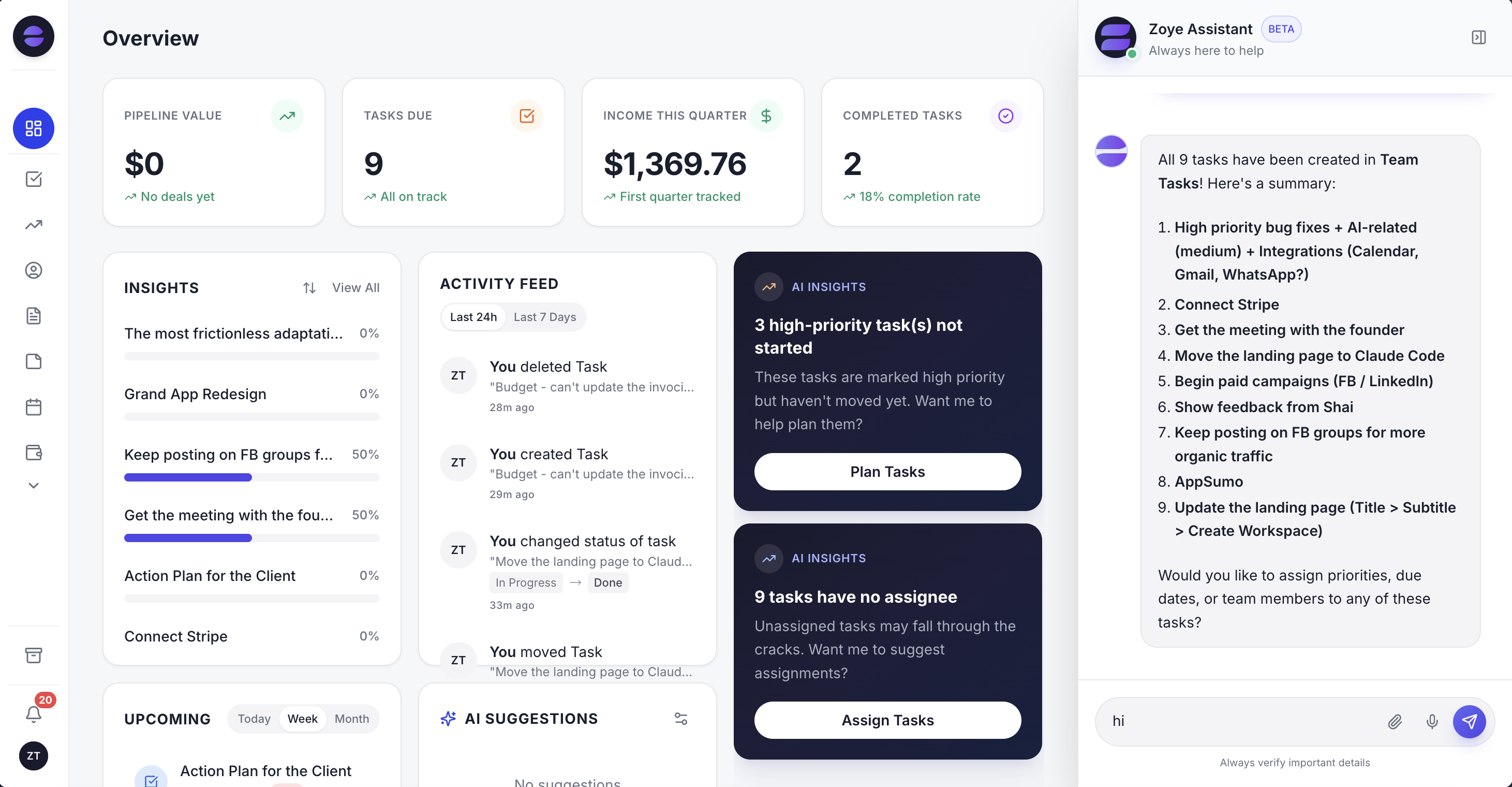 Zoye keeps client work, tasks, and the AI assistant in a single workspace
For client work specifically, Zoye covers the essentials Teamwork.com is known for and adds the layers most agencies bolt on separately. Projects and tasks run across four views, list, board (Kanban), calendar, and timeline, so a project manager can plan a retainer on a timeline while a designer works a Kanban board on the same data. Every client lives in the built-in CRM, so the conversation history, contacts, and deal value sit right next to the project, instead of in a disconnected sales tool. Budget tracking and reports complete the picture, giving the agency a real-time view of where each client engagement stands financially.
The AI is the differentiator. Where Teamwork.com's AI summarises a project or suggests a next step, the Zoye Assistant takes action. It creates tasks from incoming client emails, prioritises the team's workload by deadline and capacity, drafts follow-up messages and status updates to clients, schedules deep-work blocks on the calendar, surfaces overdue deliverables before a deadline slips, and generates a client-ready project report on demand. For an agency, that means less time spent on coordination overhead and more time on billable work.
The broader workspace is what sets Zoye apart from a pure PM tool. Tasks, CRM, calendar, budget, and reports all live together, so the account manager, the project lead, and the founder are looking at the same connected picture. There is no exporting from the PM tool into the CRM, no reconciling the calendar, no separate finance spreadsheet. Notes, a collaborative docs module, is rolling out across all plans so client briefs and runbooks live beside the work too.
Pricing is flat-rate, which is the headline for any growing agency. The entry Almost Free plan covers 1 member for just $5 per month with the full platform including AI, enough for a solo consultant. From there it scales without per-seat math.
Pricing: Almost Free from $5 per month ($4 billed annually) for 1 member with the full platform including AI. Starter from $29 per month (10 members). Growth from $59 per month (20 members). Cancel or upgrade anytime.
Best for: Agencies and client-facing teams that want client-work depth plus CRM, calendar, budget, and AI in one workspace.
2. ClickUp - the highly configurable all-in-one
ClickUp's limitation for client-facing teams is the setup tax. It is one of the most configurable PM tools on the market, with custom statuses, fields, automations, and dozens of views, but that flexibility means an agency often spends days building the right structure before a client project moves. Teamwork.com users who valued the ready-for-client-work defaults can find ClickUp's blank-canvas depth more than they need.
Pricing: Free tier with limits. Unlimited $7 per user per month. Business $12 per user per month.
Best for: Teams that want maximum configurability and are willing to invest in setup.
3. Asana - the polished work management tool
Asana's limitation for agencies is that it is built for internal team work, not client work. It does task and project tracking cleanly, with a refined interface and reliable workflows, but there is no native time tracking for billing, no built-in client portal, and no budget layer. Agencies that need to invoice by the hour or give clients controlled access end up adding third-party tools on top.
Pricing: Free for up to 10 users. Starter $10.99 per user per month. Advanced $24.99 per user per month.
Best for: Internal cross-functional teams that prize a clean, reliable interface.
4. Monday.com - the colorful Work OS
Monday.com's limitation is that its visual, board-first model can feel thin for deep client-work requirements. It is approachable and flexible for tracking projects on colorful boards, but billing, time tracking, and client collaboration depend on add-ons and higher tiers. The per-seat pricing on a minimum seat count can also surprise smaller agencies.
Pricing: Free tier for up to 2 users. Basic $9 per seat per month. Standard $12 per seat per month. Pro $19 per seat per month (billed annually, minimum seats apply).
Best for: Teams that want a visual, customizable board-first tracker.
5. Wrike - the enterprise project management platform
Wrike's limitation for smaller agencies is weight. It is a powerful, enterprise-grade PM platform with strong reporting, resource management, and proofing, but that power comes with complexity and a price point aimed at larger organizations. A lean studio often pays for and configures capability it will not use.
Pricing: Free tier with limits. Team $10 per user per month. Business $25 per user per month.
Best for: Larger agencies and enterprise teams that need advanced resource management.
6. Basecamp - the simple, opinionated organizer
Basecamp's limitation is that its deliberate simplicity leaves out the client-work mechanics agencies rely on. It is a calm, opinionated tool for organizing projects, messages, and to-dos, with flat pricing that growing teams appreciate, but there is no native time tracking, no Gantt or timeline, and limited reporting. Agencies that bill by the hour or manage complex dependencies will feel the gaps.
Pricing: Per-user plan available, plus a flat Pro Unlimited plan for unlimited users; check Basecamp's pricing page for current figures.
Best for: Teams that want radical simplicity and flat pricing.
7. Notion - the docs and database workspace
Notion's limitation for client project management is that it is docs-first, not project-first. It is a flexible workspace for wikis, databases, and lightweight project tracking, but it lacks native time tracking, billing, dependencies, and the structured project mechanics agencies need. It shines as a knowledge base or client wiki, less so as the system of record for billable delivery.
Pricing: Free for personal use. Plus $10 per user per month. Business $15 per user per month.
Best for: Doc-heavy teams that want a flexible wiki with light project tracking.
Best Teamwork alternative for agencies
For agencies specifically, the decision usually comes down to two things: client-work depth and total cost as the team grows. Zoye is the clearest pick because it delivers the client essentials, projects, multiple task views, time-aware planning, budget tracking, and a CRM that holds every client relationship, while pricing flat rather than per seat. A 20-person agency on Growth pays $59 per month total, not a per-user multiple that grows with every freelancer and account manager added.
ClickUp is the runner-up if your team genuinely wants to build a bespoke system and has the time to configure it. Wrike suits larger agencies that need enterprise resource management. But neither matches Zoye on the combination of client-work readiness, the connected CRM and budget layers, and an AI assistant that does the coordination work for you.
Best AI-powered Teamwork alternative
Zoye is the only alternative on this list with a true AI-native architecture. The others have added AI features, but they remain side panels that summarise a thread or suggest a next action. The work still lands on a human.
The Zoye Assistant operates differently. It creates tasks directly from client emails, prioritises the team's workload by deadline and capacity, drafts client status updates and follow-up messages, blocks deep-work time on the calendar, flags deliverables that are about to slip, and produces a project report whenever a client asks for one. For a client-facing team, the assistant absorbs the coordination overhead that eats into billable hours, which is exactly where an agency wants its AI working.
How to choose the right Teamwork alternative for your team
Three questions narrow the choice.
1. Do you bill clients for your work? If yes, you need native time tracking, budget visibility, and ideally client-facing reporting. Zoye and Teamwork.com cover this natively; Asana, Notion, and Basecamp need add-ons. If you do internal-only project work, the lighter tools become viable.
2. Do you want one workspace or a best-of-breed stack? If you are happy running a separate CRM, calendar, and finance tool, a pure PM tool works. If you want tasks, CRM, calendar, budget, and reports in one place, Zoye consolidates the stack.
3. How much do you want AI to do? If a suggestion sidebar is enough, every modern option has one. If you want AI that creates tasks, drafts client updates, and reprioritises the team automatically, Zoye is the only AI-native pick here.
Migration from Teamwork.com to a connected workspace
Migrating off Teamwork.com is less about moving data and more about consolidating tools. Most agencies are not just replacing a PM tool, they are deciding to fold the separate CRM, calendar, and budget tracker into the same workspace. The migration is a chance to remove that fragmentation rather than recreate it.
The pragmatic approach is to bring forward only the active client engagements. Export the open projects and tasks from Teamwork.com, filter to the live retainers and current deliverables, and rebuild the structure in the new workspace with the client relationship attached from the start. Closed projects and stale tasks get archived rather than recreated. Client contacts and history move into the CRM so each project carries its relationship context.
For teams moving to Zoye specifically, the AI assistant helps think through the restructuring interactively. Describe the agency, the client roster, and the recurring delivery workflows, and the assistant proposes a project and task structure with clients attached. Most agencies complete the reorganisation in a focused afternoon rather than a multi-week rollout.
What changes when client work lives in one workspace
The post-migration experience is shaped by three changes that make a connected workspace feel fundamentally different from a standalone PM tool.
First, the client and the work stop being separate. In a standalone PM tool, the project lives in one app and the client relationship lives in the CRM. In a connected workspace, opening a project shows the client's contacts, conversation history, and deal value right there. The account manager and the project lead see the same complete picture.
Second, the AI assistant handles coordination across the whole agency. Where a standalone tool's AI summarised one project, the Zoye Assistant sees the full workload across every client and every team member, and proposes how to distribute new work based on capacity and deadlines. The founder stops being the manual traffic controller.
Third, the financial picture is live. Budget tracking and reports pull from the same workspace as the tasks and the CRM, so the agency sees where each engagement stands financially without exporting to a spreadsheet. Profitability per client becomes visible instead of guessed.
Why teams pick Zoye as their Teamwork.com replacement
A few themes come up consistently.
The workspace covers the whole agency. Tasks, projects, CRM, calendar, budget, and reports live together, so the team stops paying for and switching between four separate tools.
The pricing scales sensibly. Flat-rate tiers mean a growing agency is not taxed per seat as it adds freelancers, account managers, and client guests.
The AI does the coordination work. Task creation, prioritisation, client update drafting, and project reporting happen automatically, freeing the team to spend its hours on billable client work rather than admin.
Trade Teamwork's per-seat invoice for one flat plan instead of a bill that grows with every hire. Almost Free costs $5 each month ($4 monthly billed annually), covers the entire platform for 1 member, and stays month to month so you can cancel or upgrade freely.
For more context, see the best project management apps in 2026, the best Asana alternatives, the best Wrike alternatives, and the best Trello alternatives.