
Best Team Collaboration Software in 2026
Most teams do not have a collaboration problem because they lack tools. They have one because they have too many. Conversation happens in a chat app, the actual work sits in a project tool, documents live in a wiki, and the calendar is somewhere else again. People spend their day copying context from one tab to another, and the thread where a decision was made rarely sits next to the task that decision created.
That fragmentation is the real cost of modern collaboration. A request mentioned in chat at 10am has to be retyped as a task. A deadline agreed in a meeting has to be re-entered in a project board. A customer detail discussed in a thread has to be found again next week, usually by scrolling. Each handoff is small, but across a week they add up to hours of friction and a constant low-level fear that something has slipped through a gap between two tools.
This guide compares the seven best team collaboration software tools in 2026, ranked for teams that want to spend less time switching contexts and more time doing the work. The tools split into two camps: chat-first apps that communicate brilliantly but keep work elsewhere, and unified workspaces that keep the conversation next to the tasks, calendar, and records it relates to.
Pricing reflects published rates as of June 2026; check each vendor's pricing page for current figures.
Why teams are looking beyond single-purpose collaboration tools in 2026
Four trends are reshaping how teams pick collaboration software this year.
Context switching has become the hidden tax. Every team now runs a stack: a chat app, a project tool, a doc tool, a calendar, often a CRM. Each is good at its job, but the seams between them are where time and information leak. Teams are increasingly counting the cost of the switching itself, not just the price of each subscription.
Conversation and work have drifted apart. Chat-first tools made communication instant, but they also separated the talking from the doing. A decision lives in a thread, the task lives in another app, and reconnecting them is manual. Teams want the discussion and the deliverable in the same place so nothing has to be retyped.
AI is moving from suggestion to action. Most collaboration tools have bolted on an assistant that summarises a thread or drafts a message. The more useful pattern in 2026 is an assistant that turns a conversation into a task, schedules the follow-up, and surfaces what is overdue, rather than one that only nudges from a sidebar.
Per-seat pricing across a stack adds up fast. A growing team paying for chat, project management, docs, and a CRM separately, all per user, watches the bill climb with every hire. Flat-rate all-in-one platforms are attractive precisely because they collapse several per-seat subscriptions into one predictable cost.
The 7 best team collaboration software in 2026
1. Zoye - the all-in-one workspace where conversation meets work
Zoye is the strongest pick for teams that are tired of switching between a chat app, a project tool, and a doc tool, because it keeps tasks, conversations, calendar, CRM, and reports in one shared workspace.
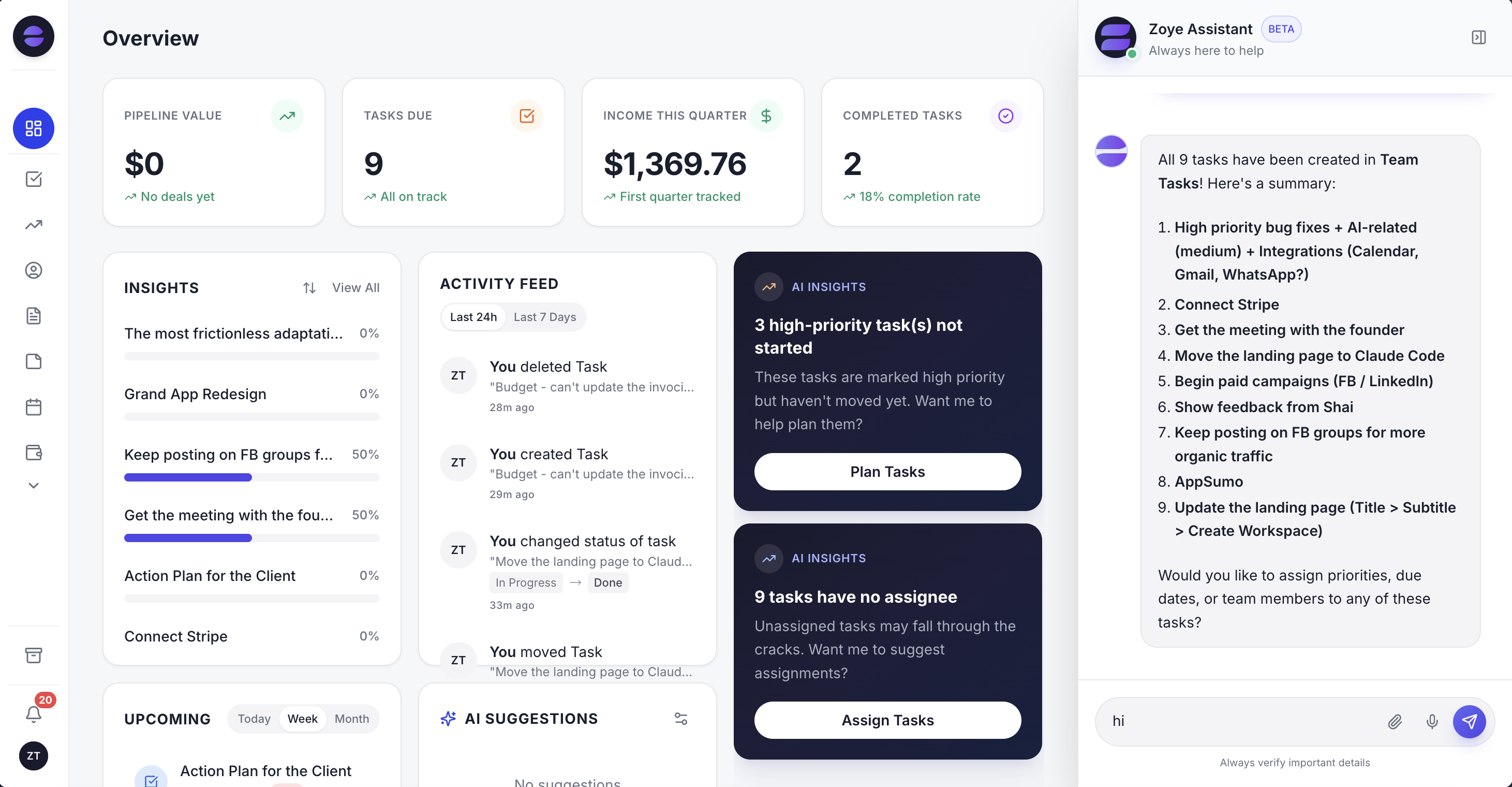 Zoye keeps a team's tasks, conversations, calendar, and reports in one shared workspace.
The core idea is that collaboration should not require copying context between tools. A conversation about a client sits next to that client's record in the CRM. A decision about a deadline becomes a task with one step, on a board the whole team can see. The calendar shows those deadlines alongside meetings, and reports pull from the same data, so nobody has to reconcile four tools at the end of the week.
Tasks come with the views teams actually use: a list for quick capture, a board (Kanban) for shared workflow, a calendar for deadlines, and a timeline for sequencing. Because the tasks, the calendar, and the customer records all live in the same workspace, a team member can move from a conversation to the related work without leaving the page or hunting through tabs.
The differentiator is the Zoye Assistant, an AI that takes action rather than only talking. Where most collaboration tools offer an assistant that summarises a thread, the Zoye Assistant creates tasks from a conversation or an email, prioritises by deadline and workload, drafts follow-up messages, schedules deep-work blocks on the calendar, surfaces overdue items before they slip, and generates reports and summaries on demand. The effect is that discussion turns into action automatically, instead of waiting for someone to retype it.
The wider workspace rounds it out: a native CRM keeps customer conversations and records in one place, budget tracking ties spend to the work, and reports bring tasks, deals, and team activity into one exportable view. Zoye Notes, collaborative docs built into the same workspace, is rolling out across plans so that a reference doc can live alongside the work it supports rather than in a separate tab.
Pricing: The entry plan, Almost Free, is 5 dollars per month (4 dollars billed annually) for 1 member with the full platform including AI. Starter from 29 dollars per month (10 members). Growth from 59 dollars per month (20 members).
Best for: Teams that want conversation, tasks, calendar, and customer records in one workspace, with an AI assistant that turns discussion into action.
2. Slack - the chat-first hub for fast communication
Slack is the benchmark for team chat. Channels, threads, search, and a deep catalogue of integrations make it the place teams talk. Its limitation for collaboration is that the conversation is where work is discussed, not where it gets done. A request in a channel still has to be retyped as a task in a separate tool, and the thread where a decision was made rarely sits next to the deliverable it produced. Teams that rely on Slack alone tend to lose track of commitments because chat is a stream, not a structure. It excels at communication and integrates with almost everything, but it expects the actual work to live in other apps you connect to it.
Pricing: Free tier with message-history limits. Paid plans are billed per user per month; check Slack's pricing page for current figures. Per-user pricing means the cost scales with every hire.
Best for: Teams that want best-in-class chat and plan to connect it to separate work tools.
3. Microsoft Teams - chat and meetings inside the Microsoft ecosystem
Microsoft Teams combines chat, video meetings, and file collaboration, and it is hard to beat for organisations already standardised on Microsoft 365. Its limitation is weight and lock-in. Teams is a large, dense application that assumes you live inside the Microsoft ecosystem, and its value drops sharply for teams that do not. Project structure beyond channels and basic Planner boards is thin, so the actual work management still tends to happen in other tools. For a smaller or more independent team, Teams can feel heavier than the collaboration it delivers, and tying everything to one vendor's stack is a real consideration.
Pricing: Included with most Microsoft 365 business subscriptions; standalone plans are billed per user per month. Check Microsoft's pricing page for current figures.
Best for: Organisations already committed to Microsoft 365.
4. ClickUp - project management with collaboration bolted on
ClickUp is a capable project management platform with tasks, docs, dashboards, and a chat feature added on top. Its limitation for collaboration is that communication feels secondary to the project structure. The chat and comment features exist, but they sit alongside a tool whose centre of gravity is task and workflow configuration. ClickUp is powerful, and that power comes with a learning curve: teams often spend real time setting up custom fields, statuses, and views before it feels usable, and the conversation layer rarely becomes the team's primary place to talk.
Pricing: Free tier with limits. Unlimited at 7 dollars per user per month, Business at 12 dollars per user per month. ClickUp Brain, the AI feature, is a separate paid add-on of around 9 dollars per user per month rather than bundled into a plan. Per-user pricing means the cost scales with every hire.
Best for: Teams that want deep project management and treat chat as a secondary feature.
5. Asana - work management with light real-time communication
Asana is a polished work management tool for tracking tasks, projects, and workflows across teams. Its limitation for collaboration is real-time communication. Asana is built around structured work, comments, and updates, not around live conversation, so most teams still pair it with a separate chat app for day-to-day talk. It is excellent at giving a clear picture of who owns what and when it is due, but the back-and-forth discussion that surrounds the work happens elsewhere, which keeps the team in two tools.
Pricing: Free tier for small teams. Paid plans are billed per user per month; check Asana's pricing page for current figures. Per-user pricing means the cost scales with every hire.
Best for: Teams that want clean work tracking and already have a chat tool.
6. Notion - docs and wiki with weak execution and communication
Notion is a flexible workspace for documents, wikis, and databases, and it is loved for knowledge management. Its limitation for collaboration is that it is docs-first, with weak execution and communication layers. Tasks in Notion are database rows rather than a purpose-built project tool, real-time chat is essentially absent, and notifications are light, so teams rarely use it as the place they communicate. Notion is excellent as a shared brain for documentation, but a team that needs to talk, assign, and track in real time usually ends up adding a chat tool and a project tool around it.
Pricing: Free for personal use. Plus at 8 dollars per user per month. Per-user pricing means the cost scales with every hire.
Best for: Teams that want a strong docs and wiki layer and handle communication elsewhere.
7. Google Workspace - docs and meet without project structure
Google Workspace covers email, documents, spreadsheets, and Meet, and its real-time document co-editing is still the standard many teams measure others against. Its limitation for collaboration is that it has no project structure. There is no shared task board, no workflow, and no place to see who owns what across the team, so Workspace ends up being the place files and meetings live while the actual work coordination happens in a separate project tool. For teams whose collaboration is mostly writing documents together and meeting, Workspace is excellent, but it leaves the structure of the work to other software.
Pricing: Business plans are billed per user per month; check Google's pricing page for current figures. Per-user pricing means the cost scales with every hire.
Best for: Teams that mainly co-write documents and meet, and manage work elsewhere.
What to look for in team collaboration software
The right tool depends on where your team currently loses time. A few criteria separate the strong choices from the rest.
Does conversation sit next to the work? The single biggest source of friction is the gap between where a decision is made and where it is acted on. Tools that keep the thread next to the task remove the retyping. Tools that separate them push that work onto people.
How many tools does it replace? Every additional subscription is another login, another place to search, and another per-seat bill. A platform that genuinely covers chat, tasks, calendar, and records reduces both the cost and the cognitive load of running a stack.
Does the AI take action or only suggest? An assistant that summarises a thread is mildly useful. An assistant that turns the thread into a task, schedules the follow-up, and flags what is overdue removes manual work. Judge the AI by what it does, not what it describes.
Will it scale without re-platforming? A tool that is great for five people but breaks at twenty forces a painful migration later. Look for one that covers the solo-to-team journey on the same workspace.
Collaboration tools vs all-in-one workspaces
The choice in 2026 is increasingly between a best-of-breed stack and an all-in-one workspace. A stack means picking the strongest chat app, the strongest project tool, and the strongest doc tool, then wiring them together. The upside is that each piece is excellent. The downside is the seams: information has to move between tools by hand or through integrations that break, and the team pays per seat several times over.
An all-in-one workspace makes the opposite trade. Each module may not have every advanced feature of a dedicated tool, but the modules share one data layer, so a conversation, a task, a calendar event, and a customer record all reference each other without copying. For most small and growing teams, the removal of the seams is worth more than any single advanced feature they rarely used. Zoye is built for this approach: tasks, conversations, calendar, CRM, and reports in one workspace, with an assistant that moves work between them automatically.
Best collaboration software for remote teams
Remote teams feel fragmentation most acutely, because there is no shared office to paper over the gaps between tools. When a request is mentioned on a call, there is no desk to walk over to and no whiteboard everyone can see, so the request has to be captured somewhere that the whole team will actually look.
For remote teams, the priority is a single source of truth that combines conversation with work. Slack and Microsoft Teams are strong on the communication side, with reliable chat and video, but remote teams still need a separate, visible place for the tasks and deadlines themselves. Zoye suits distributed teams because the conversation, the tasks, the calendar, and the customer records share one workspace, and the assistant surfaces what each person should focus on next based on deadlines and workload. That shared visibility is what replaces the casual coordination an office used to provide.
Why teams pick Zoye
A few themes come up consistently when teams move to a unified workspace.
The conversation finally sits next to the work. A decision in a thread becomes a task without retyping, and the customer detail mentioned in chat is one click from the record it belongs to. The constant copy-and-paste between a chat app and a project tool disappears.
The stack consolidates. Tasks, conversations, calendar, CRM, and reports live together, which means one login, one place to search, and one predictable bill instead of several per-seat subscriptions.
The AI does the work, not just the talking. The Zoye Assistant turns discussion into action: it creates tasks from conversations and emails, prioritises by deadline and workload, drafts follow-ups, schedules deep-work blocks, surfaces overdue items, and produces summaries and reports on demand.
And the workspace scales with the team. A founder on the entry plan today and a twenty-person team next year use the same workspace and the same assistant, with no migration in between.
Try Zoye with your team. The entry plan is Almost Free, with the full platform including AI.
For more context, see the best Slack alternatives, the best project management software, ClickUp vs Monday.com, and the best Asana alternatives.