
Slack is a focused, well-built team-chat tool, and for fast real-time messaging it is still excellent. The problem for many small teams in 2026 is not that Slack chats poorly. It is everything that surrounds the chat. Notifications pile up across dozens of channels until people mute the ones that matter. The free plan now hides message history behind a paywall, so the cost climbs the moment the team grows. And because Slack is chat-only, the conversation lives in one app while the actual work (tasks, deals, deadlines, budgets) lives in three others.
That scattering is the real pain. A typical small team ends up paying for Slack for conversation, a project tool for tasks, and a CRM for customers, then spends the day copying context between them. A decision made in a Slack thread never reaches the task board. A customer reply discussed in a DM never makes it into the CRM. The chat is fine; the fragmentation around it is what slows the team down.
This guide compares the seven best Slack alternatives in 2026. To be fair up front: for pure real-time chat, dedicated tools (including the six covered below) are stronger than any all-in-one platform, and we say so where it matters. But if your underlying problem is a stack of disconnected apps rather than the chat itself, the consolidation option deserves the top spot.
Pricing reflects published rates as of June 2026; check each vendor's pricing page for current figures.
Why teams are looking beyond Slack in 2026
Four trends drive the migration.
Notification overload is a productivity tax. Slack's channel model encourages a steady stream of messages, and at a certain team size the volume becomes noise. People mute channels, miss important threads, and develop a low-grade anxiety about falling behind. Teams increasingly want communication that is tied to specific work rather than a firehose of channels.
Cost climbs as the team grows. Slack's free plan caps message history, so growing teams are pushed onto paid tiers. At roughly $8.75 per user per month for the Pro plan, a 20-person team pays around $2,100 per year for chat alone, before the project tool and CRM that usually sit alongside it. For a small team watching every subscription, the math gets hard to justify.
Context lives away from the work. Slack is chat, and only chat. Tasks, customers, deadlines, and budgets live in other tools. Every decision made in a thread has to be manually carried into the system where the work actually happens, and a lot of it never makes the trip. The conversation and the work drift apart.
No built-in project management or CRM. Slack integrates with dozens of apps, but integrations are not the same as having tasks, a CRM, a calendar, and reports natively in the same place. Small teams increasingly prefer one workspace where the conversation, the work, and the customer record share the same home.
The 7 best Slack alternatives in 2026
1. Zoye - the consolidate-your-stack option
Zoye is the strongest pick for teams whose real problem is not chat quality but the sprawl of paying for Slack plus a project tool plus a CRM. It is honest to say what Zoye is not: it does not try to match Slack's channels, DMs, and huddles feature for feature. What it does instead is remove the reason small teams need four apps in the first place by bringing the work and the conversation about it into one workspace.
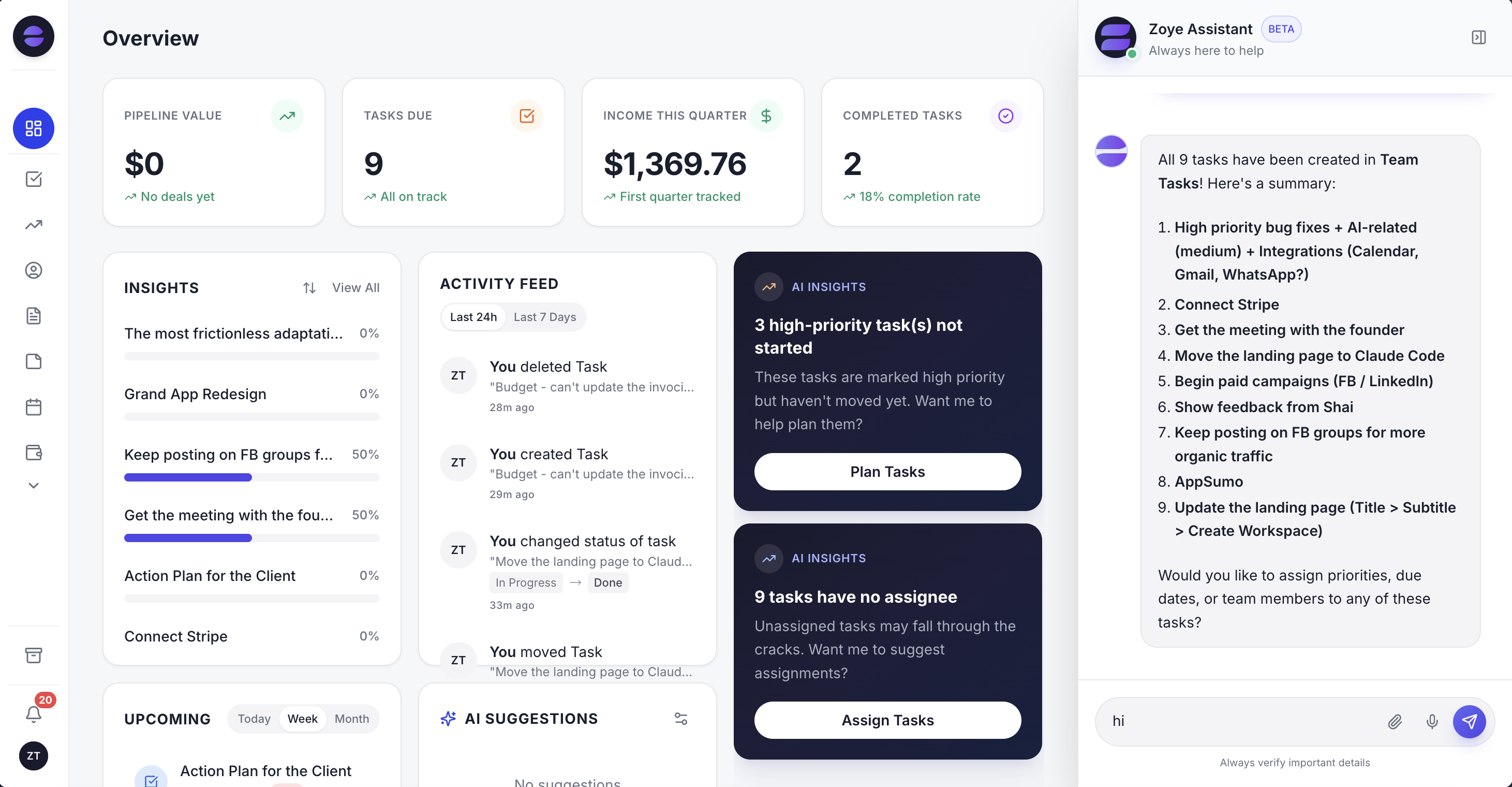 Zoye consolidates the stack - tasks, CRM, and an AI assistant in one workspace instead of Slack plus three other tools
Where Slack keeps the conversation in channels and leaves the work elsewhere, Zoye centralises both. Team and customer conversations sit alongside the tasks, deals, and deadlines they relate to, so a decision discussed in context is already next to the work it affects. There is no copy-paste from a chat thread into a separate task board, because the task board, the CRM, and the conversation share the same workspace.
The platform itself is a full operational workspace: tasks with list, board, calendar, and timeline views, a native CRM for contacts and deals, a shared calendar, budget tracking, and reports that pull from all of it. For a small team, that is the project tool and the CRM that usually live beside Slack, folded into one place.
The differentiator is the Zoye Assistant, an AI that takes action rather than just suggesting. It turns incoming customer messages into tasks, drafts replies and follow-ups, prioritises by deadline and workload, surfaces overdue items before they slip, and generates reports and summaries on demand. So when a customer conversation comes in, the assistant can draft the response and create the follow-up task in the same step, keeping the communication and the work together.
To be clear about scope: for high-volume, real-time internal banter and huddles, a dedicated chat tool is still the better instrument, and Zoye is happy to sit alongside one. But for centralising the conversations that actually drive work, especially customer-facing ones, it removes the fragmentation that makes a Slack-plus-three-tools stack feel heavy.
Pricing: Almost Free at $5 per month for 1 member with the full platform including AI. Starter from $29 per month (10 members). Growth from $59 per month (20 members).
Best for: Small teams paying for Slack plus a project tool plus a CRM who want the work and the conversation in one workspace.
2. Microsoft Teams - the Microsoft 365 chat hub
Microsoft Teams is the most natural Slack replacement for organisations already living in Microsoft 365, but its biggest limitation is weight. Teams is sprawling, the interface can feel cluttered, and it carries a lot of overhead that a small team rarely needs. For two- to ten-person teams not already committed to Microsoft, the complexity often outweighs the benefit.
Where it shines is the bundle: chat, video meetings, and tight integration with Word, Excel, SharePoint, and Outlook, all included with a Microsoft 365 subscription you may already pay for.
Pricing: Included with Microsoft 365 Business plans; a free standalone tier exists. Check the vendor pricing page for current figures.
Best for: Organisations already standardised on Microsoft 365.
3. Google Chat - the Google Workspace messenger
Google Chat's main limitation is that it is a lightweight afterthought compared to Slack's depth. The feature set is thinner, the channel and threading model feels less refined, and power-user features Slack teams rely on are often missing. It works best as the simple chat layer for teams already inside Google Workspace, not as a full Slack replacement for a chat-heavy culture.
The upside is simplicity and price: it is bundled with Google Workspace and sits right next to Gmail, Calendar, Docs, and Meet, so there is nothing extra to adopt.
Pricing: Included with Google Workspace plans. Check the vendor pricing page for current figures.
Best for: Teams already on Google Workspace that want simple, integrated chat.
4. Mattermost - the open source, self-hosted option
Mattermost's limitation is that its main advantage, self-hosting, is also its main cost. Running it well takes engineering time to deploy, secure, update, and maintain, which a small team without dedicated ops may not have. For teams that do, it offers a Slack-like experience under their own control.
It is the leading open source, self-hostable Slack alternative, popular with teams that have strict data-residency or compliance requirements and want their messages on their own infrastructure.
Pricing: Free self-hosted edition; paid Professional and Enterprise tiers. Check the vendor pricing page for current figures.
Best for: Teams with compliance or data-residency needs and the ops capacity to self-host.
5. Discord - the community-first chat platform
Discord was built for communities and gaming, not workplaces, and that origin is its limitation. It lacks business-grade administration, compliance controls, and the polished workflow integrations professional teams expect. Used at work, it can feel informal and hard to govern as the team grows.
Where it wins is voice. Always-on voice channels and a generous free tier make it genuinely good for casual, fast-moving teams and creator communities that value real-time talk over structure.
Pricing: Free for most use; paid Nitro tier for enhancements. Check the vendor pricing page for current figures.
Best for: Informal teams and communities that prioritise voice chat.
6. Twist - the asynchronous communication tool
Twist's limitation is intentional: it deliberately removes the real-time pressure that defines Slack. Conversations are threaded and async by design, which is the whole point but also means it is a poor fit for teams that need fast back-and-forth. If your culture runs on instant replies, Twist will feel slow.
For distributed teams across time zones that are tired of notification overload, that same async-first model is its strength. It is calm, organised, and built to reduce the always-on anxiety of channel-based chat.
Pricing: Free tier with limits; paid Unlimited tier. Check the vendor pricing page for current figures.
Best for: Distributed, async-first teams that want to escape notification overload.
7. Rocket.Chat - the open source enterprise messenger
Rocket.Chat shares Mattermost's core limitation: it is open source and self-hostable, which means the flexibility comes with the operational burden of running and securing it yourself. The interface is also less polished than Slack's, and getting it production-ready takes setup effort.
In return you get deep customisation, on-premise control, and an encrypted, open source platform favoured by teams with security and data-sovereignty requirements.
Pricing: Free Community edition; paid Enterprise tiers. Check the vendor pricing page for current figures.
Best for: Security-focused teams that need an encrypted, self-hosted, customisable messenger.
Best Slack alternative for small teams
For a small team, the honest question is what you are actually trying to fix. If you need a cleaner, cheaper chat app and nothing more, Google Chat (if you are on Google Workspace) or Discord (for an informal team) are the most cost-effective dedicated picks, and both have strong free tiers.
But most small teams are not just overpaying for chat. They are overpaying for chat plus a project tool plus a CRM, and losing context between all three. For that team, Zoye is the clearest choice because it collapses the stack: tasks, CRM, calendar, budget, and an AI assistant in one workspace, with the Almost Free entry plan at 5 dollars per month covering 1 member and the full platform including AI. The conversation that matters lives next to the work, not in a separate tab.
Best free Slack alternative
Several tools here are genuinely free. Google Chat is free with a Google account. Discord is free for most teams. Mattermost and Rocket.Chat offer free self-hosted editions, though you trade subscription cost for hosting and maintenance effort.
Zoye is not free, but it is the most affordable full-platform option: rather than a stripped-back chat tier, its entry plan at 5 dollars per month (4 dollars per month billed annually) gives 1 member the full platform, including the AI assistant. For a solo founder, that means tasks, CRM, calendar, and reports alongside their conversations, with no feature gates on the core workspace. It is the strongest option for a team that wants its communication tied to actual work rather than sitting in an isolated chat app.
Best open source and self-hosted Slack alternatives
If self-hosting is a hard requirement, the choice narrows to Mattermost and Rocket.Chat. Both are mature, encrypted, open source platforms that run on your own infrastructure, which is exactly what teams with strict data-residency or compliance rules need. Mattermost is generally considered the more polished of the two for a Slack-like experience; Rocket.Chat leans into deep customisation.
The honest trade-off is operational. Self-hosting means you own the deployment, security patching, scaling, and uptime. That is a real cost in engineering time. For teams without ops capacity, a hosted platform almost always works out cheaper once you count the hours.
How to choose the right Slack alternative for your team
Three questions narrow the choice.
1. Is the problem the chat, or the stack around it? If you genuinely just need better or cheaper chat, the dedicated tools here are stronger. If the problem is paying for and switching between Slack plus a project tool plus a CRM, Zoye consolidates all of it into one workspace.
2. Which ecosystem are you already in? If you live in Microsoft 365, Teams is the path of least resistance. If you are on Google Workspace, Google Chat is already there. Matching your existing tools reduces friction.
3. Do you have data-residency or compliance needs? If your messages must stay on your own infrastructure, Mattermost or Rocket.Chat are the self-hosted answers, provided you have the ops capacity to run them.
Why teams pick Zoye
A few themes come up consistently.
The stack consolidates. Instead of paying for Slack plus a project tool plus a CRM and copying context between them, the conversation, the tasks, and the customer record share one workspace.
The AI takes action. The Zoye Assistant turns customer messages into tasks, drafts replies and follow-ups, prioritises by deadline and workload, and generates reports on demand, rather than nudging from a suggestion panel.
The entry plan is real. For 5 dollars a month one member gets the full platform including AI, not a stripped-back chat tier, so the work and the conversations sit in one place from day one.
It is worth repeating the honest framing: for pure real-time internal chat, keep a dedicated tool if your team thrives on it. Zoye's value is removing the fragmentation around the conversation, not replacing the chat box itself.
Try Zoye with your team. The entry plan is Almost Free, with the full platform including AI.
For more context, see the best project management apps in 2026, the best Asana alternatives, the small business productivity guide, and the best Trello alternatives. If you are rethinking the whole suite rather than just chat, the best Google Workspace alternatives guide compares full-platform options.