
Best Basecamp Alternatives 2026: 7 Project Management Tools for Growing Teams
Basecamp built its reputation on doing less, on purpose. Message boards, to-do lists, a schedule, document storage, and Campfire chat cover the basics, and the flat per-account pricing made it a favourite for small teams who wanted to escape per-seat billing. For a long time, that deliberate simplicity was the whole point, and for a small team running a handful of straightforward projects it still works.
The problem arrives when a team grows. Basecamp has no Kanban board, no timeline, and no Gantt chart, so visualising how work moves through stages is impossible without exporting to another tool. Reporting is thin, there is no CRM to track customers alongside projects, no budget tracking, and no native AI assistant to help with planning or follow-through. The minimalism that felt freeing at five people starts to feel limiting at twenty, when projects have dependencies, deadlines stack up, and the team needs a clearer operational picture. This guide compares the seven best Basecamp alternatives in 2026, ranked for teams that have outgrown deliberate minimalism and need room to scale.
Pricing reflects published rates as of June 2026; check each vendor's pricing page for current figures.
Why teams are looking beyond Basecamp in 2026
Four trends drive the migration.
No visual project views. Basecamp's to-do lists are a flat checklist. There is no Kanban board to see work-in-progress, no timeline to map a project against its calendar, and no Gantt view for dependencies. As soon as a team needs to see how work flows from "to do" to "done", or which tasks block which, Basecamp's minimalism becomes a wall rather than a feature.
Weak reporting and no operational layer. Basecamp tells you what is on each to-do list but not much more. There is no real dashboard for workload across the team, no budget tracking, and no CRM. Growing teams that manage customers, money, and capacity end up stacking three or four other tools around Basecamp to cover the gaps.
No native AI. Basecamp has no built-in AI assistant. In 2026, that is a meaningful gap. Modern alternatives use AI to draft updates, prioritise tasks, summarise long threads, and surface what is falling behind. A team on Basecamp does all of that triage manually.
Flat pricing is great until you need more. Basecamp's flat per-account fee is genuinely good value for the features it offers. But teams are paying for simplicity, and when they need boards, timelines, reporting, and AI, they end up paying for those separately elsewhere. An all-in-one alternative with flat pricing often delivers far more for a comparable spend.
The 7 best Basecamp alternatives in 2026
1. Zoye - the AI-native all-in-one alternative
Zoye is the strongest Basecamp alternative for teams that want to keep things simple but need real project views, reporting, and native AI as they grow. It pairs an approachable workspace with the depth that Basecamp deliberately leaves out.
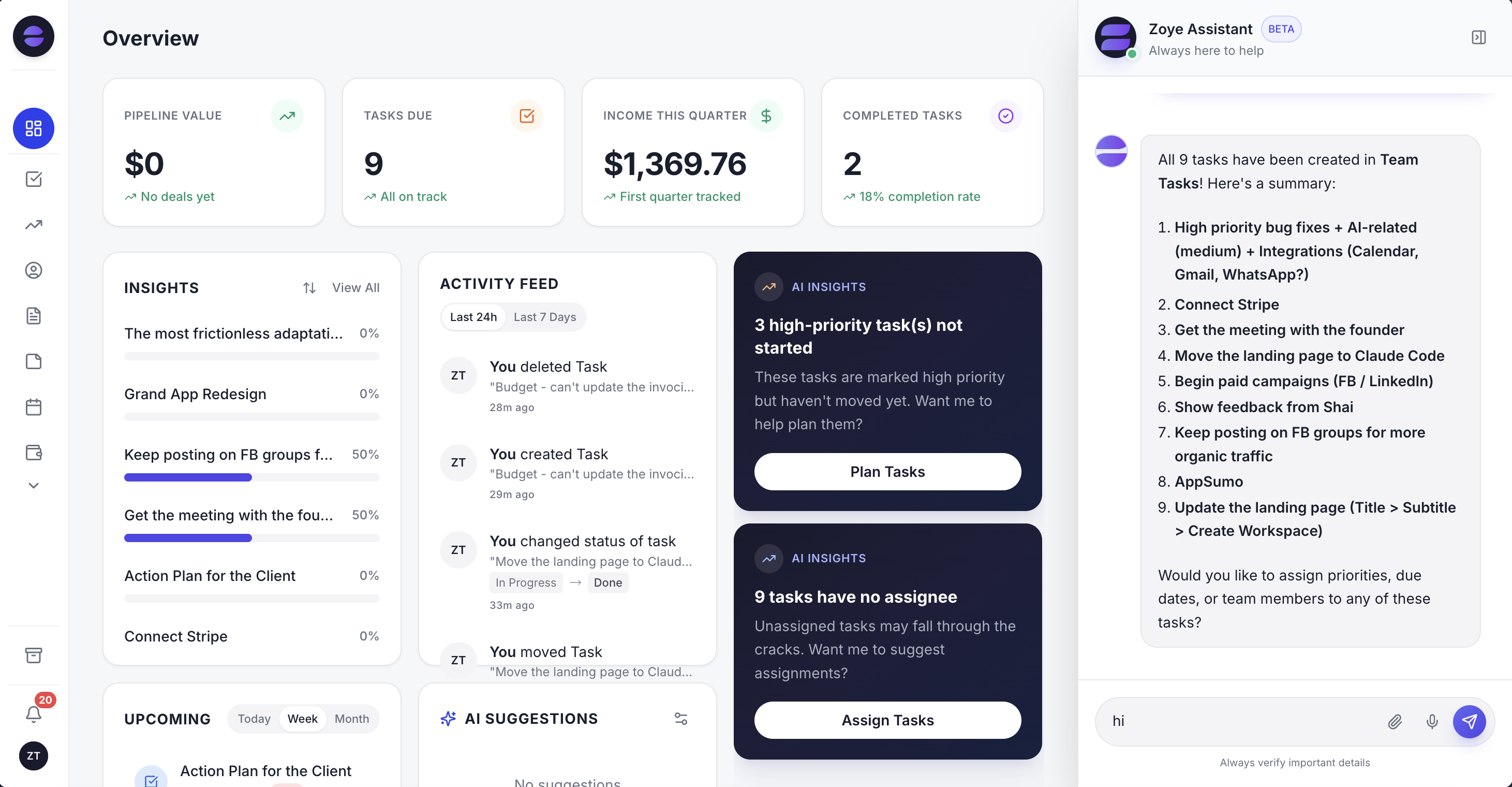 Zoye keeps the simplicity Basecamp fans like, but adds CRM, reports, and an AI assistant
The project management capability covers everything Basecamp misses. Tasks have four views: list, board (Kanban), calendar, and timeline, so a team can finally see work move through stages and map projects against their deadlines. To-do lists, comments, file attachments, and a shared schedule are all there too, so the things Basecamp does well carry over. Beyond projects, the platform includes a native CRM, a calendar, budget tracking, and reports, all in one workspace rather than five separate tools.
The Zoye Assistant is the real difference. Where Basecamp has no AI at all, Zoye's assistant takes action: it creates tasks from incoming emails, prioritises based on deadlines and workload, drafts follow-up messages to clients and teammates, schedules deep-work blocks on the calendar, surfaces overdue commitments before they slip, and generates project summaries and reports on demand. Instead of one more thing to manage, the assistant actively moves work forward.
The all-in-one workspace is what makes Zoye feel like a genuine upgrade rather than a sideways move. A growing team running on Basecamp typically also pays for a CRM, a calendar tool, a budget spreadsheet, and some reporting layer. Zoye folds tasks, CRM, calendar, budget, and reports into one place, so a 15-person agency stops switching between apps and context. Notes, a collaborative docs module, is rolling out to bring shared documentation into the same workspace too.
Pricing is flat-rate with a genuinely affordable entry plan. A solo founder can run on the Almost Free plan for $5 per month (1 member, full platform including AI). Growing teams move to Starter or Growth, and the per-account model means the cost does not balloon with every new hire.
Pricing: Almost Free at $5 per month for 1 member with the full platform including AI. Starter from $29 per month (10 members). Growth from $59 per month (20 members). Scale from $119 per month (100 members).
Best for: Growing teams that want Basecamp's simplicity plus real project views, reporting, CRM, and AI in one workspace.
2. ClickUp - the deeply customisable PM platform
ClickUp is the maximalist answer to Basecamp's minimalism. It offers boards, lists, timelines, Gantt charts, docs, goals, and dashboards, with almost everything configurable. For teams that felt boxed in by Basecamp's limited structure, ClickUp removes every ceiling.
The trade-off is the opposite problem. Where Basecamp can feel too bare, ClickUp can feel overwhelming. The breadth of features and configuration means a real setup investment, and small teams sometimes find it heavier than the work requires.
Pricing: Free tier with limits. Unlimited $7 per user per month. Business $12 per user per month.
Best for: Teams that want maximum flexibility and are willing to invest in setup.
3. Asana - the structured work management tool
Asana brings the structure Basecamp lacks: list, board, timeline, and calendar views, plus dependencies, milestones, and solid reporting. For teams that want clear project tracking with a polished interface, Asana is a mature and reliable choice.
The trade-off is that Asana is project-management-only. There is no CRM, no budget, and no broader operational layer, so teams that need customer and finance tracking still stack other tools around it. Pricing also climbs per seat as the team grows.
Pricing: Free tier for small teams. Starter $10.99 per user per month. Advanced $24.99 per user per month.
Best for: Teams that want structured project tracking with a clean interface.
4. Monday.com - the colourful visual work platform
Monday.com is a highly visual work operating system built around customisable boards. The colour-coded interface makes project status easy to read at a glance, and automations handle routine handoffs. For teams that found Basecamp visually flat, Monday is a vivid alternative.
The trade-off is pricing and complexity. Monday charges per seat with a minimum seat count on most plans, and the flexibility can require meaningful configuration before it fits a team's workflow.
Pricing: Free tier for up to 2 seats. Basic $9 per seat per month. Standard $12 per seat per month.
Best for: Visual teams that want colourful, customisable boards.
5. Trello - the simple Kanban board
Trello is the closest spiritual cousin to Basecamp in its simplicity, but built around the one thing Basecamp lacks: the Kanban board. Cards, lists, and drag-and-drop make it instantly intuitive, and a small team can be running in minutes.
The trade-off is that Trello's simplicity has the same ceiling as Basecamp's. Once projects need timelines, reporting, or anything beyond cards on a board, Trello relies on Power-Ups and paid tiers to stretch beyond its core.
Pricing: Free tier with limits. Standard $5 per user per month. Premium $10 per user per month.
Best for: Small teams that want a simple visual board and little else.
6. Notion - the docs and projects workspace
Notion combines documents, databases, and lightweight project tracking in one flexible workspace. For teams whose work centres on documentation and knowledge alongside projects, Notion's blend of docs and boards is appealing, and it covers the message-board and document side of Basecamp well.
The trade-off is that Notion is docs-first, not project-first. Task management, dependencies, and reporting feel less native than in dedicated PM tools, and complex projects can become unwieldy as databases grow.
Pricing: Free for personal use. Plus $10 per user per month. Business $15 per user per month.
Best for: Documentation-heavy teams that want projects alongside their wiki.
7. Wrike - the reporting-heavy project management tool
Wrike is a robust project management platform with strong reporting, resource management, and customisable workflows. For teams that found Basecamp's reporting too thin, Wrike's analytics and workload views are a clear step up.
The trade-off is that Wrike is built for larger, process-heavy teams. The depth that makes its reporting powerful also makes it heavier to set up and learn than a small team coming off Basecamp may expect.
Pricing: Free tier with limits. Team $10 per user per month. Business $24.80 per user per month.
Best for: Teams that need detailed reporting and resource management.
Best Basecamp alternative for small teams
For small teams that liked Basecamp's flat pricing and low overhead but need more capability, Zoye is the clearest pick. It preserves the simplicity that made Basecamp comfortable while adding the Kanban boards, timelines, and reporting that Basecamp never offered. The flat-rate model means a small team is not punished for growing, and the Almost Free plan puts a solo founder on the full platform for $5 per month, with Starter covering 10 members at $29 per month once the team arrives.
Trello is the runner-up for teams whose only real complaint with Basecamp was the missing board, and who do not need anything beyond visual task tracking. ClickUp suits small teams that want maximum capability and do not mind the setup. Neither matches Zoye on the broader workspace (CRM, calendar, budget, reports) or on native AI.
Best AI-powered Basecamp alternative
Basecamp has no native AI, which makes the AI comparison straightforward. Most alternatives on this list have added AI features over the past two years, but the majority of those features suggest rather than act: they summarise a thread, draft a sentence, or recommend a due date, and then leave the actual work to you.
Zoye is the only option here with an assistant designed to take action across the whole workspace. It creates tasks from incoming emails, prioritises based on deadlines and workload, drafts follow-up messages, schedules deep-work blocks on the calendar, surfaces overdue commitments before they become problems, and produces project reports and summaries on demand. For a team coming from Basecamp's entirely manual workflow, the jump to an assistant that does the triage is the single biggest change.
How to choose the right Basecamp alternative for your team
Three questions narrow the choice.
1. Do you need visual project views? If your only frustration with Basecamp was the missing Kanban board, Trello solves that simply. If you need timelines, Gantt, and dependencies too, Zoye, Asana, ClickUp, Monday, and Wrike all deliver them.
2. Is project management the only thing you need? If yes, the PM-focused tools work well. If you also need CRM, calendar, budget, or reporting in the same place, Zoye consolidates the stack so the team stops switching apps.
3. What is your AI expectation? If you are happy with AI that suggests, several tools offer that. If you want AI that actively manages tasks, drafts follow-ups, and builds reports, Zoye is the only AI-native pick on this list.
Migration from Basecamp to a scalable workspace
Migrating off Basecamp is usually less about moving data and more about adding structure. Basecamp's flat to-do lists do not carry dependencies, stages, or timelines, so there is little structured data to lose and a lot of structure to gain. The practical approach is to bring forward only the active projects, recreate their to-do lists as proper tasks, and then add the stages, owners, and due dates that Basecamp never asked for.
The reorganisation is the valuable part. A project that lived as a single long to-do list becomes a board with clear stages, a timeline that shows the deadline, and tasks with owners and dependencies. Message-board threads become comments on the relevant tasks, so context lives where the work is rather than in a separate channel.
For teams moving to Zoye specifically, the assistant helps with the restructuring directly. Describe the projects and the recurring workflows, and it proposes a board and task structure with sensible stages, then helps slot the existing to-dos into it. Most teams complete the move in an afternoon, and come out with far more visibility than Basecamp ever provided.
What changes when projects become structured
The post-migration experience is shaped by three changes that make a structured workspace feel fundamentally different from Basecamp.
First, work becomes visible. In Basecamp, progress lived inside to-do lists you had to open one by one. On a board and timeline, the whole team sees what is in progress, what is blocked, and what is due, at a glance, without anyone chasing for an update.
Second, the AI assistant handles the triage. Where a Basecamp team manually scanned every list to figure out what mattered, Zoye surfaces overdue items, prioritises by deadline and workload, and drafts the follow-ups, so the project lead stops being the manual bottleneck.
Third, the workspace covers everything operationally. CRM, calendar, budget, and reports all live with the projects. The team no longer runs Basecamp plus a CRM plus a calendar plus a budget spreadsheet. One workspace covers it all.
Why teams pick Zoye as their Basecamp replacement
A few themes come up consistently.
It keeps the simplicity but removes the ceiling. The approachable feel that Basecamp fans like carries over, but the Kanban boards, timelines, and reporting that Basecamp never had are finally there.
The broader stack consolidates. Tasks plus CRM plus calendar plus budget plus reports plus AI all live together. No more stacking tools around a minimal core.
The AI actively manages work. Prioritisation, follow-up drafting, deep-work scheduling, and reporting all happen automatically, freeing the team from manual triage.
Try Zoye with your team. The entry plan is Almost Free at $5 per month for 1 member, with the full platform including AI.
For more context, see the best project management apps in 2026, the best Asana alternatives, the best Trello alternatives, and the best monday.com alternatives.