
Asana vs Monday.com 2026: Which Project Management Tool Wins for Your Team
Asana and Monday.com are the two names most teams shortlist when they outgrow spreadsheets and sticky notes. They look similar from the outside - colourful boards, timelines, automations, dashboards - but they are built on different philosophies. Asana is a structured work-management platform that ties daily tasks to company goals. Monday.com is a flexible "Work OS" you shape into whatever your team needs, from a project board to a content calendar to a lightweight CRM.
The honest problem with the Asana-vs-Monday debate is that both answers leave the same gaps. Neither includes a real AI assistant in its entry plan, neither covers CRM and budget natively in the same place as tasks, and both bill per seat, so the price climbs every time you hire. If the two feel like a coin toss, that usually means the right answer is a different kind of tool.
This comparison walks through the dimensions that actually decide the choice - ease of use, views, automation, breadth, AI, and pricing - and is fair about where Asana and Monday each win. Then it covers the third option both miss.
Pricing reflects published rates as of June 2026; check each vendor's pricing page for current figures.
Asana vs Monday.com at a glance
| Dimension | Asana | Monday.com | Zoye |
|---|---|---|---|
| Core philosophy | Structured work + goal alignment | Flexible visual Work OS | AI-native all-in-one workspace |
| Ease of use | Clean, fast, opinionated | Visual, customisable, friendly | Same-day, AI does the setup |
| Views | List, Board, Timeline, Calendar, Gantt | Board, Timeline, Calendar, Kanban, Gantt | List, Board, Calendar, Timeline |
| Automation | Rules + AI Studio (higher tiers) | Strong no-code recipes | AI assistant executes directly |
| CRM / Deals | Not included | Buildable, separate product | Built in, all plans |
| Budget / finance | Not included | Add-on / manual columns | Built in |
| AI assistant | Asana AI - Advanced ($24.99/user/mo)+ | Monday AI - credit-metered, higher plans | Included at no extra cost, takes action |
| WhatsApp / messaging | Not native | Not native | Live |
| Pricing model | Per seat | Per seat (3-seat minimum) | Tier-based, not per seat |
| Free plan | Personal, up to 10 users | Free, up to 2 seats | No free tier, entry from $5/mo |
| Paid entry price | $10.99/user/mo annual | $9/seat/mo annual | $5/mo ($4/mo annual), 1 member |
Ease of use and setup
This is the first thing most teams feel, and Asana and Monday diverge here.
Asana is clean and opinionated. It loads fast, switches between views instantly, and most teams are productive within a day. Its structure (tasks inside projects inside portfolios inside goals) means there is one obvious way to organise work, which reduces decision fatigue for new users. The trade-off is that you adapt to Asana's model rather than bending it to yours.
Monday.com is more visual and more flexible out of the box. Colourful status columns, drag-to-build boards, and a friendly onboarding make it approachable for non-technical teams, and many people find it more fun to look at. The cost of that flexibility is that boards can sprawl: without discipline, a team ends up with dozens of slightly different boards and no single source of truth.
Verdict: Asana for teams that want speed and a clear structure on day one. Monday for teams that want a colourful canvas they can shape themselves and do not mind the governance work.
Views: lists, boards, and timelines
Both tools cover the core view types, with different defaults.
Asana ships List, Board (Kanban), Timeline, and Calendar across plans, with Gantt-style Timeline on paid tiers. The List view is its strongest surface - dense, fast, and ideal for teams that live in task lists. Timeline is clean for dependencies and milestones.
Monday.com leans visual. Its Board view with colour-coded status columns is the centrepiece, and Timeline, Calendar, Kanban, Gantt, and Workload are available depending on plan. For teams that think in colours and want at-a-glance status, Monday's boards are genuinely pleasant to work in.
The honest gap for both: switching views is switching views, not switching context. Neither pulls your customer pipeline, budget, or calendar into the same picture - those live in other tools.
Verdict: Asana if your team works in fast, structured lists. Monday if your team thinks visually and wants colour-coded boards as the default.
Automation and workflows
Automation is where Monday has historically marketed hardest, and it shows.
Monday.com offers a deep library of no-code automation recipes ("when status changes to Done, notify the owner and move to next group"). They are easy to build, easy to read, and cover most team workflows without a specialist. For operations-heavy teams, this is Monday's strongest argument.
Asana offers Rules (trigger-action automations) plus AI Studio on higher tiers for building no-code AI-assisted workflows. Asana's automation is capable and clean, and AI Studio is forward-looking, but the most useful pieces sit on the Advanced tier and up.
Both automate within their own walls. A rule can move a task or notify a person, but it cannot, on its own, open a customer deal, draft a follow-up email, and book a calendar event, because the customer and the calendar are not part of the same system.
Verdict: Monday for the broadest, friendliest no-code automation. Asana for cleaner rules plus an AI-assisted builder, if you are on the higher tiers.
Breadth: CRM, budget, and beyond project management
This is where the all-in-one question really lands.
Asana is deliberately focused on work and project management. There is no native CRM and no native budget tracking. You can model a pipeline as a project, but it is not a real contacts-and-deals system, and finance lives in a separate spreadsheet or tool.
Monday.com is broader: it sells separate products (monday CRM, monday Dev, monday Work Management) on the same platform. That means you can have a CRM and project boards under one login, which is a real advantage over Asana. The catch is that these are priced and managed as separate products, so a team that wants both pays for both, and the budget side is still mostly manual columns rather than true finance tracking.
Verdict: Monday if you want CRM and projects under one roof and will pay for the separate products. Asana if you only need focused work management. Neither gives you tasks, CRM, calendar, and budget as one connected workspace at one price.
AI capabilities
Both have shipped AI, and both gate it.
Asana AI (Asana Intelligence) includes smart summaries, AI Studio for no-code workflows, and assignable AI teammates. It is a strong, well-integrated set, available from the Advanced tier ($24.99/user/month) upward.
Monday AI brings AI columns, formulas, and assistants metered by credits, with serious usage tied to higher plans. It is useful for drafting and categorising inside boards.
The shared limit is that both AIs mostly suggest. They summarise, draft, and categorise inside the project tool. Neither acts as a personal assistant that takes a single instruction and executes across tasks, a CRM, a calendar, and a budget, because those modules are not all present in one system.
Verdict: Asana AI is the more mature assistant but sits behind a pricey tier. Monday AI is handy inside boards but credit-limited. For an AI that takes action across your whole business, see the third option below.
Pricing and value
Per seat, the two are closer than people assume.
Asana pricing:
- Personal: Free (up to 10 users, basic features)
- Starter: $10.99/user/month annual
- Advanced: $24.99/user/month annual (includes Asana AI)
- Enterprise / Enterprise+: Custom
Monday.com pricing:
- Free: $0 (up to 2 seats)
- Basic: $9/seat/month annual
- Standard: $12/seat/month annual
- Pro: $19/seat/month annual
- Enterprise: Custom
- (3-seat minimum on paid plans)
The 20-person team math:
- Asana Advanced (AI included): 20 x $24.99 = about $500/month
- Monday Pro: 20 x $19 = $380/month (AI credits and CRM priced separately)
- Zoye Growth (20 members, AI + CRM + budget included): $59/month
For the same headcount, Zoye costs a fraction of either, and it also covers the CRM and budget that Asana leaves out entirely and Monday sells as separate products.
Verdict: Monday is a little cheaper per seat than Asana at the mid tier, and Asana bundles AI at its top tier. But both are per-seat models that grow with headcount, and neither includes everything a running business needs.
See what Zoye can do for you
From CRM and deal tracking to AI-powered task management - explore everything Zoye offers in one workspace.
Explore FeaturesThe third option: Zoye
Asana and Monday leave the same holes: AI costs extra, the price scales per seat, and you still need separate tools for CRM and budget. Zoye is an AI-native workspace that closes all three - tasks, deals, contacts, calendar, budget, and reports in one place, with a personal AI assistant included at no extra cost on every tier that takes real action across all of them from a single text or voice instruction.
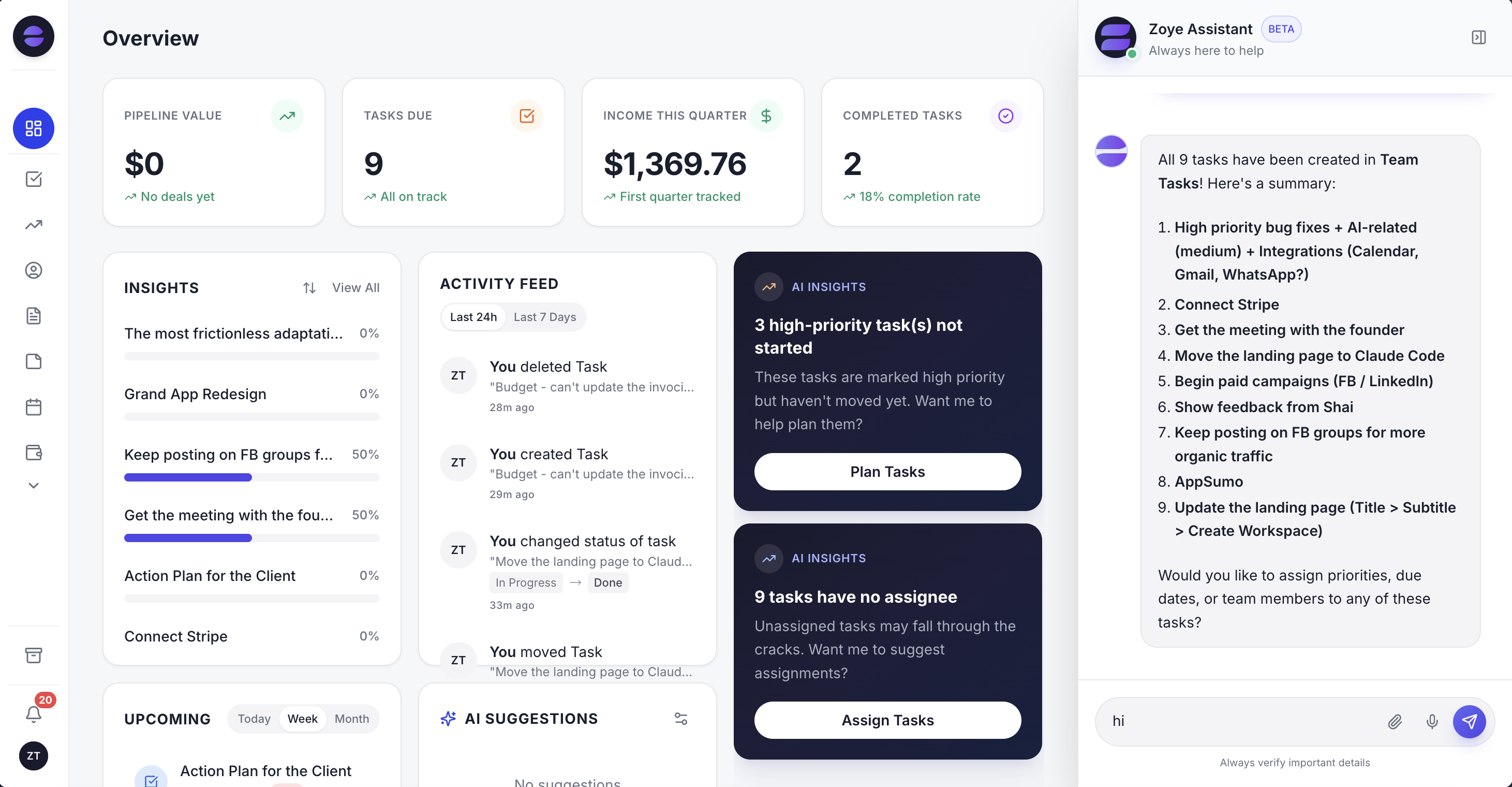 Zoye combines what Asana and Monday do with native CRM, budget, and an AI assistant
Where Asana gives you structured tasks and Monday gives you flexible boards, Zoye gives you both in list, board, calendar, and timeline views, then connects them to a real Deals-and-Contacts CRM, native budget tracking, and live reports. The Zoye Assistant does not just suggest. It creates tasks from an email, prioritises your day by deadline and workload, drafts follow-ups, schedules deep-work blocks, surfaces overdue items, and generates a status report on demand. It can also centralise customer conversations, including WhatsApp, and draft replies.
The pricing is flat, not per seat, and Zoye is the most affordable full-platform option. The entry plan, Almost Free, is $5/month ($4/month billed annually) and covers 1 member with the full platform including the AI assistant. Starter is $29/month for up to 10 members, and Growth is $59/month for up to 20. A 20-person team gets tasks, CRM, calendar, budget, reports, and an action-taking AI assistant for less than two Asana Advanced seats.
Real example: A 12-person marketing agency owner finishes a client call and dictates one line on her phone: "Brightwave wants a Q3 campaign, budget about $18K, kickoff in two weeks." Zoye opens the client deal, files the contact, books a kickoff event on the calendar, and drafts the campaign tasks against the budget. In Asana that is several screens with no record of the client or the budget; in Monday it is project boards plus a separately priced CRM you have to stitch together.
Want to see it in action?
Watch how Zoye automates your daily workflow - from lead management to team collaboration.
See How It WorksWhen to choose each
Choose Asana if:
- You want clean, fast, structured work management with goal alignment
- Your team values speed and a clear single way to organise work
- You can absorb the Advanced tier ($24.99/user/month) for AI access
- You do not need CRM or budget tracking in the same tool
Choose Monday.com if:
- You want a colourful, flexible Work OS your team can shape itself
- Visual, colour-coded boards and friendly no-code automation matter most
- You are happy to pay for separate products (CRM, Dev) on the same platform
- You have the discipline to keep boards from sprawling
Choose Zoye if:
- You want an AI assistant that takes action included at no extra cost on every tier
- You need tasks, CRM, calendar, and budget in one connected workspace
- You prefer flat tier-based pricing over per-seat charges that grow with hiring
- You want to be operational the same day with no configuration project
- You want to manage customer conversations, including WhatsApp, from one place
Ready to streamline your business?
Zoye brings AI-powered CRM, task management, and automation into one workspace.
Get StartedThe bottom line
Asana and Monday.com are both strong platforms pulling in different directions. Asana is the structured, goal-aligned choice with the cleanest task experience, ideal for teams that want speed and clarity and can pay for the Advanced tier to unlock AI. Monday.com is the flexible, visual Work OS, ideal for teams that want a colourful canvas they can shape and do not mind running separate products for CRM and dev work.
The real question for 2026 is not just which of the two wins, but whether either is built for how your business actually runs. Both bill per seat, so the cost climbs with every hire. Both gate AI behind higher tiers. And neither gives you a customer pipeline, a budget, and your tasks in one connected place with an assistant that acts across all of them.
If you need that - one AI-native workspace with tasks, CRM, calendar, and budget, an assistant that takes real action, and flat pricing that does not punish growth - the honest answer is neither Asana nor Monday. Zoye is built for that team, with everything included at no extra cost on every tier and an entry plan from $5/month ($4/month billed annually). Start on Almost Free today and cancel or upgrade anytime.
For more context, see our guides to the best Asana alternatives, the best monday.com alternatives, the best project management apps in 2026, and our ClickUp vs Asana comparison.