
Trello vs Jira 2026: Which Wins, and a Simpler AI-Native Option
Trello and Jira are both Atlassian products, but they were built for very different kinds of work. Trello is the friendly, drag-and-drop Kanban board that anyone can pick up in five minutes. Jira is the heavyweight agile platform that software teams use to plan sprints, groom backlogs, and ship releases. Choosing between them is less about which is "better" and more about who is using it and what they need it to do.
This comparison covers both honestly: where Trello's simplicity is a genuine strength, where Jira's depth pays off, and where both leave gaps that a growing number of cross-functional and business teams are filling with a different kind of tool. We will also introduce a third option, Zoye, that combines clean project views with CRM, budget tracking, and an AI assistant that actually does the work - aimed at business and operations teams rather than pure software engineering.
Pricing reflects published rates as of June 2026; check each vendor's pricing page for current figures.
Trello vs Jira at a glance
| Dimension | Zoye | Trello | Jira |
|---|---|---|---|
| AI assistant | Native, acts across the whole workspace | Limited automation (Butler rules) | Atlassian Intelligence, mostly assistive |
| Ease of use | Clean and approachable, minimal setup | Very easy - the simplest of the three | Powerful but steep learning curve |
| Agile / dev depth | Light, not built for formal sprints | Thin - basic boards only | Deep - sprints, backlogs, issue types, workflows |
| Views | Board, list, calendar, timeline | Board, plus list/calendar/timeline on paid tiers | Board, backlog, timeline, roadmap, reports |
| CRM / business ops | Built in - contacts, deals, pipeline | Not included | Not included |
| Pricing model | Flat-rate / tier-based, not per seat | Per user per month | Per user per month |
| Scale | Small to mid-size cross-functional teams | Best for small teams and light tracking | Scales to large engineering orgs |
| Best for | Business, ops, and cross-functional teams | Simple visual task tracking | Software and agile engineering teams |
Where Trello wins
Trello's superpower is that there is almost nothing to learn. You create a board, add columns, and drag cards between them. That is the whole mental model, and it works for a huge range of light use cases: a content calendar, a hiring pipeline, a personal to-do list, a small team's weekly tasks.
Speed to value. A new Trello board is useful in minutes. There is no project configuration, no permission scheme, no workflow editor to wrestle with. For a small team or a non-technical group, that low friction is exactly the point, and it is the single biggest reason Trello remains so widely loved.
Visual clarity. A Trello board is pleasant to look at. Cards carry labels, due dates, checklists, and attachments, and the board gives an instant sense of where work stands. For status-at-a-glance tracking, the simple Kanban metaphor is hard to beat.
Approachable for anyone. Marketing coordinators, event planners, freelancers, and operations staff can all use Trello without training. It does not assume you know what a "sprint" or a "story point" is, which makes it a natural fit for teams outside of software. That accessibility also makes it a popular first project tool for businesses that have outgrown spreadsheets but are not ready for anything heavier.
Power-Ups when you need a little more. Trello extends through Power-Ups and Butler automation, so you can bolt on a calendar view, a few automated card actions, or a connection to another app without leaving the board. It is not deep customization, but for light needs it keeps Trello flexible enough to grow with a small team for a while.
Where Trello runs out of road is depth. Once you need real sprint planning, dependency management, time tracking, or reporting across multiple boards, the simplicity that made Trello attractive starts to feel like a ceiling. Trello has added Premium views like timeline and calendar, but it was never designed to be an engineering planning tool, and it shows when teams push it past light task tracking.
Where Jira wins
Jira is the opposite trade-off. It asks more of you up front and rewards you with serious capability. For software teams running Scrum or Kanban at scale, Jira is purpose-built and remains one of the strongest tools in the category.
Agile engineering depth. Jira gives you sprints, backlogs, story points, velocity charts, burndown reports, epics, and configurable issue types. Engineering managers can plan releases, track work in progress, and report on team throughput with a level of rigor Trello simply does not offer.
Configurable workflows. Jira lets you model exactly how work moves through your team, with custom statuses, transitions, validators, and automation rules. Two teams in the same company can run completely different workflows. That flexibility is invaluable for complex engineering organizations, though it is also where a lot of the setup complexity comes from.
Developer ecosystem. Jira connects tightly to the tools software teams already use - source control, CI/CD pipelines, and a deep marketplace of apps. A commit or a deploy can move an issue automatically, which keeps engineering work and project tracking in sync.
Reporting and traceability. For engineering leaders, Jira's reporting is a major draw. Velocity, cumulative flow, sprint burndown, and release readiness reports give managers a defensible view of throughput and predictability. Every issue carries a full audit trail of who changed what and when, which matters in regulated industries and large teams where traceability is not optional. Trello has nothing comparable, and that gap is often what pushes a maturing engineering team to switch.
The cost of all this power is complexity. Jira has a real learning curve, and for a marketing team, an operations group, or a small business that does not write code, it is usually overkill. The terminology, the configuration screens, and the agile concepts that make Jira great for engineers can feel like overhead for everyone else. Setting Jira up well often requires an admin who knows the tool.
The third option both miss: Zoye
Here is the honest framing. If you are a dedicated software engineering team running formal agile, Jira is genuinely hard to beat and you should lean toward it. But most teams choosing between Trello and Jira are not pure dev shops. They are marketing teams, operations groups, agencies, consultancies, and small businesses that want clean project tracking without Jira's complexity, and more capability than Trello can stretch to. For those teams, the real question is not "Trello or Jira" but "why am I only getting project boards from a tool, when I also need a CRM, a budget, and someone to actually do the busywork?"
Zoye is built for that team. It is an all-in-one, AI-native workspace that combines structured project management with the business tools Trello and Jira leave out, and a native AI assistant named Zoye that executes work across all of it.
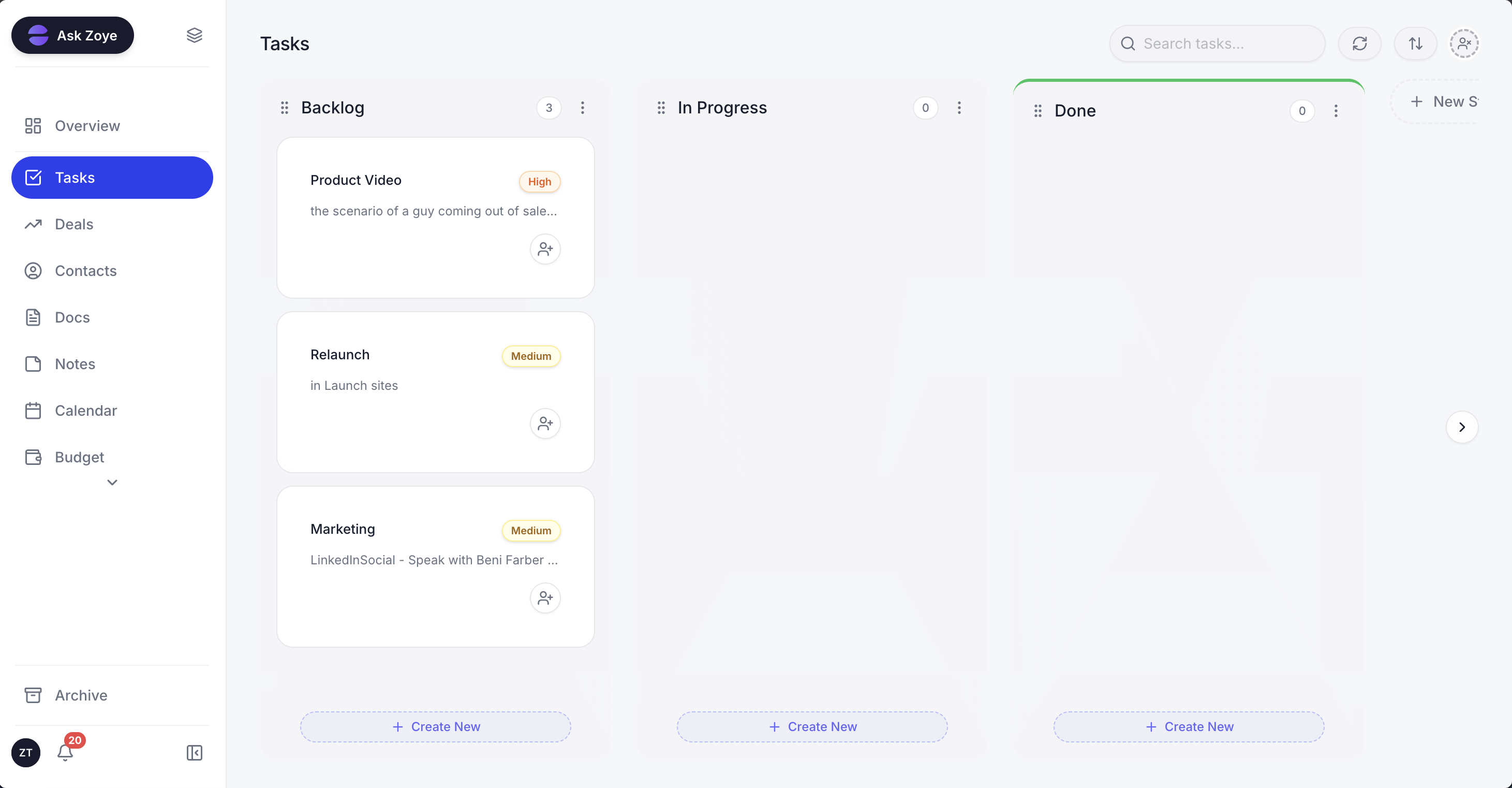
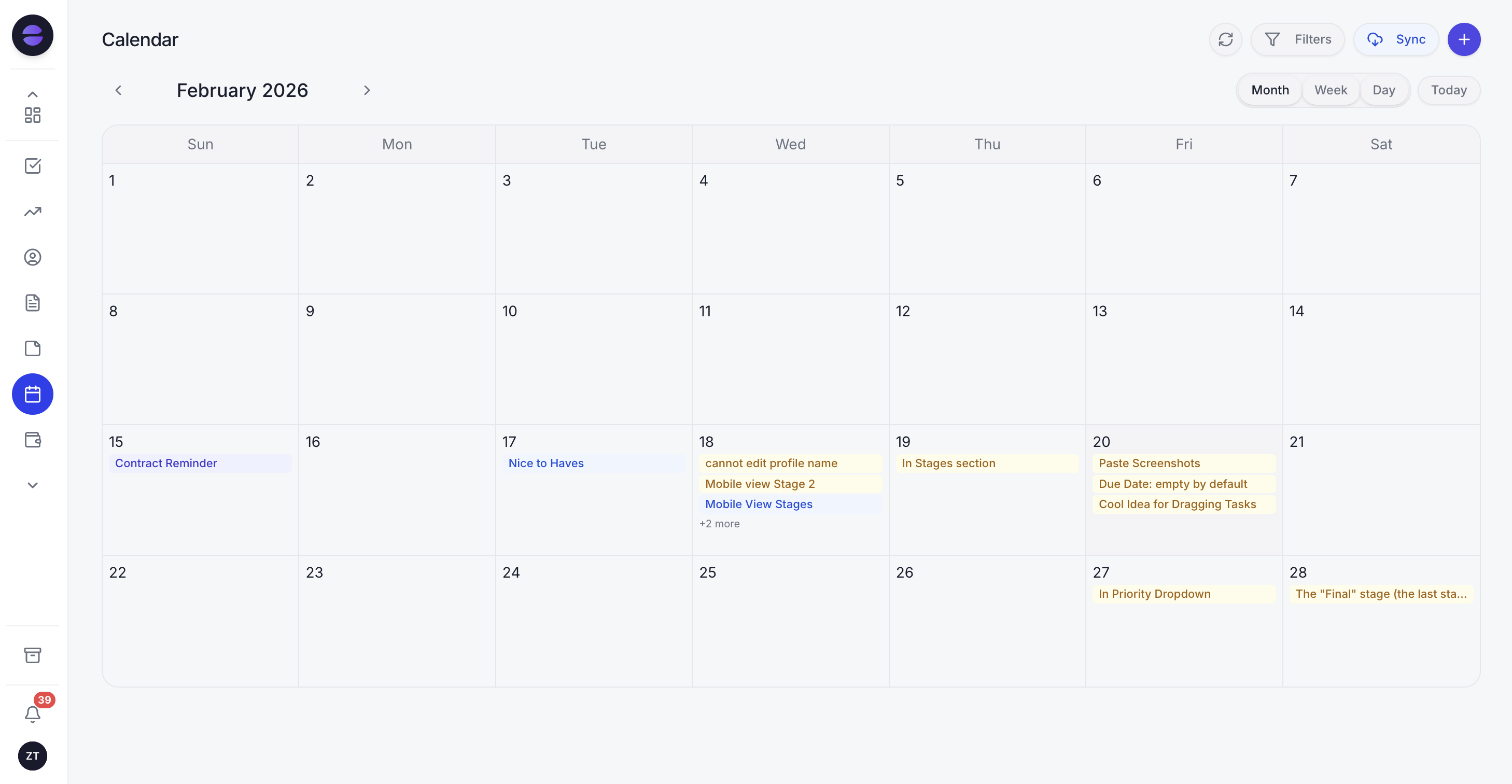
On the project side, Zoye gives you the views people actually want. A board view for the Kanban simplicity Trello fans love. A list view for structured task management. A calendar view where tasks appear automatically, with no sync setup. And a timeline view for planning work over time. You also get custom fields, dependencies, workload management, time tracking, and project templates, which covers a lot of the structured planning that pushes teams off Trello toward Jira in the first place.
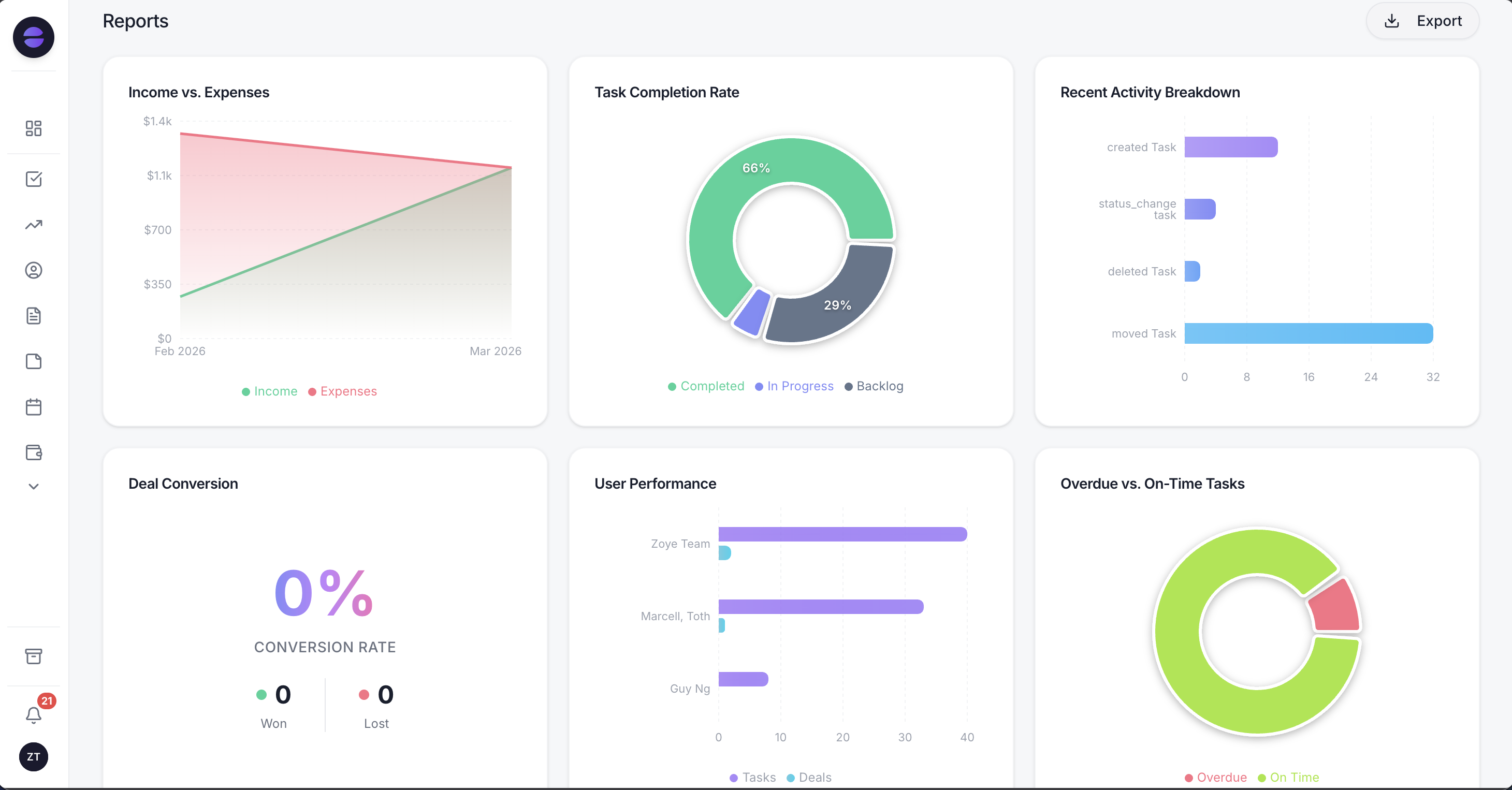
The difference that neither Atlassian tool can match is what Zoye does beyond the board. Your projects sit in the same workspace as your CRM, so a deal connects directly to the tasks being done to close it, the contacts involved, and the calendar events around it. Your budget lives there too, so the financial side of a project is never in a separate spreadsheet. And Reports pulls task, deal, finance, and team data into one exportable dashboard.
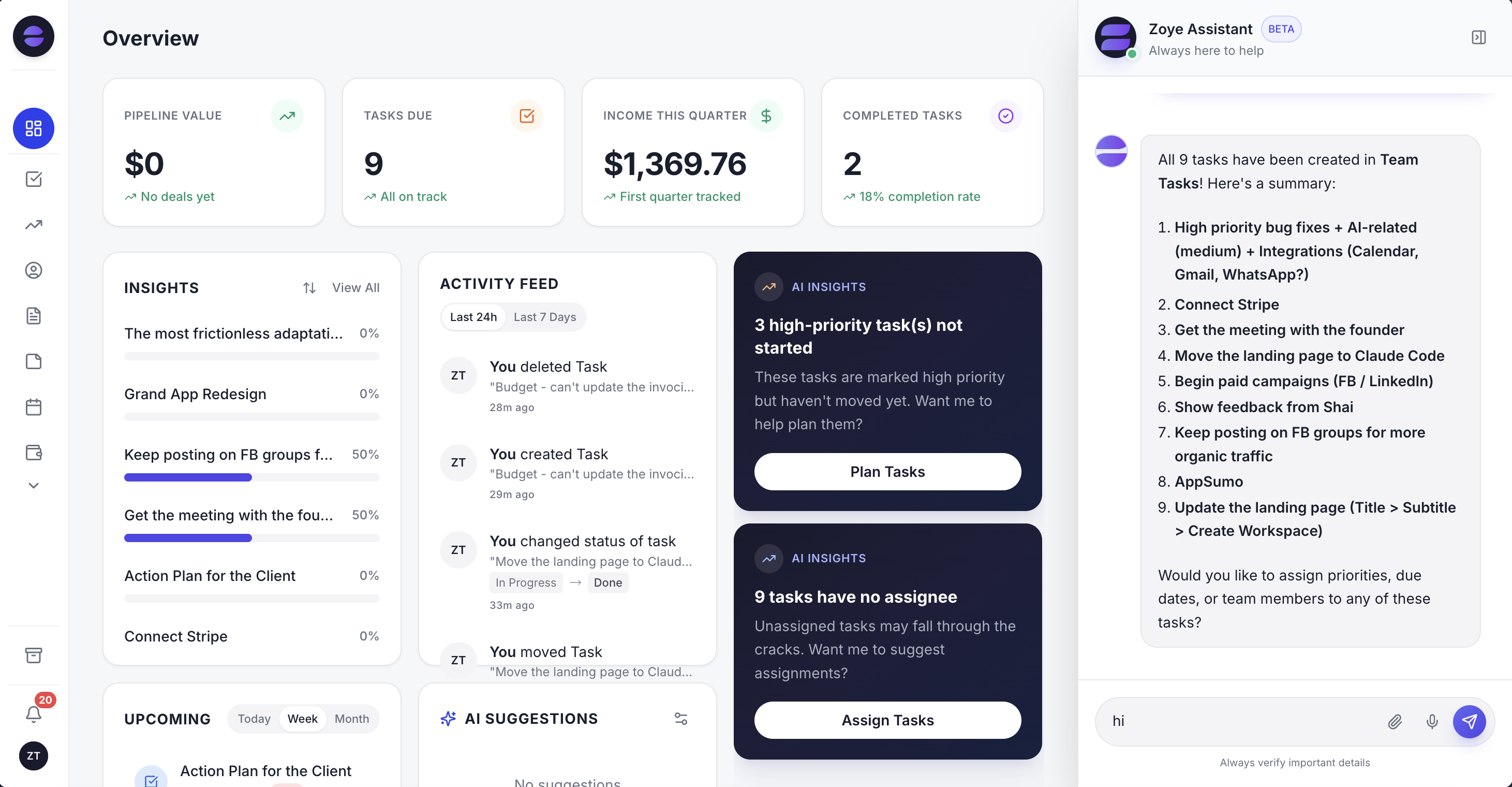
Then there is the AI. Trello has Butler automation rules and Jira has Atlassian Intelligence, but both are largely assistive - they help you do things faster within their lane. Zoye Assistant acts. Give it a brief and it drafts task descriptions. It surfaces overdue and blocked work proactively before you go looking. It reassigns workload by capacity when a teammate is overloaded. It generates a weekly status report on demand, schedules meetings around deadlines, and creates tasks from incoming emails. During a migration it handles deduplication and tagging for you. It does the work, rather than just suggesting it.
And because the whole thing is one workspace, the AI can act across every module from a single instruction. Ask it to "create a launch project, add the three deliverables as tasks due next Friday, and assign whoever has the lightest workload," and it builds the board, the tasks, and the assignments in one pass. That cross-module reach is something a single-purpose board tool, however polished, structurally cannot offer.
Zoye also imports directly from both Trello and Jira, along with Notion, ClickUp, and Monday.com, so moving your existing boards over does not mean starting from scratch.
Trello vs Jira on pricing
Both Trello and Jira use per-user pricing, which means your bill grows with every person you add. Trello Standard runs around $5 per user per month and Premium around $10 per user per month. Jira Standard runs around $8 per user per month and Premium around $15 per user per month, with discounts on annual billing. Both offer free tiers with member or feature limits that most growing teams outgrow.
For a 15-person team, that per-seat math adds up quickly, and it only covers project management - you are still paying separately for a CRM, a finance tool, and anything else your business runs on.
Zoye uses flat-rate, tier-based pricing instead. The entry plan, Almost Free, covers 1 member with the full platform including AI at just $5 per month ($4 per month billed annually), the price of a cup of coffee, and you can cancel or upgrade anytime. Starter is from $29 per month for up to 10 members, and Growth is from $59 per month for up to 20 members. Because it is not per seat, adding a teammate does not change the price within a tier, and because CRM, budget, and reporting are bundled in, you are not stacking subscriptions to cover the rest of your operations.
Which should you choose?
The decision comes down to who you are and what you need.
Choose Trello if you want the simplest possible visual board, your needs are light task tracking, and you value approachability over depth. It is a great fit for small teams, non-technical groups, and anyone who wants to be productive in minutes without configuration.
Choose Jira if you are a software or agile engineering team that needs sprints, backlogs, story points, configurable workflows, and tight developer-tool integration. The learning curve is real, but for dedicated dev teams running formal agile, that depth is worth it and Jira remains a category leader.
Choose Zoye if you are a business, operations, or cross-functional team that wants clean board, list, calendar, and timeline project views without Jira's complexity, plus the CRM, budget, and reporting that Trello and Jira do not include, plus an AI assistant that actually does the work, all in one workspace at flat-rate pricing.
Try Zoye today. The entry plan, Almost Free, gives you the full platform for up to 1 member at just $5 per month ($4 per month billed annually), so you can see how board, list, calendar, and timeline views feel alongside a real CRM, a budget, and an AI assistant that executes - and decide for yourself whether you ever needed two separate Atlassian tools in the first place. Cancel or upgrade anytime.
For more on choosing the right tool, see our guides to the best Jira alternatives, the best Trello alternatives, the best ClickUp alternatives, and the best project management apps in 2026.