
Asana vs Jira 2026: Which Project Management Tool Fits Your Team
Asana and Jira show up on almost every project management shortlist in 2026, yet they were built for opposite kinds of teams. Asana is clean, fast, and goal-aligned, the tool marketing, operations, and cross-functional teams reach for when they want their daily work visibly tied to company objectives. Jira is an issue tracker and agile engine, built for software teams that live in sprints, backlogs, and bug queues. Powerful, yes, but heavy and unapologetically developer-centric.
The reason this comparison is hard is that most teams are not purely one or the other. A product company has engineers who want Jira and a marketing team that would quietly revolt if forced into it. An agency wants Asana's polish but also needs to track clients, budgets, and deadlines that neither tool was designed to hold. If you are stuck between the two, that tension is usually a signal that the real answer is a different kind of tool entirely.
This guide breaks down how Asana and Jira compare on ease of use, boards and views, automation, breadth, AI, and pricing, with an honest verdict on each. Then it covers a third option that closes the gap both leave open: an AI assistant that actually executes, plus CRM and budget built into the same workspace as your tasks.
Pricing reflects published rates as of June 2026; check each vendor's pricing page for current figures.
Asana vs Jira at a glance
| Dimension | Zoye | Asana | Jira |
|---|---|---|---|
| Built for | Whole business, any team | Marketing, ops, cross-functional | Software and engineering |
| AI assistant | Included on every plan, executes across workspace | Advanced tier and up, suggests | Atlassian Intelligence, higher plans, suggests |
| Task views | List, board, calendar, timeline | List, board, timeline, calendar | Boards, backlog, roadmap |
| Agile / sprints | Lightweight task flow | Limited | Deep - sprints, story points, epics |
| CRM / Deals | Built in, all plans | Not included | Not included |
| Budget / finance | Built in | Not included | Not included |
| Reports / analytics | Cross-workspace live reports | Portfolios, workload | Burndown, velocity, dashboards |
| WhatsApp management | Live, by text or voice | Not available | Not available |
| Ease of adoption | Same day | About a day | Weeks, dev-led |
| Pricing model | Flat tier, not per seat | Per seat | Per seat |
| Free plan | Not offered | Up to 10 users, basic | Up to 10 users, basic |
| Paid entry price | Almost Free, $5/month (1 member, AI included) | Low-teens per user/month | Low-single-digits per user/month |
Ease of use: Asana for humans, Jira for engineers
This is the dimension where Asana and Jira separate most sharply, and it is the one that decides adoption.
Asana is designed to be obvious. A new user can open it, create a project, drop tasks into a list or board, assign owners and due dates, and be productive within a day. The interface is uncluttered, the language is plain (tasks, projects, sections), and switching between views is instant. Asana's whole product philosophy is that work tools should not need a training program. For marketing teams, operations, agencies, and any group that is not engineering-led, that ease is the headline feature.
Jira is powerful in proportion to how much you are willing to configure it. It is organised around developer concepts: epics, stories, sprints, workflows, story points, and issue types. For an engineering team that already thinks in those terms, this is exactly right. For everyone else, Jira feels like a cockpit. Setup typically runs into weeks, governance matters, and non-developers often quietly avoid it. The depth that makes Jira indispensable to a dev team is the same depth that makes it a poor fit for the rest of the company.
Verdict: Asana for any team that needs to be productive immediately. Jira only when an engineering team genuinely needs its agile machinery and has the patience to configure it.
Boards, views, and the agile workflow
Jira is an issue tracker first. Its boards are built for agile delivery: Scrum boards with sprints and burndown, Kanban boards with work-in-progress limits, a dedicated backlog, and roadmaps that map epics across releases. Story points, velocity tracking, and release management are native. If your team runs formal sprints and needs to tie work to Git commits and CI pipelines, no general task tool matches what Jira does here.
Asana offers list, board, timeline, and calendar views, with Gantt-style timelines and workload views on higher tiers. Every view is clean and fast, and the underlying data model links tasks to projects, projects to portfolios, and portfolios to goals, so daily work stays visibly connected to strategy. Asana can run a lightweight sprint, but it does not pretend to be an agile issue tracker, and it should not be forced into that role.
Verdict: Jira for deep agile and engineering workflows. Asana for cross-functional planning where clarity and goal alignment matter more than sprint mechanics.
Automation and workflows
Jira automation is mature and granular. You can build rules that transition issues, assign owners, sync fields, trigger on Git events, and enforce complex multi-step workflows. It is some of the most capable automation in the category, but it is also tuned for engineering processes and benefits from an administrator who knows the system well.
Asana automation, branded as Rules, is friendlier and more visual. You can set triggers and actions to move tasks between sections, assign work, set due dates, and notify owners without writing logic. It covers the everyday automation that operations and marketing teams actually need, even if it does not reach Jira's depth on developer-specific triggers.
Verdict: Jira for sophisticated, engineering-grade automation. Asana for approachable, no-code workflow automation that a non-technical admin can own.
Breadth: where both tools stop
Here the two rivals converge on the same weakness. Both are project and task tools, and both end at the edge of that category.
Asana manages tasks and goals well, and nothing else. There is no CRM, so the clients and deals behind the work live in another system. There is no budget or finance tracking, so the money behind a project lives in a spreadsheet. Operational analytics that span sales, delivery, and cost simply are not there.
Jira is even narrower in scope by design. It tracks issues. Atlassian sells Confluence for docs, separate tools for service management, and a wider Marketplace to extend it, which means a typical Jira deployment is really a stack of subscriptions. There is no CRM and no budget tracking in the core product.
The result is the same for both: teams stack three to five tools around their project tracker to cover the basics of running a business. Each new tool is another login, another bill, and another place data fails to sync.
Verdict: Both Asana and Jira leave CRM, budget, and unified operations out. If you need those connected to your tasks, neither tool covers it natively.
AI: who actually has it, and what it does
This is where most teams discover the hidden cost.
Asana offers AI features (Asana Intelligence, AI Studio for no-code workflows, and AI teammates) but these live on the Advanced tier (around $25 per user per month) and higher. The capabilities are genuine, but they are gated behind one of the more expensive plans in the category.
Jira relies on Atlassian Intelligence for summaries, suggestions, and natural-language search, tied to higher plans and add-ons across the Atlassian suite. As with Asana, the AI is available to teams that pay up, not to everyone on the entry tier.
The deeper limitation is what these AIs do. Both primarily assist: they summarise, draft, and answer questions about your work. Neither executes a chain of real actions across modules from a single instruction, because neither has the modules. There is no CRM for the AI to update, no budget for it to adjust, no calendar event for it to book alongside a task.
Verdict: Asana and Jira both put capable AI behind expensive tiers, and in both cases it suggests rather than acts. For an AI that takes real action across tasks, CRM, calendar, and budget, see the third option below.
Pricing: Asana vs Jira
Both Asana and Jira charge per seat, so the bill grows every time you hire, and both keep their better AI behind their pricier tiers.
Asana pricing:
- Personal: Free for up to 10 users, basic features
- Paid tiers start in the low-teens per user per month, with the Advanced tier (around $25 per user per month) carrying the AI features
- Enterprise: Custom
Jira pricing:
- Free: Up to 10 users, basic features
- Paid tiers start in the low-single-digits per user per month, with Premium (around $17 per user per month) for the fuller experience
- Enterprise: Custom
Pricing reflects published rates as of June 2026; check each vendor's pricing page for current figures.
The 20-person team math. On Asana Advanced, where the AI lives, a 20-person team pays around $500 per month for task management alone, and still has no CRM or budget tracking. On Jira Premium, the same headcount runs roughly $340 per month for what is essentially issue tracking, before adding Confluence for docs or Atlassian Intelligence. A 20-member Zoye Growth plan is $59 per month flat, with the AI assistant, CRM, and budget all included, and the price does not climb as the team grows.
Verdict: Jira is cheaper per seat than Asana, but both use the per-seat model and both leave out the tools you would otherwise buy separately. A flat-rate platform that includes AI, CRM, and budget wins on total cost once you account for everything the project tracker does not cover.
See what Zoye can do for you
From CRM and deal tracking to AI-powered task management - explore everything Zoye offers in one workspace.
Explore FeaturesThe third option: Zoye
Asana and Jira leave the same gaps. AI is expensive and only suggests, there is no CRM, and there is no budget tracking. Teams that find Jira too heavy and technical, or Asana too narrow once they grow, keep hitting the same wall. Zoye is built for exactly that team: an AI-native workspace that puts tasks, deals, contacts, calendar, budget, docs, and reports in one place, with a personal AI assistant included at every tier that takes real action across all of them from a single text or voice instruction.
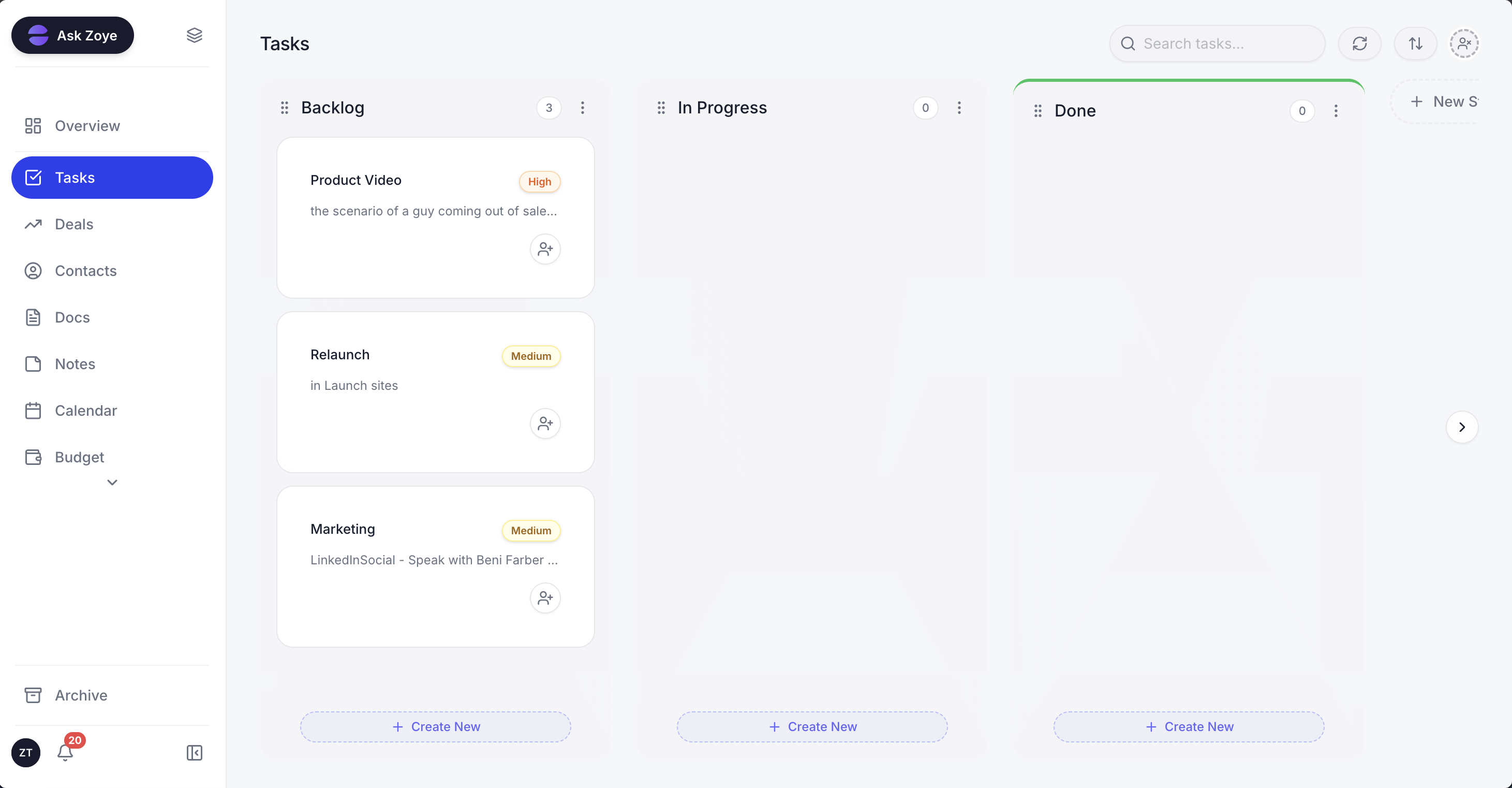 Zoye gives every project list, board, calendar, and timeline views in one workspace.
On the project side, Zoye gives every project list, board, calendar, and timeline views, so the marketing lead gets the clean Kanban they wanted from Asana while the work stays connected to the rest of the business. The difference from both rivals is the Zoye Assistant. It does not just summarise. Tell it to turn a client email into tasks, prioritise this week by deadline and workload, draft the follow-ups, block deep-work time on the calendar, or surface everything overdue, and it executes the action rather than handing you a suggestion. Because the assistant sits on top of CRM, budget, and calendar as well as tasks, one instruction can touch all of them at once.
The breadth is the other half of the story. Asana covers tasks; Jira covers issues; Zoye covers the business. A real Deals-and-Contacts CRM is connected to tasks, native budget tracking sits beside project work, live WhatsApp management runs by text or voice, and reports pull across the whole workspace in real time. That is the operational coverage both Asana and Jira ask you to buy elsewhere.
Real example: A 12-person product studio splits its tools the usual way: engineers on Jira, the marketing and client side on Asana, deals in a spreadsheet, budgets in another. The founder dictates one line into Zoye after a call: "Brightwave signed the retainer, about $30K over three months, kickoff next week." Zoye opens the client deal, files the contact, books the kickoff on the calendar, and drafts the launch tasks against the retainer. In the old split, that is four tools and nothing connecting the work to the client or the money.
Pricing: Almost Free at $5 per month for 1 member with the full platform including AI. Starter from $29 per month (10 members). Growth from $59 per month (20 members). Scale from $119 per month (100 members).
Best for: Teams that find Jira too heavy and dev-centric and Asana too narrow once they need CRM, budget, and an AI that actually does the work, all at flat-rate pricing.
Want to see it in action?
Watch how Zoye automates your daily workflow - from lead management to team collaboration.
See How It WorksWhen to choose each
Choose Asana if:
- Your team is marketing, operations, or cross-functional rather than engineering-led
- You want a tool the whole team can adopt in a day with no setup project
- Goal-to-task alignment and a clean, fast interface are priorities
- You can absorb the Advanced tier cost for AI access and do not need CRM or budget built in
Choose Jira if:
- You are an engineering team running formal agile - sprints, story points, backlogs, releases
- You need deep issue tracking, burndown and velocity reporting, and tight Git and CI integration
- You have the patience and an administrator for a multi-week setup
- The rest of the company does not need to live in the same tool
Choose Zoye if:
- You want one workspace for tasks, CRM, calendar, budget, and reports instead of a stack of subscriptions
- You want an AI assistant that takes real action, included at every tier rather than gated behind the top plan
- You prefer flat-rate pricing that does not climb every time you hire
- You want list, board, calendar, and timeline views without Jira's weight or Asana's missing operational tools
- You want to run the business from WhatsApp by text or voice, and be operational the same day
Ready to streamline your business?
Zoye brings AI-powered CRM, task management, and automation into one workspace.
Get StartedFrequently asked questions
It depends on who is using it. Jira is better for software and engineering teams that live in sprints, backlogs, story points, and bug tracking. Asana is better for marketing, operations, and cross-functional teams that want clean task management tied to goals without the agile overhead. Neither is universally better - Jira is built for developers, Asana for everyone else. Teams that need both task management and CRM, budget, and an AI assistant that takes action usually outgrow both.
Yes. Asana is consistently rated easier to learn and faster to adopt, and most non-technical teams are productive within a day. Jira is powerful but dense, built around developer concepts like epics, sprints, and workflows that take weeks to configure and longer for non-developers to feel comfortable with. If your team is not engineering-led, Asana wins on ease of use by a wide margin.
Software teams that run formal agile processes - sprints, story points, backlog grooming, release tracking, tight Git and CI integration - are generally better served by Jira, which was purpose-built for that workflow. Asana can handle lightweight engineering work but lacks the deep agile and issue-tracking features developers expect. The trade-off is that Jira is heavy and dev-centric, so the rest of the company often refuses to use it.
Both offer AI, but neither includes a capable AI layer in entry tiers. Asana AI features live on the Advanced tier (around $25 per user per month) and higher. Jira relies on Atlassian Intelligence, which is tied to higher plans and add-ons. In both cases the AI mostly suggests and summarises rather than executing real work. (Pricing reflects published rates as of June 2026 - check each vendor's pricing page.)
Yes - Zoye is built for teams that find Jira too heavy and technical and Asana missing the operational basics. It combines tasks with list, board, calendar, and timeline views, plus a real CRM, budget tracking, and a personal AI assistant included at every tier that takes action across the whole workspace. A 20-member team pays $59 per month flat on Zoye Growth with everything included, instead of paying per seat for task management alone.
The bottom line
Asana and Jira are both strong tools built for very different teams. Jira is the engineering team's home: deep agile, granular issue tracking, mature automation, and the lowest per-seat price, as long as you have the patience to configure it and do not need anyone outside engineering to use it. Asana is the cross-functional team's home: clean, fast, goal-aligned, and adoptable in a day, as long as you can absorb the Advanced tier for AI and do not need CRM or budget built in.
The real question for most teams in 2026 is whether either tool fits how the whole business runs. If you need list, board, calendar, and timeline views without Jira's weight, an AI assistant that takes action instead of just suggesting, a CRM and budget connected to your tasks, and pricing that does not grow every time you hire, the honest answer is neither. Zoye is built for that team, with all of it included at every tier and operational the same day you sign up.
Try Zoye with your team. The entry plan is Almost Free at $5 per month for 1 member, with the full platform including AI.
For more context, see our guides to the best Asana alternatives in 2026, the best Jira alternatives, Asana vs Trello, and Trello vs Jira.