
Most small businesses already run on WhatsApp. Leads message you there, customers ask questions there, bookings get confirmed there. The problem is that WhatsApp alone is a manual channel. Every reply is typed by a human, every follow-up depends on someone remembering it, and every enquiry that lands while you are with a customer or asleep waits until you get back. On a busy day, that is exactly when leads go cold and reminders never get sent.
WhatsApp automation is how you close that gap. Done well, it means a new enquiry gets an answer in seconds, a quiet lead gets chased without you lifting a finger, and appointment or payment reminders go out on schedule whether or not you remember them. Done badly, it means robotic blasts that get you reported and blocked. This guide explains what WhatsApp automation actually is in 2026, the specific flows that move the needle for a small business, the difference between the free app and the WhatsApp Business API, whether to build it yourself or buy a tool, and how to get the outcome without becoming a full-time flow builder.
Pricing reflects published rates as of July 2026; check each vendor's pricing page for current figures.
What WhatsApp automation actually means in 2026
WhatsApp automation is any software that handles a WhatsApp task so a human does not have to type it every time. That spans a wide range, from a one-line greeting message on the free app to a full sequence that captures a lead, replies instantly, follows up three times, books a slot, and reminds the customer the day before.
It helps to separate three levels.
Auto-replies. The simplest layer: a greeting when someone messages for the first time, an away message outside business hours, and saved quick replies for common questions. The free WhatsApp Business app covers these for a single number.
Automated flows. A trigger sets off a sequence of steps. A new lead triggers an instant reply plus a follow-up two hours later plus another the next day if there is still no answer. This is where most of the value sits, and it usually needs a dedicated tool or the WhatsApp Business API.
Conversational automation. The system does not just fire pre-written steps, it understands the message, answers in context, updates your records, and decides the next action. This is the direction the category is moving in 2026, and it is where an AI assistant replaces a rigid flowchart.
The mistake owners make is treating automation as bulk sending. The point is not to blast more messages. It is to make sure the right message reaches the right person at the right moment without depending on your memory or your availability.
The WhatsApp automation flows that matter for a small business
You do not need dozens of automations. Five flows cover almost every small business, and they are the ones where manual effort quietly costs you money.
1. Instant lead capture and auto-reply. The single highest-value automation. When a new lead messages, they get an answer within seconds: a friendly acknowledgement, a couple of qualifying questions, and a clear next step. Speed to first reply is the biggest predictor of whether a lead converts, and a human cannot be that fast around the clock. This is also where the lead should be captured as a contact automatically, so it never lives only inside a chat thread.
2. Follow-up sequences. Most sales are lost not on the first message but in the silence after it. A follow-up flow chases a lead who went quiet: a gentle nudge the next day, a value-add message a few days later, a final check-in before you let it go. Automating this is what separates businesses that convert from businesses that forget.
3. Appointment reminders. For anyone who books time (clinics, salons, consultants, tradespeople), a reminder the day before and an hour before cuts no-shows dramatically. The reminder can include a one-tap way to confirm or reschedule, so your calendar stays accurate without phone tag.
4. Payment and renewal reminders. A polite automated nudge when an invoice is due, or when a subscription or policy is about to renew, recovers revenue that otherwise slips because nobody chased it. These are the messages owners hate sending manually, which is exactly why they get skipped.
5. Broadcasts and re-engagement. A one-to-many message to a segment: a new offer, a seasonal reminder, a win-back to lapsed customers. Broadcasts are powerful and also the most heavily regulated, so they must go only to opted-in contacts using approved templates. Used well, a broadcast to the right segment is the cheapest sales channel you have.
Notice the pattern: every one of these flows is something you already try to do by hand and drop when you get busy. Automating them is not about doing something new, it is about making the things you already know you should do happen reliably.
Want to see it in action?
See Zoye catch a new lead, answer on WhatsApp and set up the follow-up, all from one message.
See How It WorksWhatsApp Business app vs the WhatsApp Business API
This is the fork in the road that confuses most owners, so it is worth being clear.
The WhatsApp Business app is the free app you download on a phone. It gives you a business profile, catalog, labels, and basic automation: a greeting message, an away message, and quick replies. It runs on one number and is designed for a single person or a very small operation. If all you need is an auto-greeting and saved replies, the free app is enough and you should not overcomplicate it.
The WhatsApp Business API is not an app. It is the infrastructure businesses use to connect WhatsApp to other software, accessed through a provider (often called a BSP, or Business Solution Provider) or a platform built on top of it. The API unlocks what the free app cannot do: multiple team members answering one number, higher message volume, richer automated flows, broadcasts to large opted-in lists, chatbots, and integration with your CRM or operations tools. Pricing on the API is conversation-based and changes over time, so check Meta's current rates rather than assuming a fixed figure.
The practical rule: use the free app while you are one person handling a light volume. Move to an API-based tool the moment you need a team on one number, real follow-up sequences, or your customer records to update automatically. Most businesses reach that point faster than they expect.
Build it yourself vs buy a tool
Once you decide you need more than the free app, you have two paths.
Buy a WhatsApp automation tool. The market is full of them, especially in India and other WhatsApp-first markets: inbox tools, chatbot builders, and broadcast platforms. Most give you a visual canvas where you drag triggers and steps to build a flow. This works, but it comes with a hidden cost. You are now the flow designer and the maintainer. Every new scenario is a new flow you build, test, and keep updated. The tool answers customers, but running the business, deciding who to chase and when, updating records, is still on you. Many owners buy one of these, build two flows, and never touch the canvas again, which is the WhatsApp version of buying software and stopping using it.
Wire it together yourself with a general automation platform. Connecting WhatsApp to a tool like a generic automation builder plus a spreadsheet plus a calendar gives you flexibility, but it is brittle and technical. Every integration is a point of failure, and non-technical owners rarely maintain it past the first month.
There is a third path that has emerged in 2026: instead of building flows at all, you describe the outcome you want, the way you would brief a colleague, and an AI operator builds and runs the automation for you. That is the model the next section covers.
How to set up WhatsApp automation without a canvas
The traditional setup, on any flow-builder tool, looks like this: connect your number, open the canvas, pick a trigger, add steps, write each message, set delays and conditions, test it, publish it, and then maintain it as your business changes. It works, but it turns you into a part-time automation engineer, and every change means going back into the builder.
The alternative is to skip the builder. You say what you want, and the system does the wiring. "When a new lead messages on WhatsApp, reply within a minute, ask what they need, save them as a contact, and remind me to follow up in two hours if they go quiet." There is nothing else to set up: no canvas, no nodes, no conditions to configure. When the flow needs to change, you say so and it updates.
This matters because the people who most need WhatsApp automation, busy non-technical owners, are exactly the people least likely to maintain a flow builder. Removing the builder removes the reason automation gets abandoned.
See what Zoye can do for you
CRM, deals, tasks and your Instagram, Facebook and WhatsApp automations in one workspace. Just ask Zoye and it sets any of it up for you.
Explore FeaturesHow Zoye handles WhatsApp automation for you
Zoye is not a WhatsApp inbox or a flow-builder tool. It is an AI Business Operator that runs your business, and WhatsApp is one of the places it runs it from. Instead of building automations on a canvas, you tell Zoye the outcome you want and it builds and runs the automation itself.
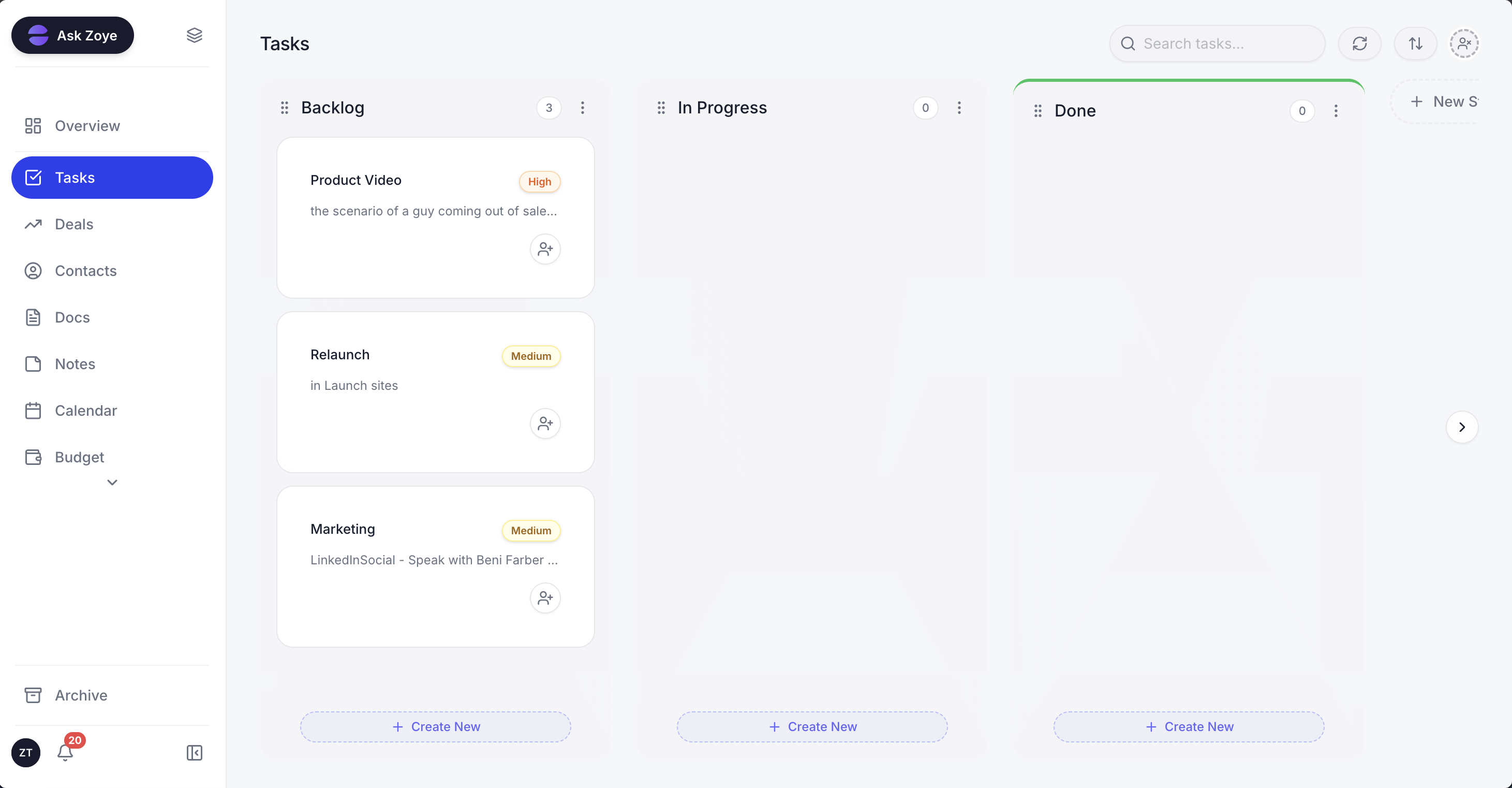 Zoye keeps every lead, task, and follow-up in one workspace and runs the WhatsApp work for you.
Here is what that looks like in practice. A lead messages your WhatsApp. Zoye replies in seconds, captures them as a contact, opens a deal, and starts the follow-up sequence, all without you touching a form. If they go quiet, the assistant chases them on the schedule you described, drafting each message so it reads like you. When a booking is confirmed, Zoye schedules the reminder the day before and the hour before. When an invoice is due, it sends the polite nudge. And you set all of this up by talking to it: "chase every quote that gets no reply within two days" is enough for Zoye to wire the automation, with no builder to learn and nothing to maintain.
Because you run Zoye by talking to it, you can operate from wherever you already are, including inside WhatsApp itself. The assistant works to Meta's rules, using consent and approved templates for outbound, so the automation is compliant rather than a bulk-blast risk. And because Zoye is a full workspace, the WhatsApp automation does not sit in a silo: the leads it captures land in the CRM, the follow-ups appear as tasks with list, board, calendar, and timeline views, bookings show on the shared calendar, and reports pull it all into one dashboard. The WhatsApp conversations, the records, and the follow-up work stay in one place instead of scattered across an inbox tool, a spreadsheet, and your memory.
To be honest about scope: Zoye is a unified operator that runs your customer conversations and follow-ups, not a specialist bulk-broadcast marketing suite with every campaign-analytics feature a dedicated marketing platform has accumulated. For a small business that wants every lead answered and every follow-up chased without maintaining a flow builder, an operator that does the work beats a canvas you have to keep feeding.
Pricing: Almost Free at $5 per month for 1 member with the core tools. Starter from $29 per month (10 members). Growth from $59 per month (20 members).
Best for: Small businesses, founders, and lean teams that want their WhatsApp lead capture, follow-ups, and reminders handled for them instead of built and maintained by them.
Mistakes to avoid with WhatsApp automation
A few patterns turn helpful automation into a liability.
Blasting without consent. The fastest way to get your number blocked is to broadcast to people who never opted in. Automation amplifies whatever you point it at, so pointing it at cold lists gets you reported. Keep consent, use approved templates for outbound, and respect the rules on initiating conversations.
Making it sound like a robot. Automation should sound like your business, not a system. Short, human, specific messages beat generic template speak. If a customer cannot tell whether the automation or a person answered, you have done it right.
Automating everything at once. Start with one flow, usually the instant lead reply, get it working, then add the next. Trying to automate five flows on day one guarantees none of them work well.
Letting flows go stale. On a traditional flow-builder, an automation you set up six months ago may now send the wrong message for a service you no longer offer. This is the maintenance trap, and it is the strongest argument for a system you can update by telling it what changed, rather than a canvas you have to remember to edit.
Conclusion: automate the follow-up, not just the reply
WhatsApp automation is not about sending more messages. It is about making sure the messages that matter, the instant reply to a new lead, the follow-up when they go quiet, the reminder before an appointment, the nudge when a payment is due, happen reliably without depending on you being available or remembering. Those flows are where small businesses leak the most money, and they are the ones a busy owner drops first.
You can build those flows yourself on a canvas and take on the maintenance, or you can describe the outcome you want and have an operator build and run it for you. In 2026, the second option is what lets a non-technical owner get enterprise-grade follow-up without hiring for it or becoming an automation engineer.
Try Zoye with your team. The entry plan is Almost Free, with the core tools.
For more context, see business automation for small business, how to sell on WhatsApp, and the best WhatsApp CRM software.
See the six automations Zoye ships for this, and how each one stays inside WhatsApp's rules, on the WhatsApp Automations page.