
Best Kanban Software 2026: 7 Tools for Visual Project Management
A Kanban board is one of the most intuitive ways to see work. Cards move left to right across columns, work in progress stays visible, and bottlenecks show up the moment a column gets crowded. Most teams that adopt Kanban love it within a week. The format is simple, fast, and honest about where things actually stand.
The limitation is what sits around the board. A Kanban board on its own does not run a business. Most standalone Kanban apps show you cards, but they have no CRM to track the customers behind those cards, no calendar to schedule the work, no budget to tie spend to projects, and no AI that does anything beyond suggesting a card title. The moment a board grows past a few people, teams end up stacking three to five separate tools around their Kanban app just to keep the work connected to the rest of the business.
This guide compares the seven best Kanban software tools in 2026, ranked for teams that want a great board AND the wider workspace that makes the board actually useful.
Pricing reflects published rates as of June 2026; check each vendor's pricing page for current figures.
Why teams are looking beyond standalone Kanban tools in 2026
Four trends drive the shift.
Boards alone do not run a business. A Kanban board tells you what is in progress, but not who the customer is, when the meeting is, or what the project costs. Standalone Kanban apps leave all of that to other tools. Teams increasingly want the board connected to CRM, calendar, and budget rather than floating on its own.
Most Kanban apps lack a real CRM and calendar. The classic Kanban tools were built to visualise tasks, full stop. Tracking deals, contacts, and deadlines means bolting on a separate CRM and a separate calendar, then keeping them in sync by hand. That stack gets expensive and brittle fast.
AI in most boards only suggests, it does not act. Many Kanban tools now advertise AI, but it usually summarises a card or drafts a description. It does not move cards, rebalance columns by workload, or chase a stuck task. AI-native alternatives treat the assistant as a worker that actually manages the board.
Per-seat pricing punishes growth. Most Kanban software charges per user per month. A 20-person team pays for 20 seats on the board alone, before the CRM, calendar, and automation tools stacked around it. Flat-rate all-in-one platforms often deliver far more for less.
The 7 best kanban software in 2026
1. Zoye - the AI-native all-in-one Kanban workspace
Zoye is the strongest Kanban software in 2026 for teams that want a clean visual board AND the broader workspace that keeps the board connected to customers, calendar, and budget, with a native AI assistant that actively manages the work.
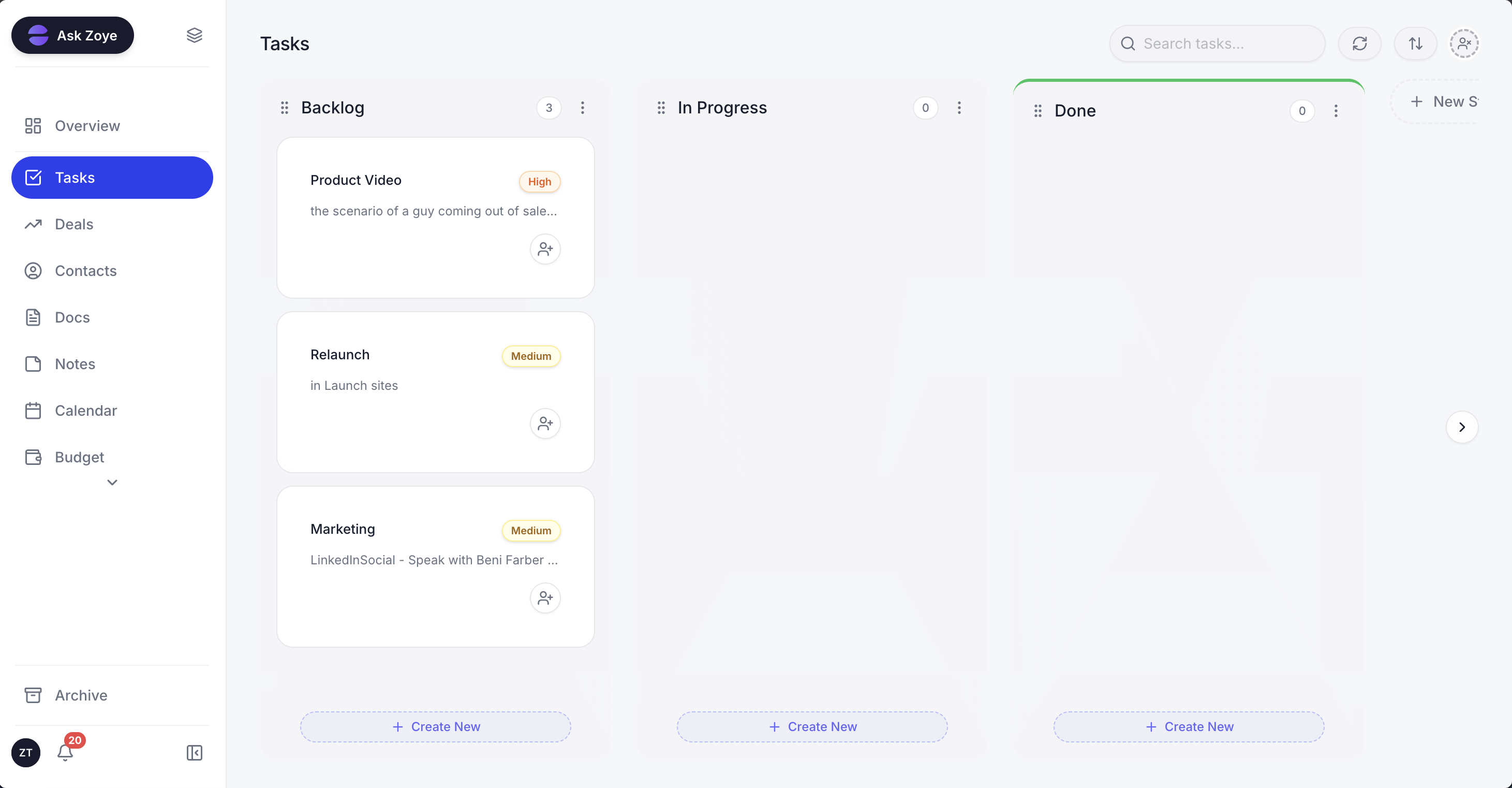 Zoye ships a clean Kanban board out of the box - no setup or template configuration
The Kanban capability is exactly what teams want from a board: columns you can rename and reorder, drag-and-drop cards, priority labels, assignees rendered as colored tags, due dates, filters, and work-in-progress visibility at a glance. Unlike most Kanban apps, the same tasks also appear in list, calendar, and timeline views, so the moment a project needs a different lens, you switch the view instead of switching the tool. There is no template gallery to wade through and no setup wizard. The board is ready the moment you open the workspace.
Where Zoye separates from every other tool on this list is the Zoye Assistant. Most Kanban software, even the ones advertising AI, only suggests text or summarises a card. Zoye's assistant takes action: it creates cards from incoming emails, moves and prioritises them across columns based on deadline and workload, drafts follow-up messages to customers and teammates, schedules deep-work blocks on the calendar, and surfaces cards that have gone stale in a column before they quietly slip. You manage the board by asking, and the assistant does the moving.
Around the board sits the part standalone Kanban tools simply do not have: a native CRM so the cards connect to the customers and deals behind them, a built-in calendar where task due dates appear automatically without any sync to break, budget tracking so projects tie to real spend, and reports that pull tasks, deals, contacts, and budget into one exportable dashboard. A collaborative Notes module is rolling out so runbooks and project docs live beside the board rather than in a separate tab. It is one workspace instead of a Kanban app plus a CRM plus a calendar plus a budget tracker.
Pricing: Almost Free from $5 per month ($4 per month billed annually) for 1 member with the full platform including AI. Starter from $29 per month (10 members). Growth from $59 per month (20 members).
Best for: Teams that want a clean Kanban board plus CRM, calendar, budget, and an AI assistant that manages the work, in one flat-rate workspace.
2. Trello - the simple, beloved Kanban classic
Trello is the tool most people picture when they hear the word Kanban. The board-and-card model is beautifully simple, onboarding takes minutes, and the free tier is genuinely usable for small projects.
The limitation is that Trello stays a board. There is no native CRM, no real calendar beyond a basic view, and no budget layer. Power-Ups extend it, but stacking them recreates the complexity teams chose Trello to avoid. AI features remain light.
Pricing: Free tier with limits. Standard $5 per user per month. Premium $10 per user per month.
Best for: Small teams and individuals who want the simplest possible Kanban board.
3. ClickUp - the highly configurable PM platform
ClickUp offers Kanban as one of many views inside a broad project management platform. For teams that want boards alongside docs, goals, and dashboards, ClickUp packs a lot into one tool.
The limitation is the learning curve. ClickUp's depth means the Kanban board sits behind a dense settings layer, and getting it configured the way you want takes real time. Teams that just want a clean board often find it heavier than the job requires, and it still has no native CRM.
Pricing: Free tier with limits. Unlimited $7 per user per month. Business $12 per user per month.
Best for: Teams that want a deeply configurable PM platform and will invest in setup.
4. Jira - the Kanban tool for software development
Jira is the standard for engineering teams running Kanban and agile workflows. Its boards handle sprints, backlogs, swimlanes, and developer-specific reporting better than any generalist tool.
The limitation is that Jira is built for software development and shows it. For a marketing team, a small agency, or any non-engineering group, the issue-tracking model and configuration overhead feel like overkill. It has no CRM, no budget, and a calendar that depends on add-ons.
Pricing: Free for up to 10 users. Standard around $7.75 per user per month. Premium around $15.25 per user per month.
Best for: Software development teams that need agile and Kanban with deep developer tooling.
5. Asana - the work management tool with boards
Asana offers a clean Kanban board view inside a polished work management platform. The board is easy to read, the design is excellent, and cross-functional teams use it well for tracking projects across departments.
The limitation is that Asana is task and project tracking first. There is no native CRM, the calendar is a view rather than a real scheduling layer, and pricing climbs quickly as the team grows. Its AI assists but does not run the board.
Pricing: Free tier with limits. Starter $10.99 per user per month. Advanced $24.99 per user per month.
Best for: Cross-functional teams that want a polished board inside a broader work tracker.
6. Monday.com - the colorful work OS with Kanban
Monday.com presents Kanban as one view inside a visual, customisable work operating system. The boards are bright and flexible, and the automation recipes are approachable for non-technical teams.
The limitation is that the flexibility comes with per-seat pricing that adds up, and the CRM lives in a separate product line you pay for on top. The core Kanban board is good, but the broader value sits behind multiple paid modules rather than one workspace.
Pricing: Free tier for up to 2 seats. Basic $9 per seat per month. Standard $12 per seat per month.
Best for: Teams that want a colorful, highly visual work OS and will pay per seat for it.
7. Notion - the docs workspace with Kanban boards
Notion can render any database as a Kanban board, so teams that live in Notion docs get boards without leaving the tool. For documentation-heavy teams, having the board beside the wiki is genuinely convenient.
The limitation is that Notion is a docs-and-database tool first. The Kanban board is a view on a database, not a purpose-built board, so it lacks the speed and task-specific polish of dedicated Kanban software, and there is no CRM, calendar, or budget layer underneath.
Pricing: Free for personal use. Plus $10 per user per month. Business $15 per user per month.
Best for: Documentation-heavy teams that want boards alongside their wikis and notes.
Best free kanban software
For teams on a budget, the free tier matters. Trello's free plan is the classic choice for a simple personal board, and Notion's free tier works if you already live in its docs. Both stay board-only and cap automations and team size.
Zoye is the most affordable full-platform Kanban pick for teams because its entry plan, Almost Free, covers 1 member with the full platform, AI included, for just $5 per month ($4 per month billed annually). You get the Kanban board plus the CRM, calendar, budget, and assistant, not a stripped-down board that pushes you to upgrade the moment you add a second column. For a solo founder or a 3-person team, it is the most complete low-cost option here.
Best AI-powered kanban software
Zoye is the only tool on this list with a true AI-native architecture. The AI in Trello, Asana, ClickUp, and Monday.com summarises cards or drafts descriptions, but the board still moves by hand. Notion's AI writes inside pages but does not manage the board at all.
Zoye's assistant actively manages the Kanban board: it creates cards from emails, prioritises and reorders columns by deadline and workload, schedules the work on the calendar, drafts the follow-ups that come out of a card, and flags cards that have stalled in a column. The board becomes something you direct in plain language rather than drag card by card.
Kanban for software development and agile teams
For engineering teams running agile, Jira remains the deepest tool, with sprints, backlogs, story points, and developer reporting purpose-built for software delivery. If your whole organisation is engineering, Jira is hard to beat for the board itself.
The trade-off is everything around the board. The moment non-engineering teammates, customer relationships, or budgets enter the picture, Jira's developer-first model fights you. Teams that want agile boards without the engineering-only overhead, and that need the customer and calendar context alongside, find Zoye's board plus workspace a better fit for the whole company rather than just the dev team.
How to choose the right kanban software
Three questions narrow the field.
1. Do you need just a board, or the business around it? If you genuinely only want cards in columns, Trello or Notion will do. If the board needs to connect to customers, calendar, and budget, Zoye consolidates the stack into one workspace.
2. Is your team engineering, or mixed? Pure engineering teams are well served by Jira. Mixed or non-technical teams are better off with a generalist board that the whole company can use without agile overhead.
3. What do you want from AI? If an AI that suggests a card title is enough, every modern tool has that. If you want an assistant that actually moves cards, rebalances columns, and chases stuck work, Zoye is the only AI-native pick here.
Why teams pick Zoye as their kanban software
A few themes come up consistently.
The board is ready instantly. No template gallery, no setup wizard, no configuration sprint before the first card moves.
The board does not float alone. CRM, calendar, budget, and reports live in the same workspace, so a card connects to the customer, the meeting, and the spend behind it.
The AI runs the board. Prioritising columns, scheduling work, drafting follow-ups, and surfacing stuck cards all happen on request, freeing the team from manual card-shuffling.
The pricing scales with the team, not against it. Flat-rate plans mean a growing team is not punished seat by seat for using its own board.
Spin up your first board in minutes and let the AI keep the cards, owners, and due dates honest. Almost Free, the entry plan, is $5 per month (or $4 per month billed annually) for everything including AI, so cancel or upgrade at any time.
For more context, see the best Trello alternatives, the best project management apps in 2026, the best Asana alternatives, and ClickUp vs Trello.