
Salesforce vs Pipedrive 2026: The SMB Sales CRM Showdown
Salesforce and Pipedrive sit at opposite ends of the CRM spectrum, and small and mid-sized sales teams keep landing on both shortlists for exactly that reason. Pipedrive is the simple, affordable, pipeline-first CRM that a non-technical team can adopt in a day. Salesforce is the enterprise standard, vast and endlessly customizable, capable of modelling almost any sales process you can imagine, given enough budget, configuration, and patience.
The honest problem with the Salesforce-vs-Pipedrive debate is that most teams sit uncomfortably between the two. Pipedrive can feel too basic the moment you need more than a clean pipeline, while Salesforce is usually too much: too expensive, too complex, and too heavy on implementation and admin overhead for a team that just wants to sell. Both are CRMs first, so your tasks, your calendar, and your budget still live in other tools. And both bill per seat, so the price climbs every time you hire.
This comparison walks through the dimensions that actually decide the choice for a small or mid-sized team: ease of use, pipeline and CRM depth, customization, automation, AI, and pricing. It is fair about where Pipedrive and Salesforce each win. Then it covers the third option built for teams stuck in the middle.
Pricing reflects published rates as of June 2026; check each vendor's pricing page for current figures.
Salesforce vs Pipedrive at a glance
| Dimension | Zoye | Salesforce | Pipedrive |
|---|---|---|---|
| Core philosophy | AI-native all-in-one workspace | Deep, endlessly customizable enterprise CRM | Simple, pipeline-first sales CRM |
| AI assistant | Included on every plan, takes action | Einstein / Agentforce - powerful paid add-ons | AI sales assistant, stronger on higher tiers |
| CRM depth | Solid contacts, companies, deals, stages | Deepest, models almost any process | Focused on the deal pipeline |
| Ease of use | Same-day, AI does the setup | Steep curve, admin-heavy | Very easy, fast to adopt |
| Customization | Custom fields, templates, flexible | Near-unlimited, code + AppExchange | Light, mostly pipeline-level |
| Tasks / projects | Built in (board, calendar, timeline) | Light tasks only | Light activities only |
| Budget / finance | Built in | Not native | Not included |
| Reports / analytics | Cross-workspace live reports | Powerful, complex to configure | Clean pipeline reports |
| Pricing model | Flat tier-based, not per seat | Per seat + add-ons + implementation | Per seat, climbs with tiers |
| Entry plan | Almost Free, $5/mo, 1 member, full platform | No real free tier | No free tier, trial only |
| Best for | SMBs between too basic and too enterprise | Large, complex sales organizations | Small teams that want a simple pipeline |
Where Pipedrive wins
Pipedrive earns its following by doing one thing exceptionally well and not pretending to be anything else.
Simplicity is the whole point. Pipedrive is organized around a visual sales pipeline: deals move left to right through stages you can see at a glance. A new rep understands it in minutes, and a small team can be running a real pipeline the same day they sign up. There is no assumption that you have an admin, a consultant, or a multi-week rollout. For founders and small sales teams that want a CRM to feel obvious rather than intimidating, Pipedrive is the comfortable choice.
It is affordable to start. Pipedrive's entry tiers are priced for small teams, well below what Salesforce expects, and the value is clear from the first paid plan. You are paying for a pipeline that works, not for capability you may never touch.
Activity-based selling keeps reps moving. Pipedrive nudges reps to log the next action on every deal, so nothing stalls quietly in the pipeline. For teams whose problem is follow-through rather than process complexity, that focus is genuinely useful.
Adoption is high because the tool is light. A CRM people actually use beats a more powerful CRM that sits half-configured. Pipedrive's restraint is its strength: it stays out of the way and lets a small team sell.
The trade-off is depth. Once you need more than a pipeline - layered reporting, complex automation, custom objects, or tools beyond sales - Pipedrive starts to feel thin, and you end up bolting on other apps.
Verdict: Pipedrive wins on simplicity, speed of adoption, and price. For small teams that want a focused pipeline CRM without overhead, it is the easier and often the smarter start.
Where Salesforce wins
Salesforce wins where depth, scale, and customization matter more than speed or simplicity.
CRM depth is unmatched. Salesforce can model almost any sales process: complex territories, multi-stage approvals, intricate forecasting, and custom objects that mirror your exact business. For organizations with non-standard workflows, this flexibility is the entire reason to choose it, and few platforms come close.
Customization is effectively unlimited. Between point-and-click configuration, Flow automation, Apex code, and the vast AppExchange marketplace, you can extend Salesforce to do nearly anything. If a capability does not exist out of the box, there is usually an app for it or a developer who can build it. That extensibility is why Salesforce remains the enterprise default.
It scales with the largest organizations. Salesforce is built for thousands of seats, complex permission models, and serious governance and compliance needs. When a business is large and its requirements are intricate, Salesforce has headroom that a pipeline tool simply does not.
The ecosystem is enormous. A huge market of consultants, certified admins, integrations, and add-ons means almost any problem has a known solution and someone who can implement it. For complex deployments, that ecosystem is a real asset.
The trade-offs are well known and they hit small teams hardest. Salesforce has a steep learning curve, usually needs a dedicated admin (often more than one), and its real cost includes editions, add-ons, and implementation work that go well beyond the per-seat sticker price. Salesforce Pro Suite starts around $100/user/month, Enterprise is $175/user/month, and Unlimited is $350/user/month, before the add-ons most teams end up buying.
Verdict: Salesforce wins on depth, customization, and scale. For large, complex sales organizations that can fund an admin and a proper rollout, it is the more powerful platform. For a small team, it is usually more than the job requires.
Ease of use and setup
This is the dimension where the two diverge most sharply, and it is the one small teams feel first.
Pipedrive is rated easy to learn, fast to set up, and fast to use day-to-day. Most teams are productive within a day, the mobile app is responsive, and the pipeline view needs no explanation. The configuration that exists is light by design.
Salesforce packs far more into the same product. The trade-off is that new users typically need weeks to feel comfortable, and a serious deployment needs a dedicated admin to configure objects, layouts, and automations. The flexibility that makes Salesforce powerful is the same flexibility that makes the rollout a project.
Verdict: Pipedrive for teams that need productivity now. Salesforce for organizations willing to invest in setup for long-term flexibility.
See what Zoye can do for you
From CRM and deal tracking to AI-powered task management - explore everything Zoye offers in one workspace.
Explore FeaturesAutomation and reporting
Pipedrive offers workflow automation and clean, readable pipeline reports that answer the questions a small sales team actually asks: where are my deals, what is stuck, what is closing this month. It is enough for most small operations and easy to configure without help.
Salesforce offers automation and reporting that are vastly more powerful and correspondingly more complex. You can build almost any report or dashboard, model any automated process, and forecast with precision - but doing so well usually requires an admin and time. The ceiling is far higher; so is the effort to reach it.
Verdict: Pipedrive gives you the reports a small team needs out of the box. Salesforce gives you near-unlimited reporting power if you have someone to build and maintain it.
AI capabilities
This is where most teams discover the hidden cost on both platforms.
Salesforce offers Einstein and Agentforce, a genuinely capable suite of AI features for forecasting, lead scoring, summaries, and AI agents. They are powerful, and they are priced as add-ons that raise an already high bill significantly.
Pipedrive offers a lighter AI sales assistant that surfaces suggestions, summarizes deals, and improves on higher tiers. It is helpful but modest compared with Salesforce, and it is focused on the sales pipeline rather than your wider operation.
On both, the AI primarily assists. It scores, summarizes, and suggests inside the CRM. Neither executes cross-module actions from a single instruction the way an AI-native workspace does, because neither has the tasks, calendar, and budget to act across in the first place.
Verdict: Salesforce AI is powerful but expensive and add-on-based. Pipedrive AI is simpler but limited. For an AI that takes real action across CRM, tasks, calendar, and budget from one message, see the third option below.
Pricing: Salesforce vs Pipedrive
Pricing is where both platforms surprise small teams, in different ways.
Salesforce pricing:
- No real free tier (trial only)
- Pro Suite: from around $100/user/month
- Enterprise: $175/user/month
- Unlimited: $350/user/month
- Add-ons (Einstein, CPQ, extra clouds) and implementation raise the real cost
Pipedrive pricing:
- No free tier (free trial only)
- Tiered per-seat plans from an affordable entry price, rising as you add features and reporting depth
- AI sales assistant and advanced automation sit on higher tiers
- Check Pipedrive's pricing page for current per-seat figures
Pricing reflects published rates as of June 2026; check each vendor's pricing page for current figures.
The 20-person team math:
- Salesforce Enterprise: 20 x $175 = about $3,500/month before add-ons and implementation
- Pipedrive: affordable per seat, but still multiplies with every rep, and you add separate tools for tasks, calendar, and budget
- Zoye Growth (20 members, AI + CRM + tasks + budget included): $59/month
The pattern is clear. Pipedrive is the cheaper, friendlier start, but it stays a sales pipeline and bills per seat. Salesforce starts high and its true cost includes add-ons and an admin. Both grow with headcount, and neither bundles the tasks, calendar, and budget a running business needs.
Verdict: Pipedrive is far cheaper and simpler; Salesforce costs more and adds implementation overhead. Both punish growth through per-seat pricing, and neither covers more than the CRM.
Ready to streamline your business?
Zoye brings AI-powered CRM, task management, and automation into one workspace.
Get StartedThe third option: Zoye
Here is the gap the Salesforce-vs-Pipedrive debate never closes. Pipedrive is often too basic for a growing team, Salesforce is usually too enterprise for a small one, and both are CRMs first - so your tasks, your calendar, and your budget still live in other tools. Both gate their best AI behind higher tiers or paid add-ons, and on both, the AI mostly suggests rather than acts. And both bill per seat, so the cost grows with every hire.
Zoye is an AI-native workspace built for exactly the team caught in the middle. It puts contacts, companies, deals, and stages alongside tasks, calendar, budget, and reports in one place, with a personal AI assistant included at every tier that takes real action across all of them from a single text or voice instruction.
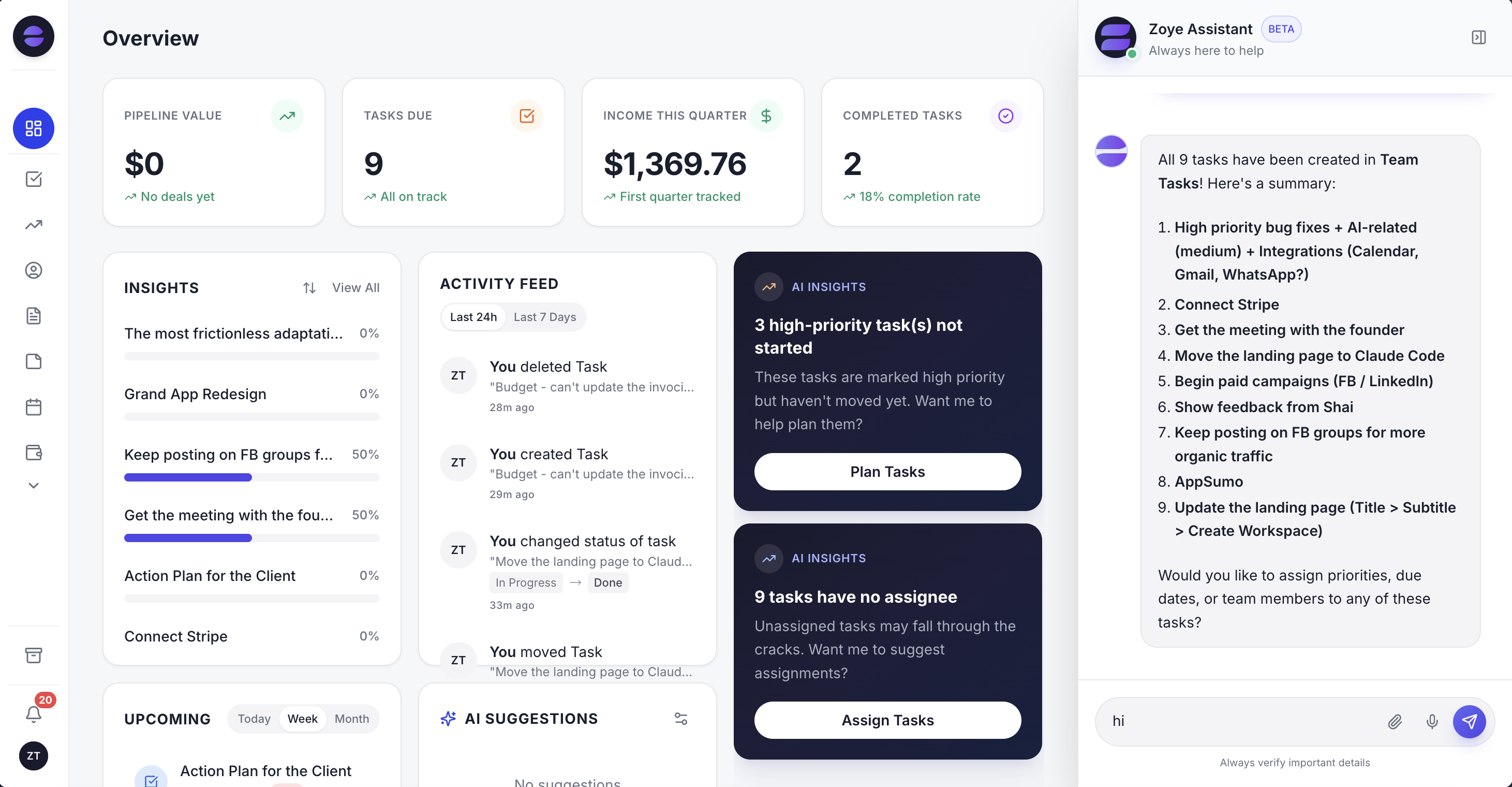 Zoye combines CRM, tasks, calendar, and reports in one AI-native workspace.
Where Pipedrive gives you a clean pipeline and Salesforce gives you deep customization, Zoye gives you a solid CRM connected to the rest of how your business actually runs. The Zoye Assistant does not just summarize records. It creates tasks from an incoming email, opens a deal and files the contact from one instruction, schedules a meeting around your deadlines, reassigns workload by team capacity, surfaces overdue and blocked work proactively, and generates a weekly status report on demand. It acts, it does not just suggest.
That is the part neither competitor offers. In Pipedrive or Salesforce, a closed deal lives in the CRM, the delivery work lives in a separate project tool, the kickoff lives in a separate calendar, and the budget lives in a spreadsheet. In Zoye, they are one connected workspace, so the assistant can move across them in a single step.
Pricing is flat, not per seat. The entry plan is Almost Free and covers 1 member with the full platform including AI. Starter is $29/month for up to 10 members, and Growth is $59/month for up to 20. A 20-person team gets a CRM, tasks, calendar, budget, reports, and an action-taking AI assistant for a flat $59/month, and the platform is operational the same day.
Real example: A 12-person agency owner finishes a client call and dictates one line on her phone: "Brightwave signed the retainer, about $24K, kickoff next Tuesday." Zoye opens the deal, files the contact, books the kickoff on the calendar, drafts the delivery tasks, and logs the budget. In Pipedrive that is the CRM plus a separate project tool plus a spreadsheet; in Salesforce it is the same, after the admin has configured the objects to make it possible.
Want to see it in action?
Watch how Zoye automates your daily workflow - from lead management to team collaboration.
See How It WorksWhen to choose each
Choose Pipedrive if:
- You want a simple, affordable pipeline CRM your reps can use without training
- Speed of adoption matters more to you than feature depth
- Your sales process is straightforward and you do not need heavy customization
- You are comfortable adding separate tools for tasks, calendar, and budget
Choose Salesforce if:
- You run a large or complex sales organization with non-standard processes
- You need near-unlimited customization, custom objects, and the AppExchange ecosystem
- You can fund a dedicated admin and a proper implementation
- Depth and scale matter more to you than speed, simplicity, and cost
Choose Zoye if:
- You find Pipedrive too basic and Salesforce too much, and want the middle ground
- You want a CRM plus tasks, calendar, and budget in one connected workspace
- You want an AI assistant that takes action included at every tier
- You prefer flat tier-based pricing over per-seat charges that grow with hiring
- You want to be operational the same day with no configuration project
- You want to manage customer conversations, including WhatsApp, from one place
Ready to streamline your business?
Zoye brings AI-powered CRM, task management, and automation into one workspace.
Get StartedFrequently asked questions
For most small businesses, yes. Pipedrive is built around a simple sales pipeline, it is quick to set up, and a non-technical team can be selling from it within a day. Salesforce is far deeper and more customizable, but that depth is usually more power, cost, and admin overhead than a small team needs. Pipedrive wins on speed and simplicity; Salesforce wins on depth and scale for larger, complex sales organizations.
Choose Pipedrive if you want a focused, affordable pipeline CRM your reps will actually use without training, and you do not need heavy customization. Choose Salesforce if you run a large or complex sales operation with non-standard processes and can fund a dedicated admin and a real rollout. If you are a small or mid-sized team that finds Pipedrive too basic and Salesforce too much, it is worth weighing an all-in-one option before committing to either.
Often, yes. Salesforce is famous for a steep learning curve and usually needs a dedicated admin to configure and maintain. Small teams frequently pay for capability they never use and spend weeks on a rollout that delays selling. Salesforce shines when requirements are genuinely complex; for a straightforward pipeline, lighter tools get a small team productive far faster.
Both have AI, and both gate it. Salesforce's Einstein and Agentforce are powerful but priced as add-ons that raise the bill significantly. Pipedrive's AI sales assistant is more modest and improves on higher tiers. On both, the AI mostly assists and suggests inside the CRM rather than taking action across your tasks, calendar, and budget.
Yes - Zoye is built for small and mid-sized teams caught between too basic and too enterprise. It puts a real CRM alongside tasks, calendar, budget, and reports in one workspace, with an AI assistant included at every tier that takes real action rather than just suggesting. Pricing is flat and tier-based instead of per seat, so a 20-member team pays $59/month on Zoye Growth with AI, CRM, tasks, and budget all included.
Yes. Pipedrive's per-seat plans start well below Salesforce, which has no real free tier and rises from around $100/user/month on Pro Suite to $175 on Enterprise and $350 on Unlimited, before add-ons and implementation. Both bill per seat, so both climb with headcount. (Pricing as of June 2026 - check each vendor's pricing page.)
The bottom line
Salesforce and Pipedrive are both strong CRMs pulling in opposite directions. Pipedrive is the simple, affordable, pipeline-first platform that small teams adopt in a day and actually use, ideal when your need is a clean sales process without overhead, though it stays thin once you need more than a pipeline. Salesforce is the deep, endlessly customizable enterprise platform that can model almost any process, ideal for large organizations that can fund the admin time and the rollout, at a real cost well above the sticker price.
The real question for most small and mid-sized teams in 2026 is not just which of the two wins, but whether either is built for how your whole business runs. Both are CRMs first, so tasks, calendar, and budget live elsewhere. Both gate their best AI behind higher tiers or paid add-ons, and on both the AI mostly suggests rather than acts. And both bill per seat, so the cost climbs with every hire.
If you find Pipedrive too basic and Salesforce too much, and you want one AI-native workspace with a CRM, tasks, calendar, and budget, an assistant that takes real action across all of them, and flat pricing that does not punish growth, the honest answer is neither. Zoye is built for that team, with everything included at every tier and operational the same day you sign up.
For more context, see our guides to the best Pipedrive alternatives, the best Salesforce alternatives, our HubSpot vs Salesforce comparison, and the best CRM software in 2026.