
HubSpot vs Zoho in 2026: Which CRM Fits Your Business (and the Third Option)
HubSpot and Zoho sit at opposite ends of the CRM market, and that is exactly why they end up on the same shortlist. HubSpot is the polished, marketing-led platform that made CRM feel like a modern app, with a generous free tier and a famously gentle learning curve. Zoho is the deep, affordable, sprawling suite that gives you a CRM plus dozens of other business apps for a fraction of what most rivals charge, if you are willing to learn your way around it.
The honest problem with the HubSpot-vs-Zoho debate is that both answers leave the same gaps. Both are CRMs first, so your projects, your team's tasks, your calendar, and your budget still live in other tools or in a separate corner of the suite. Both keep their best AI on higher tiers. And both bill per seat, so the price climbs every time you hire. If you find the two genuinely hard to separate, that is often a sign the right answer is a different kind of tool entirely.
This comparison walks through the dimensions that actually decide the choice - ease of use, CRM depth and pipeline, marketing and automation, breadth, AI, and pricing - and is fair about where HubSpot and Zoho each win. Then it covers the third option both miss.
Pricing reflects published rates as of June 2026; check each vendor's pricing page for current figures.
HubSpot vs Zoho at a glance
| Dimension | Zoye | HubSpot | Zoho |
|---|---|---|---|
| Core philosophy | AI-native all-in-one workspace | Easy, inbound-led CRM + marketing | Deep, affordable, broad app suite |
| AI assistant | Included on every plan, takes action | Breeze AI - stronger on higher tiers | Zia - spans the suite, best on upper plans |
| CRM depth | Solid contacts, companies, deals, stages | Strong and very usable | Deep and highly configurable |
| Marketing tools | Lightweight, in-workspace | Best-in-class Marketing Hub | Broad but split across apps |
| Ease of use | Same-day, AI does the setup | Clean, fast, easy to learn | Powerful but fragmented, steeper curve |
| Breadth | CRM + projects + calendar + budget | CRM + marketing hubs | Dozens of apps via Zoho One |
| Projects / tasks | Built in (board, calendar, timeline) | Light tasks only | Separate Zoho Projects app |
| Budget / finance | Built in | Not included | Separate Zoho Books app |
| Pricing model | Flat tier-based, not per seat | Per seat, rises steeply at Pro+ | Per seat, low entry, Zoho One bundle |
| Entry plan | Almost Free, $5/mo, 1 member, full platform | Generous-ish free CRM | Free for up to 3 users |
| Best for | All-in-one teams that want AI to act | SMBs and marketing-led teams | Budget-conscious teams that want breadth |
Ease of use
This is the dimension where HubSpot and Zoho diverge most sharply.
HubSpot is built to feel effortless. The interface is clean and consistent, onboarding is genuinely guided, and a small team can be running a real pipeline within days, not weeks. There is no assumption that you have an admin on staff. For founders, marketers, and sales teams who want a CRM to feel like a modern app rather than a configuration project, HubSpot is the more comfortable place to live.
Zoho is powerful but more fragmented. Zoho CRM itself is capable and configurable, but the wider Zoho experience spreads across many separate apps, each with its own interface and navigation. The depth is real, and the price is hard to argue with, but new users typically need longer to feel at home, and tying the apps together takes deliberate setup. The trade-off is classic: more capability and lower cost in exchange for a steeper learning curve.
Verdict: HubSpot wins on ease of use and time-to-value. Zoho asks more of you up front and pays it back in breadth and price.
CRM depth and pipeline
Both platforms run a real sales pipeline well, and the gap here is narrower than the ease-of-use one.
HubSpot's CRM is strong and very usable. Contacts, companies, deals, and stages are clean and intuitive, the pipeline view is easy to manage, and the records connect naturally to HubSpot's marketing and service tools. For most small and mid-sized sales teams, it has more than enough depth without ever feeling heavy.
Zoho CRM is deep and highly configurable. Custom modules, layouts, workflow rules, scoring, and multiple pipelines let you model fairly complex sales processes, and the upper tiers add serious automation and analytics. For teams that want to shape the CRM tightly around an unusual process at a low price, Zoho gives you more knobs to turn than HubSpot does at the equivalent cost.
Verdict: HubSpot for a clean, immediately usable pipeline. Zoho for deeper configurability per dollar, if you are willing to set it up.
See what Zoye can do for you
From CRM and deal tracking to AI-powered task management - explore everything Zoye offers in one workspace.
Explore FeaturesMarketing and automation
Marketing is where HubSpot built its name, and it shows.
HubSpot Marketing Hub is best in class. Email campaigns, landing pages, forms, workflows, lead scoring, and reporting are tightly integrated with the CRM, so a lead captured on a landing page flows straight into a contact record and a nurturing sequence. For inbound-led teams that want marketing and sales in one connected story, this is HubSpot's strongest argument.
Zoho covers marketing broadly, but across apps. Zoho Campaigns, Zoho Marketing Automation, Zoho Social, and others give you a wide marketing toolkit at a low price, and they integrate with Zoho CRM. The breadth is impressive and the value is excellent, but the experience is more stitched-together than HubSpot's single, polished marketing surface, and aligning it all takes more hands-on work.
Verdict: HubSpot wins on a unified, best-in-class marketing experience. Zoho wins on marketing breadth for the money, at the cost of cohesion.
Breadth: one CRM versus a whole suite
This is Zoho's signature strength.
Zoho is a sprawling suite. Through Zoho One, you get a CRM plus dozens of apps spanning finance, projects, HR, support, marketing, and more, all under one subscription at a strikingly low per-user price. For a business that wants to run almost everything on one vendor and is comfortable assembling the pieces, the sheer scope is unmatched at the price.
HubSpot is a focused CRM platform. It centers on CRM, marketing, sales, service, and content hubs that work together beautifully, but it is not trying to be your finance or HR system. It does fewer things and does them with more polish. You get depth in the go-to-market stack rather than breadth across the whole company.
Verdict: Zoho wins decisively on raw breadth and value. HubSpot wins on a tighter, more polished go-to-market core.
Ready to streamline your business?
Zoye brings AI-powered CRM, task management, and automation into one workspace.
Get StartedAI capabilities
Both platforms have AI, and both reserve the strongest capabilities for higher tiers.
HubSpot's Breeze AI features sit across plans, with the best capabilities on higher tiers: content assistance, conversation summaries, predictive scoring, and more, woven into the familiar HubSpot interface.
Zoho's Zia assistant spans the suite, offering predictions, anomaly detection, suggestions, and a conversational helper, with the most capable features on upper plans.
On both, the AI mostly assists. It writes, summarizes, scores, and suggests inside the CRM. Neither executes cross-module actions, opening a deal, filing a contact, booking a calendar event, drafting the follow-up, and logging the budget, from a single instruction the way an AI-native workspace does.
Verdict: Both have credible AI gated to higher tiers, and both assist rather than act. For an AI that takes real action across CRM, tasks, calendar, and budget from one message, see the third option below.
Pricing
Pricing is where both platforms surprise teams, in different ways.
HubSpot pricing:
- Free CRM: $0 (limited tools, contacts and deals)
- Sales Hub / Marketing Hub Starter: from around $20/seat/month
- Professional: from around $100/seat/month (Sales Hub); Marketing Hub Pro rises with contacts
- Enterprise: custom, significantly higher
Zoho pricing:
- Free CRM: $0 for up to 3 users (basic)
- Zoho CRM Standard / Professional: roughly $14 to $23/user/month
- Zoho CRM Enterprise / Ultimate: roughly $40 to $52/user/month
- Zoho One bundle: a low per-employee price for the full app suite
The pattern is clear. HubSpot is cheaper to start with a real free tier, but Marketing Hub and Sales Hub Professional climb steeply as you scale. Zoho is the value leader, especially via the Zoho One bundle, but you pay for that value in setup time and a more fragmented experience. Both are per-seat, so both grow with headcount.
Verdict: Zoho is the cheaper, broader option for teams willing to invest in setup. HubSpot is the friendlier, more polished start with a usable free tier. Both punish growth through per-seat pricing.
See what Zoye can do for you
From CRM and deal tracking to AI-powered task management - explore everything Zoye offers in one workspace.
Explore FeaturesThe third option: Zoye
Here is the gap that the HubSpot-vs-Zoho debate never closes. Both are CRMs first. Your projects, your team's tasks, your calendar, and your budget either live in other tools or in a separate app inside the suite, and you stitch them together. Both keep their strongest AI on higher tiers, and on both, the AI mostly suggests rather than acts. And both bill per seat, so the cost grows with every hire.
This is exactly where Zoye is built differently. Rather than starting as a CRM and bolting the rest on, it was designed from the ground up around an AI assistant that runs the whole operation. Contacts, companies, deals, and stages share one workspace with your tasks, projects, calendar, budget, and reporting, and a personal assistant ships on every plan that can actually carry out work across all of it from a single typed or spoken request.
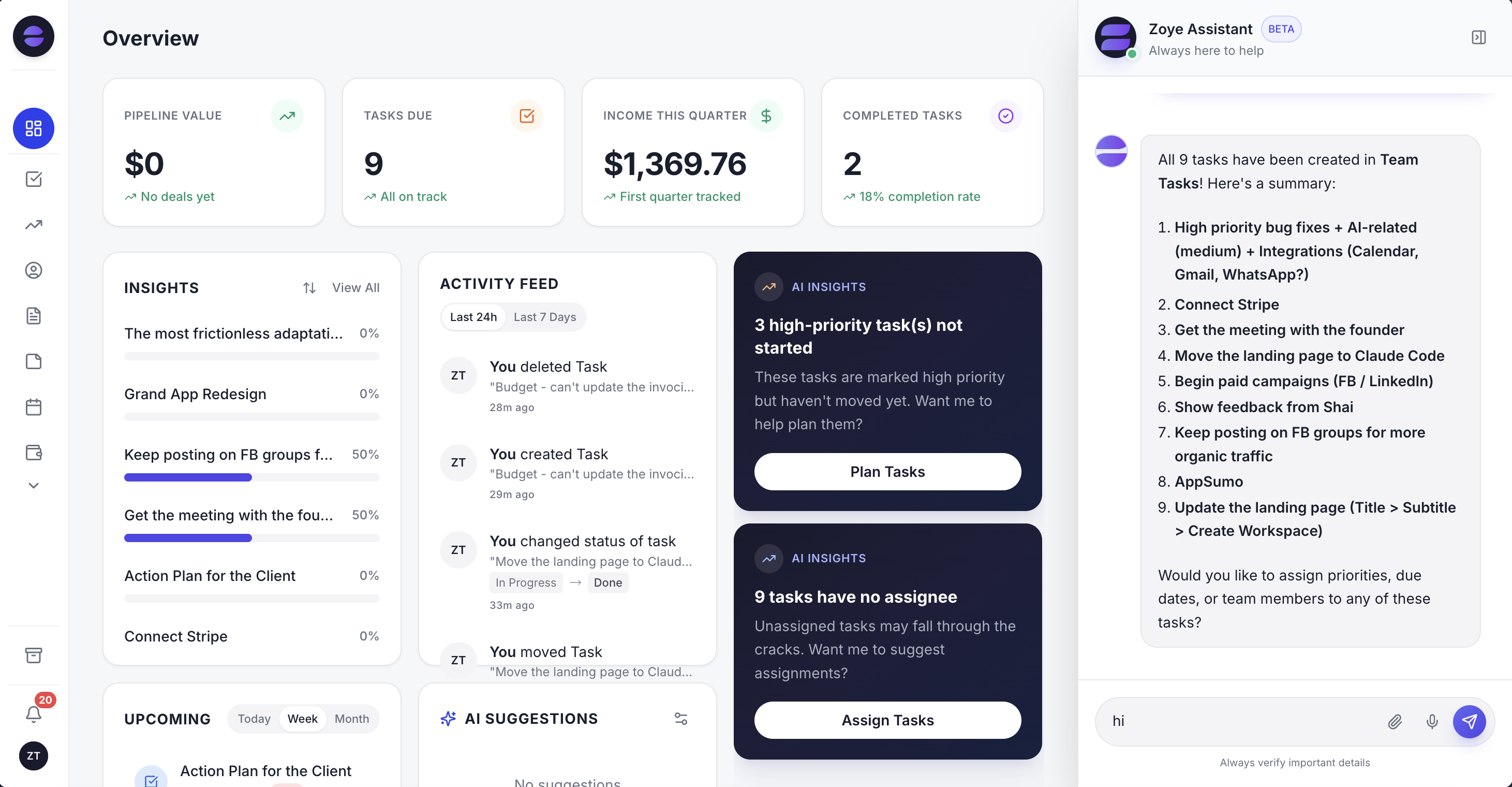 Zoye unifies CRM, tasks, calendar, and reports in one AI-native workspace.
Where HubSpot gives you a polished CRM with best-in-class marketing, and Zoho gives you depth and breadth for the lowest price, Zoye gives you a solid CRM connected to the rest of how your business actually runs. The Zoye Assistant does not just summarize records. It creates tasks from an incoming email, opens a deal and files the contact from one instruction, schedules a meeting around your deadlines, reassigns workload by team capacity, surfaces overdue and blocked deals proactively, and generates a weekly status report on demand. It acts, it does not just suggest.
That is the part neither competitor offers. In HubSpot or Zoho, a closed deal lives in the CRM, the delivery work lives in a separate project tool or app, the kickoff lives in a separate calendar, and the budget lives in a spreadsheet or a separate accounting app. In Zoye, they are one connected workspace, so the assistant can move across them in a single step.
To be fair about what Zoye is and is not: Zoye is a unified workspace with a real CRM at its core, not a dedicated marketing-automation platform at HubSpot's depth, and not a sprawling app suite at Zoho's breadth. What it offers instead is one place where CRM, tasks, calendar, budget, and reports already work together, with an assistant that takes action across all of them.
The billing model breaks from both HubSpot and Zoho: you pay per tier, not per head, so adding people never inflates the invoice. The entry plan, Almost Free, is $5/month ($4/month billed annually) and gives 1 member the entire platform, AI included. From there, Starter runs $29/month for up to 10 members and Growth runs $59/month for up to 20. Put simply, a 20-person team lands a CRM, projects, calendar, budget, reporting, and an assistant that does the work for one flat $59/month, instead of multiplying a per-seat rate the way the other two do.
Real example: A 15-person agency owner finishes a client call and dictates one line on her phone: "Brightwave signed the retainer, about $24K, kickoff next Tuesday." Zoye opens the deal, files the contact, books the kickoff on the calendar, drafts the delivery tasks, and logs the budget. In HubSpot that is the CRM plus a separate project tool plus a spreadsheet; in Zoho it is the CRM plus Zoho Projects plus Zoho Books, each configured and connected first.
Want to see it in action?
Watch how Zoye automates your daily workflow - from lead management to team collaboration.
See How It WorksWhen to choose each
Choose HubSpot if:
- You want a CRM that is easy to learn and fast to launch without an admin
- Best-in-class marketing and sales living in one connected platform matters to you
- You want a free tier to start and grow into paid plans
- Your team is an SMB or marketing-led and values polish over the lowest price
Choose Zoho if:
- You want the widest range of business apps for the lowest price
- You are comfortable investing in setup to tie the suite together
- Deep CRM configurability per dollar matters more than out-of-the-box polish
- The Zoho One bundle can replace several separate subscriptions for your team
Choose Zoye if:
- You want an AI assistant that takes action included at every tier
- You need a CRM plus projects, calendar, and budget in one connected workspace
- You prefer flat tier-based pricing over per-seat charges that grow with hiring
- You want to be operational the same day with no configuration project
- You want to manage customer conversations, including WhatsApp, from one place
Ready to streamline your business?
Zoye brings AI-powered CRM, task management, and automation into one workspace.
Get StartedThe bottom line
HubSpot and Zoho are both strong CRMs pulling in opposite directions. HubSpot is the easy, marketing-led platform that small and mid-sized teams adopt quickly and actually use, with a generous-ish free tier and a gentle learning curve, though Marketing Hub and Sales Hub Professional get pricey as you scale. Zoho is the deep, affordable, sprawling suite that gives you a CRM plus dozens of apps for a remarkable price, ideal for budget-conscious teams that are willing to put in the setup and accept a more fragmented experience.
The real question for 2026 is not just which of the two wins, but whether either is built for how your whole business runs. Both are CRMs first, so projects, calendar, and budget live elsewhere. Both keep their best AI on higher tiers, and on both the AI mostly suggests rather than acts. And both bill per seat, so the cost climbs with every hire.
If you need one AI-native workspace with a CRM, projects, calendar, and budget, an assistant that takes real action across all of them, and flat pricing that does not punish growth, the honest answer is neither HubSpot nor Zoho. Zoye is built for that team, with everything included at every tier and operational the same day you sign up.
For more context, see our guide to the best AI CRM in 2026, the best Zoho CRM alternatives, our HubSpot vs Salesforce comparison, and the Zoye pricing page.