
Most small businesses already have a client registry. It is just spread across four places at once: a notebook by the register, a WhatsApp thread you scroll through to find a phone number, a spreadsheet somebody started and nobody kept up, and your own memory. Each of those felt fine on the day you started it. Together, they mean that when a customer calls, you cannot quickly find what you agreed last time.
A client record, the ficha do cliente, is not paperwork for its own sake. It is the difference between treating a returning customer like a stranger and greeting them by name with their last order already in front of you. The problem was never that owners do not know they should keep client records. It is that almost every method they try, the spreadsheet especially, rots the moment the week gets busy, because keeping it current is manual work nobody has time for.
This guide covers client registration honestly: what a proper client record should contain, how to organize your customers in 2026 without a spreadsheet that decays, the mistakes that quietly cost you repeat business, and the one approach that keeps each record current automatically instead of adding another chore to your day.
Pricing reflects published rates as of July 2026; check each vendor's pricing page for current figures.
Why the spreadsheet always rots
A spreadsheet is where most client registries start, and it is where most of them die. It is free, it is familiar, and for the first two weeks it feels like enough. Then reality sets in.
Every entry is manual, so it stops. A spreadsheet only knows what somebody types into it. On a quiet Tuesday you might add three new customers. On the week you actually get busy, the exact week the records matter most, nobody has ten spare seconds to fill in a row, and the gaps begin. Within a month the sheet is a partial, out-of-date snapshot you no longer trust.
It lives on one person's device. The file is on the owner's laptop, or in one person's drive, named something like "clients_final_v3." Nobody else has the current version. When two people edit it, you get two versions. When the owner is out, the business is blind.
It cannot follow up. A spreadsheet is a photograph, not a worker. It can hold a phone number and a note that says "send quote Friday," but it will never send the quote, never chase the silence, and never remind you that a good customer has not been back in three months. All of that still depends on you remembering to look.
Your customers are on WhatsApp, the spreadsheet is not. The conversation that actually contains the useful information, what the customer wants, when, for how much, happens in a chat thread. Copying it into a separate sheet by hand is the precise step that gets dropped under load, and so the record and the reality drift apart.
What a client record should contain
Before choosing where to keep your customers, it helps to know what a complete record actually holds. The goal is not to collect everything imaginable; it is to capture the handful of things that let you serve the customer well and follow up at the right time. Use this as a practical template.
Identity and contact. Full name, business name if you sell to companies, phone or WhatsApp number, email, address if you deliver or invoice, and the channel the customer prefers to be reached on.
Origin. How the client found you (referral, ad, walk-in, social) and the date of first contact. Knowing your best source is worth more than most owners realize.
Relationship history. Purchases, orders, or services with dates and amounts, plus any open quote or pending job. This is the part that turns a stranger into a known regular.
Notes and preferences. The details that make service feel personal: important dates such as a birthday, sizes, usual order, restrictions or allergies where your business needs them, and preferred language.
Financial details. Payment method, outstanding balance, and agreed terms, so money is never an awkward guess.
Consent and tags. Confirmation that the client agreed to be contacted, which matters for privacy rules such as the LGPD, plus a couple of simple tags (for example "VIP," "wholesale," "inactive") so you can group customers later.
A good record is not the longest one. It is the one that is actually kept current. A ten-field record everyone maintains beats a thirty-field one that is empty by March.
How to organize client records in 2026
1. Pick one home, not four. Choose a single place where every client lands, from every source. As long as some customers live in a notebook, some in WhatsApp, and some in a sheet, you do not have a registry, you have a search problem. One home is the whole foundation.
2. Capture at the point of contact. The best moment to register a customer is the moment they message you, not later from memory. Every hour of delay is a detail lost. The closer registration sits to the actual conversation, the more complete and honest the record.
3. Standardize the fields. Decide the small set of fields that genuinely matter for your business and use them for everyone. Consistency is what later lets you answer simple questions like "who has not ordered since spring?" A registry you cannot filter is just a longer notebook.
4. Make follow-up part of the record. A registry that does not trigger the next touch is a filing cabinet. Each record should carry the next step: the quote to send, the call to make, the reorder to remind. The point of registering a client is to act on the relationship, not to archive it.
5. Keep it current automatically. This is the step that decides whether any of the previous four survive. If keeping the registry up to date depends on manual entry, it will rot, exactly like the spreadsheet, for exactly the same reason. The only durable version is one where the record updates itself as conversations happen.
Want to see it in action?
See Zoye catch a new lead, answer on WhatsApp and set up the follow-up, all from one message.
See How It WorksCommon mistakes that cost you repeat business
Collecting data you never use. A form with twenty fields feels thorough and gets abandoned. Collect what you will actually act on, nothing more.
One giant list with no segmentation. Five hundred clients with no tags is almost as useless as no list at all, because you can never target the right ones. Group as you go.
Letting the record go stale after the first sale. The value of a client registry is in the second, third, and tenth purchase. A record that stops at the first sale misses the entire point of keeping one.
Keeping it where customers cannot reach you and you rarely look. If the registry lives in a tool you open once a month while your customers live in WhatsApp, the two will never stay in sync.
Ignoring consent. Registering contact details without permission to use them is both a trust problem and, under rules like the LGPD, a legal one. Capture consent as part of the record.
How Zoye keeps every client record current for you
Zoye is not a spreadsheet or a form you fill in. It is an AI Business Operator: an assistant with real write-access to your business that captures leads, chases follow-ups, books clients, and keeps each client record itself, so you never maintain a database at all.
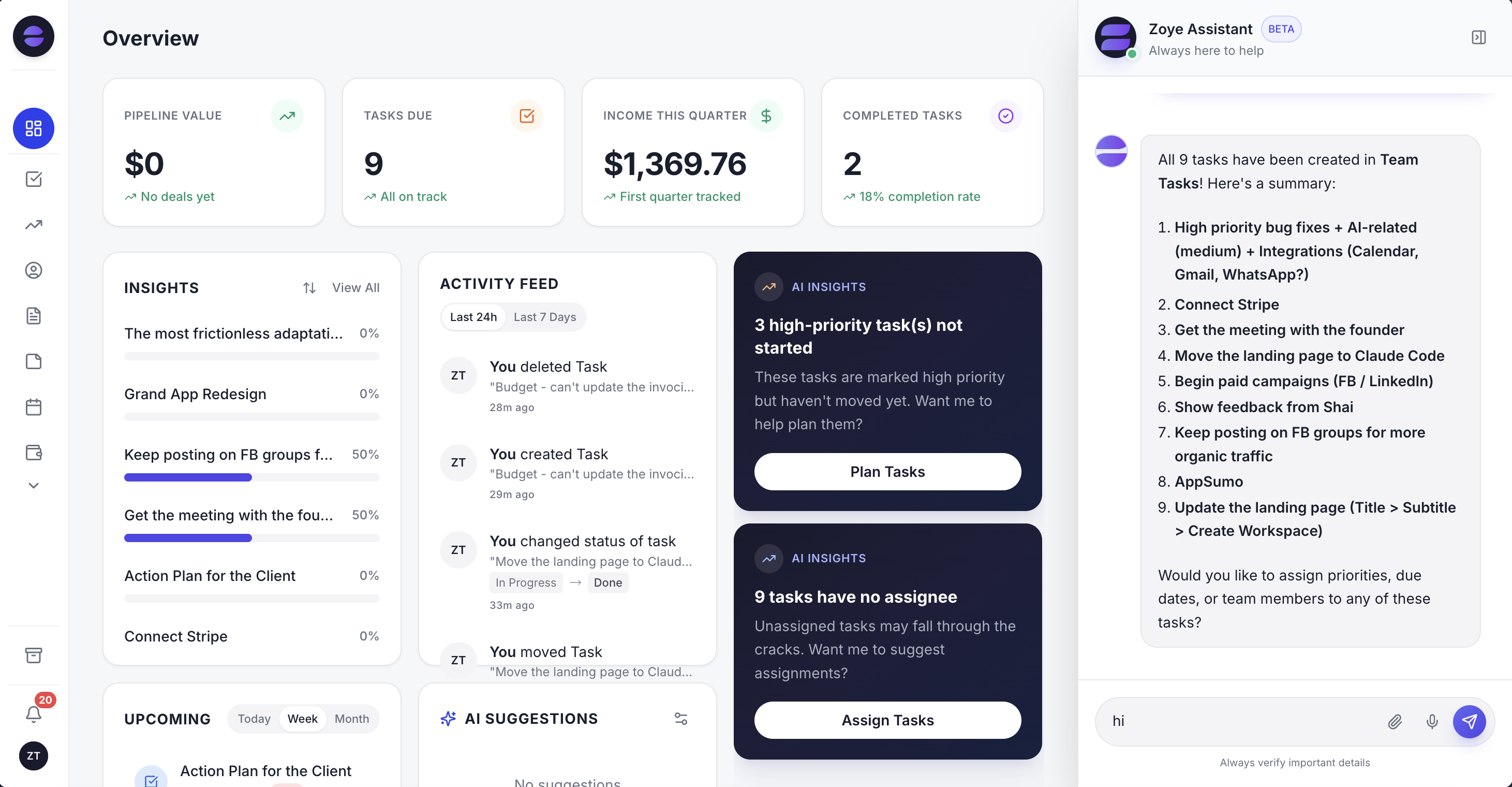 Zoye's dashboard: the operator keeps each client record current as conversations happen, so nothing depends on the owner remembering to update a sheet
The record builds itself. As you talk to customers on WhatsApp or email, the Zoye Assistant creates the client record, fills in the fields, logs what was agreed, and schedules the follow-up, without you re-typing anything into a separate database. Say "register Dana, wants a quote for Friday" and the client exists, with the quote and the follow-up already scheduled. Say "who hasn't ordered since spring?" and you get the list. Say "remind every client whose service is due this month" and the reminders go out. There is no spreadsheet to maintain and no form to keep filling, because registration happens as a byproduct of the conversation you were having anyway.
Underneath the assistant sits a complete workspace: client and lead management, tasks, a shared calendar, budget tracking, and reports, so the record is not a dead entry but a live part of how the business runs. The safety layer is what makes handing that over sensible: the assistant asks before anything irreversible, respects each user's permissions, and never invents a record or claims an action succeeded when it did not. Non-technical owners never have to "maintain" any of it; you talk, it keeps the registry current.
Pricing: Almost Free at $5 per month for 1 member with the core tools. Starter from $29 per month (10 members). Growth from $59 per month (20 members). Core tools included on every plan.
Best for: Owner-operated small businesses that want each client record captured and kept current automatically, instead of another spreadsheet to feed by hand.
See what Zoye can do for you
CRM, deals, tasks and your Instagram, Facebook and WhatsApp automations in one workspace. Just ask Zoye and it sets any of it up for you.
Explore FeaturesWhat the first weeks of a self-maintaining registry look like
The change is smaller and faster than a software migration, because there is nothing to move into place first. In the first days, you connect your channels and tell Zoye about your business the way you would brief a new hire, and it starts capturing every customer who messages you. By the second week, the registry that used to depend on your memory is simply there, current, because it filled itself as you worked. The moment a customer returns, their history is in front of you without anyone having updated a sheet.
That inversion is the whole point. The measure of a client registry is not how many fields it has, but whether it is still accurate the week you are too busy to look after it. A registry that maintains itself is the only kind that survives a real business.
Why small businesses pick Zoye
A few themes come up consistently.
The record keeps itself current. New clients get logged and answered, purchases get recorded, and quiet customers get a nudge, none of it waiting on the owner to remember to update anything.
You never have to maintain a database. There is no spreadsheet to tidy and no form to keep filling. You tell Zoye what you want, from WhatsApp if that is easiest, and the registry stays accurate automatically.
It does more than store data. Customers, leads, tasks, calendar, and budget live in one workspace the assistant can act across, so registering a client naturally connects to the follow-up, the booking, and the payment instead of sitting in isolation.
And it is built to be trusted with real customer data: it checks with you before anything irreversible, respects each teammate's permissions, and never reports a result it did not actually produce.
Try Zoye with your team. The entry plan is Almost Free, with the core tools.
Ready to hand off the busywork?
Zoye brings AI-powered CRM, task management, and automation into one workspace.
Get StartedFor more context, see the best CRM for small business, customer management software, and WhatsApp CRM software, plus the rest of the Zoye blog.