
Most field service management software was built to be a filing cabinet: a place to store jobs, schedules, and invoices so they are not scattered across a whiteboard and a glovebox full of receipts. That is genuinely useful, and for a while it feels like progress. But storing the work is not the same as doing the work. The software still waits for you to schedule the job, dispatch the tech, send the reminder, chase the quote, and follow up on the unpaid invoice. For a small service business where the owner is often the one on the ladder, that is a lot of admin that only happens if someone stops working to do it.
That is the real gap in 2026. The bottleneck for a plumber, electrician, HVAC company, or cleaning crew is rarely the lack of a place to store jobs. It is the follow-up that never happens: the quote a customer never replied to, the review that was never requested, the maintenance visit that was never rebooked, the invoice that quietly aged past due. Traditional field service software makes those tasks visible but still leaves them for you to do. This guide compares the 8 best field service management software for small business in 2026, and leads with the one that actually does the work instead of just filing it.
Pricing reflects published rates as of July 2026; check each vendor's pricing page for current figures.
Field service management software at a glance
| Software | Category | Does the work for you? | Best for | Pricing from |
|---|---|---|---|---|
| Zoye | AI Business Operator | Yes - books, reminds, chases follow-ups, requests reviews and updates records itself | Solo trades and small crews with no office admin | $5/mo (1 member), then $29/mo (10 members) |
| Jobber | Home-service standard | No - you action every task | Established home-service crews | ~$29/mo, per-user above base |
| Housecall Pro | Consumer-polished trades app | No - reminders you configure | Trades wanting a slick customer experience | ~$59/mo, scales per user |
| ServiceTitan | Enterprise platform | No - needs a dispatcher to run it | Large HVAC, plumbing and electrical firms | Quote-based, enterprise pricing |
| Workiz | Service-pro tool | No - you drive dispatch | Locksmiths, junk removal, appliance repair | ~$45/mo per user tiers |
| Service Fusion | Value all-rounder | No - flat-rate but manual | Crews wanting unlimited users at flat rate | ~$225/mo flat, unlimited users |
| FieldEdge | HVAC and plumbing specialist | No - trade-specific but manual | HVAC and plumbing with service agreements | Quote-based |
| mHelpDesk | Simple job tracking | No - basic and manual | Very small crews wanting simplicity | Quote-based |
Pricing reflects published rates at the time of writing. Check each vendor's page for current figures.
Affordable field service software: what small businesses actually pay
This category has a pricing structure that punishes exactly the businesses it claims to serve. Almost every traditional tool charges per technician, which means the software gets more expensive precisely as you take on more work.
Here is what the math looks like as a crew grows:
| Software | Solo (1 person) | Small crew (5 people) | Growing (10 people) |
|---|---|---|---|
| Zoye | $5/mo | $29/mo | $29/mo |
| Jobber | ~$29/mo | ~$129/mo | ~$249/mo |
| Housecall Pro | ~$59/mo | ~$149/mo | ~$299/mo |
| Workiz | ~$45/mo | ~$225/mo | ~$450/mo |
| Service Fusion | ~$225/mo | ~$225/mo | ~$225/mo |
| ServiceTitan | Not offered | Quote-based, typically $300+ | Quote-based, typically $500+ |
Illustrative figures based on published rates; actual pricing varies by plan, features, and contract term.
Three things follow from that table.
Per-technician pricing is a growth tax. A tool that costs $29 for you costs $249 the year you hire nine people, for software that does not do any more work than it did on day one. If you take on seasonal subcontractors, you pay for the peak.
Flat-rate is not automatically cheap. Service Fusion offers unlimited users, which is genuinely good value at fifteen technicians and terrible value at one, because the solo tradesperson pays the same $225 as the fifteen-person firm.
Watch for the extras. Payment processing fees, SMS credits, QuickBooks sync, and onboarding charges are commonly separate. Ask what the monthly total looks like with everything you actually need turned on, not the headline plan price.
For a solo tradesperson or a small crew, the honest cheapest complete answer is a flat entry price that includes everything: Zoye's Almost Free plan is $5 per month, or $4 per month billed annually, and covers one member with the full platform and the AI assistant. Starter is $29 per month for up to 10 members, which is less than most competitors charge for a single additional technician.
Is there free field service management software?
"Free field service software" is a common search and the honest answer is that genuinely free options are narrow.
Free tiers are usually demo-sized. Where a free plan exists in this category, it typically caps you at one user, a handful of jobs per month, or removes invoicing entirely. That answers "does this work?" but not "can I run my business on this?".
Free trials are the norm, not free plans. Most tools here offer 14 or 30 days and then require a card. The trial is genuinely useful for testing whether the mobile app works in the field with gloves on and bad signal, which is the thing that actually decides adoption.
Spreadsheets and a shared calendar are the real free option. Plenty of two-person crews run on exactly this, and for a while it works. It breaks in three predictable places: when two jobs get double-booked, when an invoice goes unsent, and when a quote goes quiet and nobody chases it. Those three failures cost more than any subscription in this guide.
Free has a follow-up cost. Without automation, every reminder and every chase depends on someone remembering at the end of a long day in the field. That is the most expensive kind of free there is.
Why small service businesses are rethinking field service software in 2026
Four shifts are pushing owners to look past the traditional job-scheduling app.
The bottleneck is the owner, not the schedule. In a small service business, the owner sells, quotes, works, invoices, and follows up. Software that only stores this work still needs the owner to stop and act on it. The businesses pulling ahead in 2026 want software that does the follow-up itself, so the person in the field is not the single point of failure for every reminder and every chase.
Follow-up is where the money leaks. Studies of service businesses consistently show most lost revenue is not lost jobs, it is un-chased quotes, un-requested reviews, un-booked maintenance, and un-collected invoices. Traditional field service tools surface these but rarely act on them. Recovering that leak is worth more than another scheduling feature.
Per-technician pricing punishes growth. Most dedicated field service platforms charge per user or per technician. Add a couple of subcontractors for a busy season and the monthly bill jumps. Small owners increasingly prefer flat-rate pricing that does not tax them for every seat.
Owners want to run it by talking, not by learning software. A tradesperson does not want to become an admin. The tools winning in 2026 let you say what you need from your phone, between jobs, rather than clicking through menus at the end of a long day.
The 8 best field service management software for small business in 2026
1. Zoye - the AI Business Operator that runs the jobs, not just files them
Zoye is the strongest field service pick for small businesses because it does not stop at storing jobs and schedules. It runs them. Zoye is an AI Business Operator: it captures the new lead the moment it comes in, books the appointment, sends the reminder, chases the quote that went quiet, follows up after the visit for a review or rebooking, and nudges the overdue invoice, updating your records itself as it goes.
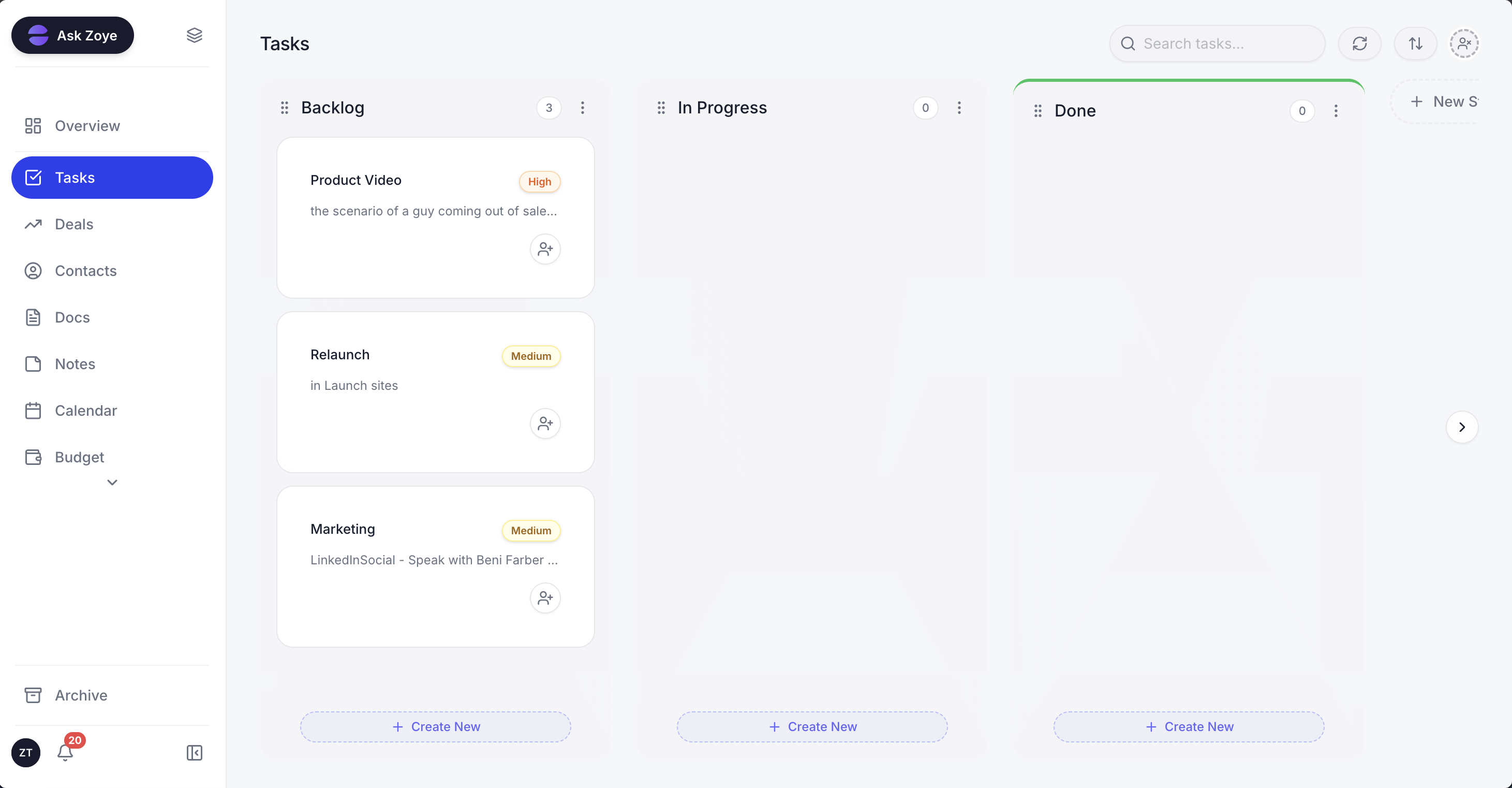 Zoye's task board: straightforward Kanban with priority labels, ready to use without any setup or template configuration
For a service business, every job can live on a simple board that moves from new request, to scheduled, to in progress, to invoiced, to paid. You see the whole day and the whole week at a glance, with priority labels and deadlines, and no template configuration to set up first. Because Zoye also includes a native CRM, every customer, their history, their properties, and their past jobs sit in the same place as the schedule, so the tech who arrives already knows the story.
The difference is the assistant. Where most field service software waits for you, you can tell Zoye, from your phone or over WhatsApp and Slack, "book the Henderson job for Thursday morning and text them a reminder the day before," or "chase everyone who got a quote last week and hasn't replied," and it does it. It creates the job, drafts the message, schedules the reminder, and follows up. You never stop working to run the admin, and a non-technical owner never has to maintain a workflow builder to keep it running.
Beyond the field work, Zoye is a full workspace: tasks, CRM, calendar, budget tracking, and reports in one place. Invoicing follow-up, cash-flow visibility, and a real report on which job types and which technicians are most profitable all come from the same system, not five bolted-together apps. You can even ask Zoye to build a new automation, such as "every time a job is marked complete, wait two days then ask the customer for a review," and it wires it up for you.
Pricing: Almost Free from $5 per month (or $4 per month billed annually) for 1 member with the full platform including AI, cancel or upgrade anytime. Starter from $29 per month (10 members). Growth from $59 per month (20 members).
Best for: Small service and trades businesses that want the software to run the scheduling, dispatch, and follow-up instead of just storing it.
2. Jobber - the popular home-service standard
Jobber is one of the best-known field service tools for home-service businesses, covering quoting, scheduling, invoicing, and client communication in a clean interface. It is a genuinely solid choice for a small crew that wants a proven, focused system.
The trade-off is that Jobber is a traditional filing-and-scheduling tool: it organises the work well but still waits for you to act on it, and pricing is tiered by the number of users, so a growing crew climbs into the higher plans quickly.
Pricing: Tiered plans, typically starting around $25 per month for a single user and rising with team size; check Jobber's pricing page for current figures.
Best for: Home-service businesses that want a proven, focused scheduling and invoicing tool.
3. Housecall Pro - the trades app with consumer polish
Housecall Pro is a widely used field service app aimed at trades like plumbing, HVAC, and electrical, with strong mobile apps, online booking, and payment processing. The consumer-facing booking experience is a highlight.
The limitation is familiar: it is built around scheduling and payments, with follow-up and marketing sold as add-ons, and the per-user pricing adds up as the crew grows.
Pricing: Tiered, commonly from around $59 per month for the entry plan; higher tiers and add-ons cost more. Check the current pricing page.
Best for: Trades businesses that value a polished customer booking and payment experience.
4. ServiceTitan - the enterprise-grade platform
ServiceTitan is a powerful, deep field service platform built for larger home-service and commercial operations, with rich reporting, dispatch, and marketing tooling. For a big company with a dispatcher and an office team, it is comprehensive.
The trade-off for a small business is that it is heavy and expensive: it is designed for scale, with pricing and complexity to match, which is overkill for a two- or three-person crew.
Pricing: Custom quote-based pricing, generally priced for larger operations. Contact ServiceTitan for figures.
Best for: Larger home-service and commercial companies that need enterprise depth.
Want to see it in action?
See Zoye catch a new lead, answer on WhatsApp and set up the follow-up, all from one message.
See How It Works5. Workiz - the field service tool for service pros
Workiz targets service businesses like locksmiths, cleaning, and appliance repair, with scheduling, dispatch, invoicing, and a built-in phone and lead-tracking system. The communications features are a nice touch for lead-heavy businesses.
The limitation is that, like its peers, it centres on organising jobs and calls rather than autonomously running follow-ups, and pricing scales with users and features.
Pricing: Tiered plans, typically from around $45 to $65 per month per plan depending on features and team size. Check the current pricing page.
Best for: Service pros who want scheduling plus built-in phone and lead tracking.
6. Service Fusion - the value-focused all-rounder
Service Fusion offers field service management with scheduling, dispatch, estimates, invoicing, and a flat-rate pricing model that appeals to businesses tired of per-user fees. The flat pricing is a genuine differentiator among traditional tools.
The trade-off is a dated interface and a learning curve, and like the rest of the category it stores and organises the work rather than acting on it for you.
Pricing: Flat-rate tiers, commonly from around $165 per month for the entry plan. Check the current pricing page.
Best for: Small businesses that want flat-rate pricing without per-user fees.
7. FieldEdge - the tool for HVAC and plumbing
FieldEdge focuses on HVAC, plumbing, and electrical contractors, with dispatch, service agreements, and QuickBooks integration as a core strength. For trades that live in QuickBooks, the accounting link is valuable.
The limitation is that it is a traditional dispatch-and-invoicing platform aimed squarely at established contractors, with pricing and setup to match, and no autonomous follow-up.
Pricing: Quote-based; contact FieldEdge for current figures.
Best for: Established HVAC, plumbing, and electrical contractors on QuickBooks.
8. mHelpDesk - the simple job-tracking option
mHelpDesk provides straightforward field service management with lead capture, quoting, scheduling, and invoicing in one place. It is a reasonable entry-level option for a small business that wants the basics covered.
The trade-off is that it is a basic organiser: it keeps jobs and invoices tidy but leaves the follow-up and the chasing entirely to you, and the interface can feel dated.
Pricing: Quote-based; contact mHelpDesk for current figures.
Best for: Small businesses that want simple, no-frills job tracking.
Best field service software for follow-up and repeat revenue
The single biggest hidden cost in a small service business is the follow-up that never happens. A quote goes out and the customer goes quiet. A job finishes and no one asks for the review. A furnace gets serviced and the annual reminder is never sent. An invoice ages past due and no one chases it. Every one of these is repeat revenue quietly walking out the door.
Traditional field service software makes these tasks visible on a list but still leaves them for a busy owner to do at the end of the day. Zoye is the only option here that closes the loop itself: the assistant chases the quiet quote, requests the review after the job, rebooks the maintenance visit, and nudges the overdue invoice, drafting each message and updating the record without you lifting a finger. For a small business, recovering that leak is usually worth far more than any single scheduling feature.
See what Zoye can do for you
CRM, deals, tasks and your Instagram, Facebook and WhatsApp automations in one workspace. Just ask Zoye and it sets any of it up for you.
Explore FeaturesBest AI-powered field service management software
Almost every tool in this category now advertises AI, but in most cases the AI is a suggestion box: it drafts a message you still have to send, or summarises a job you still have to act on. Zoye is built differently. Zoye does the work: it books the appointment, sends the reminder, chases the follow-up, and updates the record, and you direct it from your phone between jobs, the way you would talk to your office manager.
That matters most for the owner who is on the tools all day. You are not going to sit at a desk configuring workflows. You want to say "schedule the three callbacks for tomorrow and text each customer a heads-up," and have it done. Zoye can also build the automations itself when you tell it what should happen, so recurring routines like post-job review requests or seasonal maintenance reminders run themselves without you learning a workflow builder.
Best field service software by trade
The right tool shifts depending on what your crew actually does all day.
HVAC. Service agreements, seasonal maintenance cycles, and equipment history are the core requirements. ServiceTitan and FieldEdge are built around exactly this and are strong for larger firms. For a small HVAC business, the deciding factor is usually whether the annual maintenance reminder actually goes out, which is an automation question rather than a feature question.
Plumbing. Emergency dispatch, accurate arrival windows, and fast on-site invoicing matter most. Jobber and Housecall Pro handle this well. The gap for a two-truck operation is that after-hours calls still land on the owner's phone with nothing capturing them into the system.
Electrical. Quoting is the bottleneck: multi-line estimates, variations, and the follow-up on quotes that go quiet. Whichever tool you pick, check how it handles a quote that has not been answered in five days, because that is where the revenue leaks.
Cleaning and janitorial. Recurring schedules, rotating staff, and checklists dominate. See our guide to CRM for cleaning businesses.
Landscaping and grounds maintenance. Seasonal contracts, route efficiency, and weather-driven rescheduling. The ability to rebook a rained-off day quickly matters more than most feature lists suggest.
Appliance repair, locksmiths and mobile services. Workiz targets this group specifically. The workload is high job volume with short duration, so speed from call to booked slot is the metric that counts.
Mixed trades and general contractors. If you do a bit of everything, a rigid trade-specific tool becomes a straitjacket. See CRM for contractors and CRM for small business.
What to look for: a field service software checklist
Working through this list before you buy will save you a migration later.
Does the mobile app work in real conditions? Not in a demo on office wifi. Test it with one hand, outdoors, on a weak signal, with gloves. Offline capability matters more than most buyers expect: if the app cannot capture a signature or a photo in a basement with no reception, your technicians will go back to paper.
How fast is call to booked job? Count the taps. If booking a job takes eleven screens, your dispatcher will keep using the whiteboard.
What happens to an unanswered quote? This is the question most buyers forget and the one that costs the most. Ask specifically: does the software chase it, or does it simply display it on a list for someone to notice?
Does it invoice from the field? Getting paid on site, or at least sending the invoice before leaving the driveway, materially changes cash flow. Check whether payment processing is included or charged separately.
Does it handle recurring and seasonal work? Service agreements, annual maintenance, and repeat contracts are the profitable part of most service businesses. Automatic rebooking is worth more than any dispatch board.
What does it cost at your size in two years? Run the per-technician math for the crew you expect to have, not the crew you have today.
Can a non-technical person run it? If the owner is on the tools all day, they have to be able to run the software from a phone just by saying what needs doing, or it will quietly stop being used.
How to choose field service software for your small business
Three questions narrow the field.
1. Do you need software to store the work, or to do it? If you just want a tidy place for jobs and invoices, any of the traditional tools here will serve. If your real problem is that follow-ups and chasing keep falling through the cracks because you are in the field, you want an operator like Zoye that does those tasks itself.
2. How much will it cost as you grow? Per-technician pricing looks cheap for one person and expensive for five. If you add subcontractors seasonally, flat-rate pricing (Zoye, Service Fusion) protects you from a bill that jumps every time the crew grows.
3. How much admin time do you actually have? A dispatcher in an office can run a complex platform like ServiceTitan. A solo tradesperson cannot. If nobody on the team has time to maintain software, choose the one that runs itself and can be operated by talking to it.
Migrating to a field service system that runs itself
Moving off a whiteboard, a notebook, or an aging field service tool is less about data and more about deciding what should happen automatically from now on. Start by listing the recurring moments that currently depend on you remembering: the day-before reminder, the post-job review request, the unpaid-invoice chase, the seasonal maintenance nudge. Those are the tasks worth handing to an operator so they never depend on your memory again.
With Zoye specifically, the move is fast because you walk Zoye through how your business works and it proposes the job stages, the customer records, and the automations to match. Import your existing customers, tell it which follow-ups you want running, and the system starts doing the chasing from day one. Most small crews are up and running the same afternoon, without a consultant or a setup fee.
Ready to hand off the busywork?
Zoye brings AI-powered CRM, task management, and automation into one workspace.
Get StartedWhy teams pick Zoye as their field service software
A few themes come up again and again with small service businesses.
The software does the work, not just the filing. Booking, reminders, follow-ups, review requests, and invoice chasing all happen without the owner stopping to do them.
You run it by talking. From the phone, over WhatsApp or Slack, between jobs, no menus to learn and no workflow builder to maintain.
The follow-up gap gets closed. The quiet quotes, un-requested reviews, un-booked maintenance, and overdue invoices that quietly cost a small business real money are chased automatically.
The pricing scales with you, not against you. Flat-rate plans with no per-technician tax, and an entry Almost Free plan from just $5 per month that covers a solo tradesperson with the full platform including AI.
Dispatch jobs, track technicians, and invoice from the same place your customer records live. The entry Almost Free plan runs $5 per month, or $4 per month billed annually, with the full platform and AI, so cancel or upgrade at any time.
For more context, see the best business management software in 2026, the guide to CRM for insurance agents, and the best CRM software of 2026.