
A CRM system is meant to be the single place where every customer lives: every contact, every deal in the pipeline, every conversation, every follow-up you owe. In theory it means nothing slips through the cracks. In practice, most small businesses that buy a CRM system end up with a half-empty database that nobody trusts, because the classic CRM has one fatal design assumption baked in: someone will keep feeding it.
That assumption is where CRM systems go to die. A traditional CRM is a filing cabinet with a login. It stores whatever you put in and shows it back to you neatly, but it does not lift a finger on its own. The deal stage only moves when a human drags it. The call only gets logged when a human types it. The follow-up only happens when a human remembers it. For a busy, non-technical owner, that upkeep is the first thing to slip, and within a few months the CRM has become the most expensive thing in the stack that nobody opens: software you bought and stopped using.
This guide explains what a CRM system actually is, why so many owners abandon theirs, and what the alternative looks like in 2026. It then compares the seven best options for small businesses, founders, and lean sales teams who want customer relationships handled without turning data entry into a second job.
Pricing reflects published rates as of July 2026; check each vendor's pricing page for current figures.
What a CRM system actually does
Strip away the jargon and a CRM system does four things.
It stores your contacts in one place. Every person and company you deal with, with their details, history, and the deals attached to them, instead of scattered across your phone, your inbox, and a spreadsheet.
It tracks deals through a pipeline. A visual pipeline shows each opportunity moving through stages (new, contacted, proposal sent, won, lost), so you can see at a glance what is likely to close and what is stalling.
It records every interaction. Calls, emails, meetings, and messages get logged against the contact, so anyone on the team can see the full history without asking around.
It reminds you to follow up. The whole point of a CRM is that the next step never gets forgotten. The follow-up call, the quote you promised, the check-in after the sale.
The catch is that a classic CRM does all four things only if a human keeps it fed. The storing, the tracking, the logging, and the reminding all depend on someone doing the entry. Remove the discipline and every one of those four functions quietly breaks.
Why owners abandon their CRM system in 2026
Four patterns come up again and again when a small business gives up on its CRM.
The maintenance never ends. A CRM is only as good as the data in it, and keeping that data current is a permanent chore. Every call logged, every stage updated, every new lead typed in by hand. For a non-technical owner juggling ten other jobs, this is the task that always loses. Within a quarter the CRM is out of date, and an out-of-date CRM is worse than none because you stop trusting it.
It was sold as a sales tool, but the whole business needs it. Classic CRM systems assume a dedicated sales rep who lives in the pipeline all day. Most small businesses do not have that person. The owner sells, delivers, invoices, and supports, all at once, and a tool that only handles the sales slice sits mostly empty.
Per-seat pricing punishes the team that grows. The per-user model made sense when only closers touched the CRM. Now operations, finance, and support all need visibility, and every extra person who just wants to see the pipeline adds another seat charge. The bill grows faster than the value.
Customers moved to messaging. A growing share of customer conversations now happen on WhatsApp and other chat channels, not email. A CRM built around an inbox treats those threads as an afterthought, so the most important conversations often never reach the system of record at all.
The common thread is effort. The classic CRM asks the owner to do more work to keep it useful, and the answer to a busy owner's problem can never be "do more admin."
Want to see it in action?
See Zoye catch a new lead, answer on WhatsApp and set up the follow-up, all from one message.
See How It WorksThe alternative: a CRM that runs itself
The shift in 2026 is from a CRM you maintain to an operator that maintains it for you. Instead of a database waiting for input, imagine simply telling a system what happened and having it do the recording, the linking, and the follow-up on its own.
That is the AI Business Operator model. You describe a call you just finished, and the operator creates the contact, opens the deal at the right stage, links them, drafts the follow-up message, and schedules the next task. You never open a form. The CRM stays current because keeping it current is the operator's job, not yours. This is the model that fixes the abandonment problem at its root: nobody abandons a CRM they never have to feed.
The rest of this guide ranks the seven best options, starting with the operator that runs the whole thing and then covering the strongest traditional CRM systems for teams that want a classic database.
The 7 best CRM systems in 2026
1. Zoye - the AI Business Operator that runs your CRM for you
Zoye is the strongest pick for small businesses because it is not a CRM you maintain, it is an AI Business Operator that runs the business and keeps the CRM current itself. It captures leads, chases follow-ups, books clients, updates the records, and even sets up automations when you describe what should happen, so a non-technical owner never has to do the data entry that kills a classic CRM.
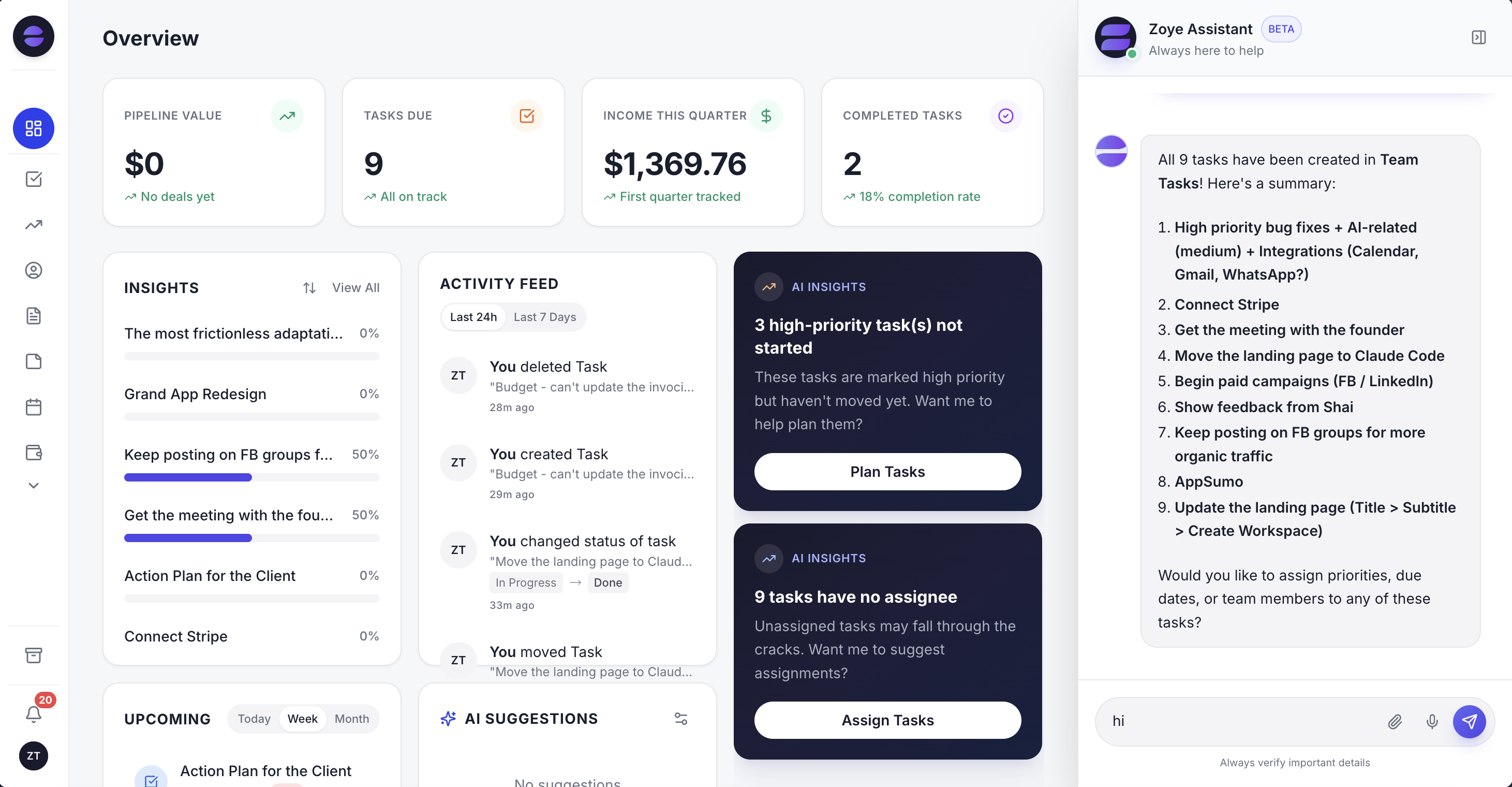 Zoye keeps contacts, deals, tasks, and calendar in one AI-native workspace and runs the follow-up work for you.
Underneath, Zoye has a genuine, modern CRM: a contact database that separates people from companies, a visual deal pipeline with custom stages, centralised customer conversations, and a full activity history on every record. But the point is what happens without you touching it. Tell Zoye about a conversation you just had, out loud or by typing, and it opens the deal, creates the contact, links them, drafts the follow-up, and assigns a task with a due date. Ask it to chase everyone who went quiet this week and it drafts and queues the messages. Ask it to build an automation ("when a lead comes in from WhatsApp, tag it and remind me in two hours") and it wires that up, no builder to learn.
Because you run it by talking to it, you can operate the whole business from wherever you already are, including WhatsApp and Slack. An incoming WhatsApp message becomes a contact, a deal, and a follow-up without you opening the app. And because Zoye is a full workspace, the CRM sits alongside tasks with list, board, calendar, and timeline views, a shared calendar, budget tracking, and reports that pull from contacts, deals, tasks, and finances into one exportable dashboard. Collaborative notes bring documents into the same place. To be honest about scope: Zoye is a unified operator with a strong modern CRM, not a twenty-year-old enterprise sales suite with every advanced sales-ops feature Salesforce has accumulated. For most small businesses and lean teams, an operator that does the work beats enterprise depth they will never touch.
Pricing: Almost Free at $5 per month for 1 member with the full platform including AI. Starter from $29 per month (10 members). Growth from $59 per month (20 members).
Best for: Small businesses, founders, agencies, and lean teams that want their CRM handled for them instead of maintained by them.
2. HubSpot - the marketing-heavy CRM with a free tier
HubSpot is the best-known CRM system, and its free tier makes it an easy starting point for contacts and basic deal tracking. The platform is polished and the ecosystem is large.
The trade-off is that HubSpot's real value lives in its paid Marketing, Sales, and Service Hubs, where costs climb quickly, and it is still a tool you maintain: the data only stays useful if someone keeps logging activity by hand.
Pricing: Free CRM tier. Paid hubs scale from around $20 per seat per month into the hundreds at higher tiers (as of July 2026).
Best for: Businesses that want a recognised CRM with room to grow into marketing automation.
3. Zoho CRM - the affordable, feature-dense classic
Zoho CRM packs a huge amount of functionality at a low per-seat price, and it plugs into the wider Zoho suite. For teams that want a traditional, configurable CRM on a budget, it is strong value.
The trade-off is complexity and upkeep. The depth means real configuration, and like any classic CRM the records only stay current if the team keeps feeding them.
Pricing: Free for up to 3 users. Paid plans from around $14 per user per month (as of July 2026).
Best for: Budget-conscious teams that want a configurable traditional CRM.
4. Pipedrive - the sales-focused pipeline CRM
Pipedrive is built around a single, clean visual pipeline, which makes it one of the easiest CRM systems for a sales team to adopt. If your only job is moving deals through stages, it does that well.
The trade-off is narrowness. Pipedrive is a sales pipeline first, so anything beyond deals (broader operations, projects, finance) lives in other tools, and it still relies on reps updating it manually.
Pricing: Plans from around $14 per user per month (as of July 2026).
Best for: Dedicated sales teams that live in a deal pipeline all day.
5. Powerlink - the established Israeli-market CRM
Powerlink is a well-known CRM and business-management platform in the Israeli market, with local support and Hebrew-language service. For companies that want a locally-backed vendor, it is a familiar name.
The trade-off is that it follows the classic build-and-maintain model: capable, but it is a system your team keeps current rather than one that runs itself.
Pricing: Quote-based; contact the vendor for current figures.
Best for: Israeli businesses that want a local vendor with Hebrew support.
6. Fireberry - the flexible, locally-known CRM
Fireberry (formerly Powerlink's neighbour in the local market) is a customisable CRM popular with Israeli small and mid-sized businesses, with drag-and-drop configuration and Hebrew support.
The trade-off is the same as the category: flexibility means setup, and the records stay useful only while someone maintains them.
Pricing: Tiered per-user pricing; check the vendor's page for current figures.
Best for: Local teams that want a configurable CRM with Hebrew-language support.
7. Salesforce - the enterprise standard
Salesforce is the most powerful CRM system on the market, with depth for almost any sales process an enterprise can imagine. If you have complex, large-scale sales operations and a team to run it, nothing matches its ceiling.
The trade-off is that power comes with cost, complexity, and a heavy maintenance burden. For a small business, most of that depth goes unused while the admin overhead does not.
Pricing: From around $25 per user per month, rising steeply with editions and add-ons (as of July 2026).
Best for: Larger organisations with complex sales operations and dedicated admins.
See what Zoye can do for you
CRM, deals, tasks and your Instagram, Facebook and WhatsApp automations in one workspace. Just ask Zoye and it sets any of it up for you.
Explore FeaturesBest CRM system for small business owners
For a small business owner, the deciding question is not which CRM has the most features, it is which one you will still be using in six months. On that test, the operator model wins, because the reason owners abandon a CRM is the maintenance, and Zoye removes the maintenance. It keeps itself updated from what you tell it, chases the follow-ups on its own, and covers the whole business, not just the sales slice, so it does not sit half-empty the way a sales-only CRM does.
Among the traditional options, HubSpot's free tier is the gentlest on-ramp and Zoho is the best value for a configurable classic CRM. But both still ask the owner to do the upkeep, which is exactly the job that never gets done.
How to choose a CRM system
Three questions narrow it down.
1. Who is going to keep it updated? If the honest answer is "nobody has time," a classic CRM will go stale no matter how good it looks in a demo. An operator that maintains itself is the safer bet. If you have a dedicated person who lives in the pipeline, a traditional CRM can work.
2. Do you need only sales, or the whole business? If you just move deals, a focused pipeline like Pipedrive fits. If the same owner also handles tasks, calendar, invoicing, and support, a unified workspace saves you from stitching five tools together.
3. How do your customers reach you? If a lot of your conversations happen on WhatsApp or chat, choose a system that treats messaging as a first-class channel rather than an afterthought, so nothing important skips the record.
What changes when the CRM runs itself
The difference between a maintained CRM and an operator shows up in the day-to-day. With a classic CRM, the workflow is: have the call, remember to open the tool, find the contact, update the stage, type the notes, set a reminder. Six manual steps, every time, and any one of them is the point where it breaks down.
With an operator, the workflow is: have the call, tell Zoye what happened. The contact, the stage, the notes, the follow-up draft, and the reminder all get handled from what you just told it. The CRM stays current because staying current is the operator's job. Multiply that across every interaction in a week and the gap is the difference between a database you trust and one you abandoned.
Why teams pick Zoye
A few themes come up consistently.
Nobody has to maintain it. The records stay current because Zoye updates them every time you mention a call, a booking, or a payment, which removes the single biggest reason small businesses abandon a CRM.
It runs the whole business, not just the sales slice. Contacts and deals sit alongside tasks, calendar, budget, and reports, so the owner is not stitching separate tools together.
It does the follow-up work, not just the reminding. Zoye chases the quiet leads, drafts the messages, books the clients, and builds the automations, and you can ask for any of it from the app, WhatsApp, or Slack.
Try Zoye with your team. The entry plan is Almost Free, with the full platform including AI.
For more context, see the best CRM software in 2026, how to choose a CRM, and the best CRM for small business.