
Here is the uncomfortable truth about sales in 2026: the deal is rarely lost on the first email. It is lost in the silence afterwards, when the seller sends one message, hears nothing, and quietly moves on. Study after study puts the same number in front of us. Most sales require five or more follow-ups after the initial contact, yet the majority of sellers give up after one or two. The gap between those two facts is where your revenue is leaking.
Follow-up is not a personality trait or a matter of being pushy. It is a system: the right message, sent at the right time, with a genuine reason for the person on the other end to reply. Done well, follow-up feels helpful rather than annoying. Done badly, it is the reason your emails get archived on sight. This playbook walks through the timing, the cadence, the subject lines, the psychology, and the mistakes, so that your follow-ups become the part of your pipeline you can actually rely on. At the end, we will look at how to stop doing all of this by hand.
Pricing reflects published rates as of July 2026; check each vendor's pricing page for current figures.
Why most follow-up emails fail
Before we fix follow-up, it helps to understand why the average attempt goes nowhere. Three failures show up again and again.
The seller gives up too early. The single biggest reason follow-up fails is that it stops. A prospect who did not reply to your first email is not a rejection. People are busy, inboxes are chaotic, and a non-reply usually means "not right now," not "never." Sellers who send one follow-up and go quiet leave the field open to the competitor who sends four.
Every message says the same thing. "Just checking in." "Circling back." "Following up on my last email." These phrases add zero new information. They ask the recipient to do work (remember who you are, dig up your last email, decide what to do) while giving them nothing new in return. A follow-up that only repeats the previous one is a follow-up that gets ignored.
The email is about the seller, not the buyer. "I wanted to see if you had a chance to look at my proposal" is entirely about the seller's need for an answer. It gives the buyer no reason to prioritise it. The follow-ups that get replies lead with something useful to the recipient: a relevant idea, a helpful resource, a clear next step, or a genuine question worth answering.
Fix these three and you are already ahead of most of the people emailing your prospects.
The follow-up timing that actually works
Timing is where good intentions turn into results. The principle is simple: follow up fast at first, then space the touches out.
The first follow-up: within 24 hours. After a sales call, demo, or meeting, send a follow-up the same day or the next morning at the latest. The conversation is still fresh in the buyer's mind, and a prompt, specific recap signals that you are organised and easy to work with. This first email is not a chase. It is a summary: what you discussed, what you agreed, and the single next step.
The follow-up sequence: days 3, 7, 12, and 20. After that first message, spread subsequent follow-ups out. A cadence many sellers rely on looks like day 3, day 7, day 12, and day 20 from the last contact. The gaps get wider on purpose. Early follow-ups are still riding the momentum of the conversation. Later ones are re-earning attention that has cooled, so crowding them together only reads as desperation.
The best days and times. Reply rates tend to be strongest on Tuesday, Wednesday, and Thursday mornings in the recipient's own timezone. Monday inboxes are a battlefield and Friday attention has already left the building. That said, do not obsess over the perfect minute. A relevant email sent on a Monday afternoon beats a generic one sent at the statistically ideal moment. Consistency and relevance win over timing tricks every time.
Want to see it in action?
See Zoye catch a new lead, answer on WhatsApp and set up the follow-up, all from one message.
See How It WorksBuilding a follow-up cadence, not a single email
A single follow-up is a coin flip. A cadence is a system. The difference between them is that each message in a cadence has a distinct job and a distinct angle, so the sequence never feels like the same email sent five times.
Here is a five-touch cadence you can adapt to almost any B2B sales situation:
- Touch 1 (day 0 to 1): the recap. Summarise the conversation, confirm the next step, and attach or link anything you promised. Short, warm, specific.
- Touch 2 (day 3): the value-add. Share something genuinely useful that relates to their situation: a relevant case, a short answer to an objection they raised, a resource. No ask beyond a soft "happy to talk it through."
- Touch 3 (day 7): the question. Ask one specific, easy-to-answer question that moves the deal forward. "Is budget approval still on track for this quarter?" earns a reply more often than "any update?"
- Touch 4 (day 12): the new angle. Introduce a fresh reason to engage: a new feature, a deadline, a limited window, a relevant change in their industry. Give them a reason that this is worth their attention now.
- Touch 5 (day 20): the breakup. Politely signal that this is your last email for now. Counterintuitively, the breakup email is one of the highest-replying messages in any sequence, because it removes pressure and triggers a gentle fear of missing out.
The magic is not in any single email. It is in the fact that a prospect who was genuinely busy has now had five well-spaced, non-repetitive chances to re-engage, each from a slightly different angle.
Subject lines: optimise for replies, not opens
Most advice about subject lines optimises for the wrong metric. A high open rate feels good, but opens do not close deals. Replies do. And the subject lines that maximise opens (curiosity gaps, fake urgency, clickbait) often actively suppress replies by damaging trust the moment the email is opened.
Optimise for the reply. That means writing subject lines that a real colleague might send:
- Reference the last conversation. "Next step on the Q3 rollout" or "Following our call: the two options." It reminds them who you are and signals a specific, low-effort action.
- Ask a genuine question. "Worth a quick call this week?" or "Still the right time for this?" A question in the subject line invites an answer.
- Keep it lowercase and human. "quick one" or "the doc from earlier" reads like a note from a peer, not a marketing blast. It stands out precisely because it looks unpolished.
- Reply within the same thread. For follow-ups, keeping the same subject line (as a reply, not a new email) preserves context and often outperforms a brand-new subject. The recipient sees the history in one place.
Avoid all-caps, exclamation marks, the word "urgent" when it is not, and anything that promises more than the email delivers. The subject line's only job is to earn the open honestly so the body can earn the reply.
See what Zoye can do for you
CRM, deals, tasks and your Instagram, Facebook and WhatsApp automations in one workspace. Just ask Zoye and it sets any of it up for you.
Explore FeaturesThe psychology of a reply-worthy follow-up
Understanding a few simple principles of human behaviour makes every follow-up sharper.
Reciprocity. People feel a pull to give back when they have received something. A follow-up that leads with genuine value (an insight, a resource, an introduction) creates a small sense of obligation to respond. A follow-up that only takes (asking for a decision, a meeting, a signature) does not.
Effortlessness. Every ounce of effort you ask of the recipient lowers your reply rate. Offer two specific time slots instead of "when are you free?" Give a yes/no question instead of an open-ended one. Attach the document instead of asking them to find it. Make replying the path of least resistance.
Loss aversion. People are more motivated to avoid losing something than to gain it. A gentle, honest deadline ("the onboarding slots for this month fill up by Friday") or a breakup email ("I will assume the timing is not right and close this out") both work because they surface a small potential loss.
Social proof and specificity. Vague claims get ignored. Specific, credible details ("teams your size usually see this live within two weeks") earn trust. Reference real, relevant situations without naming names, and let concrete detail do the persuading.
The follow-up mistakes that quietly kill deals
Even sellers who follow up diligently sabotage themselves with a handful of habits. Watch for these.
Guilt-tripping. "I have tried reaching you several times" or "I am disappointed I have not heard back" makes the recipient the villain. It never earns a reply, only resentment. Stay warm no matter how many times you have written.
The wall of text. A follow-up should be four to six sentences. If your email needs paragraphs, you are asking too much. Lead with the point, make the ask crystal clear, and stop.
No clear next step. "Let me know your thoughts" leaves the recipient with homework. "Does Thursday at 10 or Friday at 2 work for a 15-minute call?" gives them a decision they can make in three seconds.
Following up with nothing new. We said it earlier because it is the most common failure of all. Every touch must add something: a new angle, a new resource, a new question, a new deadline. If your follow-up could be summarised as "still waiting," rewrite it.
Chasing manually and forgetting. The most expensive mistake is not a badly written email. It is the follow-up that never gets sent because you got busy, lost track, and the lead went cold. This is the one problem that a human simply cannot solve reliably at scale, which brings us to the part of follow-up you should stop doing by hand.
Ready to hand off the busywork?
Zoye brings AI-powered CRM, task management, and automation into one workspace.
Get StartedHow Zoye handles this for you
Everything above assumes you have the time and discipline to write, schedule, send, and track a five-touch cadence for every open deal, every week, without ever dropping one. Nobody does. This is exactly the gap that most owners bought software to close, and then stopped using because the software still expected them to do the work.
Zoye is different. It is not another tool you have to operate. It is an AI business operator: the assistant that actually runs the follow-up for you.
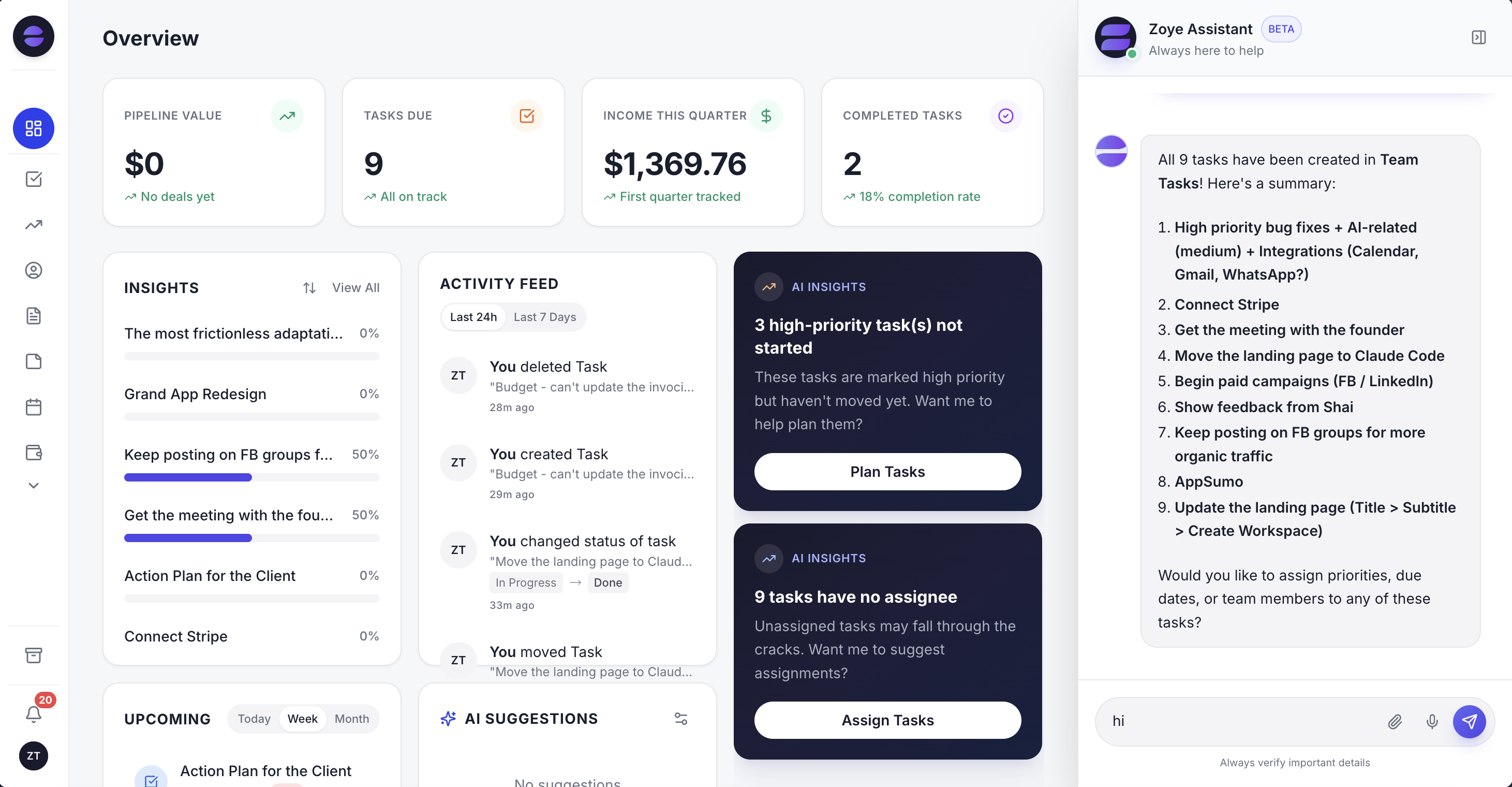 The Zoye dashboard: your whole business at a glance, with proactive AI Insights and Zoye Assistant always available on the right
Here is what that looks like in practice. After a sales call, you do not open a sequencing tool and build a flow. You tell Zoye, "follow up with this lead until they reply, then book a call." That is it. The assistant drafts the recap email in your voice, sends it, and then quietly manages the rest of the cadence: the value-add on day 3, the question on day 7, the new angle on day 12, the breakup on day 20. Every reply is logged against the deal in the CRM automatically, and the moment someone responds, the sequence stops so nobody ever gets a chase after they have already answered.
Because Zoye is an operator rather than a workflow builder, you never touch a canvas of triggers and branches. You describe the outcome and it builds the automation itself. It watches your pipeline for quotes and proposals that have gone quiet and chases them without being asked. It surfaces the deals that need a human touch and drafts the message for you to approve. A non-technical owner never has to "maintain" any of it.
And because it lives in one workspace alongside your tasks, calendar, contacts, and reports, follow-up stops being a separate discipline you have to remember. The lead comes in, the assistant captures it, the follow-ups go out, the replies land back on the deal, and the whole thing keeps running whether or not you thought about it that week. You can even run it by talking to it on WhatsApp, so you can ask Zoye to chase a quote while you are out of the office.
Pricing: Almost Free at $5 per month for 1 member with the full platform including AI. Starter from $29 per month (10 members). Growth from $59 per month (20 members). Every plan includes the assistant and the automations.
Best for: Owners and small teams who are losing deals to silence and want the follow-up to run itself.
Putting the playbook into practice
Follow-up is the highest-leverage, most-neglected part of selling. The tactics are not complicated: reply fast, space your touches, vary the angle, write subject lines for replies, lead with value, keep it short, and always give a clear next step. Do those things and you will out-close sellers with far better products who simply stopped emailing too soon.
But the real unlock in 2026 is not writing better follow-ups. It is not having to remember to write them at all. The playbook in this article is exactly the system a good AI business operator runs for you, on every deal, forever, without a single dropped thread. Talk to your assistant, describe the outcome, and let it chase.
Try Zoye with your team. The entry plan is Almost Free, with the full platform including AI.
For more context, see the best CRM software in 2026, our follow-up email templates for every situation, and the guide to automated follow-up emails. You can also browse the full Zoye blog for more on running your business with less manual work.