
WhatsApp is where your customers already are. In Brazil, most of Latin America, India, and much of Europe and the Middle East, it is the default way people talk to a business: a quick message about hours, a photo of a broken part, a "still available?" on a listing. The problem is not getting messages. The problem is answering all of them, fast, at every hour, without hiring a call center.
Most small teams start by replying by hand. It works until it does not. One person cannot watch a phone at 11pm, cover the lunch rush, and still send the follow-up that actually closes the sale. Messages pile up, the first reply slips from two minutes to two hours, and the customer who wanted to buy has already messaged a competitor who answered first. Automated WhatsApp customer service exists to close that gap without turning your business into a cold, robotic experience.
This guide is a practical walkthrough: what you can automate today, what you should never automate, how to set it up in layers, and how to make sure the automation actually helps you run the business rather than just deflecting customers.
Pricing reflects published rates as of July 2026; check each vendor's pricing page for current figures.
Why WhatsApp support breaks without automation
Four pressures push every growing business toward automation on WhatsApp.
Speed decides the sale. On chat channels, the first reply speed is the single strongest predictor of whether a conversation converts. A reply in the first minute feels like a real business; a reply two hours later feels like you might not exist. No human team can hold a sub-minute first reply around the clock, but automation can acknowledge and answer instantly, every time.
The same questions, forever. A huge share of inbound WhatsApp messages are the same handful of questions: are you open, how much is it, where is my order, do you have this in stock, can I book for Saturday. Answering those by hand is a tax on your day and adds nothing a good automated reply could not deliver in one second.
Volume spikes are brutal. A promotion, a viral post, or a busy season can multiply your message volume overnight. A human team either drowns or you overstaff for a peak that only happens sometimes. Automation absorbs the spike and only escalates what genuinely needs a person.
Nothing gets logged. When support lives in one person's phone, there is no record. You cannot see who asked what, which questions repeat, or which leads never got a follow-up. The conversation happens and then vanishes. Automation that writes every chat into a contact record turns support into data you can actually use.
What you can automate on WhatsApp today
Automation on WhatsApp is not one switch. It is a set of layers you turn on as you grow.
Greetings and away messages. The simplest layer, built into the free WhatsApp Business app. A greeting welcomes first-time messagers; an away message sets expectations outside your hours. This alone stops the silent-inbox feeling.
Quick replies. Saved responses you fire with a shortcut (like typing /hours or /price). Not full automation, but it cuts the typing on the questions you answer fifty times a day.
FAQ auto-answers. A step up: the system recognises common questions and answers them without a human. Opening hours, pricing, address, return policy, booking links. This is where you reclaim real time.
Menus and routing. An opening menu (1 for sales, 2 for support, 3 for billing) or, better, natural-language routing that reads what the customer wrote and sends it to the right place or the right person. Routing is what keeps automation from becoming a maze.
Appointment booking. For service businesses, letting customers pick a slot inside the chat removes the back-and-forth entirely and drops the booking straight onto your calendar.
Follow-ups. The most valuable and most neglected layer. The customer who asked about a service and went quiet, the quote that was never chased, the appointment that needs a reminder. Automated, well-timed follow-ups recover revenue that manual support leaves on the table.
Want to see it in action?
See Zoye catch a new lead, answer on WhatsApp and set up the follow-up, all from one message.
See How It WorksWhat you should never fully automate
Automation earns trust only if it knows its limits. Some conversations must reach a human quickly.
Complaints and anything emotional. A frustrated customer wants to feel heard, not routed. The moment a message reads as upset, the automation's job is to acknowledge, apologise briefly, and hand off to a person, not to defend or deflect.
Refunds, disputes, and money. Anything touching a customer's money is high-stakes and often edge-case. Automate the acknowledgement and the information gathering; let a human make the call.
Anything the bot is unsure about. A good automated system knows when it does not know. Instead of guessing and giving a wrong answer (which is worse than no answer), it should say a team member will follow up and route the chat to a person.
The high-value negotiation. Big deals close on rapport. Use automation to qualify and book the conversation, then let a human run it.
The rule of thumb is simple: automate the repetitive and predictable, route the sensitive and valuable. The goal is not zero humans. It is humans spending their hours only where a human changes the outcome.
How to set it up in layers
You do not build all of this at once. A sensible rollout looks like this.
Layer 1: never leave a message unanswered. Turn on greetings and away messages so every message gets an instant acknowledgement. This is a five-minute change and it immediately makes you look responsive.
Layer 2: kill the repetitive questions. Add auto-answers for your top five to ten questions. Watch your inbox for a week, list the questions you answer most, and automate exactly those.
Layer 3: route and book. Add routing so sales, support, and billing go to the right place, and let service customers book a slot without waiting for you.
Layer 4: automate the follow-up. This is where automation stops being a cost-saver and becomes a revenue engine. Set the system to chase quiet leads, remind about appointments, and reopen conversations that stalled.
Layer 5: connect it to the rest of the business. The final layer is the one most tools skip. Every WhatsApp conversation should become a contact record, feed your pipeline, and trigger the right next action. Support and sales are the same conversation on WhatsApp; your system should treat them that way.
See what Zoye can do for you
CRM, deals, tasks and your Instagram, Facebook and WhatsApp automations in one workspace. Just ask Zoye and it sets any of it up for you.
Explore FeaturesWhere most WhatsApp automation falls short
Most WhatsApp automation tools stop at the surface. They give the customer a fast, scripted reply and consider the job done. That is only half the work.
A reply bot answers the customer. It does not chase the follow-up, update your records, book the client, or tell you which leads are going cold. So you end up with a fast front door and a business that still runs on manual work behind it: someone still has to copy the lead into a spreadsheet, remember to follow up, and update the pipeline by hand. The bot deflected a question, but nobody ran the business.
The gap that matters in 2026 is between a tool that talks to your customers and an operator that runs the work behind the conversation. The first saves you a few minutes of typing. The second actually moves the business forward.
The 7 best ways to run automated WhatsApp customer service in 2026
1. Zoye - the operator that runs the business behind the conversation
Zoye is the strongest pick because it does not stop at answering the customer. It is an AI Business Operator that runs the work the conversation creates: it captures every chat as a contact, chases the follow-ups you would forget, books the client, and updates your records itself, so support on WhatsApp actually feeds the business instead of just deflecting questions.
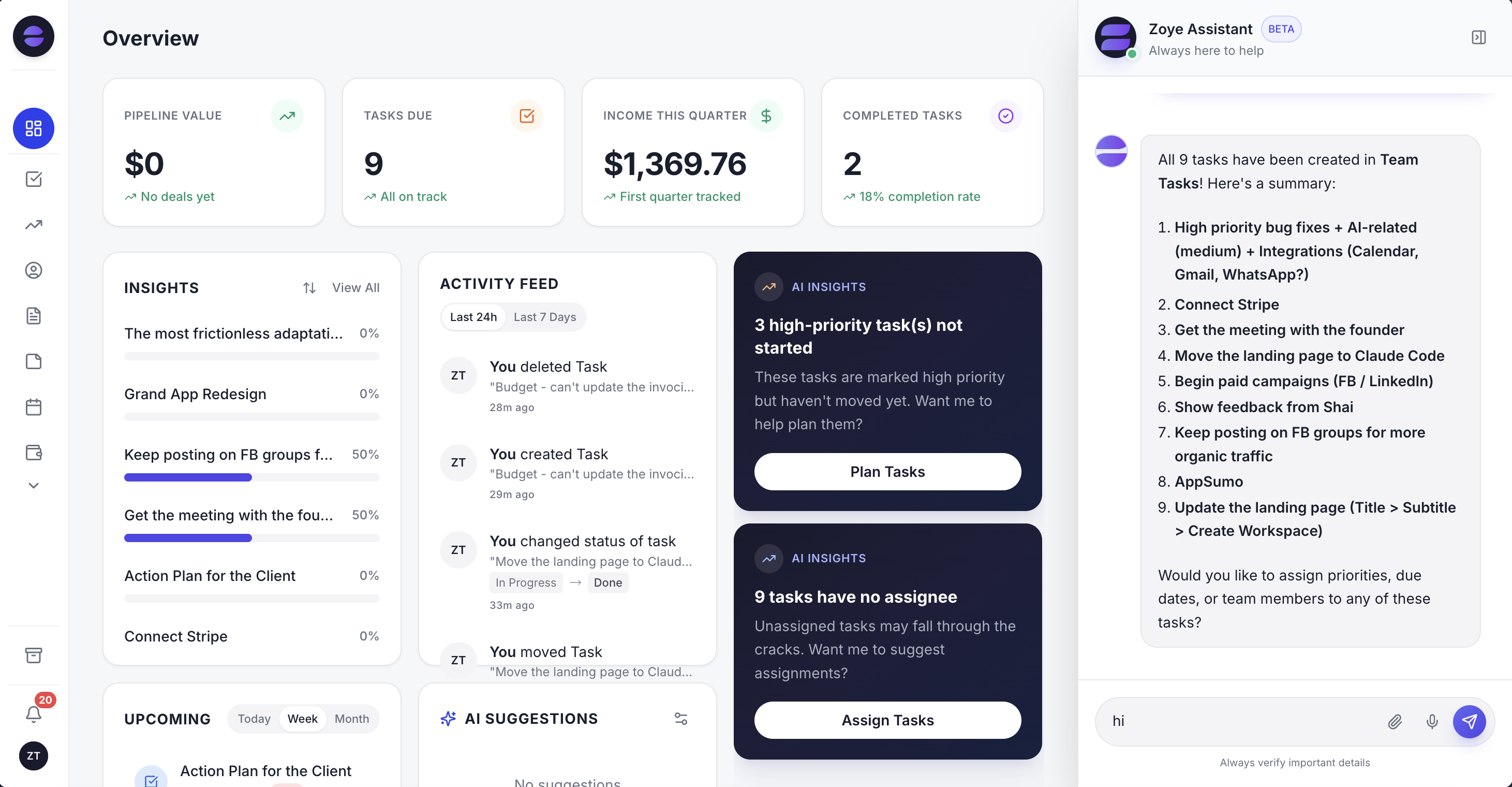 The Zoye dashboard brings customer conversations, follow-ups, and your pipeline into one operator-run workspace.
Here is what that means in practice. When a customer messages on WhatsApp, Zoye centralises the conversation alongside your other channels so nothing lives in one person's phone. The Zoye Assistant drafts the reply, and because it can take action, it does the work most bots skip: it creates a contact from the chat, logs what the customer asked, and sets the follow-up so the lead does not go cold. If the message is a booking request, the Assistant can put the appointment on the calendar. If it is a sales question, the deal lands in your pipeline. You never re-type any of it into a separate CRM.
The part that makes Zoye different from a reply bot is that you run it by talking to it. You can tell Zoye "follow up with anyone who asked about pricing this week and did not reply," or "remind me about every open quote every Monday," and it builds that automation for you. There is no flow-builder to learn and nothing to maintain. Non-technical owners describe what they want and the operator wires it up. You can drive the whole thing from WhatsApp or Slack, not just a dashboard.
Behind the WhatsApp conversation, Zoye is a full workspace: tasks, a CRM, a calendar, budget, and reports, all in one place. That matters because customer service on WhatsApp is never just support. It is sales, booking, and follow-through, and those need to live where the rest of your business lives. The Assistant surfaces overdue follow-ups, generates a weekly summary of what came in, and flags the leads going quiet, so you are running the business, not just watching an inbox.
Pricing: Almost Free at $5 per month for 1 member with the full platform including AI. Starter from $29 per month (10 members). Growth from $59 per month (20 members). Scale from $119 per month (100 members).
Best for: Owners who want WhatsApp support that actually runs the business behind it, not just an auto-reply on the surface.
2. WhatsApp Business app - the free starting point
The free WhatsApp Business app is where most small businesses begin, and for good reason. Greetings, away messages, quick replies, labels, and a product catalog cover the basics at no cost.
The limit is that it is manual by design. There is no real automation beyond canned messages, no routing, no follow-up engine, and nothing that logs a conversation as a customer record. It is a strong first layer, not a system.
Pricing: Free.
Best for: Solo owners and very small teams starting out.
3. WhatsApp Business Platform (API) - for higher volume
The official WhatsApp Business Platform (the API) unlocks true automation, chatbots, and integration with other software once your volume outgrows the app. It is the foundation most serious automation tools build on.
The trade-off is that the API is not a product you use directly; you access it through a provider, there are conversation-based fees, and setup is more technical. It is power, not simplicity.
Pricing: Conversation-based pricing via a provider; varies.
Best for: Higher-volume businesses ready for a provider-backed setup.
4. Chatbot builders - scripted flows for FAQs
Dedicated WhatsApp chatbot builders let you design flows that answer FAQs, run menus, and qualify leads. For predictable, high-volume questions they can deflect a large share of inbound messages.
The trade-off is that flow-based bots are rigid: they answer what you scripted and stumble on anything you did not, and they rarely do anything behind the conversation beyond capturing a field or two. You maintain the flows as your business changes.
Pricing: Free tiers common; paid plans typically scale with contacts or messages.
Best for: Teams with high, predictable FAQ volume willing to maintain flows.
5. Shared team inbox tools - many agents, one number
Shared inbox tools put several agents on one WhatsApp number with assignment, notes, and basic automation. For a support team that needs to divide the load, this solves the one-phone bottleneck.
The trade-off is that these tools are built for deflection and ticketing, not for running the business. They route and answer, but the follow-up, the pipeline, and the record-keeping still happen somewhere else.
Pricing: Typically per-agent per month.
Best for: Support teams that need multiple agents on one number.
6. Help desk platforms with WhatsApp - support-first suites
Established help desk suites now connect WhatsApp as one channel alongside email and chat, with automation, macros, and reporting. If your business is support-heavy and already lives in a ticketing tool, adding WhatsApp is straightforward.
The trade-off is cost and fit. These suites are built for support departments, price accordingly, and treat WhatsApp as a ticket source rather than a place where sales and booking also happen.
Pricing: Typically per-agent per month, mid to high.
Best for: Support-led businesses already standardised on a help desk.
7. No-code automation connectors - glue for the rest
No-code automation platforms can connect WhatsApp events to other apps, so a message can trigger a spreadsheet row, an email, or a task somewhere else. For technical owners, they patch gaps between tools.
The trade-off is that you are building and maintaining the plumbing yourself. Each new need is another workflow to wire and debug, and none of it understands your business the way a purpose-built operator does.
Pricing: Free tiers common; paid plans scale with tasks or steps.
Best for: Technical owners stitching existing tools together.
How to choose the right approach
Three questions narrow it down fast.
1. How much volume do you have? A few messages a day: the free WhatsApp Business app is enough. Dozens or hundreds: you need automation and, likely, the API through a provider or a platform that manages it for you.
2. Is this only support, or also sales and booking? If WhatsApp is purely deflecting FAQs, a chatbot builder or help desk works. If the same conversations turn into leads, bookings, and follow-ups (which they almost always do), you need something that runs the business behind the chat, not just a reply layer.
3. Who maintains it? If you have a technical person to build and babysit flows, a builder or connector is viable. If you are a non-technical owner who wants to describe what you need and have it done, choose the operator model, where you tell the system what you need and it wires the automation for you.
Getting the human handoff right
Every automated WhatsApp setup lives or dies on the handoff. Get these right and customers barely notice the automation; get them wrong and they feel trapped.
Always offer a way to reach a person. A visible "talk to a human" option at every step prevents the maze feeling. Never make a customer fight the bot.
Hand off with context. When a conversation reaches a person, that person should see the whole history, not ask the customer to repeat themselves. This is where a system that logs every message into a contact record pays off.
Set honest expectations. If a human will reply in the morning, say so. A clear away message beats a fake "we are here" that goes silent.
Learn from what escalates. Every conversation the bot could not handle is a lesson. Review them, and either add the answer to your automation or accept it as a human-only case. The system should get smarter every week.
Why teams pick Zoye for WhatsApp customer service
A few themes come up again and again.
It runs the business, not just the inbox. Every WhatsApp conversation becomes a contact, a follow-up, and the right next action, automatically, instead of a reply that vanishes.
You run it by talking to it. Tell Zoye on WhatsApp or Slack what you want automated, and it builds the automation. Nothing to maintain, no flow-builder to learn.
It is one workspace, not another silo. Support, sales, booking, follow-up, and reporting live together, so a WhatsApp chat flows straight into the rest of your operation.
Try Zoye with your team. The entry plan is Almost Free at $5 per month for 1 member, with the full platform including AI.
For more context, see the best WhatsApp CRM in 2026, how to sell on WhatsApp, and the best free WhatsApp chatbot options.
See the six automations Zoye ships for this, and how each one stays inside WhatsApp's rules, on the WhatsApp Automations page.