
Most travel agents do not lose bookings because their advice is bad. They lose bookings because a quote sat in an inbox for four days while a supplier was slow to reply, or because a client who was ready to book last spring never got a nudge this spring. The work of a travel agent is mostly chasing: chasing suppliers for availability, chasing clients for decisions and deposits, chasing the seasonal rebooking window before it closes. A generic contact list does none of that chasing for you.
That is the gap most tools in this category leave open. Travel-specific software is good at the parts you can see, the itinerary that looks beautiful in the client's inbox, the trip page with the hotel photos. What almost none of them do is the invisible follow-up work that actually converts an enquiry into a paid trip. You still open the tool, look at what is stuck, and message people yourself. When you are running twenty live trips across a busy season, that manual chasing is the first thing to break.
This guide ranks the seven best CRMs for travel agents in 2026. It leads with the one that closes the follow-up gap instead of just displaying it, then covers the strongest travel-specific and general options so you can match the tool to how you actually work.
Pricing reflects published rates as of July 2026; check each vendor's pricing page for current figures.
Why travel agents are looking beyond the usual tools in 2026
Four shifts are pushing travel agents away from the software they bought and toward tools that do more of the work.
Most agents bought software they stopped using. The pattern is familiar. You sign up for a travel CRM, spend a weekend importing clients, build a couple of itinerary templates, and within a month you are back to running the business from your inbox and WhatsApp because the tool needed you to maintain it. The category is full of software that stores information beautifully but never acts on it. The agents winning in 2026 want the opposite: a tool they can talk to, that does the follow-up itself, and that they never have to babysit.
Clients live on WhatsApp, and the tools do not. For a huge share of travel clients, especially outside the US, WhatsApp is the primary channel. They send you a voice note about the dates, a screenshot of a hotel they saw, a quick "is it booked yet?" at 9pm. Most travel CRMs assume email. The messages that actually move a trip forward are scattered across a personal phone, invisible to any pipeline, and impossible to hand off if you get sick or take a day off.
Itineraries are really deals, and deals need a pipeline. Every trip is a small sales cycle: enquiry, quote, deposit, balance, travelled, review. Treating trips as flat "clients" in an address book hides the stage each one is at. The agents who convert best manage trips like a pipeline, so they can see at a glance which enquiries are waiting on a quote, which quotes are waiting on a deposit, and which booked trips need a pre-departure check-in.
Seasonality punishes anyone who does not follow up on time. Travel demand comes in waves. The client who booked a ski trip last January is your warmest lead for a ski trip this January, but only if you reach out in the right window. Miss it and they book with someone else or stay home. General CRMs do not know your seasons; the assistant-led approach does, because you can simply tell it to re-engage last winter's ski clients and it handles the list.
The 7 best CRMs for travel agents in 2026
1. Zoye - the AI operator that runs the follow-up for you
Zoye is the strongest choice for travel agents who are tired of software that only stores information. Instead of another tool you have to open and operate, Zoye is closer to an assistant you talk to. It manages itineraries as deals, chases suppliers and clients on its own, and centralises the WhatsApp and email threads that decide whether a trip books.
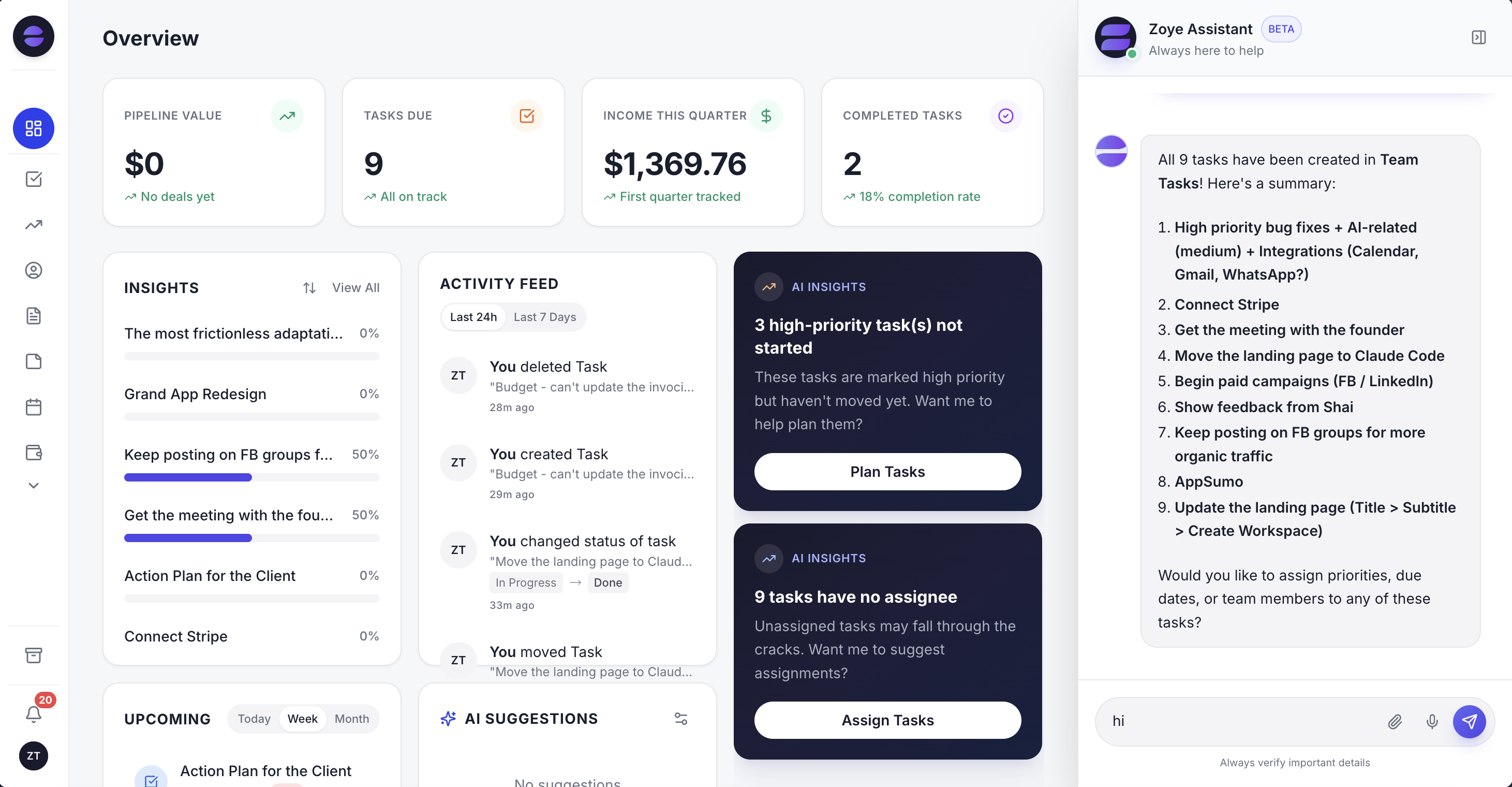 The Zoye dashboard: your whole business at a glance, with proactive AI Insights and Zoye Assistant always available on the right
The core of the workflow is a pipeline built for how trips actually move. Each itinerary lives as a deal on a board, from enquiry through quote, deposit, balance, and travelled. The supplier, the travel dates, the deposit status, and the client contact all sit on the record. You get an immediate visual answer to the question that matters most in a busy season: which trips are stuck, and what is each one waiting on.
Where Zoye separates from every travel tool in this list is the assistant, and specifically what it does rather than what it suggests. Tell it "chase the two clients who got quotes on Tuesday and have not replied" and it drafts and sends the follow-ups. Tell it "remind me about every trip with a balance due in the next two weeks" and it surfaces them and prepares the nudges. Tell it "re-engage everyone who travelled to Italy last summer" and it builds that list and starts the outreach. You say what you want done; Zoye does the work. Zoye captures new enquiries, updates the pipeline itself, and builds a recurring follow-up automation when you tell it what should happen, so seasonal rebooking runs without you setting up a workflow canvas.
The WhatsApp angle matters more here than in almost any other business. Zoye centralises customer conversations so a client's WhatsApp messages land against their trip instead of getting lost on your personal phone. The assistant can draft a reply, chase a client who has gone quiet, and log the exchange to the itinerary. You can even run Zoye by messaging it, so a quick "did the Rome supplier confirm?" gets answered from your pocket.
Around the pipeline sits a full workspace: tasks for the operational to-dos (visa reminders, document collection), a calendar where departures and deposit deadlines appear automatically, budget tracking for commissions and supplier costs, and reports that pull bookings, revenue, and pipeline into one exportable view. A non-technical agent never has to configure or maintain any of it.
Pricing: Almost Free from $5 per month ($4 per month billed annually) for 1 member with the full platform including AI. Starter from $29 per month (10 members). Growth from $59 per month (20 members).
Best for: Independent and small-agency travel agents who want the follow-up chasing done for them, especially those whose clients live on WhatsApp.
2. TravelJoy - the client-facing itinerary tool
TravelJoy is popular with independent advisors for its clean client-facing itineraries, form collection, and payment requests. It looks good to the traveller, which matters. The limitation is that it is built around presenting trips rather than running the business behind them; the proactive follow-up and pipeline chasing still fall to you, and there is no assistant taking action on your behalf.
Pricing: Free tier available; paid plans published on TravelJoy's site.
Best for: Independent advisors who prioritise a polished client-facing trip experience.
3. Tern - the modern travel advisor CRM
Tern is a newer, well-designed CRM aimed squarely at travel advisors, with trip pipelines, supplier tracking, and commission features. It is genuinely travel-native and pleasant to use. The trade-off is that, like most CRMs, it shows you what needs doing but leaves the doing to you. You still open Tern, spot the stalled trips, and send the messages yourself rather than describing the outcome and having it handled.
Pricing: Subscription plans published on Tern's site; check current figures.
Best for: Advisors who want a modern, travel-specific pipeline and are happy to drive the follow-up manually.
4. ClientBase - the established agency workhorse
ClientBase (from Sabre) is the long-standing CRM in traditional travel agencies, deeply tied to GDS workflows and back-office reporting. Its strength is maturity and integration with established agency systems. The cost is that it feels dated, carries a real learning curve, and was designed for a desktop-agency era rather than a WhatsApp-first, mobile independent advisor. Onboarding is heavier than newer tools.
Pricing: Quoted through Sabre / host agencies rather than published simply.
Best for: Established brick-and-mortar agencies embedded in GDS and host-agency systems.
5. Travefy - itinerary building with light CRM
Travefy is best known as an itinerary builder: drag-and-drop trip plans, proposals, and a professional client portal. It bolts a light CRM onto that. The limitation is that CRM is the secondary feature, not the core, so pipeline management and follow-up are thinner than in dedicated CRMs, and there is no assistant doing the chasing. Many agents pair it with something else for the sales side.
Pricing: Free trial; paid plans published on Travefy's site.
Best for: Agents whose main need is beautiful itineraries and proposals, with CRM as a bonus.
6. HubSpot - the general CRM stretched to fit travel
HubSpot is a capable general-purpose CRM that some agencies adapt for travel by customising deal stages and properties. It is powerful and scales well. The problem is that none of it is travel-native: you build the trip pipeline, the seasonal follow-ups, and the supplier tracking yourself, and the free tier's limits push serious users toward paid tiers that get expensive fast. It is a lot of tool to configure for a solo advisor.
Pricing: Free CRM tier; paid Sales Hub tiers per seat, which rise quickly for growing teams.
Best for: Larger agencies with the time and appetite to configure a general CRM to their process.
7. Pipedrive - the simple sales pipeline
Pipedrive is a clean, affordable sales-pipeline CRM that adapts reasonably to trips-as-deals. It is easy to learn and the pipeline view suits how trips move. The limitation is the same as HubSpot's in miniature: nothing about it understands travel, WhatsApp is not native, and the automation you would need for seasonal rebooking is something you build and maintain yourself rather than simply ask for.
Pricing: Per-seat tiers published on Pipedrive's site; check current figures.
Best for: Agents who want a simple, cheap pipeline and do not need travel-specific features.
Want to see it in action?
See Zoye catch a new lead, answer on WhatsApp and set up the follow-up, all from one message.
See How It WorksBest CRM for WhatsApp-heavy travel clients
If most of your client conversations happen on WhatsApp, the choice narrows fast. The travel-specific tools in this list are largely email-and-portal oriented, and the general CRMs treat WhatsApp as an afterthought or a paid add-on. Zoye is built to centralise those conversations so a client's messages sit against their trip, the assistant can draft and send replies, and nothing lives only on your personal phone. For a WhatsApp-first travel business, that is the deciding factor, because the channel where trips actually get confirmed is the one the CRM finally covers.
For more on this, see our roundup of the best WhatsApp CRMs, which goes deeper on the inbox-versus-operator distinction that matters most here.
Best free CRM for travel agents
Solo and two-person travel businesses do not need a big budget to get organised. Most travel-specific tools offer a limited free tier or a trial, and general CRMs like HubSpot have a free plan that quickly hits limits. Zoye is not free, but it is the most affordable full-platform option: its entry plan, Almost Free, starts at just $5 per month ($4 per month billed annually) and includes the full platform, the pipeline, the tasks, the calendar, and the AI assistant, for up to 1 member. You can manage itineraries as deals and let the assistant chase follow-ups for the price of a cup of coffee, then move to Starter at $29 per month only when your team grows. For a solo advisor testing whether an operator-style tool changes how much booking work gets done, that is the cleanest way in, and you can cancel or upgrade anytime.
See what Zoye can do for you
CRM, deals, tasks and your Instagram, Facebook and WhatsApp automations in one workspace. Just ask Zoye and it sets any of it up for you.
Explore FeaturesHow to choose the right travel CRM
Three questions narrow it down.
1. Where do your clients actually message you? If the honest answer is WhatsApp, prioritise a tool that centralises those conversations natively rather than one that assumes email. This alone rules out most of the field for a lot of agents.
2. Do you want to do the follow-up, or have it done? Every tool here can show you a stalled trip. Only an assistant-led tool will chase the client and the supplier for you. If your bottleneck is time to follow up, not knowing what to follow up on, weight this heavily.
3. How travel-specific do you need to be? If you need deep GDS integration and back-office agency reporting, an established tool like ClientBase fits. If you need a modern pipeline that treats trips as deals and runs the chasing, an operator-style workspace fits better and is far easier to live with day to day.
Migrating to a travel CRM without losing a season
The fear with any switch is losing momentum mid-season. The pragmatic approach is to bring across only your active pipeline first: the live enquiries, open quotes, and trips with deposits down. Historical clients can be imported in bulk afterward and re-segmented for seasonal outreach. In Zoye specifically, you get help here too: you talk Zoye through your trip stages and it sets up the pipeline, then you point it at your past travellers and it starts building the seasonal rebooking lists. The whole reset usually takes an afternoon rather than a lost weekend, and you keep booking the entire time.
Why travel agents pick Zoye
A few themes come up again and again.
The follow-up finally happens. Agents stop losing quotes to silence because the assistant chases every stalled trip on its own, instead of waiting for the agent to remember.
WhatsApp stops being a black hole. Client conversations land against the trip, the assistant can reply and chase, and no booking hides on a personal phone.
Seasonal rebooking runs itself. Describe the segment once and the assistant handles the outreach every season, so warm past travellers get reached in the right window.
There is nothing to maintain. A non-technical agent runs the whole business by talking to it, and never has to configure or babysit a tool that quietly goes unused.
Keep every traveler, itinerary, and follow-up in one place while the assistant chases the quiet leads for you. The entry plan, Almost Free, starts at $5 per month (or $4 per month billed annually), full platform and AI included, and you can cancel or upgrade anytime.
For more context, see the best WhatsApp CRMs, the best project management software, and the best CRMs for insurance agents.
Prefer the quick overview? Visit the dedicated CRM for travel agents page.